Key Strategies to Optimize Customer Experience KPIs


When you focus on customer experience KPIs, you set your business up for real growth and loyal customers. For example, 88% of people are more likely to buy again after a positive customer experience, and 50% will pay more for better service. Sobot AI makes it easy for you to connect with customers across channels, using smart chatbots and real-time analysis. With these tools, you can see big jumps in satisfaction scores and even save on costs. Try thinking about how you can use these strategies in your own customer experience journey.
Customer Experience KPIs
What Are Customer Experience KPIs
Customer experience KPIs are special numbers that help you see how well your business treats customers. These key performance indicators show if your customers feel happy, loyal, or frustrated. When you track customer experience metrics, you get a clear picture of what works and what needs fixing. You can spot problems early and make smart changes. Sobot gives you tools to track these KPIs across all your channels, so you never miss important feedback.
Why Customer Experience KPIs Matter
You want your customers to come back, right? Customer experience KPIs help you do just that. When you watch these numbers, you can boost customer loyalty and keep people from leaving. For example, a high retention rate means more repeat buyers and less money spent finding new ones. Companies that improve their customer experience metrics often see more revenue and happier customers. Take a look at how big brands improved their KPIs and saw real results:
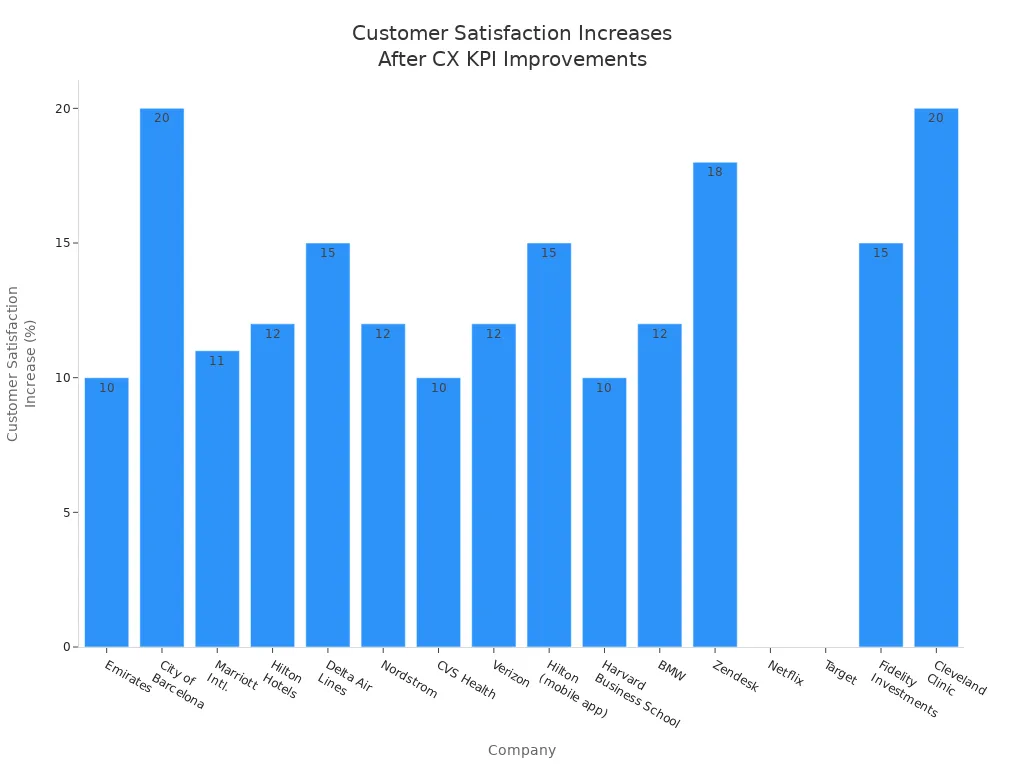
Tip: Tracking customer experience KPIs can lead to a 10-20% jump in satisfaction scores, just like it did for Hilton and Delta Air Lines.
Key Metrics to Track
You have many customer experience metrics to choose from, but some matter more than others. Here are the top ones you should watch:
- Net Promoter Score (NPS): Shows how likely customers are to recommend you.
- Customer Satisfaction (CSAT): Measures how happy customers feel after an interaction.
- Customer Effort Score (CES): Tells you how easy it is for customers to get help.
- Churn Rate: Tracks how many customers stop using your service.
- Retention Rate: Shows how many customers stick with you over time.
- Average Resolution Time: Measures how fast you solve customer issues.
- First Contact Resolution Rate: Checks if you fix problems on the first try.
| Metric | What It Tells You |
|---|---|
| NPS | Customer loyalty and word-of-mouth |
| CSAT | Satisfaction with a specific experience |
| CES | How easy it is for customers to get help |
| Churn Rate | How many customers you lose |
| Retention Rate | How many customers you keep |
| Resolution Time | How quickly you solve problems |
Sobot helps you track all these customer experience KPIs in one place. With features like real-time analytics and unified dashboards, you can spot trends and act fast. This makes it easier to improve your customer experience and grow your business.
Measuring Customer Success
Net Promoter Score (NPS)
You want to know if your customers will recommend you to others. That’s where NPS comes in. NPS is one of the most important customer success metrics. It asks one simple question: “How likely are you to recommend us to a friend?” You get a score from -100 to 100. Higher NPS means more loyalty and better customer experience. Companies with high NPS often see more referrals and stronger customer retention. Sobot helps you track NPS across all your channels, so you can spot trends and act fast. When you use NPS with other customer experience metrics, you get a full picture of customer success.
Tip: NPS is a great way to measure loyalty and predict future growth.
Customer Satisfaction (CSAT)
CSAT tells you how happy your customers feel after an interaction. You ask them to rate their experience, usually on a scale from 1 to 5. High CSAT scores mean your customers are satisfied and more likely to stay. When you combine CSAT with NPS, you get a better view of customer retention and loyalty. For example, Airbnb found that customers with high NPS scores were more likely to book again, even if their CSAT for a single stay was low. Sobot’s unified dashboard lets you see your CSAT and other customer success metrics in real time, making it easy to improve customer experience.
- High CSAT scores lead to better customer retention.
- Satisfied customers complain less and stay longer.
- Tracking CSAT helps you spot trends and improve loyalty.
Customer Effort Score (CES)
CES measures how easy it is for your customers to get help or solve a problem. You ask, “How easy was it to get your issue resolved?” and score the answers. Lower effort means a better customer experience and higher loyalty. Top-performing companies have CES scores of 6.2 or higher on a 7-point scale. The industry average is 5.5. Sobot’s AI-powered chatbots and smart routing help you lower customer effort, making support fast and simple. When you focus on CES, you remove friction and boost customer success.
| Company Type | Average CES (7-point scale) |
|---|---|
| Top-performing companies | 6.2+ |
| Industry average | 5.5 |
| Enterprise companies | 5.7 |
| Top eCommerce retailers | 5.8+ |
Churn and Retention Rates
Churn shows how many customers leave, while retention tells you how many stay. These customer success metrics are key for business growth. Low NPS or CSAT scores often mean higher churn. When you improve customer experience, you lower churn and increase customer retention. High churn hurts your revenue and customer lifetime value. Sobot’s analytics help you track these numbers, so you can act before customers leave. Focus on customer experience metrics like first contact resolution and response time to keep loyalty high and churn low.
- Low NPS and CSAT predict higher churn.
- High churn means lost revenue and lower customer success.
- Improving customer experience boosts retention and loyalty.
Customer Feedback Strategies

Collecting Feedback
You want to know what your customers think, right? Collecting feedback is the first step to improving customer success and customer experience. There are many ways you can do this:
- Send short surveys after a purchase or support chat. Keep questions simple and focused on customer success.
- Ask for reviews or testimonials. These show you how people feel about your customer experience.
- Listen on social media. People often share honest thoughts there.
- Use live chat or in-app feedback tools. These catch real-time reactions and help you spot customer success trends.
- Try customer interviews. You get deeper insights into what drives customer experience.
- Watch how customers use your site or app. Behavior analytics can reveal hidden issues with customer success.
You should time your feedback requests well. Ask right after a support call or when someone tries a new feature. This way, you get the most useful answers for customer success.
Acting on Insights
You collect feedback to make your customer experience better, not just to store it. Start by looking for patterns in your feedback. Use AI tools or dashboards, like those in Sobot’s platform, to track customer success metrics such as NPS and CSAT. When you spot a problem, act fast. Let customers know you heard them. Share updates or changes you made because of their input. This builds trust and shows you care about customer success.
Tip: Always close the loop. When you follow up, you boost customer experience and make people feel valued.
Sobot Case Study: OPPO
Let’s look at a real example. OPPO, a global smart device brand, wanted to improve customer success during busy shopping seasons. They used Sobot’s chatbot and ticketing system to handle common questions and free up agents for complex issues. Sobot also helped OPPO update its knowledge base, cutting maintenance work by 90%. By connecting all customer channels and business systems, OPPO improved customer experience and made data easy to access. The results? OPPO’s chatbot solved 83% of queries, got a 94% positive feedback rate, and saw a 57% jump in repurchase rate. This shows how acting on feedback can drive customer success and boost customer experience.
Data Analytics for KPIs
Identifying Trends
You want to know what your customers like and where they get stuck. Data analytics helps you spot patterns in your KPIs. When you track numbers like NPS, CSAT, and resolution time, you can see if your service is getting better or worse. For example, if your customer satisfaction scores drop after a new product launch, you can act fast to fix the issue. Sobot’s unified dashboard makes it easy to see these trends in real time. You can use charts and graphs to spot changes in customer engagement and adjust your strategy. This way, you keep your customer journey smooth and your business growing.
Integrating Touchpoints
Your customers talk to you in many ways—phone, chat, email, and even in your store. When you connect all these touchpoints, you get a full view of the customer journey. This helps you measure and improve KPIs across every stage. Here’s how integrating touchpoints boosts your results:
- Marketing attribution models help you see which channels drive the most engagement and sales.
- You can track pre-purchase KPIs like cost-per-click and click-through rate to measure marketing success.
- During purchase, you watch conversion rates and sales revenue.
- After purchase, you focus on customer satisfaction, NPS, and customer retention.
- Teams work together on shared KPIs, making it easier to spot problems and fix them.
- Regular reviews help you act quickly and keep your business agile.
Sobot’s omnichannel solution brings all your customer data into one place. This makes it simple to measure, compare, and improve your KPIs at every touchpoint.
Predictive Analytics
Predictive analytics lets you look ahead. You can use your data to guess what will happen next with your KPIs. Here’s how you can make it work:
- Pick the most important KPIs, like NPS or customer retention, to build your models.
- Set up your analytics tools to collect and study data in real time.
- Use dashboards to spot trends and see where customers might drop off.
- Keep checking your forecasts and update them as your business changes.
- Add customer feedback and sentiment to your models for better accuracy.
With Sobot’s analytics, you can see what’s coming and make smart choices before problems grow. This helps you keep your customer journey on track and boost customer engagement.
Empowering Customer Service Teams

Training and Coaching
You want your team to deliver great customer success every day. The best way to do this is through strong training and coaching. Start by setting clear goals for customer success. When your team knows what to aim for, they stay focused. Give regular feedback that helps agents grow. Short, frequent coaching sessions work better than long, rare ones. You can also build a safe space where agents feel free to try new ways to boost customer success without fear. Train your managers to coach daily and encourage peer learning. Many companies see a 5% jump in customer satisfaction and a 15% boost in one-touch ticket resolution when they follow these steps. Sobot’s unified workspace makes it easy to track progress and share feedback, so your customer success programs stay on track.
Customer-Centric Culture
A customer-centric culture puts customer success at the heart of everything you do. When you focus on customer needs, you see higher satisfaction scores, better NPS, and more loyal customers. Teams that care about customer success keep people coming back and spending more. Companies with this mindset grow up to 8% faster than others (Bain & Company). You can build this culture by sharing customer success stories, setting team goals around customer success, and using data to improve every day. Sobot’s omnichannel solution helps you keep all customer interactions in one place, making it easier to spot trends and act fast.
Recognizing Success
When you recognize your team’s wins, you inspire even better customer success. Use leaderboards to highlight top performers. Celebrate milestones like fast response times or high satisfaction scores. Peer-to-peer recognition and leadership shout-outs make everyone feel valued. Flexible rewards, like points or gift cards, keep motivation high. Teams that celebrate customer success see lower turnover and higher productivity. Sobot’s analytics let you track key metrics, so you always know who’s making a difference in your customer success journey.
Process Optimization with Sobot
Reducing Customer Effort
You want your customers to get help fast and without stress. When you make things easy, you improve customer experience and keep people coming back. Studies show that 96% of customers who have a high-effort service experience become disloyal (Gartner). That’s why you need to cut down on steps and make every touchpoint simple.
Sobot helps you do this by bringing all your channels together. Your customers can reach you by phone, chat, or WhatsApp, and your team sees everything in one place. With Sobot’s AI-powered chatbots, customers get answers right away, even at night. You can also use smart routing to send each question to the right person. This means less waiting and less repeating for your customers. When you lower effort, you boost customer experience and loyalty.
Tip: Make it easy for customers to find answers on their own. Sobot’s self-service options help people solve problems quickly.
Workflow Automation
You don’t want your team stuck doing the same tasks over and over. Workflow automation lets you save time and focus on what matters most—giving a great customer experience. Sobot’s platform lets you set up rules that handle tickets, route calls, and send follow-ups automatically.
Here’s how workflow automation can help you:
- Assign tickets to the right agent based on skill or language.
- Send instant updates to customers about their requests.
- Close tickets when issues are solved, without manual work.
- Trigger surveys after each support chat or call.
With Sobot, you can automate up to 70% of routine tasks. This means your team spends more time helping customers and less time on paperwork. You see faster response times and higher satisfaction scores. When you use automation, you make the customer experience smoother and more reliable.
| Benefit | How Sobot Helps |
|---|---|
| Faster responses | Automated ticket routing |
| Fewer mistakes | Rule-based workflows |
| Happier customers | Quick updates and follow-ups |
Voice/Call Center Solutions

You know that some customers still want to talk to a real person. Sobot’s Voice/Call Center gives you the tools to make every call count. You get a stable system with 99.99% uptime, so your customers never face dropped calls. The platform supports global numbers, so you can help people anywhere.
With Sobot, your agents see all customer info and past chats in one workspace. This means they don’t have to ask the same questions again. You can use smart IVR menus to guide callers to the right team. Sobot’s AI-powered voicebot can answer simple questions, freeing up your agents for complex issues.
Here’s what you get with Sobot’s Voice/Call Center:
- Real-time call monitoring and analytics
- Easy integration with your CRM
- Secure, encrypted calls for privacy
- Mobile access for agents on the go
Note: Companies using Sobot’s call center solutions see up to a 30% boost in first-contact resolution rates. This leads to a better customer experience and higher loyalty.
When you use Sobot’s tools, you make every customer experience smoother, faster, and more personal. You help your team work smarter and keep your customers happy.
Continuous Improvement
Experimentation
You want to keep your customer experience KPIs moving in the right direction. The best way to do this is by trying new things and seeing what works. Many top brands use smart experimentation to improve their results. Here are some proven methods you can use:
- A/B Testing and Multivariate Testing: Test different versions of your website or support process. See which one makes customers happier.
- Pilot Testing: Try out new features with a small group before rolling them out to everyone.
- Customer Journey Mapping: Walk through the steps your customers take. Find out where they get stuck and fix those spots.
- Structured Experimentation: Set clear goals, use control groups, and always check your results.
- Global and Cross-Functional Testing: Test in different markets and involve teams from across your company.
When you use these methods, you make data-driven decisions. You also see real improvements in customer satisfaction and efficiency. Sobot’s platform makes it easy to run these tests and track your customer experience KPIs in real time.
Tip: Start small, measure results, and keep improving. Experimentation helps you find what works best for your customers.
Feedback Loops
Feedback loops help you turn customer input into action. You collect feedback, share it with your team, and make changes fast. This keeps your customer experience KPIs moving up. Here’s how you can build strong feedback loops:
- Share insights with the right teams so everyone knows what needs fixing.
- Act quickly on feedback to show customers you care.
- Assign owners and set deadlines so nothing gets missed.
- Let customers know about the changes you made. This builds trust and loyalty.
- Repeat the process to keep improving your customer experience KPIs.
Sobot’s unified dashboard helps you collect, analyze, and share feedback across all channels. When you close the loop, you boost customer satisfaction and keep people coming back.
Measuring Impact
You need to know if your changes really work. Tracking the right customer experience KPIs shows you what’s making a difference. Here are some key metrics to watch:
| Metric | What It Shows | Why It Matters for CX KPIs |
|---|---|---|
| Net Promoter Score (NPS) | Customer loyalty and willingness to recommend | Higher NPS means happier, loyal customers |
| Customer Effort Score | How easy it is for customers to get help | Lower effort leads to better experiences |
| First Response Time | How fast you reply to customer questions | Faster replies boost satisfaction |
| Average Resolution Time | How quickly you solve customer problems | Quick fixes keep customers happy |
| Churn Rate | How many customers leave | Lower churn means better retention |
| Retention Rate | How many customers stay | High retention shows strong loyalty |
| Customer Lifetime Value | Total value a customer brings over time | Shows long-term business growth |
Sobot’s analytics let you track these customer experience KPIs easily. You can see what’s working and where you need to improve. This helps you make smart choices and keep your customer experience KPIs on the rise.
You can drive real results when you put customer success at the center of your business. A data-driven approach helps you spot trends, improve customer experience, and boost customer success at every step. Here’s what works best:
- Use AI tools to personalize support and marketing for customer success.
- Map the customer journey to find every chance for better customer experience and customer success.
- Collect feedback and act fast to close the loop on customer success.
- Keep teams working together with unified platforms like Sobot for customer success.
- Track your KPIs and keep testing new ideas for customer success.
Try a KPI audit or test one new strategy this month. With Sobot, you make customer experience and customer success easier for everyone.
FAQ
What are customer experience KPIs, and why do they matter?
Customer experience KPIs are numbers that show how happy your customers feel. They help you see what works and what needs fixing. Companies that track these KPIs often see a 10-20% jump in satisfaction scores (source).
How can Sobot help me improve my customer experience KPIs?
Sobot gives you real-time dashboards and analytics. You can track customer experience KPIs like NPS, CSAT, and resolution time in one place. Sobot’s AI-powered chatbots and unified workspace make it easy to spot trends and boost customer satisfaction.
Which customer experience KPIs should I track first?
Start with Net Promoter Score (NPS), Customer Satisfaction (CSAT), and Customer Effort Score (CES). These KPIs show loyalty, happiness, and how easy it is for customers to get help. Sobot helps you measure all three quickly.
How do I collect feedback to improve customer experience KPIs?
You can send short surveys, use live chat, or ask for reviews. Sobot’s omnichannel solution lets you gather feedback from every channel. This helps you find patterns and act fast to improve your customer experience KPIs.
Can automation really boost my customer experience KPIs?
Yes! Sobot’s workflow automation can handle up to 70% of routine tasks. This means faster replies and happier customers. Companies using automation often see higher customer experience KPIs and better retention rates.
Tip: Keep tracking your customer experience KPIs every month. Small changes can lead to big results!
See Also
Top Strategies To Enhance Customer Satisfaction In Live Chat
Effective Techniques For Managing Quality In Call Centers
Ways To Improve Call Center Results Through Monitoring

