Smarter Service 5 Intelligent Routing Strategies

Move beyond outdated 'next available' models. Intelligent call routing is a data-driven system that connects customers to the ideal agent. This modern call routing strategy can boost customer satisfaction by over 25%. You will improve first-call resolution and elevate the entire customer experience. With the market for these technologies growing, effective call routing strategies are essential. The Sobot AI-powered Sobot call center helps you build a future-ready intelligent routing call center. Our system uses superior call center routing and intelligent call routing for optimal data-driven routing. These strategies deliver results.
AI-Enhanced Routing: Predictive Behavior

What It Is
AI-enhanced routing moves your customer service from reactive to predictive. This system uses artificial intelligence to analyze customer data and anticipate their needs. It then connects them to the agent best equipped to provide a solution. This approach is a significant leap forward from basic call distribution. It makes your intelligent call routing system smarter and more effective. These advanced strategies help you create a better customer experience.
How It Works
This form of ai-based routing works by gathering and interpreting data in real time. The system analyzes various customer behaviors to build a comprehensive profile before the call even connects. This ai-based routing technology looks at several factors.
- Past Call History: The system reviews previous interactions to understand communication styles.
- Sentiment and Emotional State: It analyzes verbal cues and language to gauge if a caller is happy or upset.
- Repeat Callers: It identifies pre-existing issues to prepare agents with the right context.
- Time Constraints: The system detects customers who need quick, direct answers.
This data allows the system to make an informed decision. It ensures your call center routing sends customers to the perfect agent every time.
Key Benefits
Using ai-based routing delivers powerful results for your business. You will see major improvements in efficiency and customer happiness. The primary benefit is getting the customer to the right person on the first try. This boosts your First Call Resolution (FCR) rate significantly. Better call center routing directly impacts your key performance metrics.
Tip: Pairing customers with agents who match their personality and needs can increase satisfaction by over 25%.
Studies show that companies see tangible gains with this technology.
| Metric | Improvement |
|---|---|
| FCR rates (AI Care Now) | 5% increase |
| FCR rates (AI-powered routing) | 20% boost |
These numbers show how predictive technology transforms your contact center's performance. You reduce customer frustration and improve your bottom line.
Data-Enriched Skills-Based Routing
What It Is
Data-enriched skills-based routing takes traditional skills-based routing to the next level. Basic skills-based routing matches customers to agents based on simple criteria, like language-based routing. This advanced skill-based routing uses rich customer data to make smarter connections. It considers an agent's expertise with specific products, their performance metrics, and their history with certain customer types. This ensures your call center routing connects every caller to the agent most qualified to solve their unique problem, moving beyond simple language-based routing or geographic routing. This is a core part of modern intelligent call routing strategies.
How It Works
This system works by integrating your call center with other business tools, like your CRM. Modern platforms, such as Sobot's Voice/Call Center, use seamless CRM integration to pull crucial customer data in real-time. When a call comes in, the system instantly knows the customer's:
- Purchase history
- Support tier (e.g., VIP, standard)
- Previous interactions
- Products they own
The system then matches this profile against agent skills. This goes far beyond basic language-based routing or geographic routing. It finds an agent with proven success in that specific area. For example, the hotel industry uses this type of skills-based routing. A system can see a customer's booking history and route their call about dietary needs directly to kitchen services, bypassing the front desk. This is a powerful form of skills-based routing.
Key Benefits
Adopting data-enriched skills-based routing delivers significant advantages for your call center routing. You create a more efficient and satisfying customer journey.
By connecting customers to the right expert on the first try, you dramatically improve First Call Resolution (FCR). This reduces customer frustration and cuts down on repeat calls.
This approach to skills-based routing also empowers your agents. They handle inquiries they are best equipped to solve, which boosts their confidence and job satisfaction. This method of skills-based routing, which avoids basic language-based routing and simple geographic routing, is a smarter way to operate. Ultimately, this skills-based routing strategy enhances your brand's reputation for excellent service, unlike simple language-based routing, geographic routing, or other basic skills-based routing methods. Your team will be better prepared than with just language-based routing or geographic routing.
Omnichannel Journey-Aware Routing

What It Is
Omnichannel journey-aware routing is one of the most powerful modern strategies. It looks beyond the single, current interaction. This type of omnichannel call routing understands the customer's entire journey with your brand. It knows if a customer just chatted with a bot, sent an email, or abandoned a shopping cart. This holistic view ensures your call center routing is not just fast but also incredibly smart. The goal of omnichannel call routing is to create a truly seamless and personal customer experience. This approach makes every omnichannel interaction feel connected.
How It Works
This form of omnichannel call routing works by unifying all your communication channels. A platform like Sobot's Omnichannel Solution is central to this process. It uses a unified workspace to give your agents a complete picture of the customer. When a customer calls, the agent instantly sees their entire history.
- Recent website activity
- Previous chats on WhatsApp or social media
- Past support tickets and emails
- Interactions with an AI chatbot
This single view eliminates the need for agents to switch between different tools. They have all the context they need in one place. This makes the omnichannel call routing decision intelligent and informed. The system can route a customer back to the same agent they emailed earlier, ensuring continuity. This is how omnichannel call routing transforms your customer experience. The omnichannel approach is key.
Key Benefits
Adopting omnichannel journey-aware routing delivers major benefits for your business and customers. It directly improves your call center routing efficiency and customer satisfaction.
With a full view of the customer's journey, your agents can provide faster, more personalized service. This intelligent call routing method avoids forcing customers to repeat themselves, which is a major point of frustration.
This omnichannel strategy boosts key metrics. You will see accelerated resolution times because agents have all the data they need upfront. This omnichannel approach also increases team productivity. Agents work smarter, not harder, from a single interface. Ultimately, omnichannel call routing builds stronger customer relationships and a reputation for effortless support. This is the power of a true omnichannel system.
Value-Based and Urgency-Based Call Routing Strategies
What It Is
This call routing strategy treats every customer interaction with the appropriate level of attention. It is a form of priority-based routing that organizes your queue based on two key factors: customer value and issue urgency. Instead of a first-in, first-out model, this intelligent call routing system identifies high-value customers and time-sensitive problems. High-value customers are not just those who spend the most; this status also considers their purchase frequency and how recently they bought from you. Urgency is detected by keywords like "emergency" or "unacceptable" and emotional cues like frustration in a customer's tone. These strategies ensure your most critical calls get immediate attention.
How It Works
This system uses data to make smart decisions instantly. Your call center routing connects with your CRM to identify a customer's value. An advanced IVR can also ask initial questions to determine the reason for the call. The system then applies predefined rules for priority-based routing.
- Value Identification: It analyzes customer data for recency, frequency, and monetary (RFM) value to flag VIPs.
- Urgency Detection: AI scans for urgent keywords or analyzes the caller's sentiment.
- Queue Prioritization: The system automatically moves high-priority callers to the front of the line.
This priority-based routing ensures that a VIP customer with an urgent issue is routed to a specialized agent immediately. This approach makes your call center routing far more dynamic and responsive.
Key Benefits
Implementing value and urgency-based call routing strategies delivers powerful results. You provide a superior experience for your most important customers and efficiently manage crises. This priority-based routing directly impacts customer retention and satisfaction.
By giving VIPs concierge-level service, you strengthen loyalty. By quickly resolving urgent issues, you prevent small problems from becoming major complaints.
This call routing strategy improves operational efficiency. Your agents focus their skills where they are needed most, handling critical issues first. This form of priority-based routing reduces churn and protects your brand's reputation. It is a proactive approach to customer service that shows you value your customers' time and business. This priority-based routing is essential for a modern contact center.
NLP Intent-Based Routing
What It Is
NLP Intent-Based Routing is one of the smartest call routing strategies available today. NLP, or Natural Language Processing, allows a system to understand the meaning behind a customer's spoken words. Instead of forcing callers through a maze of button-press menus, this technology listens to what they say and figures out their goal, or "intent." Common intents include:
- Handling technical problems
- Answering billing inquiries
- Providing product information
- Addressing complaints
This ai-based routing approach determines the purpose of the call and directs it to the right place automatically.
How Intelligent Call Routing Works with NLP
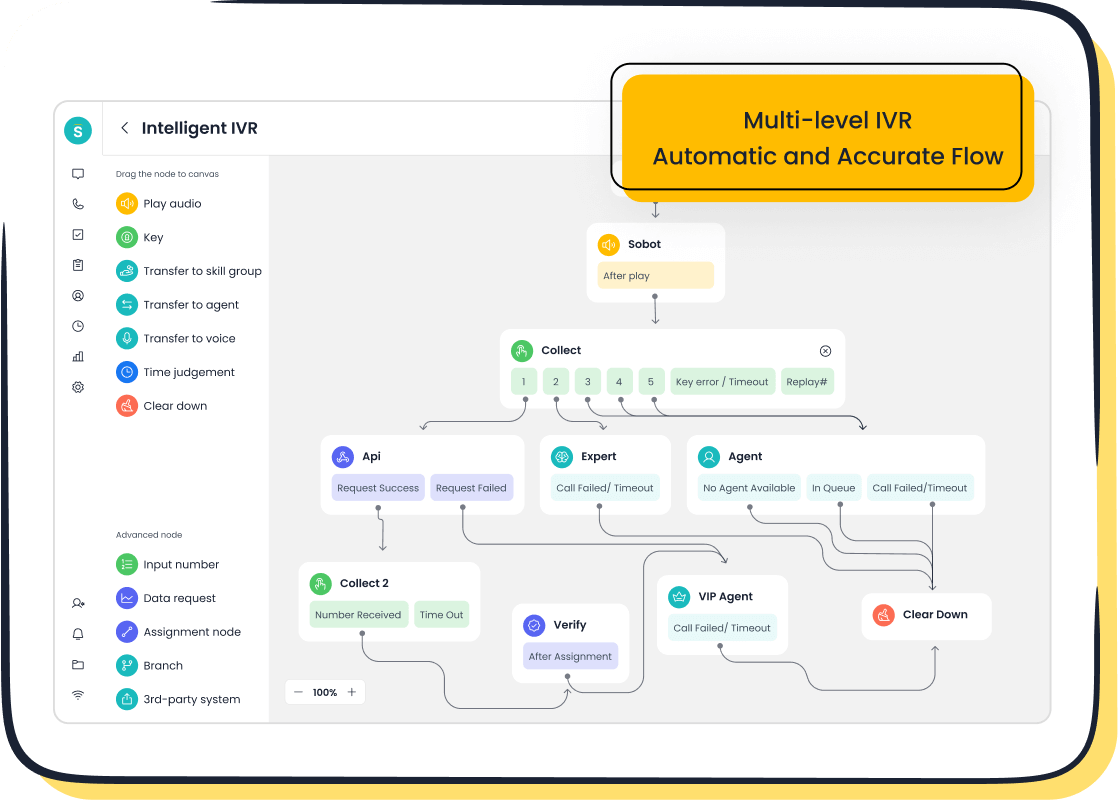
This system works by using advanced AI to listen and interpret. When you call, a system like Sobot's AI-powered Voicebot engages you in a natural conversation. You can simply state your need, like, "I want to check my order status" or "I need to update my payment info." The ai-based routing technology uses NLP to instantly understand your request.
This information is then used by the call center routing logic. For example, Sobot's drag-and-drop Intelligent IVR can be configured to recognize the "order status" intent and send your call directly to the fulfillment team. This intelligent call routing process bypasses complex menus entirely. The ai-based routing system is smart enough to handle variations in phrasing, ensuring it understands you correctly the first time.
Key Benefits
Adopting NLP-based routing delivers a faster and more satisfying customer experience. Modern NLP systems can achieve accuracy rates comparable to human interpretation, ensuring your request is understood correctly. This dramatically improves your call center routing efficiency.
The biggest benefit is the elimination of frustrating phone menus. Customers no longer have to press endless buttons or wait to speak with an agent just to be transferred.
This leads to several key advantages:
- Faster Resolutions: Customers connect to the right expert immediately.
- Reduced Agent Workload: Simple requests are handled or routed without agent intervention.
- Higher Customer Satisfaction: A smooth, conversational experience leaves a positive impression.
This technology transforms your contact center from a series of hurdles into a direct path to a solution.
Measuring Success and Improving Customer Satisfaction
Implementing new strategies is only half the battle. You must track performance to understand what works. Measuring intelligent call routing success requires a focus on the right data. This allows you to refine your call center routing and continuously improve the customer experience.
KPIs for Your Intelligent Routing Call Center
Key Performance Indicators (KPIs) are the vital signs of your contact center. An intelligent routing call center directly impacts these numbers. You should monitor several core customer experience metrics to gauge your success.
- First Call Resolution (FCR): The percentage of issues solved in a single interaction.
- Average Handling Time (AHT): The average time an agent spends on a call.
- Customer Satisfaction (CSAT): A direct measure of customer happiness.
- Call Abandonment Rate: The percentage of callers who hang up before reaching an agent.
Look at the success of Weee!, America's largest online Asian supermarket. By implementing Sobot's intelligent call routing, they achieved tangible results. They saw a 20% increase in agent efficiency, a 50% reduction in resolution time, and an incredible 96% customer satisfaction score. These results prove that a well-executed intelligent routing call center strategy delivers powerful outcomes.
Analyzing First Call Resolution (FCR)
First-call resolution is one of the most critical metrics for any contact center. A high FCR rate means your call center routing is effective and your agents are well-equipped. When customers solve their problems on the first try, their satisfaction soars. In fact, research shows that for every 1% improvement in first-call resolution, you can see a 1% decrease in operating costs.
Low FCR is often a symptom of deeper issues. Ineffective routing systems, agents lacking the authority to solve problems, or insufficient training can all force customers to call back.
Improving first-contact resolution requires giving agents the right tools and knowledge. An intelligent routing call center ensures calls go to the right expert from the start, which is the first step to a better customer experience.
Tracking CSAT and NPS
Ultimately, your goal is to create happy, loyal customers. Customer satisfaction (CSAT) and Net Promoter Score (NPS) are how you measure this. There is a direct link between first-call resolution and customer satisfaction. When you resolve issues quickly, CSAT scores naturally rise.
You can track these metrics effectively. Use transactional surveys to ask for feedback immediately after an interaction. This gives you a clear view of how your intelligent routing call center is performing. By tracking CSAT and NPS over time, you can identify trends, address issues proactively, and prove the value of your investment in a smarter customer journey.
These five strategies are essential for your call center routing. By 2026, customers will demand more personalization. You can meet this need with a proactive call routing strategy. An intelligent routing call center uses AI and data to create seamless experiences. This intelligent call routing improves your call center routing and builds loyalty. The future of service is here.
Ready to see how these strategies can transform your support? Embark on Your Contact Journey. Schedule a demo of the Sobot Voice/Call Center or explore our Omnichannel Solution today.
FAQ
What is the difference between intelligent routing and older methods?
Older methods like least-idle routing or round robin routing simply find the next free agent. Intelligent direct routing uses data to find the best agent. This modern direct routing approach solves many common call routing challenges by personalizing the experience, unlike basic least-idle routing or round robin routing.
How do I choose the right routing strategy?
Your choice depends on your goals. For efficiency, you might use least-idle routing or round robin routing. For personalization, you need direct routing. A good system offers scalability and flexibility. This flexibility allows you to combine strategies like direct routing with least-idle routing or round robin routing.
Can these strategies handle high call volumes?
Yes. Modern systems are built for scalability. Strategies like automated call distribution, least-idle routing, and round robin routing manage volume well. The scalability and flexibility of intelligent direct routing also help you handle peaks efficiently. This scalability ensures you can grow without facing new call routing challenges.
See Also
Mastering IVR Software Setup: A Comprehensive Guide to Interactive Voice Response
Exploring Top AI-Powered Solutions for Modern Enterprise Call Centers
Unlocking Peak Efficiency: AI Customer Service Software Transforms Operations
Navigating Call Center AI Software: Your Essential Artificial Intelligence Handbook
Elevating SaaS Support: Strategic Live Chat Approaches for Enhanced Customer Service

