A Guide to Omnichannel Speech Recognition Software

Omnichannel speech recognition is a unified system. It captures and analyzes every customer voice interaction across all touchpoints. This speech recognition software provides deep insights into the customer experience. An effective omnichannel deployment gives customer support teams a complete view of the customer journey. This advanced recognition technology powers modern solutions. For example, the Sobot call center uses Sobot AI for speech recognition to enhance customer support. Integrating speech recognition with omni-channel support platforms is crucial for a superior customer experience. These solutions transform a simple interaction into valuable insights, offering better support for every customer.
Beyond Transcription: The Value of Specialized Solutions
An effective omnichannel speech recognition strategy requires more than just converting words to text. While basic transcription is a foundational step, specialized solutions unlock the true value hidden within customer interaction data. These platforms use advanced conversational AI to deliver actionable insights that transform customer support operations.
The Limits of Basic Speech-to-Text
Basic automated speech recognition (ASR) services are designed for general use cases. They often struggle in the complex environment of a contact center. Factors like overlapping speech, industry-specific jargon, and background noise significantly reduce recognition accuracy. This can lead to flawed data and missed opportunities. A generic recognition model simply isn't built for the unique demands of customer support.
For example, the accuracy of a basic speech recognition service can drop considerably in common contact center scenarios.
| Scenario | Typical Accuracy Range | Key Challenges |
|---|---|---|
| Noisy environments | 70-85% | Background noise, multiple speakers |
This gap in recognition means a simple transcript cannot capture the full context of a customer interaction.
Enhancing the Customer Journey with Actionable Insights
Specialized voice recognition technology moves beyond words to analyze how things are said. Advanced speech analytics and conversational AI provide deep insights into every conversation. This technology helps a customer experience platform understand the true voice of the customer. These solutions offer capabilities that basic transcription lacks, turning raw data into a powerful tool for improving the customer experience.
These platforms provide critical insights by:
- Interpreting meaning and intent: Conversational AI can determine if a customer is satisfied or frustrated, even with sarcastic comments.
- Detecting emotion: Speech analytics tracks changes in tone, volume, and pace to identify emotional highs and lows during a customer interaction.
- Flagging risks in real-time: The system can alert supervisors to compliance issues or a deteriorating customer experience, allowing for immediate support.
By analyzing the emotional drivers behind a customer decision, a business can better meet the needs of each customer. This focus on the customer experience strengthens relationships and provides support teams with the insights they need to excel.
Comparing Top Call Center Voice Recognition Platforms

Choosing the right call center voice recognition platform depends on your specific business needs. Some businesses need an all-in-one system, while others require specialized tools for compliance or security. This section compares four leading platforms to help you identify the best fit for your goals. Each platform uses conversational AI in unique ways to improve the customer experience.
Sobot: For All-in-One AI-Powered Contact Centers

Sobot offers a complete, all-in-one contact center solution. It is ideal for businesses that want to unify all customer communication channels into a single platform. The system integrates its chatbot, live chat, ticketing system, and voice call center into one unified workspace. This approach gives agents a full view of every customer interaction.
Sobot's AI-driven voice recognition technology powers its entire suite. The platform uses advanced conversational AI to deliver powerful features.
- AI-Powered Voicebot: An intelligent voicebot handles both inbound and outbound calls. It can answer common customer questions or make marketing calls, tagging each customer based on their intent.
- AI Agent: This bot uses both Natural Language Processing (NLP) and Large Language Models (LLM) for advanced conversational AI. It provides automated support across voice and email channels.
- Intelligent Quality Inspection: The system uses AI to automatically check call quality based on preset rules. This process helps maintain a high standard of support.
This integrated approach delivers measurable results. The conversational AI helps agents provide better support and improves overall efficiency.
Success Story: Weee! America's largest online Asian supermarket, Weee!, used Sobot to upgrade its customer support. The company achieved a 20% increase in agent efficiency and a 96% customer satisfaction score. Resolution times for each customer also dropped by 50%.
Sobot's platform provides powerful recognition capabilities designed to enhance every customer interaction.
NICE: For Enterprise-Grade Compliance and WFO
NICE is a leading choice for large enterprises, especially those in highly regulated industries. Its platform excels at workforce optimization (WFO), compliance, and performance management. NICE uses conversational AI to provide deep insights into agent performance and customer behavior.
Key features focus on managing a large workforce and ensuring strict quality standards.
- AI Forecasting and Scheduling: The system uses predictive AI to optimize agent schedules. This reduces costs and ensures the right agents are available to support each customer.
- Enlighten AI: This suite of tools includes Enlighten Copilot, which offers real-time agent assist during live calls. It also includes Enlighten Actions, which uses generative AI to create summaries of contact center activities. This real-time support helps agents resolve issues faster.
- Advanced Quality Management: NICE provides tools for call recording, screen recording, and automated quality scoring. This helps supervisors monitor and improve the performance of every customer support agent.
NICE is an ideal solution for industries like financial services, healthcare, government, and telecommunications. These sectors require robust tools for compliance and large-scale agent management. The platform's advanced voice recognition helps maintain high quality across the board.
Verint: For Advanced Voice Biometrics and Security
Verint specializes in security and fraud prevention through its advanced voice recognition technology. The platform is a top choice for businesses that handle sensitive customer data, such as banks and financial institutions. Verint's conversational AI focuses on identifying speakers and analyzing conversations for risk.
Verint’s standout feature is its voice biometrics. The system creates a unique voiceprint for every customer during normal conversation. This passive authentication process is frictionless for the customer. It confirms the identity of a legitimate customer without security questions. It also identifies known fraudsters, allowing agents to stop fraudulent activity in real-time.
Verint also offers powerful ai-powered speech analytics to improve the customer experience.
- Use Case Examples: A telecom company used Verint to discover that a confusing bill format caused high call volumes. A bank used real-time prompts to help agents resolve issues faster, improving customer satisfaction.
- Pricing Model: Verint offers custom pricing based on the number of agents, call volume, and features needed. This tailored approach differs from standard subscription models.
For businesses where security is the top priority, Verint provides unmatched recognition and authentication solutions.
Genesys Cloud CX: For Native CCaaS Integration
Genesys Cloud CX is a comprehensive Contact Center as a Service (CCaaS) platform. Its strength lies in its native integration. Speech and text analytics are built directly into the platform, not offered as a separate add-on. This creates a seamless experience for analyzing 100% of customer interactions across all channels.
The platform's conversational AI provides a complete picture of contact center performance.
- Omnichannel Analytics: Genesys transcribes and analyzes every interaction, from voice calls to digital messages. This gives managers a holistic view of the customer journey.
- Trend and Sentiment Detection: The system uses natural language processing to identify emerging trends and understand customer sentiment. It can automatically flag calls for quality review.
- Unified Platform: Because analytics are built-in, businesses get a single, unified solution for engagement, analytics, and workforce optimization. This simplifies operations and provides a single source of truth for all customer data.
Genesys is an excellent choice for businesses seeking a powerful, all-in-one cloud platform with deeply integrated analytics capabilities. The real-time agent assist features provide immediate support to agents.
Platform Feature Comparison
Each platform offers a unique set of features. The right choice depends on your primary business goal, whether it's unified service, enterprise-level compliance, advanced security, or native cloud integration. The table below compares the key features of each solution.
| Feature | Sobot | NICE | Verint | Genesys Cloud CX |
|---|---|---|---|---|
| Real-Time Agent Assist | AI Copilot for response generation and summaries. | Enlighten Copilot provides in-conversation guidance. | Real-time prompts guide agents to faster resolutions. | Built-in real-time agent assist for guidance and information. |
| Sentiment Analysis | Offers customer sentiment analysis and predictive modeling. | Advanced sentiment and emotion detection. | Detects emotions and identifies patterns in conversations. | Identifies customer sentiment across all channels. |
| Automated QA Scoring | Intelligent quality inspection with AI-based rule sets. | Comprehensive AI-powered Quality Management (QM). | Analytics tools enable automated quality checks. | Automatically flags calls for quality review based on triggers. |
| CRM Integration | Simple and seamless integration with existing systems. | Integrates with major CRM and business applications. | The Verint Open Platform allows for modular integration. | Extensive pre-built integrations via AppFoundry Marketplace. |
This comparison highlights how different ai-driven voice recognition solutions cater to different needs. Whether you need real-time agent assist, customer sentiment analysis, or automated quality checks, there is a platform designed to support your objectives.
When to Use General-Purpose Speech-to-Text APIs
While all-in-one platforms offer comprehensive features, some businesses may consider using general-purpose speech-to-text APIs. These services are powerful tools for specific projects. They are best suited for companies with in-house development teams that need a basic transcription component rather than a full-stack customer support solution. Understanding their role is key to making the right choice.
Google Cloud and AWS Transcribe
Google Cloud and AWS Transcribe are leading providers of speech recognition APIs. They offer a pay-as-you-go pricing model that scales with usage. This can be cost-effective for projects with fluctuating or high-volume transcription needs. The price per minute of recognition often decreases as volume increases.
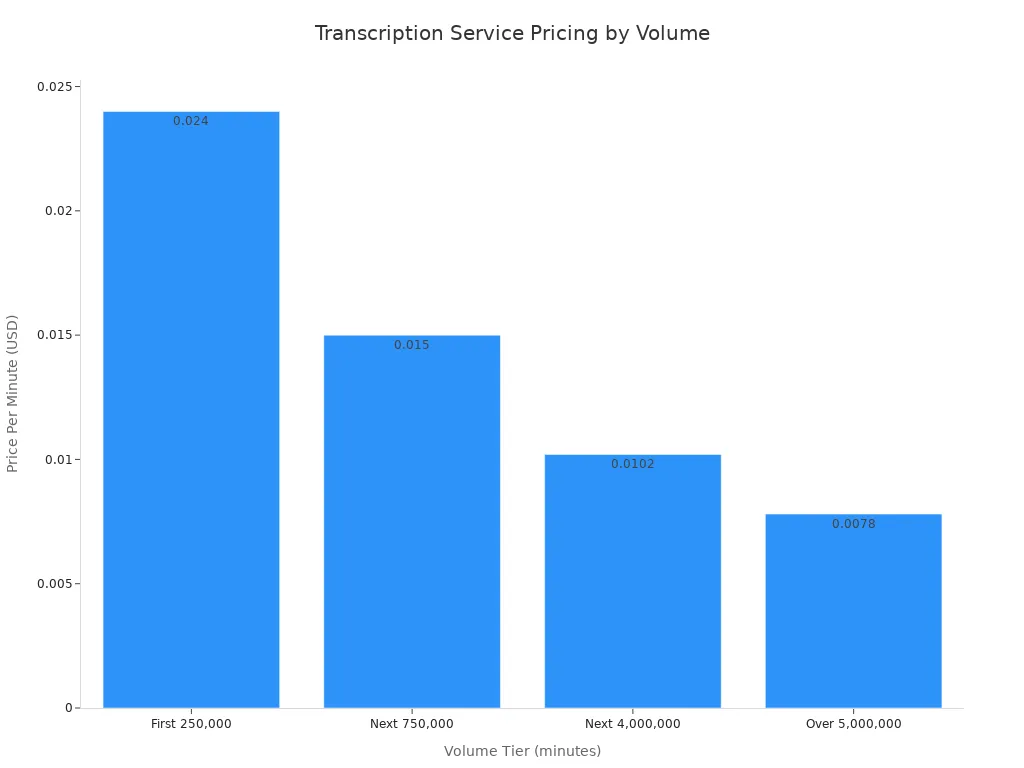
This model is ideal for developers who need a raw transcription engine to build custom applications. However, the initial price does not include the cost of building the surrounding infrastructure for customer support.
Understanding Their Role: Components vs. Solutions
General-purpose APIs are components, not complete solutions. A business must build the entire application around the API. This requires significant resources and expertise.
Building an In-House Solution:
- Expertise: Requires Machine Learning knowledge for model tuning and IT operations for system maintenance.
- Time: It can take a year or more to build a production-ready system.
- Cost: The total cost of ownership can range from $300k to $2 million annually.
In contrast, integrating a pre-built API is much faster. A developer can add speech recognition to an application in weeks. The provider handles all the complex backend work, including model updates and scaling. This makes APIs a good choice for adding simple recognition features, but not for creating a full customer support platform.
Evaluating Omnichannel Capabilities
General APIs have limitations for complex contact center use cases. Their omnichannel capabilities are not as developed as specialized platforms. These APIs often lack the context-aware features needed to analyze the full customer journey.
For example, some API limitations include:
- Only supporting two-channel audio (one for the agent, one for the customer).
- Limits on the number of concurrent analysis jobs.
- Inability to apply new analysis categories to existing transcriptions.
These technical constraints make it difficult to get a unified view of every customer interaction. A specialized platform provides superior recognition and analytics designed specifically for customer support environments.
How to Choose the Right Speech Recognition Software

Selecting the right speech recognition software requires a clear strategy. A business must look beyond flashy features and focus on its core objectives. The best choice aligns directly with specific business goals and integrates smoothly into the existing technology stack. This process involves three critical steps: defining goals, matching them to features, and planning for integration.
Step 1: Define Your Primary Business Goal
Before evaluating any platform, a business must first define what it wants to achieve. A clear goal acts as a compass. It guides every decision in the selection process. The most common goals drive significant improvements in customer support and sales operations.
Key business objectives often include:
- Improving Customer Service and Satisfaction: Speech analytics can reveal the reasons behind customer frustration. It helps businesses identify pain points and discover opportunities to improve the customer experience.
- Optimizing Agent Performance and Training: Conversational AI provides automated feedback and targeted insights. This allows supervisors to offer timely coaching based on actual interactions, improving agent skills and reducing turnover.
- Increasing Operational Efficiency and Reducing Costs: Automating quality assurance across all conversations reduces the need for manual reviews. This streamlines processes, lowers handling times, and decreases escalations.
- Finding New Sales Opportunities: Conversational AI can identify cross-sell and up-sell opportunities during a customer interaction. This data improves sales conversion rates and maximizes marketing campaign effectiveness.
Focusing on a primary goal delivers a clear return on investment. This focus on efficiency can yield impressive results, such as a thirty to fifty percent reduction in call handling times and up to a sixty percent savings in operational costs.
“When used properly and accompanied by best practices, speech analytics typically pays for itself in three to nine months.” – Donna Fluss, DMG Consulting LLC
Defining a goal provides the foundation for choosing a platform that delivers measurable value and a better experience for every customer.
Step 2: Match Goals to Essential Features
Once a primary goal is set, the next step is to identify the essential features needed to achieve it. Different objectives require different tools. Matching goals to features ensures a business invests in a solution that directly addresses its most important needs. Powerful conversational AI offers a wide range of capabilities.
For Improving Agent Performance: To boost agent productivity and quality, a platform should offer tools that provide real-time support and actionable insights.
- Real-time Transcription and Monitoring: This feature converts speech to text during a live call. It allows supervisors to monitor interactions and provide immediate feedback to agents.
- Intent Recognition: Conversational AI analyzes language patterns to understand a customer's true intent. This helps agents identify needs more quickly and provide more accurate support.
- Analysis of Key Themes: The system can identify recurring topics in conversations. This equips agents with tailored knowledge to handle common issues proactively.
For Enhancing the Customer Experience: Creating a superior customer experience requires a deep understanding of the voice of the customer. The right features turn this understanding into action.
- Natural Language Processing (NLP): Advanced NLP helps the system comprehend context and customer intent. This enables more relevant responses and a personalized experience.
- Sentiment Analysis: This feature uses conversational AI to analyze a customer's tone and word choice. It identifies emotions like frustration or delight, giving agents the insights to provide more empathetic support.
- Custom Models: The ability to build custom recognition models with specialized vocabulary ensures high accuracy for industry-specific jargon, leading to fewer misunderstandings.
For Ensuring Regulatory Compliance: For businesses in regulated industries, compliance is a top priority. Speech recognition features can automate monitoring and reduce risk.
- Keyword and Phrase Flagging: The system can automatically flag calls where specific compliance-related words are spoken or missed. This helps with quality assurance.
- Accurate Speaker Identification: This feature is essential for correctly attributing spoken words to the agent or the customer. It enriches compliance documentation and quality checks.
- Secure Data Handling: Solutions must offer features like data encryption and on-premise options to comply with regulations like GDPR and HIPAA.
Measuring the success of these features is critical. Businesses should track Key Performance Indicators (KPIs) to evaluate impact. Important operational metrics include Average Handling Time (AHT), First-Call Resolution (FCR) rate, and the transfer rate to human agents. A lower transfer rate, for example, indicates that the conversational AI is effectively resolving customer issues.
Step 3: Integrating Speech Recognition with Omni-Channel Support Platforms
A successful omnichannel deployment depends on seamless integration. The speech recognition software must work in harmony with other systems, especially the CRM. Integrating speech recognition with omni-channel support platforms creates a single, unified view of the customer. This process breaks down data silos and empowers teams with complete insights.
Technical and Performance Requirements Integrating speech recognition with omni-channel support platforms involves specific technical considerations.
- API Integration: Most modern platforms, like Salesforce and HubSpot, use REST APIs. The integration process involves connecting the voice agent to the CRM to read and write data, such as updating contact records or creating support tickets.
- Data Synchronization: High-quality CRM data is crucial for effective integration. Clean contact records and a well-organized knowledge base ensure the conversational AI has the right information to support the customer.
- Latency and Voice Quality: The system must provide sub-second response times for a natural conversation flow. Human-like speech synthesis and emotion recognition contribute to a positive customer experience.
Workflow Automation and Best Practices Beyond the technical setup, integrating speech recognition with omni-channel support platforms is about automating processes. The goal is to connect the voice agent to complex business workflows, such as lead scoring, task creation, and email triggers. This level of integration transforms the recognition tool from a simple listening device into an active participant in the customer support ecosystem.
For a truly effective omnichannel deployment, a business must share the insights from speech analytics across departments. When the marketing, sales, and product teams have access to the voice of the customer, the entire organization benefits. This holistic approach is the core of integrating speech recognition with omni-channel support platforms, turning every customer interaction into a source of valuable business intelligence. A unified customer experience platform makes this data sharing possible, ensuring every team has the support and insights needed to serve the customer better. Ultimately, integrating speech recognition with omni-channel support platforms is what elevates a company's service from good to exceptional.
Choosing the right omnichannel speech recognition software goes beyond simple transcription. The best solutions deliver actionable insights tailored to your business goals. These insights help improve the customer experience and can increase customer satisfaction scores by 15%. A business should use the guide's framework to evaluate its options. The right platform provides deep insights into every customer interaction. This helps a customer support team achieve its objectives. For an integrated, AI-driven solution that provides powerful insights, businesses can request a demo from vendors like Sobot to see how their platform supports each customer.
FAQ
What is the role of conversational AI in customer support?
Conversational AI is the engine behind modern customer support solutions. It uses natural language processing to understand a customer's intent during an interaction. This technology powers real-time agent assistance, automates responses, and provides deep speech analytics insights to improve the overall customer experience.
How does real-time speech analytics help agents?
Real-time speech analytics provides live transcription and sentiment analysis during a call. This immediate feedback helps agents understand a customer's mood and needs. The conversational AI can also offer real-time suggestions, giving agents the support they need to resolve issues faster and more effectively.
Why is advanced voice recognition better than basic ASR?
Basic automated speech recognition often struggles with accents and background noise, which lowers voice recognition accuracy. Advanced voice recognition uses specialized conversational AI models. These models are trained for contact center environments, providing superior speech analytics and more reliable data for every customer interaction.
Can this technology integrate with other business tools?
Yes, leading voice recognition technology solutions are designed for integration. They connect seamlessly with CRM systems and other business software. This creates a unified platform for customer data, enabling powerful conversational AI and real-time support across all departments.
See Also
Comprehensive Guide to Omnichannel Solutions for Modern Call Centers
Comparing Leading Voice of Customer Software for Enhanced Business Insights
Leading Interactive Voice Response Systems: A Comparative Analysis
The 10 Best Speech Analytics Tools for Call Centers in 2024
Reviewing the Best Automated Voice Calling Software Solutions for 2024

