Inbound vs Outbound Telemarketing Examples for Call Centers

Inbound telemarketing means you receive calls from customers who need help or information. Outbound telemarketing means you reach out to customers to offer products or collect feedback. This difference shapes how you interact with customers and impacts your results. For example, inbound teams focus on solving problems and keeping people happy, while outbound teams aim to drive sales and follow up with leads.
| Call Center Type | Focus | Key Metrics |
|---|---|---|
| Inbound | Customer service and support | Customer Satisfaction, First Contact Resolution |
| Outbound | Sales and marketing | Conversion Rates, Calls per Agent |
Knowing how these methods differ helps you improve customer satisfaction and reach your business goals. Sobot provides advanced solutions for both types, making it easier for you to manage all telemarketing examples in one place.
Inbound Telemarketing Overview

Definition and Features
Inbound telemarketing happens when customers call your business for help, information, or support. You answer these calls and solve their problems. This approach puts you in a position to build trust and loyalty. Inbound teams use special tools and skills to handle calls well. Here is a table showing the most common features and skills you find in inbound telemarketing:
| Feature/Skill | Description |
|---|---|
| Automatic Call Distributors | Efficient call routing to the appropriate agents. |
| Interactive Voice Response | Manages high call volume and offers self-service options. |
| CRM Systems | Provides quick access to customer history and past interactions. |
| Active Listening | Understanding the customer's issue and emotional state. |
| Empathy | Connecting with the customer's frustration or concern. |
| Problem-Solving | Diagnosing and resolving issues critically. |
| Product Mastery | Deep knowledge to confidently answer questions. |
| De-escalation | Calming upset customers and turning negative experiences around. |
| Patience and Resilience | Handling diverse inquiries without losing composure. |
Inbound Telemarketing Examples
You can see inbound telemarketing in action in many industries. For example, a virtual telethon invites people to call in and donate to a nonprofit. In real estate, agents answer calls from interested buyers, qualify leads, and set appointments for open houses. These telemarketing examples show how inbound teams support both service and sales goals.
| Example Campaign | Description |
|---|---|
| Virtual Telethon | A media blitz encourages people to call in and donate to a nonprofit. |
| Real Estate Call Center | Agents qualify leads and promote open house events using scripts. |
Benefits for Call Centers
Inbound telemarketing brings strong results for your call center. You can boost customer retention by 42% and improve satisfaction by 33%. You also lower your cost per call by 45%. When you talk to customers in real time, you get instant feedback and learn what they need. This helps you give better service and keep customers coming back.
- Enhanced customer loyalty through quality communication and quick problem-solving.
- Proactive, personalized support reduces customer churn and keeps revenue steady.
Challenges and Solutions
You may face challenges like language barriers, technical issues, or sudden spikes in call volume. You can solve these problems by offering multilingual support, training agents to fix technical problems, and using advanced software to route calls and manage queues.
| Challenge | Solution |
|---|---|
| Language Barriers | Provide multilingual support, train agents, and use translation tools. |
| Technical Issues | Monitor downtimes, train agents in troubleshooting, and ensure minimal downtime. |
| Unexpected Surges in Call Volume | Use advanced software for automated routing and manage call queues effectively. |
Tip: When you invest in the right tools and training, you make your inbound telemarketing team stronger and more effective.
Outbound Telemarketing Overview
Definition and Features
Outbound telemarketing means your team reaches out to customers first. You do not wait for calls to come in. You call people to share information, promote products, or collect feedback. This approach is proactive. It helps you find new customers and grow your business.
- Outbound telemarketing is a proactive approach where you initiate contact with potential customers to generate leads and sales.
- Inbound telemarketing is reactive, focusing on responding to incoming calls from customers who have already shown interest.
- The main differences include who starts the call, the goals of the conversation, and the skills your agents need.
Modern call centers use advanced tools to make outbound telemarketing more effective. Here is a table showing key features:
| Feature | Description |
|---|---|
| Proactive outreach | You start the conversation with customers. |
| Scripted communication | Agents use scripts tailored to each campaign or audience. |
| Technology-driven tools | Auto-dialers and CRM systems help agents work faster and smarter. |
| Performance metrics | You track call volume and conversion rates to measure success. |
You may also use auto-dialers, CRM integration, and call recording to improve productivity and quality.
Outbound Telemarketing Examples
You can find outbound telemarketing in many industries. Here are some common telemarketing examples:
- Customer feedback campaigns: You call travelers after their trips to collect feedback.
- Loyalty program campaigns: You promote loyalty programs and help customers sign up.
- Appointment reminders for healthcare: You remind patients about upcoming appointments.
- Nonprofit fundraising calls: You reach out to donors to ask for support.
- Political campaign outreach: You engage voters during elections.
These telemarketing examples show how outbound calls help you connect with customers, gather information, and drive results.
Benefits for Call Centers
Outbound telemarketing brings many benefits to your call center. You can reach new customers and open new markets. You create sales opportunities that may not happen with inbound calls. Outbound calls help you gather market intelligence and understand customer needs.
| Benefit | Description |
|---|---|
| Direct customer engagement | You build relationships and learn what customers want. |
| Expanding customer base | You find new leads and grow your business. |
| Generating sales opportunities | You create new leads and close more deals. |
| Gathering market intelligence | You learn about trends and competitors from your calls. |
| Enhancing customer retention | Regular follow-ups keep customers happy and loyal. |
| Increasing brand awareness | More calls mean more people know your brand. |
| Cost savings in marketing | Outbound calls cost less than many ads and give you clear results. |
Companies that nurture leads well generate 50% more sales-ready leads at 33% lower cost.
Challenges and Solutions
You may face challenges with outbound telemarketing. These include low contact rates, high costs, and the need to follow rules. You can solve these problems with the right strategies.
| Challenge | Solution |
|---|---|
| Misalignment of brand voice | Train agents to match your brand’s style and values. |
| Low contact rates | Qualify leads to find the right people to call. |
| Regulatory compliance | Use technology to stay compliant and avoid mistakes. |
| Time consuming | Automate calling and tracking to save time. |
| Costly processes | Plan your campaigns to manage costs and get the best return. |
| Lack of incentives for prospects | Offer rewards or special deals to encourage customers to engage. |
“We are seeing an increase in existing and repeat customer business. There was a transformation from people contacting customer service with comments like ‘I wanted to get something else and now I never want to do business with you again,’ to now becoming repeat loyal customers thanks to Global Response.”
When you use automation, train your agents, and plan your campaigns, you can overcome these challenges and see better results.
Telemarketing Examples with Sobot Voice/Call Center
Inbound Telemarketing Examples with Sobot
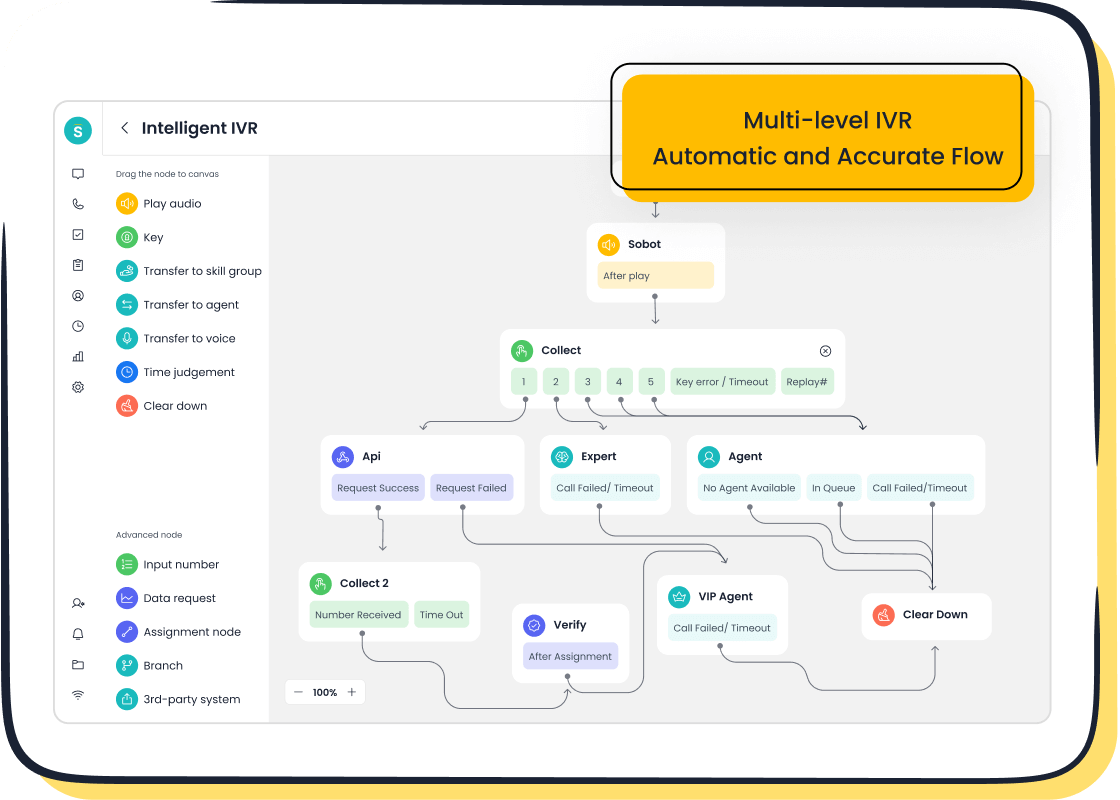
You can use Sobot’s Voice/Call Center to handle inbound telemarketing in many ways. When customers call your business for help, Sobot’s intelligent IVR greets them and guides them to the right department. For example, a retail company can set up a menu that lets callers choose between product support, order tracking, or billing questions. This system reduces wait times and helps customers get answers fast.
Sobot’s AI-powered Voicebot can answer common questions, such as store hours or return policies, without needing a live agent. If a customer needs more help, the Voicebot transfers the call to an agent who can see the caller’s history in the unified workspace. This workspace shows all past interactions, so agents do not have to ask for the same information again. You can use these tools to solve problems quickly and make customers feel valued.
Here are some telemarketing examples you can try with Sobot’s inbound features:
- A bank uses Sobot’s IVR to route loan inquiries to the right team. Customers get answers in less than one minute.
- An e-commerce company uses the Voicebot to handle order status requests. Agents only handle complex cases, which reduces their workload by 60%.
- A healthcare provider uses Sobot’s system to let patients schedule appointments or get test results through automated menus.
Sobot’s inbound tools help you personalize communication and automate simple tasks. You can see the impact in the following table:
| Metric | Value |
|---|---|
| Resolution Time | < 1 minute |
| ROI | 234% |
| Agent Workload Reduction | 60% |
| Conversion Rate Increase | 15% |
| NPS Improvement | 35% |
You can also benefit from:
- Personalized communication for each caller.
- Precise call routing to the right agent.
- Automated workflows that save time.
- Omnichannel support, so customers can reach you by phone, chat, or WhatsApp.
These telemarketing examples show how Sobot’s inbound features help you improve customer satisfaction and efficiency.
Outbound Telemarketing Examples with Sobot
You can use Sobot’s Voice/Call Center to run outbound telemarketing campaigns that reach more customers and boost sales. The platform lets you set up bulk outbound tasks, so you can call hundreds or thousands of leads with just a few clicks. You can assign leads to agents based on priority or skill, which helps you get better results.
For example, a financial services company can use Sobot to call customers about new credit card offers. The system tracks which customers answer, records the calls, and updates the CRM automatically. Agents see all customer data in the unified workspace, so they can personalize each call.
Here are some outbound telemarketing examples you can run with Sobot:
- A retail brand launches a new product and uses Sobot to call loyal customers with a special offer. The campaign increases conversion rates by 15%.
- A healthcare provider uses Sobot to remind patients about upcoming appointments. The reminders reduce no-shows and improve patient care.
- An education company uses Sobot to invite students to free trial lessons. The system tracks responses and helps agents follow up with interested leads.
Sobot’s outbound tools help you work faster and smarter. You can see the benefits in the following table:
| Metric | Improvement |
|---|---|
| Agent Workload Reduction | 60% |
| Conversion Rate Increase | 15% |
| Net Promoter Score | 35% |
| Resolution Time | <1 minute |
You can also:
- Use auto-dialers to save time.
- Track every call and result in real time.
- Integrate with your CRM for better follow-up.
These telemarketing examples show how Sobot’s outbound features help you grow your business and keep customers engaged.
Customer Story: Opay’s Success
Opay, a leading financial service platform, wanted to improve customer service and marketing. The company faced challenges with high call volumes and managing customer interactions across many channels. Opay chose Sobot’s omnichannel solution to solve these problems.
With Sobot, Opay unified its social media, email, and voice channels. The company used Sobot’s intelligent IVR to handle more calls and let customers solve simple issues on their own. Opay also used WhatsApp for targeted marketing, sending messages that reached 85% of customers.
Here is what Opay achieved with Sobot:
- Customer satisfaction increased from 60% to 90%.
- Operational costs dropped by 20%.
- Conversion rates went up by 17%.
- 60% of customers solved their issues without talking to an agent.
Opay’s story shows how Sobot’s Voice/Call Center and omnichannel tools can transform your telemarketing strategy. You can manage all customer contacts in one place, automate routine tasks, and focus on building strong relationships.
Tip: You can use Sobot’s chatbot, live chat, ticketing system, and WhatsApp API to support your telemarketing campaigns. These tools help you reach customers on their favorite channels and provide fast, helpful service.
Sobot’s Voice/Call Center gives you a stable, secure, and easy-to-use platform. You can handle millions of calls every day, integrate with your CRM, and use AI to improve every customer interaction. These telemarketing examples prove that you can achieve better results with the right technology.
Inbound vs Outbound: Comparison and Selection
Key Differences
You need to know the main differences between inbound and outbound telemarketing before you choose the best approach for your call center. Inbound telemarketing happens when customers call you for help or information. Outbound telemarketing means you call customers to offer products or ask for feedback. Each method uses different tools, skills, and goals.
Here is a table that shows the key differences:
| Aspect | Inbound Telemarketing | Outbound Telemarketing |
|---|---|---|
| Initiation | Customer calls you | You call the customer |
| Objective | Solve problems, answer questions, build loyalty | Promote products, generate leads, set appointments |
| Interaction Type | Reactive, focused on service | Proactive, focused on sales |
| Skills Required | Listening, empathy, problem-solving | Persuasion, attention capture, handling objections |
| Technology Used | IVR, ACD, CRM for customer history | Predictive dialers, CRM for lead management |
| Success Measurement | Customer satisfaction, loyalty, first-call resolution | Conversion rates, appointments set, leads generated |
Inbound telemarketing focuses on customer service and retention. Outbound telemarketing aims to reach new customers who may not have shown interest before. You can see these differences in many telemarketing examples, such as a support hotline (inbound) or a product launch campaign (outbound).
Choosing the Right Method
You should choose your telemarketing method based on your business goals, customer type, and campaign objectives. Here are some steps to help you decide:
- Define your campaign goals. If you want to build trust and keep current customers happy, inbound telemarketing works best. If you want to find new customers or promote a new product, outbound telemarketing is the right choice.
- Know your audience. If your customers often reach out with questions or need support, focus on inbound. If you need to introduce your brand to new people, outbound is more effective.
- Think about timing and compliance. Outbound campaigns must follow rules about when and how you contact people. Inbound calls usually come from customers who want to talk to you.
- Match your technology to your needs. Use IVR and ACD systems for inbound calls. Use predictive dialers and CRM tools for outbound campaigns.
- Personalize your message. Make sure your communication fits the needs and interests of your audience.
You can also look at your industry benchmarks. For example, inbound call centers often measure success with customer satisfaction scores and first-call resolution rates. Outbound centers focus on conversion rates and the number of leads generated.
Tip: Assess your business needs and customer base before you choose. For sales growth, outbound telemarketing is effective. For capturing leads from existing customers, inbound telemarketing is better.
Impact on Customer Experience
Your choice between inbound and outbound telemarketing affects how customers feel about your brand. Inbound telemarketing usually leads to higher customer satisfaction. Customers call you when they need help, so they feel valued and heard. This builds trust and loyalty over time.
Outbound telemarketing can help you reach new customers and grow your business. However, some people may see outbound calls as intrusive if you do not plan your campaigns well. You need to make sure your calls are relevant and respectful.
Here is a table that shows how each method impacts customer experience:
| Aspect | Inbound Calls | Outbound Calls |
|---|---|---|
| Initiated By | Customer | Business |
| Primary Goal | Support, service, satisfaction | Sales, marketing, outreach |
| Nature of Interaction | Reactive | Proactive |
| Performance Metrics | CSAT, NPS, First-Call Resolution | Conversion Rate, Call-to-Sale Ratio |
| Customer Perception | Helpful, trustworthy, responsive | Can be intrusive if not targeted well |
| Long-term Effect | Builds loyalty and trust | Raises awareness, may lower trust if overused |
Inbound telemarketing helps you provide immediate assistance and personalized service. This leads to better retention and higher Net Promoter Scores. Outbound telemarketing can drive growth and reach new markets, but you need to balance your approach to avoid negative reactions.
Regular engagement through inbound calls can re-engage inactive customers and improve retention. Outbound calls, when done right, can introduce your brand to new audiences and create new sales opportunities.
Note: The best call centers use both inbound and outbound telemarketing. You can combine these methods to support your customers and grow your business at the same time.
You have learned that inbound telemarketing focuses on customer service and satisfaction, while outbound telemarketing drives sales and lead generation. The table below highlights the main differences:
| Metric | Inbound Telemarketing | Outbound Telemarketing |
|---|---|---|
| Conversion Rate | Less emphasized | Higher with warm leads |
| Customer Satisfaction | High priority | Less emphasis |
| Cost per Call | Lower | Higher, but higher ROI |
Choosing the right method depends on your goals and your customers’ needs. When you use Sobot’s Voice/Call Center, you gain advanced AI, automation, and omnichannel tools that boost ROI by 234% and improve customer experience. For the best results in inbound vs outbound telemarketing examples for call centers, trust Sobot to help you succeed.
FAQ
What is the main difference between inbound and outbound telemarketing?
You handle inbound telemarketing when customers call you for help or information. Outbound telemarketing means you call customers first to offer products or collect feedback. This is the core of Inbound vs Outbound Telemarketing Examples for Call Centers.
How does Sobot improve inbound and outbound telemarketing?
Sobot gives you tools like intelligent IVR, AI-powered Voicebot, and a unified workspace. These features help you manage both inbound and outbound calls efficiently. You see better results in all Inbound vs Outbound Telemarketing Examples for Call Centers.
Can one call center use both inbound and outbound telemarketing?
Yes! You can use both methods in your call center. Many companies combine inbound and outbound strategies to support customers and grow sales. This approach works well for Inbound vs Outbound Telemarketing Examples for Call Centers.
What industries benefit most from inbound and outbound telemarketing?
Industries like retail, finance, healthcare, and education use both methods. You can see Inbound vs Outbound Telemarketing Examples for Call Centers in these fields, where customer service and sales are important.
How do you choose between inbound and outbound telemarketing?
You look at your goals. If you want to help current customers, choose inbound. If you want to find new customers, choose outbound. Review Inbound vs Outbound Telemarketing Examples for Call Centers to decide what fits your needs.
See Also
Effective Strategies for Managing Call Center Quality
Comprehensive Overview of Omnichannel Call Center Tools
Best Remote Call Center Companies to Work For

