Inbound vs Outbound Calls Which Do You Need?


Choosing your call strategy is a key business decision. You must decide between inbound and outbound calls. Do you need inbound calls to support your current customer base? Or do you need proactive outbound calls to drive growth? A strong outbound process can increase revenue by up to 28%. The right inbound or outbound approach defines your path, and a modern Sobot call center with Sobot AI can power that journey.
Understanding Inbound Calls for Customer Support

Inbound calls are reactive. A customer contacts you for help. Your goal is to provide excellent support that builds loyalty. An effective inbound strategy turns your contact center from a cost center into a value-driver that strengthens your brand and improves the customer experience. These inbound call center services are the foundation of customer retention.
Common Uses and Goals
You will receive inbound calls for a few primary reasons. Each one represents an opportunity to deliver a positive customer experience.
- Customer Service: Customers call with questions, account issues, or general inquiries. Your goal is to provide fast and accurate answers.
- Technical Support: Users need help troubleshooting a product or service. Your goal is to resolve their technical problems efficiently.
- Order Processing: A customer wants to place an order, check its status, or make a return. Your goal is to make the process smooth and simple.
💡 Tip: A powerful solution like Sobot's Voice/Call Center helps you manage these different inbound calls. Its Intelligent IVR feature automatically routes customers to the right agent or department, reducing wait times and frustration.
Essential Agent Skills
The success of your inbound call center depends on your agents. They need a specific set of skills to handle inquiries effectively.
- Problem-Solving: Agents must quickly understand a customer's issue and find the right solution.
- Product Knowledge: Deep knowledge of your products and services is essential for providing credible help.
- Empathy: Customers want to feel heard. Research shows customer satisfaction is 35% higher when an agent shows genuine empathy. This skill builds trust and improves the overall customer experience.
Sobot’s Unified Workspace empowers agents by putting all customer information in one place, helping them deliver this personalized and knowledgeable service.
Key Performance Indicators (KPIs)
To measure the success of your inbound operations, you need to track the right metrics. The most important KPI is the customer satisfaction score (CSAT). While a solid score is between 75-80%, top-performing inbound call centers target a customer satisfaction score of 85% or higher. This shows you are consistently meeting and exceeding customer expectations.
Driving Growth with Outbound Calls
Outbound calls are proactive. Your team initiates contact with potential or existing customers to achieve a specific business goal. Unlike inbound calls that focus on service, outbound efforts are designed to drive sales, generate leads, and expand your market reach. A well-executed outbound strategy can be a powerful engine for business growth.
Common Uses and Goals
You can use outbound calls to actively pursue business objectives. These campaigns are focused and results-driven. Common uses include:
- Lead Generation: Your agents contact potential customers to gauge their interest in your products or services. Successful outbound calling campaigns have generated significant business for companies in diverse sectors, from medical insurance to technology.
- Appointment Setting: The goal is to schedule a meeting or product demo between a prospect and a sales representative. This moves qualified leads further down the sales funnel.
- Market Research: You can gather valuable feedback on new product ideas, brand perception, or market trends directly from your target audience.
💡 Pro Tip: Managing large-scale outbound campaigns requires organization. Sobot’s Bulk Outbound Task feature automates your workflow by assigning leads to agents based on priority, streamlining your outbound call center services.
Essential Agent Skills
Agents in outbound call centers need a unique skill set to succeed. They must be comfortable initiating conversations and guiding them toward a desired outcome.
- Persuasion: Agents need to build rapport quickly and present a compelling value proposition. Training through role-play sessions and peer feedback helps agents improve their real-time responses.
- Resilience: Hearing "no" is part of the job. Resilient agents handle objections professionally. For example, when a prospect says, "We don’t have the budget," a skilled agent might respond, "I appreciate that. Our clients typically see a return on investment within the first quarter."
- Goal-Orientation: Outbound work is target-driven. Agents must stay focused on their goals, whether it's hitting a certain number of appointments or generating a specific number of leads.
Key Performance Indicators (KPIs)
Measuring the effectiveness of your outbound calls is crucial for optimizing your strategy. You should track metrics that directly reflect your campaign's success. The most important KPI for outbound is the Conversion Rate, which measures how many calls result in a sale or appointment.
Benchmarks vary by industry and lead quality. For B2B sales, a good conversion rate is between 5% and 10%.
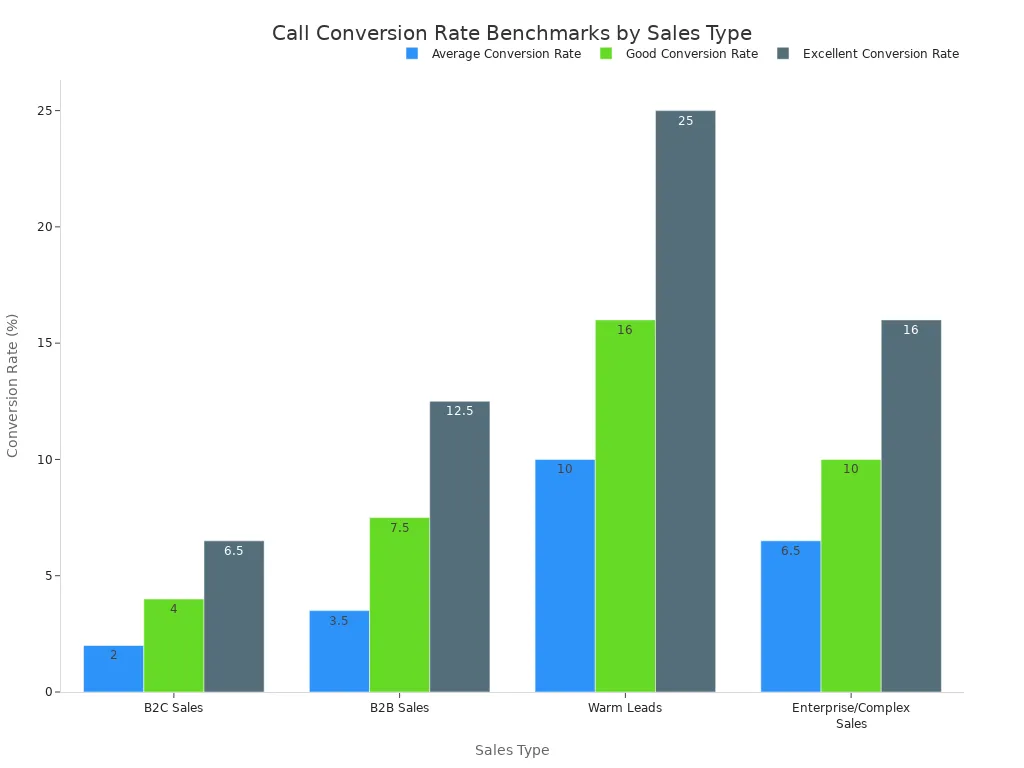
Another key metric is Cost Per Lead (CPL). While it varies, the average CPL for cold calling is around $300. Tracking these KPIs helps you understand the ROI of your outbound call center and make data-driven decisions to improve performance.
Inbound Call Center vs. Outbound Call Center

Understanding the fundamental differences between inbound and outbound calls helps you choose the right strategy. While both use phones to connect with people, their purpose, direction, and focus are completely opposite. Deciding between inbound and outbound call centers means deciding what you want to achieve: keeping the customers you have or finding new ones.
Core Purpose: Retention vs. Acquisition
The core purpose of an inbound call center is customer retention. When a customer calls you, you have a golden opportunity to provide a great customer experience and strengthen their loyalty. Happy customers stay with you longer. This is important because acquiring a new customer can cost 5 to 25 times more than keeping an existing one. A small effort in retention brings big rewards. Studies show that increasing customer retention by just 5% can boost your profits by 25% to 95%.
Loyal customers are your best asset. They are:
- 5 times more likely to buy from you again.
- 4 times more likely to refer a friend to your business.
- 7 times more likely to try a new product you offer.
In contrast, the core purpose of an outbound call center is customer acquisition. Your team makes outbound calls to find new leads and grow your business. This proactive approach is designed to generate revenue. While the cost is higher, a successful outbound strategy directly fuels expansion by turning potential leads into paying customers. Your inbound and outbound call center services work together, with inbound calls securing your base and outbound calls expanding it.
Call Direction: Reactive vs. Proactive
The direction of the call defines your team's entire workflow. Inbound and outbound call centers operate on opposite principles.
- An inbound operation is reactive. You wait for the customer to contact you. Your main challenge is managing unpredictable call volumes and ensuring every person who calls gets a fast, helpful response.
- An outbound operation is proactive. Your agents initiate contact from a list of prospects. Your challenge is to engage people who are not expecting your call and guide the conversation toward a specific goal.
This core difference shapes everything from technology to agent skills. The following table breaks down the operational distinctions between inbound and outbound call centers.
| Aspect | Inbound Call Center | Outbound Call Center |
|---|---|---|
| Primary Objective | Address customer issues and build loyalty. | Generate leads and convert sales. |
| Agent Skill Focus | Empathy, problem-solving, product knowledge. | Persuasion, resilience, handling objections. |
| Core Technologies | Automatic Call Distribution (ACD), IVR. | Predictive dialers, lead management lists. |
| Key Metrics | First Call Resolution (FCR), Average Handle Time. | Conversion Rate, Cost Per Conversion. |
| Interaction Nature | Reactive: responding to a customer's need. | Proactive: creating interest and dialogue. |
Because inbound calls are reactive, you need tools like an Interactive Voice Response (IVR) to route callers to the right department automatically. For proactive outbound calls, you need technology that helps agents make calls efficiently.
Primary Focus: Service vs. Sales
The primary focus of your call center dictates the type of conversations your agents have. An inbound call center is focused on service. An outbound call center is usually focused on sales. This distinction changes agent training, scripts, and success metrics.
Agents handling inbound calls must be excellent listeners. Their goal is to understand a customer's problem and solve it. They need deep product knowledge and a high degree of empathy to handle potentially frustrated callers. Success is measured by customer satisfaction and how quickly they can resolve an issue.
An inbound agent asks, "How can I help you today?" An outbound agent asks, "Do you have a moment to discuss how we can help you?"
On the other hand, agents making outbound calls must be persuasive and goal-oriented. Their job is to build rapport quickly, present a compelling reason for the call, and handle rejection. Their training focuses on sales techniques and overcoming objections. Success is measured by conversion rates, like how many outbound calls lead to a sale or an appointment. This is why the focus of inbound and outbound calls is so different. One aims to deliver a positive customer experience, while the other aims to create a new customer.
Technology for Inbound and Outbound Calls
The right technology powers your entire call strategy. Whether you focus on inbound calls, outbound calls, or both, your software determines your team's efficiency and your customers' experience. Choosing the right platform is not just about features; it is about aligning technology with your business goals.
Choosing Your Call Center Software
You must first evaluate your primary business needs. Are you building inbound call centers for stellar customer support? Or are you creating outbound call centers to drive sales? Your answer guides your software choice.
When you look at different software options, you will see a focus on different areas.
- Some platforms excel at team collaboration.
- Others are known for their powerful AI and live-agent support.
- Many prioritize intelligent call routing and queuing for inbound traffic.
Your business model is the most important factor. If your main goal is service, you need software with strong inbound features like smart routing and IVR. If you focus on sales, you need powerful outbound tools for your outbound calls. This decision ensures your team has the right tools for their specific tasks, whether they are handling inbound calls or making proactive outbound calls.
Key Features in Sobot's Voice/Call Center
An all-in-one platform gives you the flexibility to manage all your communication needs. Sobot's Voice/Call Center is built to support both inbound and outbound call centers with a single, unified solution. This approach simplifies your operations and prepares you for future growth.

Here are key features that make a difference:
- AI-Powered Voicebot: An intelligent voicebot can transform your customer experience. Sobot’s AI-powered Voicebot understands what a customer wants and routes them to the right agent. It also automates simple tasks like checking an order status. This frees up your human agents to handle more complex issues, which improves first-contact resolution and boosts customer satisfaction.
- Simple CRM Integration: Connecting your call center to your Customer Relationship Management (CRM) system is essential. A simple integration gives your agents a complete view of every customer's history. This unified data allows for a more personalized customer experience. It also improves agent productivity by removing the need to switch between different applications.
- Global Number Availability: If you serve an international audience, you need global number availability. Using local or toll-free numbers helps you build trust with customers in different regions. People are more likely to answer a call from a local number. This feature expands your market reach for outbound campaigns and makes your inbound support more accessible.
The Blended Approach: Combining Strategies
Why choose between inbound and outbound when you can do both? A blended strategy allows your agents to handle both inbound and outbound calls. This approach maximizes productivity by keeping agents busy during lulls in either inbound or outbound call volume. A unified system is the key to making this work.
A Real-World Example of Success: Weee!
America's largest online Asian supermarket, Weee!, needed to improve its complex customer service operations. They faced challenges with an inflexible IVR and language barriers. By implementing Sobot's voice product, Weee! adopted a more efficient approach. The results were remarkable:
- Agent efficiency increased by 20%.
- Resolution time for customer issues dropped by 50%.
This success story shows how a powerful, unified platform for inbound and outbound call center services can solve real business challenges. It empowers agents to handle inbound calls more effectively while providing the foundation for any future outbound efforts. A blended model for inbound and outbound calls, powered by the right technology, turns your contact center into a highly efficient engine for both service and growth.
Choosing your call strategy depends on your primary business objective. You should prioritize an inbound call center to deliver excellent customer satisfaction. You should use an outbound call center to drive proactive growth. However, you do not have to choose just one. A modern, blended platform like Sobot's Omnichannel solution gives you the flexibility to manage both inbound and outbound calls from a single system. This unified approach prepares you to successfully Embark on Your Contact Journey.
FAQ
Can I use one system for both inbound and outbound calls?
Yes, you can. A modern platform like Sobot's Voice/Call Center supports both inbound and outbound calls. This blended approach lets your team switch between tasks. It improves your team's productivity and simplifies your operations with a single, unified system.
How does an IVR help my inbound call center?
An Interactive Voice Response (IVR) system automatically greets your customers. It guides them to the right agent or department using a simple menu. This reduces wait times and ensures callers get help faster, improving the overall customer experience.
What is a blended call center?
A blended call center allows agents to handle both inbound and outbound calls. This strategy maximizes efficiency. Your agents can answer customer service inquiries and then switch to making sales calls during quiet periods, keeping your team productive at all times.
Can my team make calls from anywhere?
Yes, with the right software. Sobot's Cloud Call Center is available on Android and iOS devices. This gives your team the flexibility to manage calls from the office, at home, or on the go, ensuring you never miss an important connection.
See Also
Comparing Leading Interactive Voice Response Software Solutions for Your Business Needs
Your Essential Guide to Omnichannel Call Center Software Implementation and Benefits
Unveiling the Efficiency: How Call Center Automation Streamlines Operations Effectively
Genesis Call Center Versus Genesys: A Comprehensive Comparison to Determine Superiority
Demystifying Live Chat Outsourcing Costs: What You Need to Know

