Choosing Inbound or Outbound Call Centers


Inbound call centers reactively handle inbound calls from your customers. In contrast, outbound call centers proactively make outbound calls to new leads. Your choice impacts your goals, from improving customer service to driving sales. An inbound call center excels at retention, with studies showing 76% of customers report better support from these interactions. Meanwhile, an outbound call center focuses on growth. The market for a call outbound strategy is expanding, fueled by tools like Sobot AI that improve outbound calls. The Sobot call center from Sobot helps you manage both, ensuring your inbound call centers run smoothly.
Defining the Inbound Call Center

An inbound call center is your business's front line for customer interactions. It operates on a reactive model, meaning agents respond to incoming customer inquiries. This setup is essential for building trust and loyalty.
The Reactive Customer Service Model
The primary purpose of an inbound call center is to provide solutions when your customers need them. Think of it as the central hub for all incoming customer communications. When a customer has a question, a problem, or needs assistance, they initiate the contact. This model is crucial for industries where a positive customer experience is paramount. Many sectors rely on inbound call centers, including E-commerce, Healthcare, and Banking & Finance. These businesses use an inbound call center to manage high volumes of inbound calls and deliver consistent customer service.
Tip: A well-run inbound call center strengthens customer relationships by showing you are available and ready to help, directly impacting retention and brand perception.
Core Functions for Handling Inbound Calls
Agents in inbound call centers perform a variety of tasks focused on resolving customer needs efficiently. These inbound call center services are designed to support customers throughout their journey. Key functions include:
- Order Processing: Agents guide customers through purchases, handle custom orders, and provide real-time tracking information. They can also upsell or cross-sell relevant products to enhance the customer experience.
- Technical Support: Your team provides troubleshooting steps and technical assistance for your products or services.
- General Inquiries: Agents answer questions about billing, account information, and company policies.
Essential Skills for Inbound Agents
The quality of your customer support depends heavily on your agents' skills. Handling inbound calls effectively requires a unique blend of technical knowledge and soft skills. An agent in an inbound call center must be more than just a voice on the phone. They are problem-solvers and brand ambassadors.
Essential skills include:
- Active Listening: Agents must fully focus on the caller to understand the core issue without distractions.
- Empathy: Showing you understand a customer's frustration helps build trust and de-escalate tense situations.
- Clear Communication: Agents need to explain complex solutions in simple terms to avoid confusion.
- Patience: Remaining calm and composed, especially with upset customers, is vital for a successful resolution.
These skills ensure your team can manage all inbound calls professionally, turning a potential problem into a positive interaction.
Defining the Outbound Call Center

An outbound call center operates on a proactive model designed for business growth. Unlike inbound centers that wait for customers to call, agents in an outbound call center initiate contact. You use this approach to actively pursue new opportunities, making it a powerful engine for expansion. Outbound call centers help you reach potential customers, follow up on leads, and drive revenue.
The Proactive Business Growth Model
You can think of an outbound call center as your business's growth engine. This model focuses on making outbound calls to connect with prospects and customers directly. The goal is to create new business rather than just respond to existing needs. Many outbound call centers work closely with a sales team to turn leads into loyal customers. This proactive outbound calling strategy allows you to control the conversation and guide potential customers through your sales funnel. Successful outbound call centers are essential for companies looking to scale quickly.
Core Functions for Making Outbound Calls
The outbound call center services you choose should align with your growth objectives. Agents perform various tasks that involve making outbound calls to generate results. Key functions of an outbound call center include:
- Lead Generation: Your agents make contact with potential customers to identify interest in your products or services.
- Telesales: You can use sales calls to sell products directly over the phone, turning conversations into conversions.
- Appointment Setting: Agents schedule meetings for your sales representatives with qualified decision-makers.
- Market Research: Your team conducts surveys to gather valuable insights about your target audience's needs and opinions.
Essential Skills for Outbound Agents
Success in a call outbound strategy depends on your agents' ability to persuade. Making effective sales calls requires a specific skill set that differs from inbound support. Agents in outbound call centers must be confident and resilient.
Key skills for making successful outbound calls include:
- Persuasion: Agents must clearly explain the benefits of your product, not just its features. They help prospects visualize how your solution solves their problems.
- Clarity: Using simple, direct language is crucial. You want to avoid industry jargon so prospects can easily understand the value you offer.
- Adaptability: Great agents listen to prospect cues and adjust their approach. They know how to find common ground to build trust and keep the conversation on track.
Key Differences at a Glance
Understanding the key differences between inbound and outbound call centers helps you choose the right strategy. While both use phone calls, their purpose, technology, and measures of success are fundamentally distinct. The main distinction lies in who starts the conversation.
Call Initiation: Customer vs. Business
In an inbound call center, your customer initiates the contact. They call you with a question or a problem. In contrast, an outbound call center is proactive. Your business initiates the outbound calls to reach potential customers.
Primary Goal: Support vs. Sales
The primary goal of inbound call centers is to provide excellent support and build relationships. The focus is on resolving issues efficiently. For outbound call centers, the main objective is driving growth through sales calls, lead generation, and market research.
Agent Approach: Problem-Solving vs. Persuasion
Agents in inbound call centers are expert problem-solvers who use empathy and product knowledge to help customers. Agents in outbound call centers are skilled persuaders who focus on communicating value and closing deals.
To help you see these differences clearly, here is a simple comparison:
| Feature | Inbound Call Center | Outbound Call Center |
|---|---|---|
| Call Initiation | Customer-initiated (Reactive) | Business-initiated (Proactive) |
| Primary Goal | Customer support, issue resolution, and retention. | Sales, lead generation, and appointment setting. |
| Agent Approach | Problem-solving and empathy. | Persuasion and goal-orientation. |
| Key Technologies | • Automatic Call Distribution (ACD) • Interactive Voice Response (IVR) | • Predictive Dialers • CRM Integration |
| Success Metrics | • First Call Resolution (FCR) • Average Handle Time (AHT) | • Conversion Rate • Calls Per Agent |
This table highlights how each model is built for a different business need. Your inbound call center services focus on nurturing existing customers, while your outbound call center is designed to find new ones. The technology and metrics for inbound calls differ greatly from those for outbound calls.
How to Choose the Right Model for Your Business
Selecting the right call center model depends entirely on your primary business goals. You need to decide if your focus is on nurturing existing customers or acquiring new ones. Your business strategy will determine whether an inbound, outbound, or blended approach is the best fit.
Choose Inbound for Customer Retention
You should choose an inbound call center if your main goal is to strengthen customer relationships and boost loyalty. This model makes your business available when customers need you most. A positive customer experience is a powerful retention tool. When customers feel heard and appreciated, they are more likely to stay with your brand.
Poor service can drive customers away. In fact, 68% of customer churn happens because customers feel unappreciated. Investing in your inbound call centers directly addresses this.
Key Retention Statistics:
- 86% of consumers will pay more for a superior customer experience.
- Proactive support can reduce churn by 27% among customers who have had a problem.
- The speed of support is the top factor influencing long-term customer retention.
Many industries rely on inbound call centers to build trust and provide essential support. If your business is in one of these sectors, an inbound model is likely crucial for your success:
- Healthcare providers
- Retail businesses
- Fintech companies
- Educational institutions
- Hospitality businesses
An effective inbound call center shows you are committed to your customers. This builds a strong foundation for long-term growth.
When to Focus on a Call Outbound Strategy
You should focus on a call outbound strategy when your primary goal is rapid business growth. This proactive approach is ideal for generating leads, setting appointments, and making sales calls. Outbound call centers are your engine for expansion. You actively reach out to potential customers instead of waiting for them to contact you.
This strategy is not just about making a high volume of outbound calls. It is about making smart, effective calls that convert. As cold calling expert David Kreiger notes, sales teams must obsessively track metrics to improve their outbound calling effectiveness. The data shows that a well-executed outbound call center can produce impressive results.
Top performers in outbound call centers see significant success with their campaigns.
| Metric | Benchmark (Top Performers) |
|---|---|
| Prospect Answer Rate (first attempt) | 75% |
| Appointments Set with Decision-Maker | 33% |
| Held Appointments | >90% |
| Close Rate | 30% |
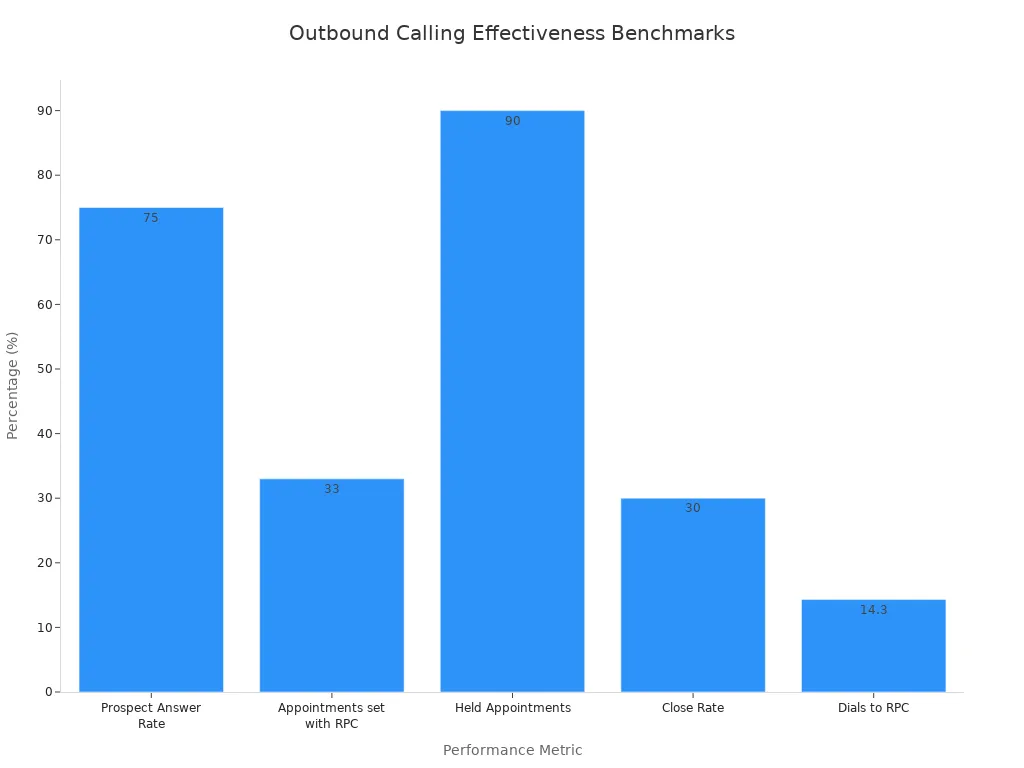
If you need to fill your sales pipeline and drive revenue, a dedicated outbound call center is a powerful choice.
Why a Blended Model Offers the Best of Both
For many businesses, the choice is not simply inbound or outbound. A blended model combines both functions, offering maximum flexibility and efficiency. Your agents can switch between handling inbound calls and making outbound calls based on real-time needs. This ensures your team is always productive. When inbound call volume is low, agents can work on a call outbound campaign. When call volume surges, outbound agents can help handle the queue.
This adaptability is crucial for companies with complex needs. For example, Weee!, America's largest online Asian supermarket, needed a flexible voice solution. They had to manage complex inbound support across different languages and time zones. By implementing a modern solution, they improved agent efficiency by 20% and cut resolution time in half.
A unified platform is the key to making a blended model work. Sobot's Omnichannel Solution helps you manage both inbound and outbound tasks seamlessly from a single workspace. This integration can increase agent efficiency by up to 20-30%. Your team no longer wastes time switching between different systems. Instead, they have all the tools and customer information they need in one place. This approach optimizes your workforce, reduces agent idle time, and improves both the customer experience and your bottom line.
Leveraging a Modern Call Center Platform
Modern call center platforms give you the power to manage both inbound and outbound communication from one place. Instead of using separate tools, you can use a single solution like Sobot's Voice/Call Center to support all your business goals. This approach streamlines operations for both customer support and sales-focused outbound call centers.
Unifying Workflows with Sobot

You can make your team more efficient with a unified platform. Sobot provides a Unified Workspace where agents see all customer information and conversations in a single view. This eliminates the need to switch between different applications. Your agents can handle interactions more smoothly, which improves their productivity. The platform also helps you manage proactive outreach. You can use Bulk Outbound Task management to assign leads and automate your outbound calls, keeping your team focused and effective.
Leveraging AI and Voicebots for Efficiency
You can use artificial intelligence to improve your customer experience and reduce costs. Sobot’s platform includes powerful AI tools.
Key AI Features:
- Intelligent IVR: You can build smart call menus that guide customers to the right agent or department. This improves first-call resolution and provides 24/7 self-service options.
- AI-powered Voicebots: These bots can handle up to 80% of routine customer questions. This automation can cut customer service costs by 30% and frees your agents to focus on more complex problems.
These features help you deliver faster, more accurate service.
Ensuring Stability and Global Reach
Your call center must be reliable to maintain a positive customer experience. Sobot guarantees business continuity with a 99.99% uptime SLA. This level of stability means your system faces only minutes of potential downtime per month. For businesses expanding globally, Global Number Availability is essential. You can get local phone numbers in different countries, making it easier for international customers to reach you. This feature helps you build a local presence anywhere in the world, supporting both inbound and outbound call centers as you grow.
Your choice between inbound call centers and outbound call centers depends on your goals. An inbound call center excels at nurturing your current customers to improve the customer experience. An outbound call center is designed to create new opportunities through a proactive call outbound strategy. For maximum value, many businesses use a blended model with both inbound call centers and outbound call centers. The best outbound call centers and the top inbound call center use unified tools.
Analyze your objectives and see how an all-in-one platform can help your outbound call center and outbound call centers succeed. Embark on Your Contact Journey and explore the Sobot Voice page today.
FAQ
What is the best call center model for a small business?
Your best model depends on your goals. You should choose an inbound call center if you want to focus on customer support. You can use an outbound call center to actively find new customers. Many small businesses benefit from a blended model for maximum flexibility.
How does AI help both inbound and outbound call centers?
AI improves efficiency for both models. For inbound calls, AI-powered Voicebots answer common questions. For outbound calls, AI can help manage lead lists and automate tasks. This frees up your agents to handle more complex work, improving overall productivity and the customer experience.
Can I use the same agents for inbound and outbound calls?
Yes, you can use the same agents in a blended model. This approach maximizes productivity, as agents can switch tasks based on call volume. It requires a unified platform like Sobot that allows seamless management of both inbound call centers and outbound call centers.
How do I measure the success of my call center?
You measure success with different metrics for each model.
- Inbound: Track First Call Resolution (FCR) and customer satisfaction.
- Outbound: Focus on conversion rates and appointments set.
A modern platform provides analytics to track these key performance indicators easily.
See Also
Navigating Omnichannel Call Center Software: A Comprehensive Implementation Guide
Implementing Top-Tier Quality Management Practices for Your Call Center
Genesis Call Center Versus Genesys: A Detailed Comparison for Optimal Choice
Discovering The Top 10 Remote Call Center Employers For You
An In-Depth Review of AI-Powered Enterprise Call Center Solutions

