Inbound Call Center Service: What’s Next for Customer Experience


The future of inbound call center service brings rapid digital transformation, driven by AI, automation, and omnichannel strategies. Businesses see new trends in customer experience as cloud and remote work reshape the contact center. Strong growth continues in the global market, with AI and cloud-based contact center segments projected to soar:
| Market Segment | Base Year Value | Projected Value | Projection Year | CAGR (%) |
|---|---|---|---|---|
| Global Call Center AI Market | $1.6 billion (2022) | $4.1 billion | 2027 | 21.3 |
| Global Cloud-Based Contact Center | $14.5 billion (2021) | $82.43 billion | 2030 | 21.3 |
Emerging trends in digital transformation demand customer-focused solutions. Sobot AI and Sobot call center products lead the way, helping brands deliver seamless customer experience in a digital world.
AI and Automation Trends

AI-Driven Personalization
AI-driven personalization stands at the forefront of inbound call center service trends. Companies use AI to analyze customer data and deliver tailored experiences. Automated quality assurance evaluates every inbound call, improving agent coaching and performance. Businesses like Rick’s Custom Fencing & Decking increased call etiquette pass rates by 23% after implementing AI-driven QA. Renewal by Andersen saw a 47% rise in customer appointments and a 129% improvement in agents correctly assessing caller needs. AutoNation uses AI to record, transcribe, and score calls, providing real-time feedback that boosts service quality. AI features such as intelligent call routing and sentiment analysis help agents deliver personalized service, reduce wait times, and improve first-call resolution. By automating basic inquiries, AI allows human agents to focus on complex customer needs, enhancing satisfaction and loyalty.
- AI-powered systems evaluate 100% of inbound calls.
- Intelligent call routing and sentiment analysis enable personalized service.
- Chatbots handle simple queries, freeing agents for complex customer interactions.
Automation in Inbound Call Center Service
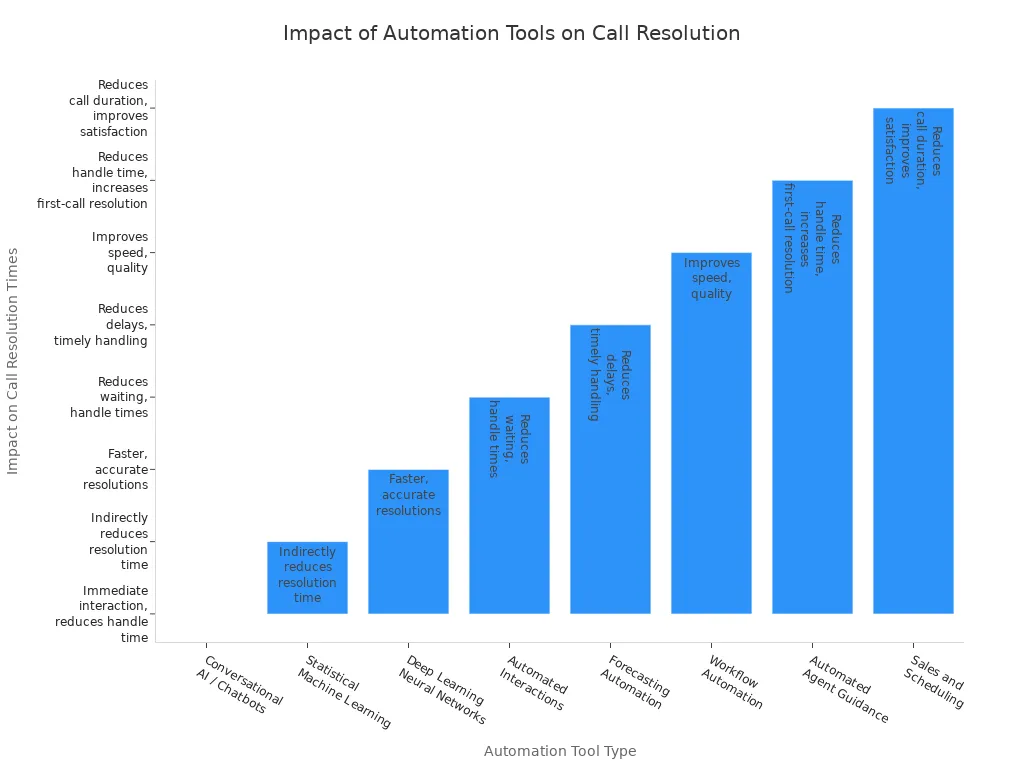
Automation transforms the contact center landscape. Companies deploy conversational AI, statistical machine learning, and workflow automation to streamline operations. These tools reduce average handle time and improve first-call resolution rates. Automated interactions, such as AI-powered IVR and robotic process automation, handle repetitive tasks and basic queries. Forecasting automation predicts call volumes, optimizing staffing and reducing delays. Workflow automation saves agent time, allowing focus on complex calls. Automated agent guidance connects customers to the right expert, improving resolution speed and quality.
| Automation Tool Type | Description and Functionality | Impact on Call Resolution Times and Service Efficiency |
|---|---|---|
| Conversational AI / Chatbots | Virtual agents using NLP for self-service tasks. | Reduces average handle time; improves first-call resolution. |
| Statistical Machine Learning | Analyzes interaction patterns and metrics. | Enhances productivity; reduces resolution times. |
| Deep Learning Neural Networks | Analyzes call recordings for insights. | Improves experience; aids faster resolutions. |
| Automated Interactions (AI IVR, RPA) | Self-service tools for repetitive tasks. | Reduces waiting and handle times. |
| Forecasting Automation | Predicts call volumes and optimizes staffing. | Ensures timely handling; reduces delays. |
| Workflow Automation | Automates data entry and follow-ups. | Saves time; improves resolution speed. |
| Automated Agent Guidance | Skill-based routing to connect customers to the right agent. | Reduces handle time; increases first-call resolution. |
| Sales and Scheduling Automation | Automates sales and appointment scheduling. | Streamlines workflows; improves satisfaction. |
Sobot Voice/Call Center AI Features
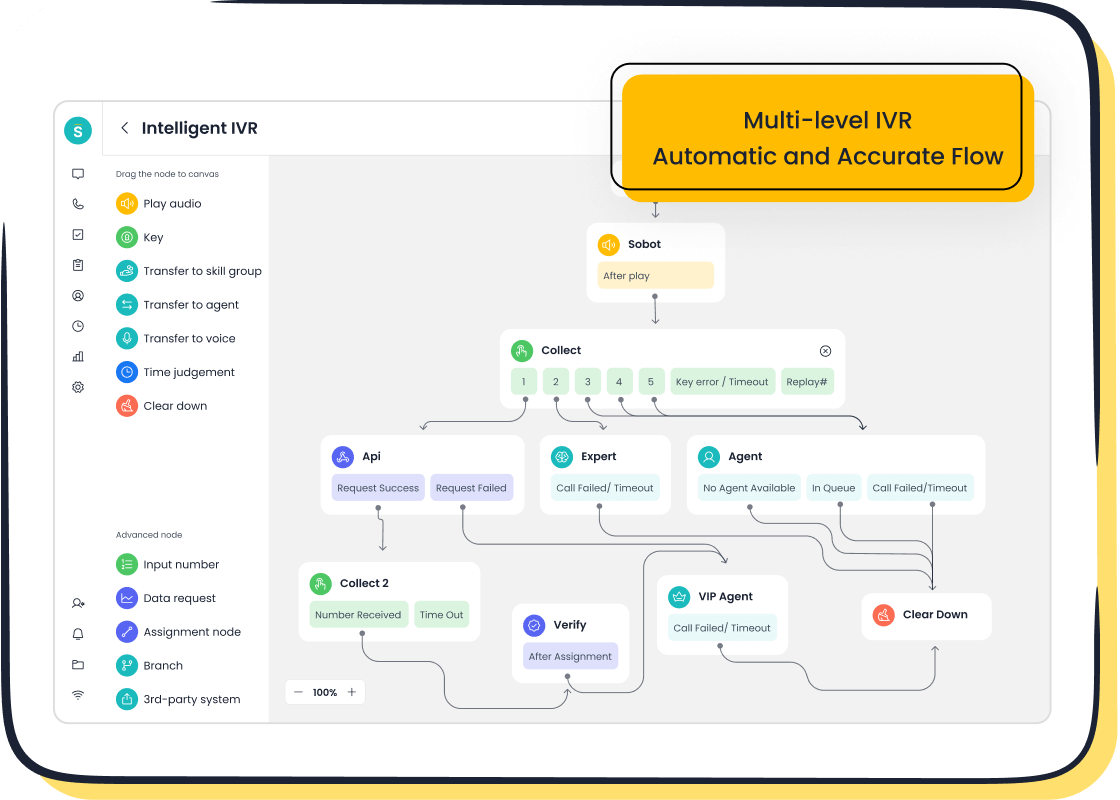
Sobot leads digital transformation in contact center trends with advanced AI and automation. The Sobot Cloud Call Center offers an AI-powered Voicebot for intelligent interaction and intent recognition. Intelligent IVR customizes greetings, builds menus, and routes calls to agents or teams. Workflow automation assigns leads based on priorities and SLAs, improving efficiency. Sobot’s unified workspace lets agents manage calls and customer information in one place. Real-time monitoring and analysis provide actionable insights, supporting personalized service and faster resolutions. Sobot’s stable system ensures 99.99% uptime and global support, making it a reliable choice for businesses seeking intelligent automation and digital transformation in inbound call center service.
Learn more about Sobot’s AI-powered solutions at Sobot Voice/Call Center.
Omnichannel Customer Experience
Unified Communication Channels
Modern contact center trends highlight the importance of omnichannel strategies in shaping the customer journey. Unified communication channels consolidate voice, video, social media, and messaging into a single system. Agents access accurate customer information quickly, which enables personalized interactions and consistent support. This integration streamlines workflows, allowing agents to handle calls, messages, and emails through one interface. The result is faster resolution times, improved customer satisfaction, and enhanced engagement. Messaging platforms like WhatsApp and Messenger cater to customer preferences, increasing engagement and enabling real-time support. Advanced analytics and reporting tools combined with unified communications further boost contact center performance and customer experience.
- Agents maintain context and deliver informed support.
- Centralized data reduces risks and improves efficiency.
- Unified platforms foster agility and adaptability in contact centers.
Sobot Omnichannel Solution
Sobot’s omnichannel solution stands out in digital transformation trends. The platform deploys AI-powered chatbots across websites, social media, and messaging apps, ensuring consistent customer engagement. Integration with CRM data allows agents to personalize interactions based on customer preferences and behavior. Predictive analytics models evaluate customer intent and forecast behaviors, helping prioritize leads and tailor recommendations. Advanced chatbot features include contextual understanding, sentiment analysis, and intent identification, which enable empathetic and effective responses. These components create seamless customer interactions, improving satisfaction, engagement, and loyalty. Companies like Microsoft Dynamics and Sephora have reported reductions in complaints and increases in sales due to AI-driven omnichannel solutions (source).
Enhancing Customer Experience
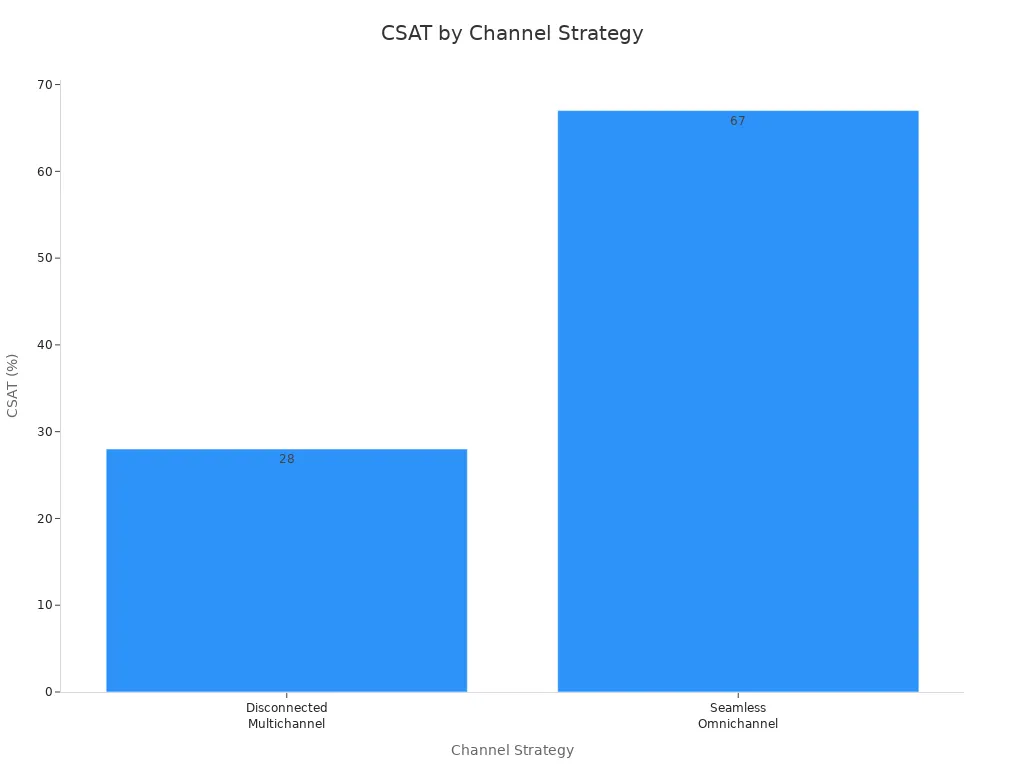
Omnichannel strategies drive measurable improvements in customer experience metrics. Contact center trends show that seamless omnichannel solutions increase customer satisfaction scores (CSAT), Net Promoter Scores (NPS), and customer retention. The following table demonstrates the impact:
| Metric | Disconnected Multichannel | Seamless Omnichannel | Improvement/Impact |
|---|---|---|---|
| Customer Satisfaction (CSAT) | 28% | 67% | 39 percentage points increase |
| Net Promoter Score (NPS) | N/A | +54% | Higher customer loyalty |
| Customer Engagement | N/A | +45% | More active interaction |
| Customer Retention | N/A | +35% | More customers retained |
| Customer Loyalty | N/A | +35% | Increased loyalty |
| Customer Lifetime Value (CLV) | N/A | +46% | Higher long-term value |
| First-Resolution Time | N/A | -31% | Faster problem resolution |
| Customer Wait Time | N/A | -39% | Reduced waiting improves experience |
Sobot’s omnichannel platform delivers seamless integration, a unified workspace, and improved CSAT. These benefits empower businesses to adapt to digital transformation and elevate every customer journey. Learn more about Sobot’s omnichannel solutions at Sobot Omnichannel Solution.
Real-Time Analytics and Insights
Data-Driven Decision Making
Contact center leaders now rely on real-time data to guide every decision. Data-driven insights help managers spot trends, track agent performance, and improve customer satisfaction. By monitoring live dashboards, supervisors can adjust staffing, identify bottlenecks, and respond to sudden spikes in call volume. This approach ensures that every customer receives timely and effective support. Data from call recordings, chat logs, and post-call surveys provides a clear view of what customers need. Managers use these insights to refine scripts, coach agents, and optimize workflows. As a result, contact centers become more agile and responsive to changing customer expectations.
Predictive Analytics in Contact Centers
Predictive analytics transforms how contact centers operate. By analyzing large volumes of data, teams can forecast call volumes, predict customer needs, and allocate resources more efficiently. The most common data sources for predictive analytics include:
- Metrics from customer interactions, such as average hold time, agent utilization rates, and call volume
- Speech analytics from call recordings and transcriptions, using natural language processing to assess sentiment and agent performance
- Text analytics from emails, texts, social media, and live chat, identifying areas for agent improvement
- Interaction analytics that aggregate data across multiple support channels for a comprehensive view of engagement
- Customer feedback from post-call surveys, measuring satisfaction and resolution effectiveness
- Reputation management software that gathers feedback from social media and review sites
These data-driven insights allow contact centers to anticipate issues, reduce wait times, and deliver a better customer experience. For more on predictive analytics in contact centers, see TechTarget's guide.
Sobot Monitoring and Analysis Tools
Sobot provides advanced monitoring and analysis tools that empower contact centers to harness real-time data. Supervisors track key metrics, analyze trends, and generate actionable reports. Sobot’s platform supports data-driven insights that drive continuous improvement. The following table highlights measurable outcomes achieved by using Sobot’s tools:
| Measurable Outcome | Achieved Value |
|---|---|
| Customer satisfaction rate | Over 95% |
| Reduction in inbound volume | Approximately 20% |
| Conversion rate lift | Approximately 38% |
These results show that Sobot’s monitoring and analysis tools help contact centers boost customer satisfaction, lower call volume, and increase conversions. Learn more about Sobot’s analytics capabilities at Sobot Voice/Call Center.
Remote and Hybrid Workforce
Cloud-Based Inbound Call Center Service
Cloud contact center solutions have transformed how inbound call center service teams operate. Cloud-based platforms allow agents to work from anywhere, using only a computer and internet connection. This flexibility supports both remote and hybrid work models. Recent surveys show that between 27% and 50% of American employees now work from home at least part of the time, and 58% have the opportunity to work remotely at least once per week (McKinsey). Cloud-based platforms offer several benefits:
- Agents can access systems from any location, reducing the need for physical office space.
- Integration with CRM and scheduling tools streamlines communication.
- Fast deployment and scalability help businesses adjust staffing quickly.
- Enhanced security features, such as encryption and compliance certifications, protect sensitive data.
- Lower costs result from reduced hardware and IT maintenance needs.
Cloud contact center platforms also provide reliable uptime and easy setup, improving the experience for both agents and customers.
Flexible Staffing Models
Flexible staffing models have become essential for modern cloud contact center operations. Data-driven forecasting aligns staffing with call volumes, preventing overstaffing and understaffing. Remote work models reduce facility expenses and open access to a wider talent pool. Cloud-based platforms support these models by enabling quick scaling up or down as demand changes. Advanced management tools, such as real-time feedback and skill-based routing, help boost agent productivity and service quality. These tactics lower operational costs while maintaining high standards for customer experience.
Sobot’s Global Support
Sobot delivers robust support for remote and hybrid call center teams worldwide. The platform uses multilingual AI prompts that detect a customer’s preferred language and channel, such as WhatsApp, SMS, or voice. Localized messaging and channel-ready scripts help agents connect with customers in their own language and style. Sobot’s AI-driven features improve first response time by up to 37% and speed up ticket resolution by about 52%. Safety and compliance controls, including continuous monitoring and human-in-the-loop checkpoints, ensure privacy and regulatory adherence. Sobot recommends a phased rollout plan for distributed teams, prioritizing bilingual channels and gradual AI expansion. These capabilities make Sobot a trusted partner for global cloud contact center operations.
Tip: Cloud-based platforms and remote work models help businesses stay agile and competitive in a changing world.
Security and Compliance Trends
Data Protection in Contact Centers
Security threats in the contact center industry continue to evolve as technology advances. Recent trends show attackers targeting voice-first AI systems with prompt injection attacks. These attacks manipulate AI agents into unauthorized actions, such as accessing sensitive data or modifying records. Voice interactions add complexity because real-time processing makes detection harder than in text-based systems. Organizations now adopt comprehensive AI security strategies to protect customer data. These strategies include real-time prompt injection detection, behavioral analysis of AI actions, and strict integration security boundaries. Continuous monitoring and staff training on AI security awareness have become standard. Companies also invest in platforms designed with security at their core to maintain operational resilience and customer trust. Proactive security measures help avoid costly breaches and regulatory fines (source).
- Real-time detection and filtering of prompt injections
- Behavioral analysis of AI agent actions
- Security boundaries for integrated systems
- Continuous monitoring and threat detection
- Staff training on AI security
Compliance in Inbound Call Center Service
Contact center operations must comply with a range of regulations across different countries. In the United States, the FTC and FCC enforce rules like TCPA and TSR, which set standards for telemarketing and protect consumer information. The European Union requires strict adherence to GDPR, focusing on opt-in consent and data protection. Japan’s APPI mandates clear disclosure of data usage and protection measures. Multinational contact centers must stay updated on changing regulations to avoid fines and legal risks. Compliance standards such as PCI DSS, GDPR, and TCPA require secure networks, encrypted storage, and regular audits. These standards ensure that customer data remains protected and that organizations maintain trust (source, source).
| Region | Key Regulation | Focus Area |
|---|---|---|
| United States | TCPA, TSR | Telemarketing, data privacy |
| European Union | GDPR | Consent, data protection |
| Japan | APPI | Data usage, disclosure |
Sobot’s Security Standards
Sobot prioritizes security and compliance in every contact center deployment. The platform uses encrypted data transfer, secure networks, and continuous monitoring to protect sensitive information. Sobot maintains certifications such as ISO27001 and SOC 2, demonstrating a commitment to global security standards. The company implements regular compliance audits and updates security protocols to address emerging threats. Sobot’s approach ensures that businesses can trust their contact center operations to meet the highest standards for data protection and regulatory compliance.
Human Touch in Digital Service

Empathy in Customer Experience
Empathy remains a cornerstone of customer experience, even as digital transformation accelerates. Research in telehealth and nursing shows that empathetic communication in virtual settings increases satisfaction, trust, and adherence to recommendations. Carl Rogers’ person-centered theory highlights empathy’s role in building trust and effective communication. In digital environments, empathy bridges the gap created by the lack of physical presence. Hojat’s empathy model divides empathy into cognitive, emotional, and behavioral components, which adapt well to digital platforms. Digital empathy theory emphasizes emotional engagement and responsiveness, helping overcome the limitations of non-verbal cues. Companies that prioritize empathy in customer interactions create authentic connections, leading to better outcomes and higher engagement.
Note: Empathic chatbots can improve social presence and information quality, but their effectiveness depends on context. Under time pressure, empathic responses may not always enhance the customer journey.
Balancing Automation and Human Agents
Digital transformation brings powerful automation tools to inbound call centers. Best practices recommend using self-service options like IVRs, AI chatbots, and knowledge bases for routine inquiries. These tools provide 24/7 availability and reduce wait times. When customer needs exceed automation’s capabilities, intelligent routing ensures smooth escalation to human agents. Real-time monitoring through KPI dashboards allows agents to intervene when necessary, maintaining seamless customer engagement. Companies like Smile.CX demonstrate that integrating AI-driven automation with human expertise reduces operator handling time and improves customer satisfaction. Avoiding over-automation is critical, as customers expect personalized service for complex issues. Continuous AI training and agent adoption help maintain effectiveness and support a positive customer experience.
Training for Quality Interactions
Training equips agents to deliver high-quality customer interactions in digital environments. Companies invest in programs that teach active listening, emotional intelligence, and problem-solving skills. Role-playing exercises and feedback sessions help agents practice empathy and adapt to diverse customer needs. Ongoing training ensures agents stay updated on new digital tools and automation features. Supervisors use real-time analytics to identify areas for improvement and coach agents accordingly. Well-trained agents contribute to a smooth customer journey, fostering engagement and loyalty throughout every digital transformation.
- Key training areas:
- Active listening
- Emotional intelligence
- Digital tool proficiency
- Real-time feedback
Success Stories and Future Outlook
Sobot and Weee! Case Study
Sobot continues to drive future growth in the contact center industry by delivering innovative solutions. The partnership with Weee!, America's largest online Asian supermarket, highlights Sobot's impact on customer service. Weee! faced challenges with inflexible IVR systems and language barriers. Sobot provided a flexible IVR, multilingual support, and an integrated workbench. These features improved agent efficiency by 20% and reduced resolution time by 50%. Customer satisfaction reached 96%, showing the effectiveness of Sobot's approach (source). Sobot's contact center platform enabled Weee! to manage high volumes of orders and diverse customer needs. The case demonstrates how Sobot helps businesses adapt to changing contact center trends and achieve sustainable growth.
Future Contact Center Trends
Industry analysts predict several trends will shape the future of contact centers in 2025:
- AI and cloud-based solutions will lead technology growth and innovation.
- AI agents will handle simple tasks, allowing human agents to focus on complex and emotional interactions.
- Upskilling agents into professionals will enhance brand loyalty.
- Agents will receive real-time information for seamless customer interactions.
- Contact center platforms will become integrated, data-driven ecosystems.
- Proactive outreach powered by AI will improve customer experience and loyalty.
- Personalized and timely communications will increase satisfaction and reduce friction.
These trends reflect a shift toward smarter, more efficient contact centers. Companies must embrace these changes to remain competitive and foster future growth.
Preparing for 2025
Contact centers can prepare for future challenges and opportunities by following actionable steps:
- Improve agent engagement and retention with culture-first strategies and wellness programs.
- Conduct system audits before upgrading technology.
- Use API-based and pre-built integrations for faster adoption.
- Implement unified agent desktops for efficiency.
- Invest in agent training for new systems and workflows.
- Develop omnichannel platforms that integrate voice, email, chat, social media, and messaging apps.
- Add self-service options like chatbots and knowledge bases.
- Personalize customer interactions using history and data.
- Establish quality assurance with call monitoring and feedback.
- Leverage analytics platforms to measure performance and drive continuous improvement.
Contact center leaders who adopt these steps will position their organizations for future growth and success. Sobot's solutions support these strategies, helping businesses stay ahead of evolving contact center trends.
The future of inbound call center service depends on adopting AI, omnichannel platforms, analytics, and secure, flexible solutions. Companies see growth by using AI voicebots that handle over half of customer interactions and improve agent efficiency. Omnichannel AI connects chat, email, and voice, creating seamless customer experience. Analytics dashboards help teams optimize operations and drive continuous improvement. To stay ahead, businesses should invest in technology that supports customer needs, enables operational insight, and fuels growth.
Tip: Companies that embrace these trends position themselves for long-term customer loyalty and sustainable growth.
| Feature Category | Benefit Example |
|---|---|
| Omnichannel AI | Seamless customer experience across channels |
| Analytics | Operational insight and continuous improvement |
| Secure AI | Data privacy and global compliance |
FAQ
What is an inbound call center service?
An inbound call center service handles incoming customer calls. Agents answer questions, resolve issues, and provide support. Companies use inbound call centers to improve customer experience and build loyalty.
How does AI improve customer experience in inbound call centers?
AI analyzes customer data and automates routine tasks. Voicebots and chatbots answer simple questions quickly. AI-powered systems help agents deliver faster, more personalized service, which increases customer satisfaction.
Why is omnichannel important for inbound call center service?
Omnichannel platforms connect voice, chat, email, and social media. Agents see all customer interactions in one workspace. This unified approach creates a seamless customer experience and reduces wait times.
What makes Sobot’s inbound call center service unique?
Sobot uses AI-driven voicebots, intelligent IVR, and workflow automation. The platform supports omnichannel communication and real-time analytics. Sobot’s solutions help businesses increase efficiency and improve customer experience.
How does Sobot ensure data security in its call center solutions?
Sobot uses encrypted data transfer and continuous monitoring. The platform meets global compliance standards, such as ISO27001 and SOC 2. These measures protect customer information and maintain trust.

