In-House vs Outsourced Support The Right Choice

Choosing between in-house and outsourced customer support depends on a company's unique goals. The global market for outsourcing support is expanding rapidly, with projections showing it could reach USD 113.18 billion by 2030. This growth highlights why many businesses consider an outsourced model. The table below compares the in-house and outsourced approaches across key factors for a customer.
| Factor | In-House Support | Outsourced Support |
|---|---|---|
| Costs | Higher initial investment | Lower operational costs |
| Quality | Direct control over quality | Expertise from partners like Sobot |
| Scalability | Slower to scale | Excellent scalability |
| Brand Alignment | Stronger brand immersion | Can provide service to customers worldwide |
Core Differences: In-House vs. Outsourcing

Understanding the fundamental differences between in-house and outsourced models is the first step toward making an informed decision. Each approach has a distinct structure, set of responsibilities, and cost model. This choice impacts how a company delivers customer support and manages its brand.
Defining the In-House Support Team
An in-house support team consists of employees who work directly for your company. This model gives you complete control over hiring, training, and daily operations. The in-house customer support team becomes an integral part of your company culture. Their primary duties often include:
- Resolving product issues and providing technical assistance.
- Informing customers about company offerings and promotions.
- Conducting proactive outreach and monitoring social media.
- Handling complaints and referring complex issues to other departments.
- Collecting and analyzing customer feedback for improvements.
Building an in-house support team ensures deep product knowledge and brand alignment.
Defining Outsourced Customer Support
Outsourced customer support involves hiring a third-party company to handle customer interactions. This strategy allows businesses to leverage external expertise and infrastructure. Outsourcing is a flexible option for companies looking to scale quickly or provide 24/7 support. Common service models for outsourced customer support include:
- Pay-Per-Resolution: You pay only when an issue is successfully solved.
- Pay-Per-Hour: This model bills for an agent's time, regardless of the outcome.
- Fixed Price: A set monthly fee provides predictable costs for outsourcing.
This approach to customer support can significantly reduce operational overhead.
Side-by-Side Comparison Table
To simplify the choice, the table below summarizes the key differences between an in-house and an outsourced approach. It compares the two models across essential factors like cost, quality, and scalability, helping you see the trade-offs at a glance.
| Factor | In-House Support | Outsourced Support |
|---|---|---|
| Costs | Higher initial investment | Lower operational costs |
| Quality | Direct control over quality | Expertise from partners like Sobot |
| Scalability | Slower to scale | Excellent scalability |
| Brand Alignment | Stronger brand immersion | Can provide service to customers worldwide |
Choosing In-House Customer Service for Control
Opting for an in-house customer service model is a strategic decision centered on one key principle: control. Companies that prioritize direct oversight of their brand identity, service quality, and customer relationships often find this approach superior. An in-house team operates as a core part of the business, deeply integrated into its culture and mission. This structure provides unmatched authority over every aspect of the customer experience, from agent training to the technology they use.
Mastering Brand Voice and Culture
An in-house team lives and breathes the company’s culture every day. This immersion makes it easier for agents to embody the brand’s unique voice and values in every customer interaction. Engaged employees develop a deep understanding of how to meet customer needs. This connection has a measurable impact on business outcomes.
- Brands with high employee engagement see a 24% higher Net Promoter Score (NPS).
- A one-star increase in an employee's rating of their company can lead to a 1.3-point rise in customer satisfaction scores.
- Highly engaged brands also enjoy 12% greater customer advocacy.
Happy employees who care about their work deliver better results. For example, the meditation app Headspace successfully maintains its brand voice by embedding it directly into its quality assurance (QA) process. Both its in-house and outsourced agents are graded on their ability to reflect the brand’s authentic and simple style, ensuring a consistent experience for every customer. This shows how an in-house team can set the standard for brand consistency.
Handling Complex or Sensitive Issues
Some customer problems require a level of nuance and expertise that is difficult to replicate externally. An in-house team, with its deep product knowledge and direct access to internal experts, is uniquely positioned to manage these situations. These are not issues that generic templates can solve.
Note: Complex scenarios often involve sensitive data or require multi-step troubleshooting. An in-house team can navigate these challenges with greater security and accuracy.
Common examples of issues best handled by an in-house team include:
- Billing errors that involve multiple accounts or transactions.
- Healthcare-related inquiries where precision is critical.
- Disputes over financial services or insurance claims.
- Technical failures that demand advanced product knowledge.
An in-house customer support team can work directly with other departments, like finance or engineering, to resolve these complex issues efficiently. This direct line of communication shortens resolution times and improves customer trust.
Creating a Tight Product Feedback Loop
One of the most significant advantages of an in-house team is its ability to create a powerful product feedback loop. Agents on the front lines hear directly from customers about their pain points, feature requests, and general experiences. When this team is in-house, their insights can be channeled directly to the product and engineering departments.
Managers can gather valuable opinions from their teams to improve product quality. This internal process ensures that the company delivers the best possible version of its product. Businesses can structure this feedback loop using various tools and processes.
| Category | Description |
|---|---|
| Stages | Feedback is most active during the discovery and planning phases to shape what gets built. |
| Roles | Product managers lead the effort, while customer success, sales, and research teams help gather feedback. |
| Structure | Strong processes are supported by tools like idea management software, AI analysis, and roadmap integrations. |
Effective communication channels are essential. Teams often use shared Slack channels, dedicated email lists, or project management boards like JIRA or Trello to centralize feedback. This keeps everyone synchronized and ensures the customer’s voice influences development.
The True Cost of In-House Operations
While control is a major benefit, building an in-house customer service operation comes with significant costs. These expenses go far beyond agent salaries and represent one of the main customer service disadvantages of this model. Companies must account for a wide range of operational overhead.
The technology stack for in-house contact centers is a major investment. This includes communication platforms, CRM software, and quality assurance systems.
- Companies spend an average of $2,700 per agent on technology infrastructure alone.
- Ongoing maintenance and upgrades add another 15-20% to these technology costs each year.
Recruitment and training also contribute to the high cost of in-house contact centers. Onboarding a new agent for in-house contact centers costs around $4,000, with the figure rising in specialized industries. Agents need continuous training on new products, policy changes, and system updates. Furthermore, scaling in-house contact centers to meet fluctuating demand can be inefficient, potentially increasing operational costs by 18-24% compared to more flexible models. These customer service disadvantages make financial planning crucial for any business considering an in-house customer support model. The investment in in-house contact centers must align with the company's long-term goals and budget. Managing these expenses is key to running successful in-house contact centers.
Choosing Outsourced Customer Service for Efficiency
While in-house teams offer control, many businesses choose outsourced customer service for superior efficiency and strategic growth. Outsourcing allows companies to leverage external expertise, advanced technology, and global infrastructure. This approach transforms customer support from a cost center into a flexible, scalable asset. It is an effective way to improve customer service efficiency and expand market reach.
Provide Service to Customers Worldwide with 24/7 Coverage
Modern customers expect immediate assistance, regardless of their location or time zone. Outsourcing makes it possible to provide service to customers worldwide without interruption. Companies can adopt a "follow-the-sun" model. This global workflow passes customer issues between offices in different time zones. An issue can move from San Francisco to Paris to Sydney, ensuring continuous progress.
This model delivers significant customer service benefits.
- Constant Availability: Customers get instant support and never have to wait for office hours to open.
- Higher Productivity: Issues are worked on around the clock. This can reduce resolution times by up to 40% compared to a single-location team.
Many leading global brands use outsourcing to provide service to customers worldwide. For example, Google, Netflix, and Apple partner with outsourced contact centers to offer multilingual technical support and user assistance. This strategy ensures they can serve a global user base effectively. To make this work, teams use detailed documentation in shared systems and schedule brief overlap windows for smooth handoffs between shifts. This commitment to global coverage is a key reason businesses choose customer care outsourcing. An outsourcing partner helps companies provide service to customers worldwide.
Managing Rapid Growth and Demand Spikes
Rapid growth is exciting, but it can overwhelm an in-house support team. Outsourcing provides the agility needed to manage sudden increases in customer inquiries. An outsourcing partner can quickly deploy trained agents to handle product launches or seasonal demand spikes. This avoids the long delays associated with in-house hiring and training.
The impact of this scalability is significant. One e-commerce business grew its revenue from $2M to $8M. Its small in-house team was overwhelmed. By outsourcing, it deployed a 12-person team in just four weeks. This change reduced response times from 18 hours to 90 minutes. Another fintech company facing 400+ daily tickets used outsourced customer service to drop its response time to 38 minutes within 60 days.
Note: Failing to scale support quickly has consequences. Studies show 67% of customers will hang up if they cannot reach a real person. Every hour of delay in response time increases the probability of customer churn by 8%.
Outsourced contact centers offer a proven solution for scaling. The data below shows the average improvements companies see after moving to an outsourced model.
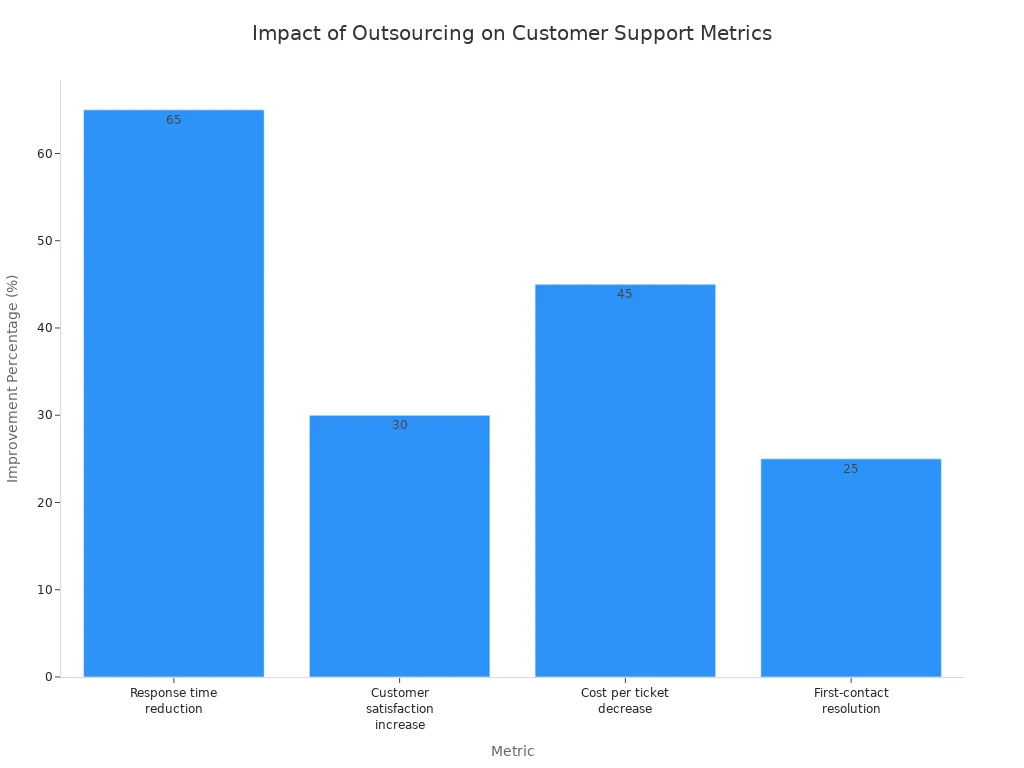
These metrics show how outsourced contact centers empower businesses to maintain high-quality support during periods of rapid expansion. This flexibility is one of the core customer service benefits of outsourcing.
Reducing Operational Overhead and Costs
One of the most compelling benefits of outsourcing is cost reduction. Building an in-house team requires significant capital investment in facilities, technology, and recruitment. Outsourced contact centers convert these large, fixed costs into predictable, variable expenses. Businesses pay only for the resources they need, which provides immediate budget relief.
The savings are substantial.
- Over 86% of companies report a reduction in customer service expenses after outsourcing.
- Businesses can save between 30% and 60% on operational costs.
- For companies with over 20 agents, outsourcing can reduce costs by an average of 52%.
This financial flexibility allows companies to reallocate capital to core business functions like product development and marketing. Outsourced contact centers already have the global infrastructure and management expertise in place. This eliminates the need for businesses to spend on real estate, server maintenance, and software licenses. By choosing customer care outsourcing, companies avoid these heavy upfront costs and gain long-term operational resilience. The ability to manage costs effectively is a major driver for adopting an outsourced customer service model.
Accessing Specialized Skills and Technology
Outsourcing offers more than just cost savings; it provides access to a deep pool of specialized talent and advanced technology. An outsourcing partner invests heavily in training agents on cultural nuances and communication skills, turning them into true brand ambassadors. This is especially valuable for companies looking to provide service to customers worldwide with multilingual support. Outsourced contact centers often have teams of linguists and culture-trained professionals ready to engage with a diverse customer base.
More importantly, top-tier outsourced contact centers provide access to cutting-edge technology that may be too expensive to develop in-house. This includes AI-powered chatbots, advanced analytics platforms, and integrated CRM tools. A prime example is OPPO, a leading smart device innovator.
Success Story: OPPO & Sobot Facing overwhelming inquiry volumes, OPPO partnered with Sobot to implement a human-machine cooperation model. By using Sobot's chatbot and ticketing system, OPPO automated responses to common questions. This freed human agents to handle more complex issues. The results were remarkable:
- 83% chatbot resolution rate
- 94% positive feedback rate
- 57% increase in repurchase rate
OPPO's success demonstrates the power of leveraging an outsourcing partner's technology. Instead of building an AI platform from scratch, they gained immediate access to a proven solution. This strategic move improved their customer service efficiency and delivered measurable business outcomes. The following table compares the trade-offs of building versus buying such technology.
| Feature | Outsourcing AI and Analytics Tools | In-House Development |
|---|---|---|
| Cost | Low initial costs, flexible pricing | High initial investment in talent and infrastructure |
| Expertise | Immediate access to specialized teams | Requires recruiting and training skilled professionals |
| Scalability | On-demand and rapid scaling | Difficult and expensive to scale quickly |
| Technology | Access to state-of-the-art platforms | Requires continuous investment to stay current |
For most companies, the decision is clear. Outsourced customer service provides a faster, more cost-effective path to deploying advanced tools and specialized skills. This is one of the most powerful customer service benefits available through outsourced contact centers. It allows businesses to provide service to customers worldwide with a high level of sophistication.
Key Factors to Guide Your Decision
Choosing the right support model requires a careful look at four key areas. A business must weigh its financial resources, brand identity, growth plans, and security needs. Analyzing these factors helps a company make a strategic choice that benefits both the business and its customers.
Financial Analysis: Budget vs. Cost Structure
A financial analysis goes beyond the initial price. Companies should compare the full cost of ownership. An in-house team has clear costs, but also hidden ones like management overhead and employee turnover. Outsourcing presents a different cost structure, often with variable fees. To make a clear comparison, businesses should track specific metrics.
- In-House Costs: Track overall expenses, including salaries, equipment, and training. Also, measure the time agents spend on each task to find inefficiencies.
- Outsourced Costs: Focus on cost per unit and the overall cost reduction percentage. It is also vital to watch for hidden fees related to contract changes or translation services.
This detailed view helps a company understand the true financial impact of each support model.
Quality and Control: Aligning with Brand Promise
Maintaining a high-quality customer experience is essential. An in-house team gives a company direct control over training and performance, which helps protect the brand promise. When outsourcing, a business must establish strong processes to ensure the partner delivers the desired quality. Effective strategies include:
- Create Thorough Brand Guidelines: Develop a detailed guide on brand voice, mission, and messaging.
- Implement Robust Training: Onboard the outsourced team with brand immersion and role-playing scenarios.
- Establish Quality Assurance: Regularly audit customer interactions and collect feedback to maintain a consistent customer service experience.
These steps help align the outsourced team with the company’s values and ensure a positive customer experience.
Scalability: Support Needs from Startup to Enterprise
A company's size and growth stage heavily influence its support needs. Startups often need to preserve capital and may prefer the low overhead of an outsourced partner. As a company grows, its requirements for scalability and flexibility change. Different business sizes have distinct needs.
| Company Size | Support Requirement |
|---|---|
| SMBs | Value low-risk offers and fast transactions. |
| Mid-market | Requires flexibility, automation, and reliable support. |
| Enterprises | Demands customization and multi-stakeholder alignment. |
Choosing a model with the right scalability ensures that the quality of customer support remains high during periods of rapid growth.
Data Security and Compliance
Outsourcing customer support introduces data security risks. Companies share sensitive customer information, such as account details or personal data, with a third party. This creates several potential problems.
- Exposure of Sensitive Data: The biggest risk is a data breach that exposes confidential information.
- Lack of Direct Control: A business depends on the vendor's security practices, which may not match its own.
- Insider Threats: A vendor's employees could intentionally or unintentionally compromise data.
Companies must ensure their partners comply with regulations like GDPR or HIPAA. A thorough review of a vendor's security protocols is critical to protect customer data and the company's reputation.
The Hybrid Model: A Best-of-Both-Worlds Strategy

The choice between in-house and outsourced support is not always black and white. A hybrid model offers a flexible strategy, combining the control of an in-house team with the efficiency of outsourcing. This approach allows a business to customize its support structure to meet specific needs. Companies can balance costs, quality, and scalability effectively.
Structuring a Hybrid Support Team
A successful hybrid model requires clear structure and communication. The goal is to create one cohesive customer service team. This means the in-house team and the outsourced team must work together seamlessly. Companies can establish clear protocols for communication and define which tools to use for specific tasks. Many leading companies use a hybrid approach to empower employees and improve collaboration.
| Company | Hybrid Model Description |
|---|---|
| Spotify | Allows employees to "work from anywhere" and provides stipends for home office or co-working spaces. |
| Implemented a model where most employees spend three days in the office and two days working remotely. |
To make this work, businesses focus on outcomes rather than hours worked. This ensures the in-house team and any partners are aligned. A strong in-house team can set the standard for the entire customer service team. The in-house support team works with the outsourced agents to ensure brand consistency. This structure helps the in-house team manage quality across all channels.
Tiered Support: Outsourcing Tier 1, In-Housing Tier 2/3
A popular hybrid strategy is tiered support. This model uses outsourcing for Tier 1 issues, which are simple, high-volume questions. The industry average for resolving issues on the first contact is around 70%. An outsourced partner can efficiently handle this volume.
This frees up the expert in-house team to manage complex Tier 2 and Tier 3 problems. These issues often require deep product knowledge or access to sensitive company data. This division of labor makes the entire support operation more efficient. The in-house team is not bogged down by repetitive questions, and customers with simple problems get fast answers through outsourcing.
Using Outsourcing for Off-Hours and Overflow
Outsourcing is an excellent solution for expanding support availability. A business can use an outsourced partner to provide 24/7 coverage. This ensures customers receive help outside of the in-house team's standard business hours. This approach improves customer satisfaction without the high cost of running an in-house, round-the-clock operation.
Additionally, outsourcing helps manage unexpected demand spikes. During a product launch or holiday season, an outsourced team can handle the overflow of inquiries. This prevents the in-house team from becoming overwhelmed and maintains short response times. This strategic use of outsourcing provides scalability when it is needed most.
Enhancing Your Support Model with the Right Tools
The success of any support model, whether in-house or through outsourcing, depends heavily on the tools agents use. A powerful platform like Sobot provides the technology needed to streamline workflows and improve performance. The right tools empower agents to deliver consistent, high-quality service regardless of their location. This makes the choice of technology a critical factor for any business focused on customer satisfaction.
Unifying Channels with Sobot's Omnichannel Solution
Customers expect to connect with a business on their preferred channel. Sobot's Omnichannel Solution unifies communications from live chat, email, voice, and social media into a single workspace. This integration is vital for both in-house and outsourced teams. It eliminates the need for agents to switch between different platforms.
AI-driven platforms like Sobot improve first-contact resolution by giving agents instant access to information. This technology also reduces average handling time by automating routine tasks. A unified approach ensures every agent has the full customer context, leading to faster and more effective support.
Empowering Agents with an AI-Enhanced Workspace
An AI-enhanced workspace boosts agent productivity and confidence. Sobot equips agents with tools that automate repetitive tasks and provide real-time guidance. This allows them to focus on solving complex customer problems. This level of support is crucial for maintaining quality in any outsourcing arrangement. The impact of these tools is significant.
| Benefit Description | Improvement Percentage |
|---|---|
| Less time spent searching | 20-30% |
| Fewer compliance-related mistakes | 50% |
| AHT reduction (automating routine tasks) | 30% |
These improvements help teams deliver better outcomes and enhance the overall customer experience.
Ensuring Stability with Sobot's 99.99% Uptime SLA
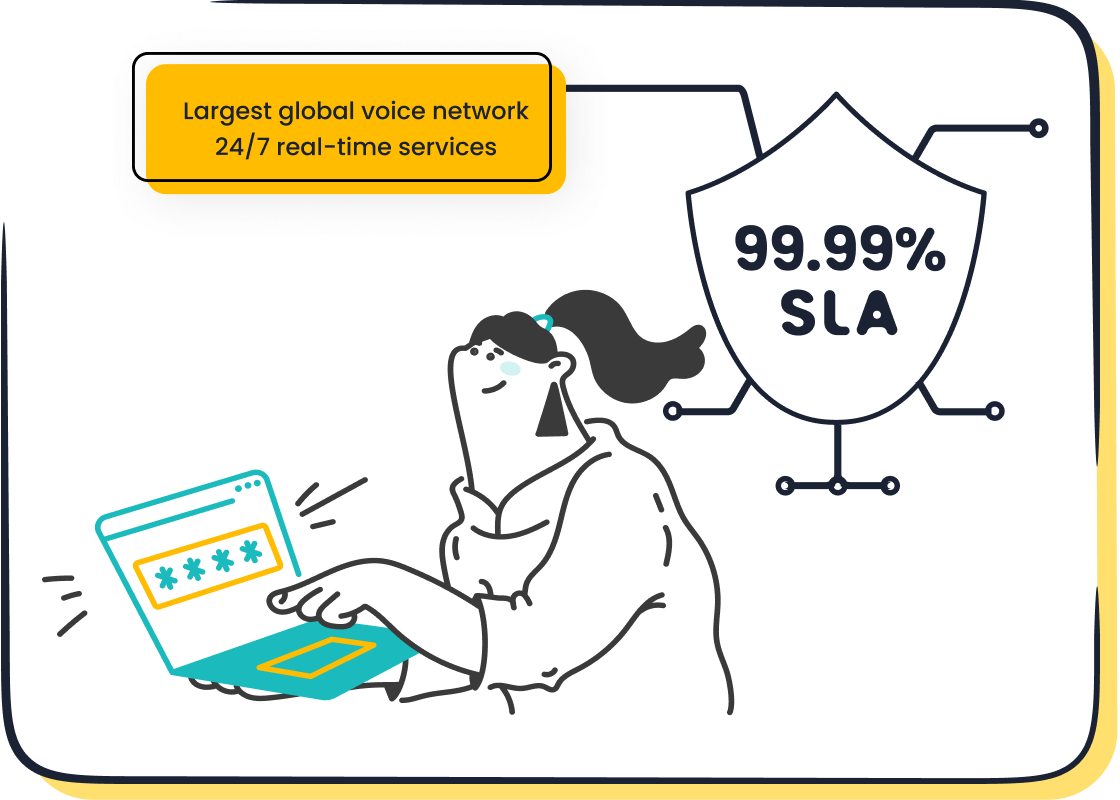
Reliability is non-negotiable in customer support. Sobot's Voice/Call Center guarantees 99.99% uptime, which means less than five minutes of potential downtime per month. This stability ensures customers can always reach a business. For companies using outsourcing, this SLA provides peace of mind that their partner can consistently deliver service. Features like an Intelligent IVR and Global Number Availability further enhance efficiency, routing customers to the right agent quickly. This commitment to stability protects brand reputation and customer loyalty.
Choosing the right support model is a strategic decision. The best approach depends on a company's unique goals for customer care. Businesses should consider their priorities before committing to an outsourcing strategy. This simple checklist can help guide the decision on outsourcing.
- How important is direct control over agent training? (1-5)
- What is the budget for customer support?
- How quickly does the company need to scale its support?
Ultimately, the right choice serves the customer best. A model with outsourcing can evolve as a business grows, and successful outsourcing requires a good partner.
FAQ
What is the main benefit of an in-house support team?
The primary benefit is control. A business directly manages hiring, training, and quality assurance. This ensures agents fully embody the brand's voice and culture, which is ideal for handling complex issues and protecting the brand promise.
When should a company choose to outsource support?
A company should outsource when it needs to scale quickly, provide 24/7 coverage, or reduce operational costs. Outsourcing offers flexibility to manage demand spikes and access specialized technology without a large upfront investment.
Can a business use both in-house and outsourced support?
Yes, this is called a hybrid model. A business can outsource simple, high-volume questions (Tier 1) and keep an expert in-house team for complex problems (Tier 2/3). This approach balances cost-efficiency with high-quality service.
How does technology help both support models?
The right tools improve efficiency for any team. An omnichannel platform like Sobot unifies all communication channels. This gives both in-house and outsourced agents a complete view of the customer, leading to faster and more consistent support.
See Also
Demystifying the Expenses of Outsourcing Live Chat Support Services
Elevate Your SaaS Customer Support Through Effective Live Chat Tactics
A Comprehensive Guide to Comparing Live Chat Support Service Costs
Exploring the Advantages and Disadvantages of Remote Call Center Operations
An In-Depth Look at AI-Powered Enterprise Call Center Solutions

