How to Measure Customer Retention with Simple Metrics

You need to track customer retention metrics to grow your business and keep your customers happy. Here are the key metrics you should know:
| Metric | Description |
|---|---|
| Customer Retention Rate (CRR) | Percentage of customers who remain active over a period. |
| Churn Rate | Percentage of customers who stop using the product or service over a period. |
| Repeat Purchase Ratio (RPR) | Percentage of customers who buy again within a set time frame. |
| Customer Lifetime Value (CLV) | Projected revenue from a customer over their entire lifetime with a business. |
| Net Promoter Score (NPS) | A measure of customer loyalty and satisfaction based on their likelihood to recommend the service. |
You can see big results by focusing on retention. Loyal customers are worth up to ten times their first purchase. Good service matters—66% of people leave if they do not get good support, even if they like the product. Sobot makes tracking customer retention metrics simple with real-time, AI-powered insights. Start using these metrics to improve customer satisfaction today. If you want to know how to measure customer retention, Sobot gives you the tools you need.
Retention Rate Metrics
How to Measure Customer Retention Rate
You need to know how to measure customer retention to understand your business’s health. The customer retention rate shows how many customers stay with you over time. You can use a simple formula to calculate this important metric:
| Variable | Description |
|---|---|
| E | Number of customers at the end of the period |
| N | Number of new customers added during the period |
| S | Number of customers at the start of the period |
| Formula | Customer Retention Rate = [(E - N) / S] x 100 |
| Example | If S = 500, E = 530, N = 80, then Retention Rate = 90% |
You should track user retention metrics regularly. Sobot’s contact center solutions, including chatbot, AI Agent, live chat, and voicebot, help you monitor these metrics in real time. You can see which customers return and which leave, making it easier to improve satisfaction.
Why Retention Rate Matters
Retention is a key driver of business success. Higher customer retention rates mean more loyal customers and better profits. For example, a 5% increase in retention can boost profits by 25% to 95%. Most companies get 65% of their revenue from existing customers. Selling to retained customers is easier, with a 60-70% chance of success. You should compare your retention rate to industry benchmarks:
| Industry | Average Customer Retention Rate |
|---|---|
| eCommerce | 62% |
| Financial Services | 74% |
| Hotels & Hospitality | 55% |
| Manufacturing | 66% |
| Software Development | 82% |
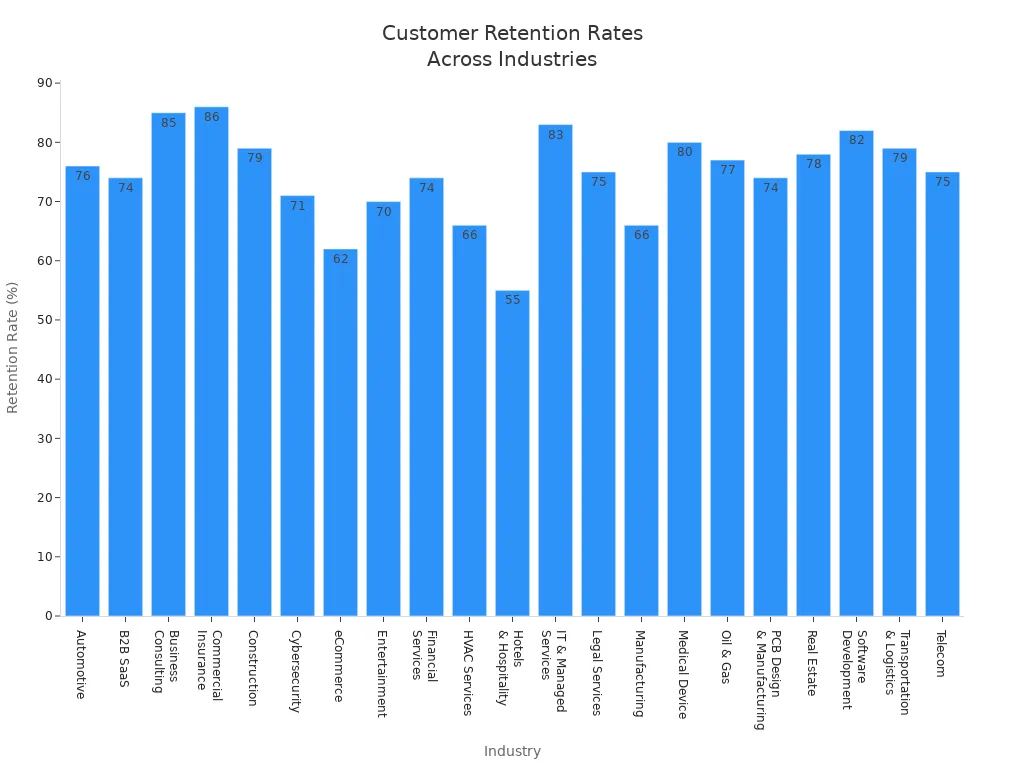
Retention rates vary by industry. You should use customer retention metrics to see if your business meets or exceeds these standards.
Sobot’s Approach to Retention Rate

Sobot’s Voice/Call Center gives you powerful tools to track user retention metrics. You get real-time call tracking, AI-powered voicebot, and unified workspace for agents. These features help you reduce response times and improve satisfaction. For example, AI can lower call abandonment rates by 33% and decrease resolution times by up to 52%. Sobot’s platform lets you see how to measure customer retention easily. You can use live chat, ticketing system, and chatbot to keep customers engaged and happy. Sobot helps you boost retention and build lasting relationships.
Tip: Use Sobot’s analytics to spot trends in customer retention rate and take action quickly.
Churn Rate Insights
Churn Rate Definition
You need to understand churn to improve customer retention rate. Churn rate shows how many customers leave your business during a set time. This metric helps you see if your retention strategies work. Here is what churn rate means:
- Churn rate measures the loss of customers over a defined period.
- You find churn by comparing the number of customers at the start and end of a period.
- The customer churn rate formula is:
[(Number of Customers at Start – Number of Customers at End) / Number of Customers at Start] x 100
Tracking customer churn rate helps you spot problems early. If you see a high churn, you know your retention needs work. You can use this metric to set goals and measure progress.
Calculating Churn Rate
You can calculate customer churn rate with a simple formula. This method works for most businesses, especially those with subscriptions. Here is a step-by-step example:
| Churn Rate Formula | Description |
|---|---|
| Annual Churn Rate = [(Number of Customers at Start of Year – Number of Customers at End of Year) / Number of Customers at Start of Year] x 100 | This formula shows the percentage of customers lost in a year. |
- Start with 100 customers at the beginning of the year.
- End with 80 customers at the end of the year.
- Customers lost: 100 - 80 = 20.
- Divide by the starting number: 20 / 100 = 0.2.
- Convert to a percentage: 0.2 x 100 = 20% annual customer churn rate.
You should track customer churn rate every month or quarter. This helps you react fast if you see a rise in churn. Lower churn means better customer retention and higher profits.
Reducing Churn with Sobot Solutions
You can lower customer churn rate by using the right tools. Sobot’s contact center solutions help you keep more customers and boost retention. Here is how Sobot helps:
- Sobot’s chatbot and AI Agent answer questions fast, so customers do not leave out of frustration.
- The live chat and voicebot give real-time support, which helps solve issues at the first contact. Studies show that 67% of customer churn could be avoided if you resolve problems right away.
- The ticketing system tracks every customer request, so nothing gets missed. This reduces churn and improves customer retention rate.
- Sobot’s call center and unified workspace let your team see all customer data in one place. This makes it easy to spot unhappy customers and act before they churn.
- Sobot’s analytics show trends in customer churn rate and revenue churn rate. You can use these metrics to improve your retention strategy.
Note: Acquiring a new customer costs seven times more than keeping an existing one. A 5% increase in retention can boost profits by 25% or more.
Sobot’s solutions help you reduce customer churn, increase customer retention, and grow your business. You can see the impact in your customer retention rate, customer churn rate, and revenue churn rate. Loyal customers can be worth up to ten times their first purchase. By lowering churn, you raise customer lifetime value and long-term revenue.
Repeat Purchase Rate
Measuring Repeat Purchases
You can measure repeat purchase rate to see how many customers come back to buy again. This metric gives you a clear view of customer loyalty and satisfaction. To calculate repeat purchase rate, use this formula:
Repeat Purchase Rate = (Number of Repeat Customers ÷ Total Number of Customers) × 100.
For example, if 200 out of 1,000 customers made more than one purchase in a month, your repeat purchase rate is 20%. This metric helps you track how well your retention strategies work. You should check this rate often to spot trends and improve your customer retention.
Impact on Customer Loyalty
Repeat purchase rate connects directly to customer loyalty. When you see a high repeat purchase rate, you know your customers trust your brand. Loyal customers spend more and return often. The table below shows how repeat purchase rate links to loyalty and business growth:
| Evidence | Description |
|---|---|
| Repeat Customer Rate | Shows your ability to build lasting customer relationships. |
| Revenue Generation | Stores with 40% repeat customers make 50% more revenue than those with 10%. |
| Purchase Behavior | After a first purchase, only 27% return, but after a third, over 54% return. |
| Personalization Impact | 60% of buyers become repeat customers after a personalized experience. |
| Loyalty Program Influence | 83% of shoppers say loyalty programs affect their repeat purchase decisions. |
You can see that customer loyalty grows as repeat purchase rate rises. Loyal customers also help with word-of-mouth marketing and boost your retention. They spend more over time, which increases your loyal customer rate and helps reduce churn.
Sobot’s Tools for Tracking Repeat Purchases
Sobot gives you powerful tools to track and increase repeat purchase rate. You can connect Sobot with e-commerce platforms like Shopify and Amazon. This lets you see all customer orders in one place. Sobot’s chatbot and AI Agent send instant updates about orders and shipping. These tools help you monitor every step of the customer journey and improve retention.
You can use Sobot’s abandoned cart recovery to send reminders and bring customers back. AI-driven product recommendations during live chat or voice calls encourage more purchases. Sobot’s analytics dashboard shows real-time metrics, including repeat purchase rate, loyal customer rate, and churn. You can spot trends and take action to improve customer loyalty.
Here are some ways to boost your repeat purchase rate and retention:
- Start a loyalty program with points or discounts for repeat buyers.
- Use Sobot’s data to personalize offers and messages.
- Give fast, helpful support with Sobot’s live chat, voicebot, and ticketing system.
When you use Sobot’s customer contact center, you make it easy to track loyal customer rate and retention. You can see which customers return, spot churn early, and build strong loyalty. This approach helps you grow your business and keep customers coming back.
Customer Lifetime Value
CLV Calculation Basics
You can measure customer lifetime value with a simple process. This metric helps you see how much revenue each customer brings to your business over time. Here is how you can calculate it:
- Find your average annual customer revenue. Divide your total gross annual sales by the number of unique customers in a year.
- Figure out the average customer lifespan. This is the average time a customer stays with your business.
- Multiply the average annual customer revenue by the average customer lifespan. This gives you the customer lifetime value.
You should use this formula to track customer lifetime value as part of your retention strategy. It helps you understand the long-term impact of your customer relationships and spot trends in repeat purchase rate.
Why CLV Is Important
Customer lifetime value shows you how much each customer is worth. This metric helps you make smart decisions about marketing and support. You can see why maximizing customer lifetime value matters by looking at these facts:
| Statistic | Description |
|---|---|
| 91% ROI | A strong Customer Success program can give you a 91% return on investment. |
| 65% Revenue | 65% of your revenue comes from existing customers. |
| 60-70% Probability | You have a 60-70% chance of selling to current customers, but only 5-20% for new ones. |
- Getting a new customer costs 5 to 25 times more than keeping one.
- A 5% increase in retention can boost profits by 25-95%.
You should focus on retention and repeat purchase rate to grow your profits. Loyal customers buy more often and stay longer, which increases customer lifetime value.
Enhancing CLV with Sobot’s Contact Center
Sobot’s contact center helps you improve customer lifetime value by supporting every step of the customer journey. You get tools that boost retention, reduce churn, and increase repeat purchase rate. Sobot uses AI-powered segmentation to group customers for targeted marketing. Journey orchestration lets you create custom paths for each customer. Hyper-personalization builds customer loyalty by sending the right message at the right time.
| Feature | Benefit |
|---|---|
| AI-Powered Segmentation | Targets the right customers to improve retention and repeat purchase rate. |
| Journey Orchestration | Guides customers through personalized experiences to increase customer lifetime value. |
| Hyper-Personalization | Builds customer loyalty and reduces churn with tailored campaigns. |
You can use Sobot’s analytics to track key metrics like customer lifetime value, retention, and repeat purchase rate. This helps you spot trends and take action quickly. Sobot’s unified workspace makes it easy for your team to deliver great service, which keeps customers coming back and raises your customer lifetime value.
Tip: Focus on retention and repeat purchase rate to see the biggest gains in customer lifetime value.
Net Promoter Score (NPS)
NPS and Retention
You can use Net Promoter Score to measure how satisfied your customers feel and how likely they are to stay. NPS connects directly to retention. When you see a high NPS, you know your customers are happy and will probably stick with your business. Studies show that companies with high NPS often have lower churn and higher retention. For example:
- The NPS formula is % promoters minus % detractors. A high score means strong customer satisfaction and higher retention.
- ICON has an NPS of 70, much higher than the industry average of 44, and reports a customer retention rate of 98.8%.
- Companies that listen to customer feedback and improve their NPS see better retention and stronger customer loyalty.
You should track NPS as one of your key metrics for retention. This helps you spot trends and take action to keep customers happy.
How to Measure NPS
You can measure NPS with a simple survey. Ask your customers, “On a scale of 0-10, how likely are you to recommend our business to a friend or colleague?” Then, group the responses:
- Promoters (9-10)
- Passives (7-8)
- Detractors (0-6)
Calculate NPS using this formula:
Net Promoter Score = % promoters - % detractors
For example, if 60% of your customers are promoters and 15% are detractors, your NPS is 45. Passives do not count toward the score, but their feedback helps you improve retention and customer loyalty.
Using Sobot to Improve NPS
You can boost your NPS with Sobot’s solutions. Sobot’s chatbot, AI Agent, live chat, call center, voicebot, ticketing system, and customer contact center help you deliver fast, helpful service. Advanced Natural Language Processing and Omnichannel Support let you respond quickly and solve problems. Sobot’s platform adapts and learns, so your team gets better at meeting customer needs. For example, Samsung used Sobot’s contact center to unify communication channels and saw a 97% customer satisfaction rate. You can use Sobot’s analytics to track NPS and other metrics for retention. When you improve service, you raise NPS, boost retention, and build customer loyalty.
Tip: Use Sobot’s tools to collect feedback and act on it. This helps you keep customers happy and increase retention.
Applying Retention Metrics
Tracking Over Time
You need to track retention metrics regularly to see how your business grows. Start by setting clear retention goals that match your industry and customer behaviors. Choose metrics like retention rate, churn rate, repeat purchase ratio, and customer lifetime value. Compare your numbers to industry benchmarks to understand your progress. Use Sobot’s platform to centralize customer interactions and purchase history. Integrate data from CRM, analytics, and ad platforms into one workspace. This helps you spot trends and identify what drives retention. Set a schedule for monitoring, such as monthly or quarterly, based on your business type. Sobot’s real-time analytics let you track sentiment metrics like NPS and get instant feedback from customers.
Tip: Automate reporting with Sobot to get real-time updates on retention metrics. This saves time and helps you react quickly.
Interpreting Results
You must interpret retention metrics to make smart decisions. Look at key metrics in Sobot’s dashboard, such as churn rate, retention rate, customer lifetime value, and repeat purchase rate. Use cohort analysis to group customers and see how retention changes over time. Analyze feedback from surveys and direct channels to understand why customers stay or leave. The table below shows how to interpret common metrics:
| Metric | Description | Calculation Method |
|---|---|---|
| Churn Rate | Percentage of customers lost | Start vs. end customer count |
| Retention Rate | Percentage of customers kept | Cohort analysis for repeat customers |
| Customer Lifetime Value | Revenue from each customer over time | Average order value x frequency x lifespan |
| Customer Feedback Mechanisms | Insights from surveys and feedback | Surveys, direct feedback channels |
You can use Sobot’s unified workspace to combine quantitative data with qualitative insights. This gives you a full picture of retention trends.
Actionable Steps with Sobot
You can improve retention by acting on metric analysis. Sobot’s platform lets you personalize customer experiences with tailored communication and product recommendations. Segment customers based on behavior and demographics to target groups with relevant offers. Launch loyalty programs using Sobot’s tools to reward repeat customers. Monitor key retention metrics to find areas for improvement. Analyze churn reasons and adjust your strategy. Use AI-powered analytics to gain deeper insights into customer preferences. Proactive support helps you address issues before they lead to churn. Sobot’s automation and real-time data make it easy to optimize retention strategies.
Note: The top 10% of loyal customers spend twice as much per order as others. Personalizing retention efforts boosts customer satisfaction and loyalty.
You need to monitor customer retention to grow your business and keep customers loyal. Retaining customers costs less than finding new ones and helps you build steady revenue. Tracking simple metrics like retention rate, churn, and customer lifetime value gives you clear insights into loyalty and engagement. Sobot’s platform makes it easy to track these metrics and act fast. To get started, set clear goals, use the right tools, train your team, review your retention data often, and work together across departments. Simple steps help you turn customer retention into business growth.
FAQ
What is the most important metric for measuring retention?
You should focus on retention rate. This metric shows how many people stay with your business over time. It helps you see if your efforts to keep users are working.
How often should I check my retention metrics?
You should check your metrics every month. Regular tracking helps you spot changes early. This way, you can act fast if you see a drop in retention.
Can Sobot help me track customer retention?
Yes. Sobot gives you real-time tools to track retention, churn, and repeat purchases. You can see all your data in one place and make smart decisions.
Why do customers leave a business?
People leave for many reasons. Poor service, slow support, or lack of value can cause them to go. You should listen to feedback and fix problems quickly.
How can I improve retention quickly?
You can improve retention by giving fast support, personalizing messages, and rewarding loyal users. Use tools like Sobot to automate follow-ups and track results.
See Also
Enhancing Call Center Efficiency Through Effective Monitoring
Ten Strategies to Improve Customer Satisfaction in Live Chat
Comparative Analysis of Leading Voice of Customer Tools
Excelling at Live Chat Within the Retail Sector
Best Practices for Effective Quality Management in Call Centers

