Guide to Improving Customer Service in Call Centers 2025


Customer experience shapes every contact center interaction in 2025. Companies now face higher expectations, with metrics like CSAT and Net Promoter Score defining success.
- Nearly 80% of customers want short wait times, yet only 60% experience them.
- 66% of consumers value accurate resolution over speed.
- 40% may switch brands after one poor service experience.
Sobot AI transforms the contact center experience by combining advanced automation with human understanding. Sobot call center solutions deliver efficient, personal, and secure service across channels. Leaders now ask how to improve customer service in a call center to keep up with these changes.
Customer Experience Matters
Defining Customer Experience
Customer experience in call centers shapes how people feel about a brand at every step of the customer journey. It covers all interactions between customers and support teams, including phone calls, SMS, chat, email, and automated systems. Each touchpoint leaves an impression, whether a customer asks about an order, requests technical support, or uses self-service options.
- Customers form opinions based on how quickly agents respond and how well they resolve issues.
- The variety of channels, from phone to chat, gives customers more ways to connect.
- Seamless service across channels builds trust and reduces frustration.
- Consistency matters. Customers expect not to repeat information or face delays.
- A strong customer experience also depends on agent training, the quality of communication, and the tools agents use.
Customer journey mapping helps companies see every interaction from the customer’s point of view. By understanding the full customer journey, organizations can identify pain points and improve each stage. Customer journey mapping also supports better engagement and helps teams deliver a unified experience.
Why It Drives Success
Customer experience drives the success of call centers by shaping satisfaction, loyalty, and business results. When agents receive ongoing training and support, they deliver better service and create positive moments along the customer journey. Engaged employees feel motivated, which leads to higher-quality interactions and lower turnover.
Customer journey mapping allows leaders to spot gaps and make improvements that matter most to customers. Regular feedback and quality monitoring help teams adjust quickly and keep service levels high. Effective engagement and communication within the team ensure everyone works toward the same goals.
Research shows that companies with strong customer experience see higher returns. Over half of customers leave after two poor experiences, but those who feel valued stay longer and spend more. Real-time feedback and omnichannel visibility help teams act fast, strengthen relationships, and grow revenue. Customer experience is not just a goal—it is the foundation of a successful call center.
How to Improve Customer Service in a Call Center
Building a Customer-Centric Culture
A customer-centric culture forms the backbone of every successful call center. Leaders set the tone by prioritizing customer satisfaction and modeling customer-first values. They celebrate team achievements and ensure every agent understands their role in delivering customer service excellence. This approach builds trust and loyalty, which leads to long-term business growth.
Tip: Leadership commitment, employee engagement, and continuous improvement are essential for a customer-centric environment.
To build this culture, organizations should:
- Engage employees by empowering them to make decisions that benefit customers.
- Integrate customer feedback into daily operations and use it to guide improvement.
- Map the customer journey to identify pain points and opportunities for better customer interactions.
- Invest in technology, such as Sobot’s Voice/Call Center, to personalize and streamline the contact center experience.
Sobot’s unified workspace allows agents to access customer data and history in real time. This feature helps agents tailor their responses, creating a seamless and personalized experience. Companies like Samsung have achieved a 97% customer satisfaction rate by integrating all communication channels into a single platform, which demonstrates the power of a customer-centric approach.
A customer-centric culture also relies on continuous training. Agents need regular coaching in empathy, communication, and problem-solving. Sobot’s platform supports this by providing easy access to knowledge bases and real-time analytics, which help agents deliver consistent and high-quality service.
“The most important thing in a company is listening to the people on the front lines. It’s a disservice to the company if you create a space where people don’t feel safe sharing their ideas.”
— Melina McPhee, Manager of Global Customer Care at Estee Lauder
Empowering Agents
Empowered agents drive improvement in call center customer service. When agents feel confident and supported, they deliver better customer interactions and resolve issues more efficiently. Research shows a strong link between happy employees and satisfied customers. Companies that invest in agent well-being see higher engagement and improved business outcomes.
Key strategies for empowering agents include:
- Establishing feedback channels and regular one-on-one meetings to gather agent insights.
- Implementing recognition programs and transparent feedback loops to foster continuous improvement.
- Providing ongoing training and access to knowledge management tools to reduce hold times and improve first call resolution.
- Allowing agents to contribute to knowledge bases and service enhancements.
- Integrating AI and CRM technologies, such as Sobot’s intelligent IVR and unified workspace, to personalize customer interactions and predict needs.
Sobot’s Voice/Call Center empowers agents with features like smart call routing, AI-powered voicebots, and real-time monitoring. These tools reduce agent effort and allow them to focus on meaningful customer interactions. For example, Weee!, America’s largest online Asian supermarket, faced challenges with inflexible IVR systems and language barriers. By implementing Sobot’s flexible IVR and multilingual support, Weee! increased agent efficiency by 20% and reduced resolution time by 50%. The customer satisfaction score reached 96%, showing the impact of agent empowerment on the contact center experience.
Empowered agents gain confidence in problem-solving and provide long-term solutions, which reassures customers and builds loyalty.
Organizations should also support agent well-being through wellness programs, professional development, and flexible work arrangements. Sobot’s cloud-based platform enables remote work, ensuring agents stay motivated and connected. Regular coaching and transparent communication between agents and managers foster a positive work environment and reduce burnout.
- Share customer success stories to reinforce the positive impact of agents’ work.
- Provide direct feedback loops so agents see the results of their efforts.
- Focus metrics on customer outcomes, not just call handling efficiency.
- Allow agents to follow up with customers they previously helped to strengthen connections.
These strategies align agent behavior with business goals and improve key metrics like first call resolution and customer satisfaction.
Training for Empathy
Empathy stands at the heart of every great contact center experience. Agents who understand and share customers’ feelings create meaningful connections and resolve issues with care. Training for empathy involves structured exercises, real-world scenarios, and continuous reinforcement.
| Training Technique | Description |
|---|---|
| Active Listening | Focus fully on the customer’s words, tone, and language; respond with affirmations and paraphrasing. |
| Personalize Customer Interactions | Use customer data and insights to tailor conversations and offer unique solutions. |
| Ask Probing Questions | Encourage curiosity by asking follow-up questions to understand the customer’s situation deeply. |
| Approach Issues from Customer's Perspective | Set aside biases and try to see the problem through the customer’s eyes. |
| Replace Language Triggers | Use empathetic alternatives instead of words that may seem dismissive. |
Agents should practice active listening, maintain a positive tone, and avoid taking negative emotions personally. Sobot’s unified workspace and AI-powered tools help agents access customer history and context, making it easier to personalize interactions and show empathy.
Effective empathy training includes:
- Practicing empathy statements and using realistic customer scenarios.
- Integrating empathy into daily workflows, such as team meetings and coaching sessions.
- Measuring empathy through observable behaviors, emotional tone analysis, and customer feedback.
Companies that invest in empathy training report significant improvements in customer satisfaction, employee retention, and customer lifetime value. Sobot’s platform supports these efforts by providing real-time analytics and feedback, helping agents continuously improve their skills.
Customer Service Tip: Teach agents to manage difficult emotions by acknowledging feelings and refocusing the conversation. This approach reduces escalation and builds rapport.
Weee!’s story highlights the value of empathy in action. With Sobot’s multilingual templates and time zone support, agents could better understand and address the needs of a diverse customer base. This led to faster resolutions and higher satisfaction, proving that empathy is a measurable business capability.
How to Improve Customer Service in a Call Center: Practical Steps
Organizations seeking improvement in call center customer service should focus on these practical steps:
- Build a customer-centric culture by engaging employees, integrating feedback, and investing in technology.
- Empower agents with training, recognition, and the right tools, such as Sobot’s Voice/Call Center features.
- Train agents in empathy using structured exercises, real-world scenarios, and continuous feedback.
- Use unified workspaces and AI-driven automation to streamline customer interactions and reduce agent workload.
- Monitor key metrics and act on customer feedback to drive continuous improvement.
Sobot’s solutions have helped companies achieve measurable results, such as a 30% increase in customer satisfaction scores and a 35% boost in Net Promoter Score. By unifying communication channels and providing agents with advanced tools, Sobot enables organizations to deliver customer service excellence and build lasting trust.
Rigorously test for quality assurance, provide self-service options, and maintain a centralized knowledge base to empower both agents and customers.
The journey to outstanding call center customer service requires commitment, innovation, and a focus on people. By following these strategies and leveraging advanced solutions like Sobot, organizations can transform the contact center experience and achieve sustainable improvement.
Omnichannel Call Center Customer Service
Unified Workspaces
Unified workspaces transform the contact center experience by bringing all customer interactions and support tools into a single interface. Agents no longer need to switch between multiple applications. They can view customer history, tickets, and communication channels in one place. This setup allows agents to access order details and past conversations instantly, which reduces errors and speeds up resolutions. Real-time access to customer data supports personalization, making each interaction more relevant and effective. Unified workspaces also help agents stay focused and reduce burnout, leading to higher productivity and better customer satisfaction. Customers benefit from faster, more accurate, and personalized service, which builds loyalty and trust.
Seamless Channel Integration
Seamless channel integration is essential for modern call center customer service. It connects voice, chat, email, and social media into one system. Agents use a single dashboard to manage all customer communication, which improves response times and service quality. Best practices include starting with a channel audit, using a unified customer data platform, and training agents to handle multiple channels. Companies that integrate channels well see higher first-contact resolution rates and lower handling times. Customers enjoy a consistent experience and do not need to repeat information, which enhances the overall contact center experience.
Omnichannel strategies can increase customer satisfaction by up to 30% and reduce average handling time.
Sobot Omnichannel Solution
Sobot’s omnichannel solution stands out in the contact center experience. It offers seamless integration across websites, mobile apps, social media, email, phone, and SMS. AI-powered voicebots handle both inbound and outbound calls, providing 24/7 automated customer service. Multilingual support enables global engagement, while the intelligent knowledge base ensures accurate, AI-powered responses. Sobot’s no-code implementation makes adoption easy for any team. Advanced analytics and unified information across all channels help businesses deliver personalized service and optimize customer interactions. These features empower agents, reduce workload, and ensure a smooth, consistent customer journey. Learn more about Sobot’s omnichannel solution at Sobot Omnichannel.
Technology for Better Customer Experience
AI and Automation
Artificial intelligence and automation have transformed the way call centers deliver customer experience. AI-powered chatbots and virtual assistants answer routine questions at any time, reducing wait times and allowing agents to focus on complex issues. Intelligent call routing uses AI to analyze caller intent and history, connecting customers to the right agent for faster resolutions. Real-time agent assistance tools, such as sentiment analysis and knowledge bases, help agents respond with accuracy and empathy. Generative AI suggests responses and automates call summaries, boosting productivity and satisfaction. AI-driven quality assurance tools monitor calls, flagging performance issues and supporting targeted coaching. Predictive analytics forecast call volumes and customer behavior, helping managers plan resources efficiently.
Gartner predicts that by 2029, agentic AI will resolve 80% of common customer service issues without human help (Gartner Prediction on Agentic AI). Automation brings measurable benefits:
- Customer satisfaction scores increase by 15-25% after automation.
- First call resolution rates rise to 85-90%.
- Average handling time drops due to AI-powered suggestions.
- 24/7 support ensures immediate engagement.
- Automation reduces agent burnout and improves retention.
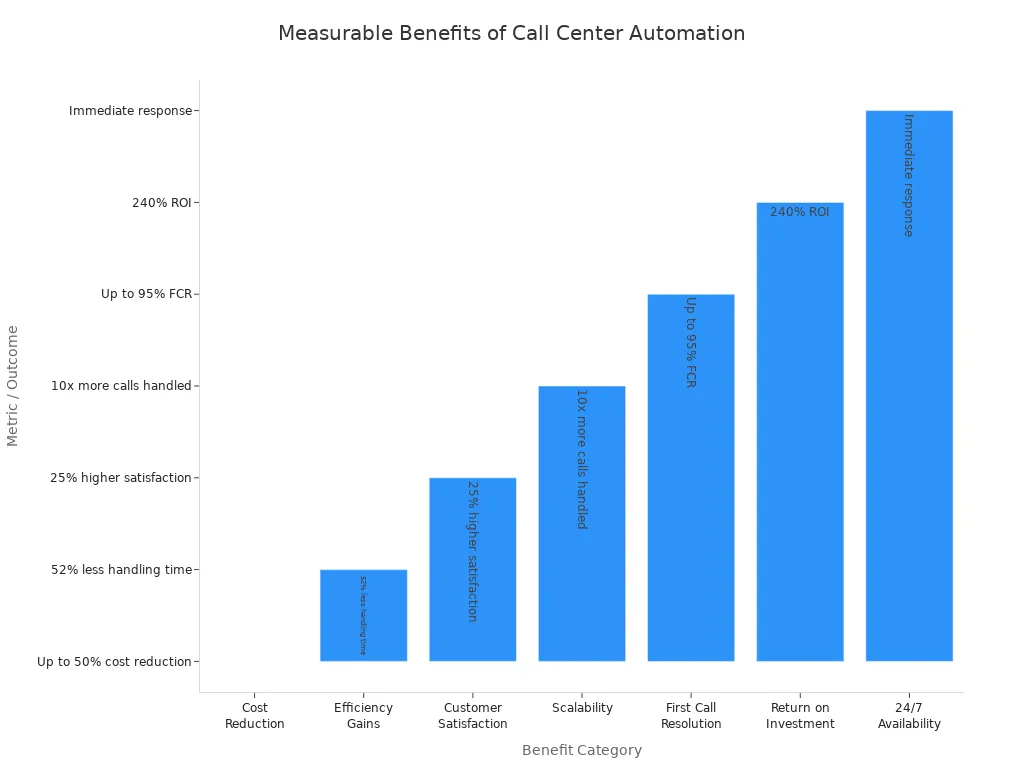
| Benefit Category | Measurable Metric / Outcome |
|---|---|
| Cost Reduction | Up to 50% reduction in operational costs |
| Efficiency Gains | 52% reduction in task handling time |
| Customer Satisfaction | 25% improvement in customer satisfaction scores |
| Scalability | 10x more calls handled during peak periods |
| First Call Resolution | Up to 95% FCR, unlocking major annual savings |
| ROI | 240% ROI within months of deployment |
| 24/7 Availability | Immediate responses, global coverage |
Real-Time Analytics
Real-time analytics give call center managers instant access to key performance indicators such as call volume, wait times, and agent availability. Managers use these insights to optimize resource allocation and reduce inefficiencies. Real-time quality monitoring identifies customer frustrations and compliance issues, allowing for immediate corrective actions. Targeted training and coaching based on live data improve agent skills and confidence. These capabilities help call centers respond quickly to changing conditions and maintain high service quality. For example, real-time queue management enables dynamic staffing adjustments, reducing wait times and call abandonment. Sentiment detection helps agents tailor responses to customer emotions, improving interaction quality. Real-time analytics support proactive management and better decision-making, leading to improved customer experience.
Sobot Voice/Call Center
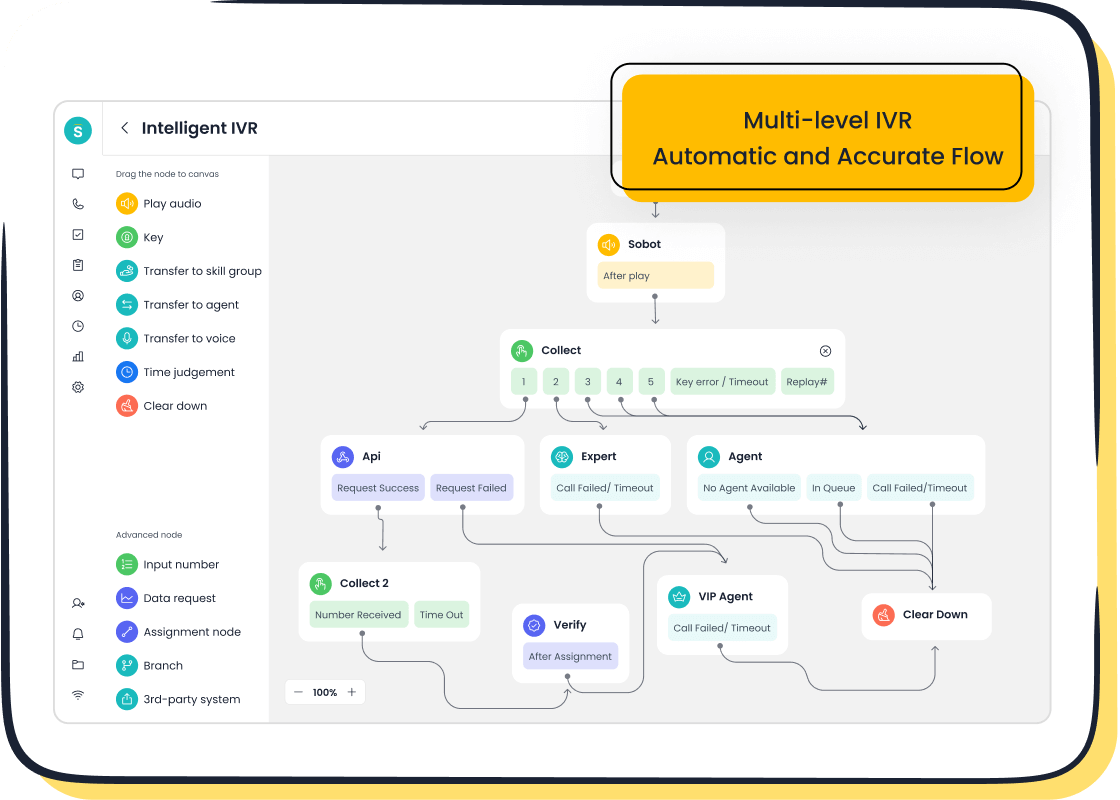
Sobot’s Voice/Call Center technology delivers advanced solutions for both inbound and outbound calls. The platform features intelligent IVR, smart call routing, and AI-powered voicebots for natural speech analysis. Agents benefit from a unified workspace that allows them to manage calls and collaborate internally. Real-time monitoring and analysis tools provide comprehensive reports and alert rules for call duration, keywords, and customer actions. Sobot integrates easily with CRM systems, enabling quick deployment and seamless workflow. The system offers high stability with 99.99% uptime and global phone number resources covering over 100 countries. Security features include encrypted data transfer and phone number masking to protect customer privacy. Sobot’s mobile app supports agents on Android and iOS, enabling calls on the go. Customer feedback highlights increased efficiency, improved Net Promoter Scores, reduced average handle time, and higher first-contact resolution rates. Sobot’s technology empowers agents to deliver personalized service and enhances personalization across every customer interaction, setting a new standard for customer experience in call centers.
Measuring and Enhancing Service

Key Metrics
Call centers rely on clear metrics to measure performance and guide improvement. These metrics help teams understand how well they support the customer journey and where to focus their efforts. Important metrics include:
- Customer Satisfaction (CSAT): Shows how happy customers feel after an interaction.
- Net Promoter Score (NPS): Measures loyalty and the chance customers will recommend the service.
- First-Call Resolution (FCR): Tracks if agents solve issues on the first contact.
- Average Handle Time (AHT): Measures the time spent on each call, including talk and follow-up.
- Service Level: Percentage of calls answered within a set time.
- Abandon Rate: Percentage of customers who hang up before reaching an agent.
- Cost Per Call (CPC): Shows the average cost to handle each call.
Tracking these metrics gives leaders a full view of the customer journey and supports customer journey mapping. Sobot’s analytics dashboard displays these metrics in real time, helping managers spot trends and act quickly.
Using Customer Feedback
Customer feedback drives improvement in every call center. Teams collect feedback through post-call surveys, direct agent questions, speech analytics, and social media monitoring. Sobot’s Insight & Analytics module gathers feedback from all channels and uses sentiment analysis to highlight areas needing attention. Managers can identify repeat issues, develop solutions, and check results using a structured feedback loop. Sharing feedback with agents and customers keeps everyone engaged and supports transparency. By acting on customer feedback, call centers improve service quality and enhance customer experience ratings.
Tip: Combine feedback from surveys, calls, and online reviews for a complete view of the customer journey.
Continuous Improvement
Continuous improvement ensures call centers adapt and grow. Teams use customer feedback and key metrics to guide training, update knowledge bases, and refine processes. Sobot’s real-time analytics and quality inspection tools help managers monitor compliance and agent performance. Automated sentiment scoring and dashboards track progress and highlight new opportunities for improvement. Regular coaching, script testing, and technology upgrades keep service fresh and effective. By focusing on the customer journey and using customer journey mapping, call centers deliver better experiences and higher customer satisfaction.
| KPI | Improvement Range |
|---|---|
| Customer Satisfaction (CSAT) | Increased by 25–45% |
| Resolution Time | Reduced by 77% |
| First Contact Resolution | Increased by 40% |
Successful call centers drive results by embracing innovation, omnichannel solutions, and agent empowerment. Teams that use AI-driven tools, cross-train agents, and invest in real-time analytics see measurable gains in the contact center experience. Companies that prioritize customer experience build loyalty and stand out in a crowded market. Sobot’s solutions help organizations take the next step—describe your needs, clarify requirements, and partner with Sobot to transform service. Every interaction offers a chance to deliver excellence and shape lasting customer relationships.
FAQ
What makes Sobot’s call center solution unique?
Sobot’s call center solution offers intelligent IVR, unified workspaces, and AI-powered voicebots. These features help agents deliver fast, personalized customer service. The platform supports global telephony, integrates easily with CRM systems, and maintains 99.99% uptime for reliable contact center operations.
How does Sobot improve customer experience in a contact center?
Sobot enhances customer experience by unifying communication channels, automating routine tasks, and providing real-time analytics. Agents access customer history instantly, which helps resolve issues quickly. The system supports multilingual interactions and ensures every customer receives accurate, efficient service.
Can Sobot’s platform support remote call center agents?
Sobot’s cloud-based contact center platform enables agents to work remotely. The mobile app supports Android and iOS devices. Agents manage calls, access customer data, and collaborate with teams from anywhere, ensuring consistent customer service and high productivity.
What metrics can managers track with Sobot’s analytics?
Managers use Sobot’s analytics dashboard to monitor customer satisfaction, Net Promoter Score, first-call resolution, average handle time, and service levels. Real-time insights help leaders optimize contact center performance and improve customer service outcomes.
How does Sobot help agents handle high call volumes?
Sobot’s intelligent call routing and bulk outbound task automation distribute calls efficiently. AI-powered voicebots answer routine questions, reducing agent workload. The system scales easily during peak periods, maintaining high-quality customer service and contact center stability.
See Also
Effective Strategies For Managing Call Center Quality
Comprehensive Overview Of Call Center Quality Management Systems
Best Contact Center Technologies Evaluated For 2024

