Intelligent Routing A How-To Guide

Your customers feel immense frustration. One-third make multiple calls to resolve a single issue, while 75% consider long waits a major source of annoyance. Intelligent call routing is the solution. This guide provides a practical plan for implementing call center intelligent routing. You will learn how intelligent call routing transforms the customer journey, boosting satisfaction. A Sobot call center with Sobot AI connects your customers to the right agent on their first of many calls. Sobot helps you create better calls and a superior customer experience for all customers.
Understanding Call Center Intelligent Routing

Intelligent call routing transforms your call center from a simple queue into a smart, responsive system. It works in three key stages. You first gather information, then analyze it, and finally, direct calls based on that insight. This process ensures your customers connect with the right person on the first try.
Step 1: Collecting Customer Data
Your call routing systems need information to make smart decisions. You can collect this data in several ways. The system identifies the purpose of incoming calls based on the number dialed. An Interactive Voice Response (IVR) menu also lets customers tell you why they are calling. Finally, your CRM can match a caller's ID to their account history. This gives you valuable context for all calls.
The data you collect for call center intelligent routing includes:
- Customer profile information like purchase history and past interactions.
- Specific details about the inquiry, such as language, urgency, and channel.
This information creates a clear picture of the customer's needs before an agent ever answers.
Step 2: Analyzing Intent and Matching Skills
Once you have the data, you need to understand it. Modern intelligent call routing uses Artificial Intelligence (AI) to analyze customer intent. AI can understand spoken words or menu selections to determine what customers need. This technology helps you match the call to an agent with the right skills. For example, you can route calls based on an agent's language proficiency or product knowledge. This creates an efficient call flow and a better experience.
Step 3: Executing the Strategic Route
The final step is executing your call routing strategy. This is where the system sends the call to the perfect destination. There are several strategic routing models. Skills-based routing sends calls to the most qualified agent. Value-based routing prioritizes high-value customers. This intelligent call routing flow ensures every one of your calls is handled efficiently. A well-designed call flow directs traffic smoothly, reducing wait times and improving satisfaction across your call center. This strategic routing makes every interaction count.
A 5-Step Guide to Intelligent Routing
Implementing intelligent call routing is a strategic project. You can break it down into five manageable steps. This guide will walk you through auditing your current system, designing better flows, integrating data, profiling agents, and optimizing for success. Following these steps will help you build a system that improves outcomes for your customers and your business.
Step 1: Audit Call Patterns & Define Goals
Before you build your new system, you must understand your current state. Auditing your call patterns gives you the data needed to make smart decisions. This process involves more than just listening to a few calls. You need a structured approach.
Start by developing a clear framework for quality assurance. This sets the standard for evaluation. You should consistently monitor calls to identify trends and maintain high standards. Use the data you gather to spot patterns and refine your call center processes.
Pro Tip: Involve your agents in the audit process. Encourage them to do self-assessments and participate in feedback sessions. This fosters a culture of continuous improvement and gives you valuable frontline insights.
Once you have a clear picture of your call patterns, you can define your goals. Your intelligent call routing strategy should align directly with key business objectives. Common goals include:
- Improving the customer experience
- Boosting first call resolution (FCR) rates
- Increasing agent efficiency and reducing costs
- Enhancing customer satisfaction (CSAT)
Step 2: Design Flows for a Better Customer Experience
Your call flow is the path a customer takes from the moment they dial your number. A well-designed flow creates a smooth and effortless customer journey. A poor flow leads to frustration and dropped calls. Your goal is to make the experience as simple as possible.
Map out your customer interactions to understand their pain points. This helps you build a call flow that directly addresses their needs. Keep your IVR menus short and use simple language.
Here are a few examples of effective call flow designs:
- E-commerce: Use an auto-attendant to quickly route calls about product inquiries, order status, or returns. You can also offer a call-back option during peak shopping seasons to reduce wait times.
- Healthcare: Implement a priority path for emergency calls to ensure they are handled immediately. Use automated messages for appointment reminders to reduce no-shows.
- Telecommunications: Guide customers through simple troubleshooting steps, like restarting a modem, before connecting them to an agent. This empowers customers and frees up agent time.
The best call routing systems allow you to design a straightforward flow without confusing options. This lets agents focus on helping customers.
Step 3: Integrate Your CRM and Data Sources
Intelligent call routing runs on data. The more context you have about a caller, the smarter your routing decisions will be. Integrating your call center software with your Customer Relationship Management (CRM) system is essential. This integration gives your agents a complete view of the customer, including their contact information, purchase history, and past interactions.
This unified data allows for powerful personalization. For example, you can automatically route high-value customers to your most experienced agents. You can also use data from their digital journey to anticipate their needs before they even speak to an agent.
Seamless integration is key. Platforms like Sobot are designed to connect easily with the tools you already use, including systems like Salesforce and Shopify. When you integrate an e-commerce platform, you can use order data to inform your routing. For instance, a call about a recent high-value order can be prioritized and sent to a specialized agent. This creates a truly connected and intelligent flow for all incoming calls.
Step 4: Profile and Assign Agent Skills
Your agents are your most valuable resource. Matching their unique skills to the right calls is at the heart of intelligent call routing. Start by creating detailed profiles for each agent. Document their specific skills and proficiency levels.
Common skills to track include:
- Language Fluency: (e.g., English, Spanish, Mandarin)
- Product Knowledge: (e.g., Expert in Product A, Basic knowledge of Product B)
- Technical Expertise: (e.g., Tier 1 Support, Advanced Troubleshooting)
- Soft Skills: (e.g., De-escalation, Sales)
Once you have these profiles, you can build rules that route calls accordingly. A technical question goes to a technical expert. A Spanish-speaking customer connects with a fluent Spanish-speaking agent. This simple matching process dramatically improves the quality of the interaction and boosts the chance of first call resolution. You should also provide continuous training and coaching to help agents develop new skills and refine existing ones.
Step 5: Monitor KPIs, Test, and Optimize
Your call routing strategy is not a "set it and forget it" system. You must continuously monitor performance, test new ideas, and optimize your flow. Tracking the right Key Performance Indicators (KPIs) tells you what is working and what is not.
Focus on these essential metrics to measure success:
| KPI | What It Measures | Why It Matters |
|---|---|---|
| First Call Resolution (FCR) | The percentage of calls resolved on the first attempt. | A high FCR is a strong indicator of an efficient and effective call flow. |
| Average Handle Time (AHT) | The average duration of a single customer interaction. | Intelligent routing should lower AHT by connecting customers to the right agent faster. |
| Customer Satisfaction (CSAT) | A measure of how happy customers are with their interaction. | This is the ultimate measure of a positive customer experience. |
Use these insights to test changes to your call flow. You might adjust your IVR menu options or tweak your skill-based routing rules. Small adjustments can lead to big improvements. Treat your call center intelligent routing as an ongoing process of learning and refinement to ensure you always meet your customers' expectations.
Intelligent Routing in Action: A Weee! Case Study
Theory is helpful, but seeing intelligent call routing in action makes its value clear. Let's look at how Weee!, America's largest online Asian supermarket, transformed its customer support with Sobot. This case study shows how you can overcome common call center challenges.
The Challenge: Inflexible IVR and Language Barriers
Weee! serves a diverse community of customers across North America. Their existing Interactive Voice Response (IVR) system was rigid. It could not adapt to the varied needs of their callers. This led to frustrating experiences and multiple calls to resolve simple issues. The company also faced challenges with:
- Language Barriers: Their customers speak many languages, including English, Spanish, and Mandarin.
- System Inefficiency: Agents had to switch between different systems to handle calls and access customer data.
- Time Zone Gaps: The customer support team was in a different time zone than most of their customers.
These issues made it difficult to deliver high-quality service and created long wait times for incoming calls.
The Sobot Solution: A Flexible, Integrated System
Weee! needed a modern solution. They implemented Sobot’s Voice/Call Center product to build a smarter system. The new, flexible IVR allowed them to create dynamic paths for all calls. This intelligent call routing system directs customers based on their language and needs.
Sobot’s unified workspace brought all communication channels and customer data into one place. This eliminated the need for agents to switch between systems. The platform’s multilingual support and time zone settings empowered agents to provide a better customer experience for all customers. This integrated approach streamlined the entire process for handling calls.
The Results: Serving Diverse Customers Better
The impact of intelligent call routing was immediate and significant. By connecting customers to the right agent on the first try, Weee! achieved remarkable results. This improved both efficiency and customer satisfaction.
The Weee! & Sobot Success Story:
- 20% increase in agent efficiency
- 50% reduction in average resolution time for calls
- 96% customer satisfaction (CSAT) score
These numbers show the power of a well-executed strategy. Weee! now provides faster, more accurate support, which boosts first call resolution and overall satisfaction. Their story proves that the right tools can turn support challenges into opportunities for excellence.
Choosing Your Intelligent Call Routing Software
Selecting the right software is crucial for successful call center intelligent routing. The best platforms are powerful yet easy to use. They give you the tools to design, manage, and optimize your customer interactions. Use this checklist to evaluate your options and find a solution that delivers both efficiency and a high quality of service.
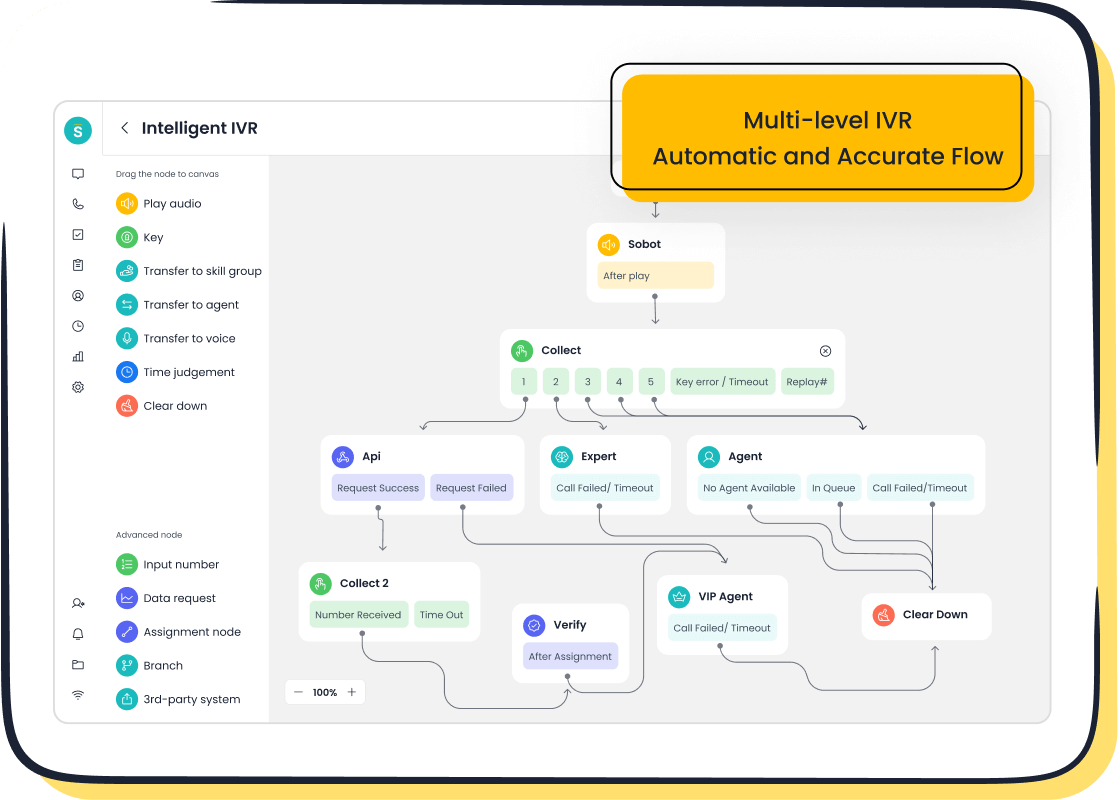
Visual Drag-and-Drop IVR Builder
Your Interactive Voice Response (IVR) is often the first impression you make. A complex, code-heavy system is difficult to manage. Look for software with a visual drag-and-drop builder. This feature allows you to design your call flow by connecting blocks, much like building with Legos. You can create a multi-level IVR, add custom greetings, and set routing rules without writing any code. This empowers non-technical staff to build and update the customer journey, ensuring your call routing systems can adapt quickly to changing business needs. A good builder makes your call flow easy to visualize, which reduces errors and speeds up deployment.
Unified Workspace and CRM Integrations
Agents waste valuable time switching between different applications to find customer information. A unified workspace solves this problem. It brings all communication channels and customer data into a single view. When your intelligent call routing software integrates seamlessly with your CRM, agents can see a caller's history the moment the phone rings. This context leads to faster resolutions for all calls and a more personalized experience for your customers. This all-in-one approach improves agent productivity and reduces call handling time, allowing your team to focus on solving problems instead of searching for data.
Advanced Analytics and Reporting
You cannot improve what you cannot measure. The best call routing systems provide advanced analytics and reporting tools. These features give you real-time insights into your call center performance. You should be able to monitor essential KPIs like First Call Resolution (FCR), Average Handle Time (AHT), and Customer Satisfaction (CSAT). This data helps you identify bottlenecks in your call flow and understand agent performance. A platform with a guaranteed high uptime, such as a 99.99% SLA, ensures you are always collecting accurate data to make informed decisions and continuously optimize your intelligent call routing strategy.
AI-Powered Voicebots and Automation
Modern intelligent call routing uses AI to enhance the customer experience and improve efficiency. AI-powered voicebots can provide 24/7 support for common inquiries. They can answer questions like "Where is my order?" or help customers schedule appointments, freeing up your human agents for more complex calls. This automation handles high call volumes and reduces wait times. The right platform will also offer global number availability, allowing you to deploy automated, high-quality support across different time zones and languages. This makes your advanced call routing flow smarter and more responsive to every customer.
Implementing intelligent routing is a strategic move. You can elevate customer interactions from frustrating to efficient. This approach boosts customer satisfaction and operational efficiency. It also reduces costs, as AI can resolve many calls for under $1. Your customers get faster answers, which improves their satisfaction.
Start your journey today. Audit your current processes for handling calls. Explore a powerful solution like Sobot to bring your vision to life.
FAQ
How does intelligent routing improve customer satisfaction?
Intelligent call routing connects customers to the best agent for their specific needs on the first try. This reduces wait times and eliminates frustrating transfers. Your customers get faster, more accurate answers, which greatly improves their experience and boosts your CSAT scores.
What is the main benefit of skills-based routing?
Skills-based routing matches a caller's needs to an agent's specific expertise. A technical question goes to a technical expert. A sales inquiry goes to a sales agent. This ensures your customers talk to the most qualified person, increasing First Call Resolution (FCR).
Can small businesses use intelligent call routing?
Yes, modern solutions make intelligent call routing accessible for businesses of all sizes. Cloud-based platforms offer affordable, scalable options without needing a large IT team. You can improve efficiency and provide excellent service, just like a large enterprise.
How do I measure the success of my routing strategy?
You should track key performance indicators (KPIs). Focus on metrics like First Call Resolution (FCR), Average Handle Time (AHT), and Customer Satisfaction (CSAT). These numbers show you if your intelligent call routing strategy is working effectively and meeting its goals.
See Also
Setting Up Your IVR Software: A Comprehensive Guide for Businesses
Unlocking Efficiency: Your Guide to Call Center AI Software Solutions
Understanding the Mechanics: How IVR Voice Recognition Software Operates
Comparing the Best Interactive Voice Response Software Options for You
Essential Features of Interactive Voice Response System Software Explained

