How business leaders can optimize CX program management


You can transform your cx program by leading with a clear strategy and focusing on measurable results. When you put customers at the center of every decision, your business sees real improvements in customer experience. Sobot’s mission of innovation and customer-centricity sets a strong example for cx programs that deliver value. Leveraging Sobot AI and the Sobot call center can elevate your customer interactions to new heights. Think about how your current cx program supports your business goals and how ready your team is for change. Agilent’s partnership with Sobot shows what is possible: a sixfold increase in service efficiency, a 25% reduction in costs, and a 95% customer satisfaction score. These results highlight the power of cx leadership, the right technology, and a customer-first mindset.
Strategic Leadership in CX Program
Vision and Alignment
You set the tone for your cx program by defining a clear vision and aligning it with your business goals. When you lead with purpose, your team understands why customer experience matters and how it connects to your company’s success. Leaders who prioritize customer experience create a culture where every employee feels responsible for delivering value at every touchpoint.
“A strong vision for customer experience acts as a compass, guiding every decision and action across your organization.”
To align your cx initiatives with business objectives, you need to:
- Recognize customer experience as a strategic priority, not just a support function.
- Connect cx efforts to measurable business outcomes like revenue growth, cost reduction, and customer loyalty.
- Build cross-functional teams that break down silos and encourage collaboration.
- Use customer insights and analytics to make data-driven decisions.
- Communicate your vision consistently through workshops, visual reminders, and leadership endorsement.
Many organizations struggle with fragmented leadership, unclear ownership, and disconnected systems. You can avoid these pitfalls by embedding your cx vision into daily operations and aligning departmental goals and KPIs with customer-centric values. For example, companies like Southwest Airlines and American Express have achieved high customer loyalty by continuously adapting their cx vision to evolving customer needs and empowering employees to act on that vision.
Sobot stands out as a leader in customer-centric innovation. The company’s mission focuses on delivering intelligent, omnichannel solutions that put the customer at the center of every interaction. Sobot’s leadership team prioritizes customer experience as a core value, not just a business improvement. By combining data insights with empathy, Sobot creates solutions that adapt to changing customer expectations. This approach has helped clients like Agilent achieve a sixfold increase in service efficiency and a 95% customer satisfaction score (source). Sobot’s commitment to innovation and customer-centricity provides a model for aligning your cx program with your business strategy.
Executive Sponsorship
Executive sponsorship drives the success of your cx initiatives. When senior leaders actively support your cx program, you gain the resources, visibility, and momentum needed for transformation. Sponsors must be visible, committed, and willing to champion customer experience at every level.
| Key Role of Executive Sponsors | Impact on CX Transformation Success |
|---|---|
| Visible leadership | Increases implementation success rates by up to 60% |
| Resource allocation | Accelerates time-to-value by 30-50% |
| Barrier removal | Improves employee adoption and organizational alignment |
| Vision communication | Secures stakeholder buy-in and aligns goals |
| Sustaining momentum | Maintains focus and commitment |
| Cross-functional alignment | Overcomes resistance and drives collaboration |
You need executive sponsors who have organizational credibility, decision authority, and a deep understanding of your business priorities. These leaders play a critical role in removing barriers, allocating resources, and communicating the vision for customer experience. Their active involvement helps overcome resistance to change and ensures that your cx initiatives stay aligned with your business objectives.
In large organizations, executive sponsorship can raise the likelihood of cx program success by ensuring leadership, funding, and cross-functional collaboration. For example, when a CEO acts as the executive sponsor for a major initiative, the entire organization feels the impact. Employees become more engaged, adoption rates improve, and the company culture shifts toward customer-centricity.
Sobot’s leadership demonstrates the power of executive sponsorship. By embedding innovation and customer focus into every level of the organization, Sobot ensures that its cx programs deliver measurable results. The company’s executive team models the behaviors needed for transformation, empowering teams to act on customer insights and drive continuous improvement.
Tip: Choose executive sponsors who can champion your cx initiatives, communicate the vision clearly, and hold teams accountable for results.
When you combine a clear vision with strong executive sponsorship, your cx program becomes a catalyst for business growth. You create an environment where customer experience drives every initiative, and your organization stays agile in a rapidly changing market.
Listening to Customers and Employees

Voice of the Customer
You need to understand what customers truly think and feel at every stage of their journey. Gathering customer feedback across all touchpoints helps you identify pain points, improve engagement, and drive cx excellence. Reliable methods for collecting actionable feedback include:
- Using an omnichannel contact center to automate post-interaction surveys and consolidate responses for analysis.
- Engaging with online communities, such as Reddit or Slack, to observe real conversations and gather unfiltered insights.
- Hosting virtual workshops or feedback events to receive direct, real-time input from customers.
- Running social media polls on platforms like Instagram or X to quickly gauge preferences and boost engagement.
- Implementing in-product surveys within your website or app to capture feedback immediately after customer actions.
Sobot’s Omnichannel Solution (source) enables you to centralize feedback from voice, chat, email, and social media in one unified workspace. This approach prevents data silos and helps you spot trends across the customer journey. By segmenting feedback by product or demographic, you can tailor your responses and improve customer satisfaction. Advanced features like AI-powered sentiment analysis help you extract actionable insights from unstructured feedback, making your cx program more responsive and data-driven.
Tip: Always close the feedback loop by acknowledging customer input and sharing the actions you take. This builds trust and encourages ongoing engagement.
Employee Feedback
Your employees interact with customers daily and understand the strengths and weaknesses of your cx program. Their feedback acts as an engine for operational improvements and innovation. To harness this resource:
- Encourage real-time feedback from employees who engage with customers and processes.
- Use incentives—such as recognition, rewards, or gamification—to motivate honest and actionable input.
- Analyze and act on employee feedback to create a continuous improvement cycle.
- Integrate employee insights with customer data using technology like Sobot’s unified workspace, giving you a holistic view of the customer journey.
- Recognize and reward employees who contribute to cx enhancements, reinforcing a positive, customer-centric culture.
When you listen to both customers and employees, you create a virtuous cycle of improvement. This approach drives higher engagement, better customer outcomes, and sustained cx excellence.
Customer Experience Journey Mapping
Mapping the customer journey helps you see every step your customers take with your business. When you understand each touchpoint, you can spot where customers feel frustrated or delighted. This process gives you a clear view of how your cx program works in real life, not just in theory. You can use journey mapping to find gaps, remove friction, and create a better customer experience.
Touchpoints and Pain Points
You start by listing all the ways customers interact with your business. These touchpoints include your website, mobile app, social media, phone calls, and in-person visits. At each point, customers have different needs and feelings. By tracking these moments, you can see where problems happen most often.
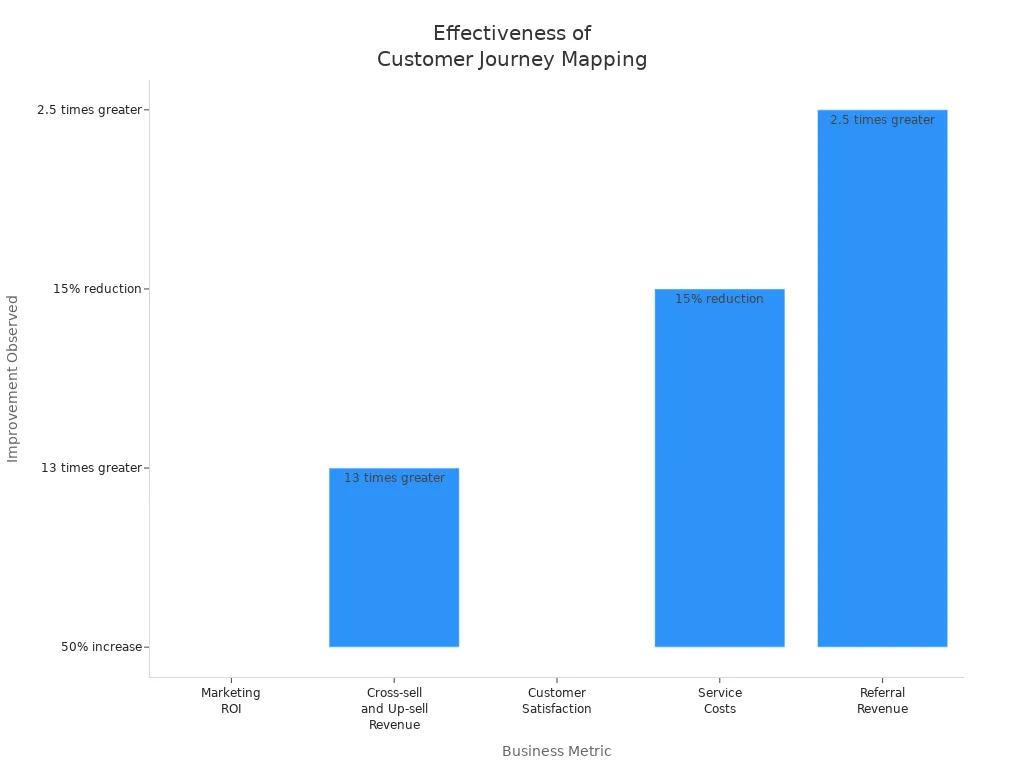
Research shows that journey mapping leads to big improvements in business results:
| Business Metric | Improvement Observed | Source Type | Implementation Timeframe |
|---|---|---|---|
| Marketing ROI | 50% increase | Industry research | 6-12 months |
| Cross-sell and Up-sell Revenue | 13 times greater | Comparative analysis | 12-18 months |
| Customer Satisfaction | 50% increase | McKinsey research | 3-6 months |
| Service Costs | 15% reduction | McKinsey research | 6-12 months |
| Referral Revenue | 2.5 times greater | Industry research | 12-24 months |
You gain the most value when you use real customer feedback and data, not just guesses. Combining surveys, interviews, and analytics helps you see the emotional side of the customer experience. This approach lets you find pain points and act quickly.
Journey Improvements
Once you know where customers struggle, you can make changes that matter. Sobot’s omnichannel platform gives you tools to manage the customer journey across all channels. You get AI-powered chatbots, real-time analytics, and smart routing. These features help you respond faster and keep the customer experience smooth. The platform also lets you track customer behavior and satisfaction, so you can see if your changes work.
To measure your progress, you should:
- Set clear goals for your journey mapping project.
- Track key metrics like customer satisfaction, support ticket volume, and retention.
- Use analytics to compare results before and after improvements.
- Share your findings with your team and adjust your strategy as needed.
Sobot’s unified workspace and AI-driven insights help you keep improving your cx program. You can deliver a seamless customer journey, boost satisfaction, and grow your business. For more details on Sobot’s omnichannel platform, visit Sobot Omnichannel Solution.
Building a CX Team
Roles and Skills
You need a diverse team to deliver an outstanding customer experience. Each role brings unique strengths that help you understand, support, and delight your customer at every stage. The table below outlines the key roles, responsibilities, and skills you should look for:
| Role | Key Responsibilities | Essential Skills and Attributes |
|---|---|---|
| Support Agents | Respond to inquiries, handle complaints, provide product info, escalate issues, maintain systems | Strong communication, product knowledge |
| Technical Support Agents | Troubleshoot technical issues, assist with implementation, create documentation, remote assistance | IT knowledge, problem-solving, troubleshooting skills |
| Customer Success Managers | Onboard customers, build relationships, monitor health, proactive outreach, training, upselling | Customer relationship management, communication, training |
| Chief Customer Officer | Implement customer-centric culture, monitor feedback, oversee CX strategy, report to management | Strategic leadership, customer advocacy, data analysis |
| CX Admins | Manage customer data, monitor trends | Data management, analytical skills |
You should also include team members who understand customer needs, map journeys, and ensure a consistent brand experience. Cross-functional collaboration with marketing, sales, and product teams helps you break down silos and improve customer retention. When you bring together people from different backgrounds—such as HR, operations, and product—you boost creativity and problem-solving. This diversity leads to higher engagement and better customer outcomes.
Tip: Choose a CX Lead who can manage the customer journey, drive collaboration, and use data to make informed decisions.
Training and Empowerment
Ongoing training keeps your team sharp and motivated. You should invest in programs that build both technical and soft skills. Workshops, hands-on learning, and real-time feedback help your team stay aligned with customer expectations. When you empower your team with autonomy, you see faster issue resolution and higher customer satisfaction.
- Regular training in empathy, communication, and conflict resolution can increase customer satisfaction by up to 25% and reduce complaints by 20%.
- Empowered employees who can make decisions on the spot help improve customer retention and lower churn.
- Use tools that provide real-time feedback and dashboards so your team can adjust quickly to customer needs.
You should also recognize and reward team members who go above and beyond for the customer. This approach builds a positive culture and motivates everyone to deliver their best. Companies like Amazon and Disney have seen strong results by focusing on continuous learning and leadership development for their CX teams.
Note: Measuring training impact with KPIs like CSAT, NPS, and retention rates helps you track progress and make improvements.
Technology for CX Program Success
Modern customer experience management relies on advanced technology to deliver seamless, efficient, and personalized service. You need the right tools to support your cx program and empower your team to exceed customer expectations. Sobot’s Voice/Call Center and AI-powered solutions provide a strong foundation for optimizing every customer interaction.

Sobot Voice/Call Center
Sobot’s Voice/Call Center stands out as a comprehensive solution for managing customer conversations across the globe. You can use this platform to handle both inbound and outbound calls, automate repetitive tasks, and ensure every customer receives timely, accurate support. The system’s intelligent IVR (Interactive Voice Response) lets you customize greetings, build menus, and route calls to the right agents or teams with a simple drag-and-drop interface. This flexibility helps you adapt quickly to changing customer needs.
The unified workspace brings all customer information and communication channels together. Your agents can view call histories, customer profiles, and ongoing conversations in one place. This setup reduces the time spent switching between systems and allows agents to focus on delivering high-quality service.
Sobot’s Voice/Call Center leverages AI-powered Voicebot technology to provide human-like, empathetic support. The Voicebot detects emotional cues, maintains context, and responds in multiple languages. This capability builds trust and rapport with customers, leading to higher satisfaction. Studies show that AI-powered emotion detection can increase customer satisfaction by up to 25% and reduce complaints by 15%. Companies using advanced AI voice agents report a 30% increase in customer satisfaction and a 25% reduction in support queries. Sobot’s Voicebot handles over 50% of customer interactions instantly, freeing your human agents to focus on complex issues and improving first-contact resolution rates (source).
You also benefit from real-time monitoring and analytics. The platform tracks call data, measures agent performance, and identifies trends. You can use these insights to optimize workflows, allocate resources, and improve service quality. Sobot’s global network ensures 99.99% uptime, so your cx program remains reliable and scalable as your business grows.
Tip: Use Sobot’s bulk outbound task feature to automate marketing campaigns and customer follow-ups. This approach can boost sales by over 30% and ensure consistent outreach across your customer base.
Sobot’s Voice/Call Center integrates easily with your existing CRM and business systems. You can access the platform on desktop or mobile devices, making it easy for your team to stay connected and responsive. The secure, encrypted data transfer protects sensitive customer information and supports compliance with industry standards.
Data and AI
Data and AI are transforming how you manage customer experience. With Sobot’s omnichannel solutions, you can collect, analyze, and act on customer data from every touchpoint. AI-driven analytics help you understand customer behavior, predict needs, and personalize every interaction.
Here’s how AI and analytics improve your cx program:
- AI personalizes customer interactions by analyzing historical data and current behavior. You can tailor recommendations, offers, and responses to each customer’s preferences.
- Predictive analytics identify customers at risk of leaving, allowing you to engage them proactively and reduce churn.
- Sentiment analysis and natural language processing help your team understand customer feelings and respond with empathy.
- AI-powered chatbots and self-service agents resolve common issues 24/7, improving response times and freeing your team for more complex tasks.
- Real-time personalization adjusts website content and customer journeys based on live data, enhancing engagement and satisfaction.
- AI-powered CRM automates tasks like data entry and lead scoring, so your sales team can focus on building relationships and closing deals.
Sobot’s unified workspace brings all these capabilities together. You can view customer profiles, track interactions across channels, and monitor key metrics in one dashboard. This holistic view enables you to deliver consistent, high-quality service at every stage of the customer journey.
Note: Organizations measure the impact of technology upgrades using metrics like Customer Satisfaction Score (CSAT), Net Promoter Score (NPS), Customer Effort Score (CES), Customer Retention Rate, and First Contact Resolution (FCR). AI and analytics help improve these metrics by enabling personalization, automation, and proactive support.
AI adoption in customer experience management continues to accelerate. Businesses use AI for intent categorization, volume reporting, and multilingual support, making it easier to serve customers worldwide. Self-service options like chatbots and knowledge bases are in high demand, allowing customers to resolve issues independently at any time. Omnichannel AI support ensures a seamless journey, integrating voice, chat, email, and social media into one unified experience.
When you integrate new technology into your cx program, you may face challenges such as technology overload or integration complexity. You can overcome these obstacles by choosing scalable, seamlessly integrated platforms like Sobot, and by maintaining a customer-first approach. Regularly evaluate your technology’s ROI and adjust your strategy to meet evolving customer needs.
Tip: Engage your employees in the technology selection process. Their insights help you choose tools that address real challenges and support future customer journeys.
Sobot’s commitment to innovation, security, and scalability ensures your cx program stays ahead of industry trends. By leveraging AI, analytics, and unified workspaces, you can deliver exceptional customer experiences, improve operational efficiency, and drive business growth.
Executive Support and ROI
Business Case
You need strong executive support to drive your cx initiative and achieve measurable results. Leaders who champion customer experience help secure funding, resources, and cross-functional alignment. When you build a business case for your cx initiative, focus on clear financial impact and strategic alignment.
Research shows that customer experience directly links to customer loyalty, repeat purchases, and brand advocacy. CX is now a key competitive advantage that is hard to copy. Successful cx initiatives deliver impressive results, including revenue growth and cost savings. To make your business case compelling, follow these steps:
- Frame your cx initiative as a growth strategy. Show how it drives revenue and supports business goals.
- Use financial data, such as customer lifetime value and operational efficiency, to connect your initiative to business outcomes.
- Find an executive champion who will advocate for your cx initiative and align it with company strategy.
- Launch pilot projects to demonstrate quick wins and early results.
- Create feedback loops to share customer insights and build trust across teams.
- Leverage technology, like AI and unified platforms, to scale your cx initiative and support future growth.
Example: A three-month pilot that improved first-response times reduced complaints by 20% and retained $500,000 in revenue. Quick wins like this help you scale your cx initiative and gain executive buy-in.
A comprehensive business case should define the opportunity, explore options, analyze ROI, assess risks, and present a clear implementation plan. Align your cx initiative with business objectives to ensure leadership support and long-term success.
Measuring Outcomes
You must measure the results of your cx initiative to prove its value and guide future investments. Start by aligning your metrics with organizational goals. Use both qualitative and quantitative data for a complete view of your results.
Key metrics include:
- Net Promoter Score (NPS): Measures loyalty and likelihood to recommend.
- Customer Satisfaction Score (CSAT): Tracks satisfaction with products or services.
- Customer Effort Score (CES): Evaluates how easy it is for customers to interact with your business.
- Customer retention rate and lifetime value: Show long-term impact.
- Operational metrics: Task completion time, error rates, and compliance.
Companies that track these metrics see clear financial results. For example, Watermark Consulting found that cx leaders achieved a 183% cumulative stock return over ten years, compared to 63% for cx laggards. McKinsey reports that cx initiatives can increase revenue by 10-15% and reduce costs by 15-20%. You can calculate ROI using the formula: CX ROI = (Net Gain from CX Strategy / Total CX Investment Costs) x 100.
| Source / Study | ROI Metric | Reported Figures |
|---|---|---|
| Watermark Consulting (2019) | Cumulative stock return (10 years) | 183.3% for CX leaders |
| McKinsey (2015) | Revenue increase | 10% to 15% |
| McKinsey (2015) | Cost reduction | 15% to 20% |
| Nextiva Example | ROI calculation | 100% ROI (doubling investment) |
Track and report your cx initiative results regularly—monthly, quarterly, and yearly. Share actionable insights across departments to drive continuous improvement. When you link cx initiative results to business outcomes, you maintain executive support and demonstrate the long-term value of your efforts.
You can optimize your customer experience program by focusing on leadership, technology, and alignment with business goals. When you bring together cross-functional teams, invest in technology, and empower employees, you create a culture that puts the customer first.
- Leadership commitment shapes a customer-centric culture and clear goals.
- Technology enables you to capture, predict, and act on customer needs.
- Aligning CX activities with commercial objectives reduces churn and increases loyalty.
Take inspiration from Sobot’s approach and Agilent’s results. Start assessing your customer experience program today to deliver value at every customer touchpoint.
FAQ
What is the first step business leaders should take to improve a cx program?
You should start by setting clear business goals for your cx program. Define what customer experience means for your business. Align your team around these goals. This helps everyone focus on delivering results that matter for both customers and your company.
How can you measure the success of a cx initiative?
You can track customer satisfaction, retention, and engagement. Use metrics like Net Promoter Score and Customer Effort Score. Regularly review customer feedback and compare results to your business goals. This approach helps you see if your cx initiative delivers real value.
Why is customer feedback important for cx programs?
Customer feedback gives you direct insight into what customers want and need. You can use this information to improve the customer journey and experience. Listening to feedback helps you spot problems early and make changes that boost satisfaction and retention.
How does technology help improve customer experience?
Technology lets you collect and analyze customer data from every touchpoint. You can use AI to personalize engagement and automate routine tasks. This makes the customer journey smoother and helps your team focus on complex issues, leading to better results.
What role do employees play in delivering a great customer experience?
Employees shape every customer interaction. When you empower your team and provide training, they deliver better service. Engaged employees improve customer satisfaction and retention. Their feedback also helps you refine your cx program and reach your business goals.
See Also
Effective Strategies For Managing Call Center Quality
A Ten Step Guide To Deploy Omnichannel Contact Centers
How To Successfully Manage Live Chat Support Agents
Key Benefits And Features Of CRM For Call Centers
Comprehensive Overview Of Omnichannel Software For Call Centers