HITL Guide How to Save Your Agents' Time

You adopted AI to boost efficiency, but it can create more review work. Many leaders agree, with 71% feeling their teams need to cut repetitive tasks. A smart Human-in-the-Loop (HITL) system is the solution. This approach helps save the time of human agents. Sobot's HITL systems use AI to filter simple tasks. This lets your human team focus on critical issues.
Think of a human in the loop (HITL) system not as complex tech, but as a strategic filter. It is a human-in-the-loop process designed to maximize your team's impact.
The Core Principle of HITL: Saving Time
The core idea behind a Human-in-the-Loop (HITL) system is simple. You leverage the best of both worlds. The human-in-the-loop principle combines AI speed with human judgment. This creates a system where the strengths of one balance the weaknesses of the other, leading to a more reliable workflow.
Automate the Obvious, Escalate the Ambiguous
Your AI should handle the easy, repetitive tasks. This is the "obvious" part. The AI processes large amounts of data and completes tasks with high confidence. The "ambiguous" part is where your team shines. When the AI encounters a problem it cannot solve or has low confidence in its answer, it escalates the task to a human agent. This HITL model ensures that simple work gets done instantly through automation. Your team's valuable time is reserved for complex issues that require critical thinking and nuanced decisions. This creates a powerful learning loop. The human feedback on escalated tasks helps train the AI, improving its accuracy and quality over time.
How HITL Helps Save the Time of Human Agents
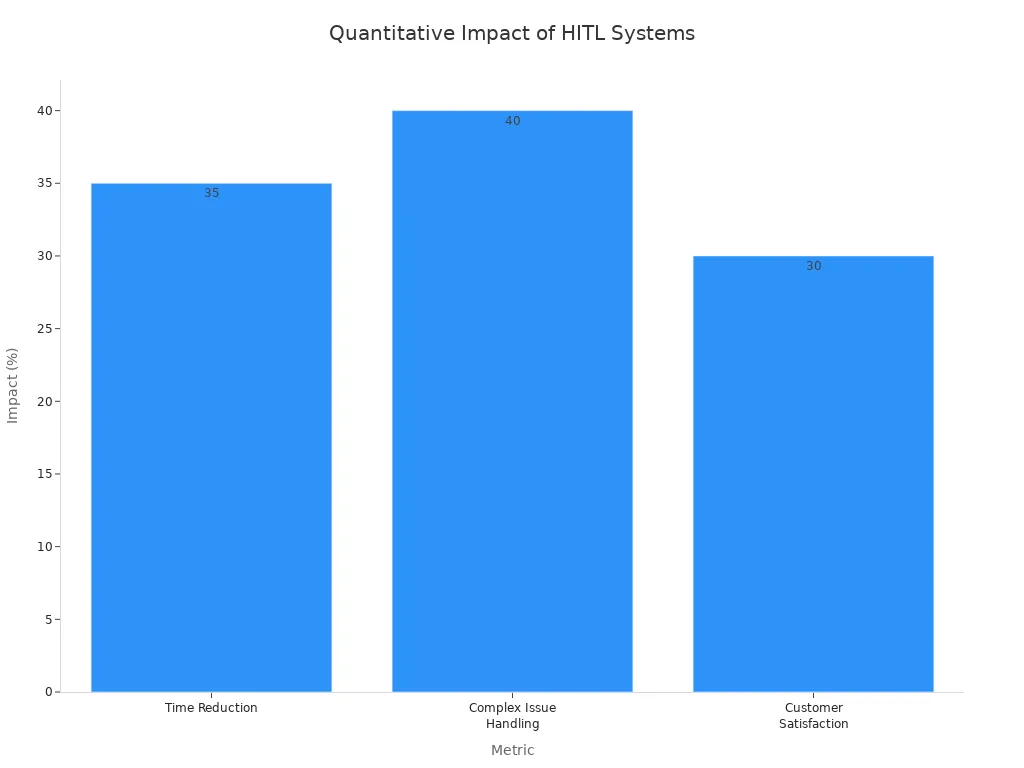
Implementing this model directly impacts your team's efficiency. Studies show that HITL systems can lead to a 30-40% reduction in handling time. This automation frees up your agents to handle more complex issues successfully. The result is a significant boost in productivity and customer satisfaction. This approach helps save the time of human agents by filtering out the noise.
Shifting Agents from Data Entry to Decision-Making
This system fundamentally changes your agents' roles for the better. You shift them from repetitive data entry to high-value decision-making. Instead of processing endless forms or answering the same questions, they become problem-solvers and quality controllers. This focus on meaningful work improves job satisfaction and expertise. This strategic use of technology is how you truly save the time of human agents. Your team stops being a data processing center and becomes a hub of expert learning and human insight. This learning process continuously refines your data and automation quality.
When to Use Human in the Loop for Efficiency

You need a clear framework to decide which tasks to automate. The key is to balance the AI's confidence with the potential impact of an error. This helps you apply automation and human oversight where they matter most.
The Confidence and Consequence Matrix
Think of your decision-making process as a simple matrix. One axis is the AI's confidence level in its own output. The other axis is the consequence if the AI makes a mistake. Using this matrix helps you make smart decisions about automation. It guides you on when to trust the AI completely and when to bring a human in the loop for quality assurance. This strategic approach ensures you get the benefits of AI speed without risking the quality of your data and outcomes.
Identifying Tasks for Full Automation
You should use full automation for tasks with high AI confidence and low consequences. These are predictable, low-risk jobs where an error is easy to fix and has little impact. This is the foundation of safe and compliant automation. The AI handles these tasks, and your team never has to see them. This is a core part of the learning process, as successful automation provides clean data for future learning.
Examples of tasks perfect for full automation include:
- Routing straightforward form submissions to the correct department.
- Filling in standard customer addresses based on verified data.
- Answering simple, common FAQs with a confidence score over 95%.
Pinpointing Tasks Needing a Human Safety Net
A human-in-the-loop system is essential for high-consequence tasks. This applies even when AI confidence is high, but it is critical when confidence is low. Your human agents act as a safety net to prevent costly errors. The HITL workflow flags these tasks for review, ensuring an expert makes the final call. This HITL model is crucial for maintaining high-quality data and building trust in your automation. This continuous learning from human intervention improves the AI's future performance.
- High Consequence, Low Confidence: A complex refund request flagged by the AI needs a human to review the data and approve it.
- High Consequence, High Confidence: An AI might detect a potential high-value fraudulent order. A human should verify the data before canceling the transaction.
Deciding Which Tasks Remain Fully Manual
Some tasks should always remain with your human team. These are jobs that require deep expertise, creativity, or emotional intelligence. Automation is not cost-effective or capable of handling the nuances of these roles. Your team's unique skills are best used for these high-value activities. This focus on human strengths is another form of learning, as it generates unique data and insights that no AI can replicate.
- Negotiating complex business deals.
- Providing personalized, empathetic customer service for sensitive issues.
- Developing long-term business strategy.
Implementing Time-Saving HITL Workflows
Putting a Human-in-the-Loop system into practice does not have to be complex. You can build effective AI workflows with HITL by following a clear, four-step process. This structure ensures you get the benefits of automation while keeping your team in control. Following these best practices for HITL implementation will save your agents valuable time.
Step 1: Triggering the Initial AI Task
Every automated process needs a starting signal. Your AI workflow begins with a trigger. A trigger is a specific event that tells the AI to start a task. This is the first step in your automation journey. You define what events kick off a process, removing the need for manual initiation.
Common triggers that start an AI task include:
- An employee submits a support ticket, which tells an AI agent to analyze and route the request.
- A customer uploads a new form, launching a compliance review.
- A sales opportunity is marked as 'closed won' in your CRM, which updates all related records.
Step 2: Setting Rules for Human Review
After the AI completes its task, you need rules to decide what happens next. These rules determine if a task is finished or if it needs a human review. The most common rule is based on the AI's confidence score. You set a threshold. If the AI's confidence is below that number, the system will pause for human review.
However, you can use other business rules to escalate tasks. These rules add another layer of safety and control.
Pro Tip 💡: Your rules should not be static. You should track metrics like how often agents override the AI. Use this data to update your thresholds. This creates a powerful cycle of learning and improvement.
Examples of other escalation rules include:
- Risk Keywords: The system flags any task containing specific words related to regulated topics or policy violations.
- Value Thresholds: An expense report or purchase order over a certain amount (e.g., $10,000) is automatically sent to a manager.
- Data Deviations: A contract that differs from your standard template is flagged for legal review.
Step 3: Designing a Human-in-the-Loop Review Interface
When a task is escalated, your agent needs a clear and efficient interface to make a decision. A well-designed screen is critical for saving time. The goal is to give your human agent all the necessary information at a glance. This allows for fast and accurate decisions, which is key to the learning process.
An effective human-in-the-loop interface should follow three core principles:
- Explainability: The interface must show why the AI flagged the task. It should display the confidence score and the data it used.
- Control: Your agent must have the final say. The screen should provide clear options to approve, reject, or edit the AI's output.
- Transparency: The system should be honest about the AI's limits. This builds trust and helps your team understand when to be extra cautious with the data.
The review screen should prioritize information like risk keywords, customer tier, or validator failures. This focus helps your team quickly understand the context and make the right call.
Step 4: Defining Post-Decision Automation
The workflow does not end with the human decision. The final step is to define what happens next. This post-decision automation ensures the process is completed without more manual work. The agent's choice becomes a new trigger for the next part of the workflow. This human feedback is valuable data for future AI learning.
This step usually follows a simple path:
- If Approved: The workflow continues down the 'approved path'. For example, an approved invoice is automatically sent to the finance system for payment.
- If Rejected: The workflow follows the 'rejected path'. For instance, a rejected expense report is sent back to the employee with a note requesting more information.
This final step closes the loop in the HITL process, connecting human intelligence back into the automation stream and making the entire system smarter over time.
Practical HITL Use Cases That Save Hours
Theory is helpful, but seeing HITL in action shows its true power. You can apply these principles to many parts of your business. These practical use cases for HITL show how you can start saving your team hours of work. By implementing smart automation, you empower your agents to focus on what matters.
Pre-Approving Expenses with Confidence Scores
Processing expense reports is a classic time-sink for any team. Your employees submit reports, and managers must manually check each line item against company policy. A HITL workflow can transform this process.
You can use an AI to scan each expense report first. The AI checks for policy violations and assigns a confidence score to its findings. This creates a fast and efficient review system.
- High-Confidence Approvals: If the AI is over 95% confident that an expense report is fully compliant, the system can approve it automatically. Your team never has to touch it.
- Low-Confidence Escalations: If the AI finds a potential issue or has low confidence, it flags the report. The system then sends it to a human manager for a final decision.
This approach uses key metrics to ensure the automation is working effectively. You can track AI coverage (% transactions with >80% confidence) to see how much work the AI handles. You can also measure Policy adherence (% spend pre-approved vs after-the-fact) to confirm the system is enforcing your rules. This data-driven learning process helps you fine-tune the automation over time.
Drafting Customer Replies with Sobot's AI

Customer support teams face a constant stream of inquiries. Many of these questions are repetitive. A HITL system, powered by tools like Sobot's AI Chatbot and Ticketing System, can manage this volume and save the time of human agents. This creates a powerful human-machine interaction.
Here is how the workflow operates:
- A customer submits a question through your support channels.
- Sobot's AI analyzes the ticket and instantly drafts a response for common issues.
- If the AI has high confidence, it can send the reply automatically.
- If the issue is complex or the AI has low confidence, it assigns the ticket to a human agent. The agent sees the AI-drafted reply as a starting point, which they can edit and send.
A perfect example of this is how OPPO, a leading smart device company, uses Sobot. During peak shopping seasons, their support volume would overwhelm agents. By implementing a human in the loop model with Sobot, they achieved incredible results.
The Sobot Chatbot handled the repetitive questions, leading to:
- An 83% chatbot resolution rate, meaning most issues were solved without human intervention.
- A 94% positive feedback score from customers who interacted with the bot.
- A 57% increase in their repurchase rate, showing that great service drives loyalty.
This automation allowed OPPO's agents to focus on complex problems, improving service quality and efficiency. This is a clear demonstration of how a well-implemented HITL strategy delivers measurable business value through continuous learning.
Validating Customer Data from Forms
Your business relies on accurate customer data. However, manually validating information from web forms is slow and full of potential errors. Users often make mistakes that compromise your data quality.
Common problems include:
- Single Input Error: A user might forget a required field or enter an invalid phone number.
- Inconsistent Data Entry Formats: A user might write their full name in the "first name" field or use a different date format.
You can use AI with HITL to fix this. An AI can scan form submissions at a massive scale. It uses technologies like Natural Language Processing (NLP) to extract and structure the data. The AI flags any entries that seem incorrect or have low confidence. A human agent then reviews only the flagged data in a simple interface. This focused review cycle is much faster than checking every single field manually. This workflow ensures higher precision and better data for your business intelligence while accelerating the entire learning process.
Integrating HITL with Your Existing Tools
You do not need to build a new system from scratch to use HITL. The best approach is to integrate HITL workflows into the tools you already use, like your CRM or helpdesk. This makes the adoption of automation seamless for your team.
For instance, Sobot's AI solutions are designed for easy integration. You can connect them to your existing customer service systems to enhance your current workflow. Leading companies integrate AI with their CRM systems to unify customer data and meet changing demands.
OPPO's success story again highlights this. Sobot integrated with their global communication channels and internal business systems. This eliminated data silos and gave agents a complete view of the customer. When a human agent took over from the chatbot, they had all the necessary context, from purchase history to past support interactions. This deep integration is what makes modern HITL systems so powerful. It turns a simple AI tool into a core part of your operational strategy, helping to save the time of human agents and improve the customer experience through constant learning.
A well-designed HITL system strategically removes unnecessary steps from your workflow. This approach empowers your human agents. They can focus their valuable time on high-impact decisions instead of routine checks.
Take the Next Step 🚀 Identify one repetitive, low-risk task in your current workflow. Think about how a Sobot-powered process could streamline it and free up your human team.
FAQ
How does HITL improve AI models?
Your team's decisions provide valuable feedback data. This process is a form of reinforcement learning from human feedback. This learning helps refine the AI's future performance. The AI uses this data to get smarter, improving its accuracy with each human interaction and providing better data for future learning.
Is my company's data safe in a HITL system?
Yes, your data is secure. A good HITL system has strong data protection. It includes data encryption and access controls. These measures protect your sensitive data. The system's design prioritizes the security of all your business data, customer data, and internal data.
What are the ethics of using AI with human oversight?
Ethical considerations are very important. A HITL system promotes responsible AI use. It ensures a human reviews high-stakes decisions, reducing bias in the data. This approach to ethics helps build trust. It makes sure your AI tools use data fairly and transparently, with human values guiding the learning.
How does HITL improve data quality?
HITL acts as a quality check for your data. When the AI is unsure, a human corrects the data. This data labeling process creates clean, accurate data. This high-quality data is then used for reinforcement learning from human feedback, which improves your large language models and overall data integrity.
Remember 💡: The goal of HITL is not to slow things down. It is to create a powerful learning loop. Your team's expertise makes the AI smarter, and the AI handles more data, saving your team time. This continuous learning cycle is key to efficient automation.
See Also
Mastering Live Chat Agent Management: A Comprehensive Guide for Optimal Performance
Elevate Your Round-the-Clock Live Chat Operations for Peak Efficiency
Unveiling the Mechanics of Efficient Call Center Automation for Enhanced Productivity
Achieving Depop Live Chat Success: Essential Quick Tips for Sellers
Demystifying the IT Call Center Agent Role: Key Responsibilities and Skills

