Best Practices for Implementing Inbound Call Trackers in Enterprises


Inbound call tracking drives business growth by helping you measure and improve every customer interaction. You see how inbound calls boost acquisition, marketing, and enhanced customer experiences. Many enterprises now prefer cloud-based solutions, with over 65% using them for inbound call tracking. Sobot offers highly recommended inbound call trackers for enterprises, transforming inbound customer experience with AI-powered voicebots. These tools provide 24/7 support, personalize inbound conversations, and help you deliver growth in marketing and customer service.
| Statistic | Value |
|---|---|
| Enterprises preferring cloud-based solutions | Over 65% |
| Fortune 500 companies using AI-driven solutions | More than 70% |
| SMEs implementing call tracking solutions | Over 55% |
| Marketers reporting improved ROI | Over 60% |
| Improvement in lead conversion rates with AI-driven tracking | 40% |
Context-aware AI voicebots let you create inbound customer experience that feels personal and engaging. Multilingual support helps every customer feel understood.
Defining Enterprise Inbound Call Strategy
A strong inbound call strategy shapes the way your enterprise connects with customers and drives growth. You need to build a foundation that aligns call tracking with business goals, maps customer journeys for better experience, and engages stakeholders across departments. These steps help you deliver measurable improvements in customer experience, marketing, and performance-based lead generation.
Aligning Call Tracking with Business Goals
You start by connecting your inbound call strategy to your enterprise’s objectives. Highly recommended inbound call trackers for enterprises give you the tools to measure and optimize every interaction. You can use these trackers to support marketing, sales, and customer service goals. When you align call tracking with business goals, you create a clear path for performance-based improvements.
- The enterprise behavioral healthcare network used real-time agent reports to manage calls efficiently. This led to a 60% reduction in reliance on third-party answering services.
- Integration with CRM systems improved data management. You can see better patient care and operational efficiency as a result.
- Streamlining operations and improving marketing effectiveness through data-driven insights helps you reach your goals faster.
You define clear KPIs for inbound call handling strategies. These KPIs include call answer rates, conversion rates, and customer satisfaction scores. You monitor and analyze call metrics to track progress. Highly recommended inbound call trackers for enterprises provide dashboards and analytics that make this process simple. You can use these insights to adjust your strategy and improve customer experience.
Tip: Set measurable goals for your inbound call strategy. Use call tracking data to show progress and share results with your team.
Mapping Customer Journeys for Better Experience
Mapping customer journeys helps you understand every touchpoint in the inbound call process. You identify critical moments where customers interact with your business. Missed calls can lead to lost customers, so you need to track these moments closely. Highly recommended inbound call trackers for enterprises let you monitor call answer rates and conversion rates. You use this data to improve customer experience and increase performance-based outcomes.
- Mapping customer journeys highlights conversion moments in phone interactions.
- You see where customers face pain points and improve inbound call handling strategies.
- Tracking key metrics shows the effectiveness of journey mapping.
You build a strong knowledge base for your agents. Training agents thoroughly ensures they handle inbound calls with confidence. You use advanced call center technology to support customer-centric communication. Highly recommended inbound call trackers for enterprises offer smart call routing and unified workspaces. These features help agents deliver a seamless experience.
Note: Customer experience improves when you understand their journey. Use inbound call tracking to identify pain points and optimize every step.
Engaging Stakeholders Across Departments
Successful inbound call strategy requires collaboration across departments. You bring together marketing, sales, customer service, and IT teams. Highly recommended inbound call trackers for enterprises support cross-team collaboration and transparency. You use digital engagement platforms to centralize information and reduce administrative burden.
| Strategy | Description |
|---|---|
| Create cross-team collaboration | Establish Communities of Practice to allow stakeholder leads from different departments to share insights and coordinate outreach, preventing duplicate efforts and ensuring a unified voice. |
| Implement digital engagement platforms | Centralize engagement in a single digital workspace to create transparency and reduce administrative burden, allowing stakeholders to access information easily. |
| Establish portfolio-wide visibility | Use dashboarding capabilities to provide executives with aggregate views of engagement health across projects, highlighting systemic risks and enabling strategic interventions. |
| Standardize with smart templates | Create standardized templates for stakeholder maps and communication plans to ensure consistency and reduce setup time for new initiatives, while allowing teams to adapt workflows as needed. |
| Utilize technology for communication | Leverage technology to enhance engagement by reducing administrative friction, allowing teams to focus on building relationships while maintaining effective communication and feedback integration. |
You use standardized templates for stakeholder maps and communication plans. This ensures consistency and saves time. Technology helps you maintain effective communication and feedback integration. Highly recommended inbound call trackers for enterprises offer tools that make collaboration easy. You can share performance-based insights and adjust workflows as needed.
You embrace omnichannel support to unify customer interactions. Sobot’s solutions let you connect voice, chat, email, and social media in one platform. You strengthen self-service options so customers can resolve issues quickly. This approach improves customer experience and boosts marketing effectiveness.
Callout: Engaging stakeholders across departments creates a unified inbound call strategy. You build relationships and share insights to drive continuous improvement.
Key Components of an Effective Enterprise Inbound Call Strategy
Industry experts identify several key components for a successful inbound call strategy. You can use these elements to guide your approach and maximize results.
- Train agents thoroughly
- Use advanced call center technology
- Prioritize customer-centric communication
- Improve call routing and queuing
- Define clear KPIs
- Monitor and analyze call metrics
- Build a strong knowledge base
- Embrace omnichannel support
- Strengthen self-service options
You integrate these components into your inbound call strategy. Highly recommended inbound call trackers for enterprises help you achieve each goal. You see improvements in customer experience, marketing, and performance-based lead generation.
Emoji: 🚀 Building a strong inbound call strategy sets your enterprise on a path to growth and success.
You focus on customer experience at every stage. You use inbound call tracking to measure and optimize interactions. Marketing teams benefit from data-driven insights that improve campaigns and increase conversion rates. You deliver performance-based results by aligning your strategy with business goals and engaging stakeholders across departments.
You create a seamless experience for every customer. Highly recommended inbound call trackers for enterprises provide the tools you need to monitor, analyze, and improve inbound call handling strategies. You see measurable improvements in customer satisfaction, operational efficiency, and marketing effectiveness.
Choosing Highly Recommended Inbound Call Trackers for Enterprises
Selecting the right inbound call tracker for your enterprise shapes the way you connect with customers and grow your business. You need a solution that supports your call center, improves customer experience, and helps your marketing team reach new goals. Sobot stands out as a trusted provider, offering a full suite of products like chatbot, AI Agent, live chat, call center, voicebot, ticketing system, and a unified customer contact center. These tools work together to help you manage every inbound call and deliver better results.
Evaluating Sobot Voice/Call Center Features
When you evaluate inbound call trackers, you want to know which features matter most. Sobot Voice/Call Center gives you a powerful set of tools designed for enterprise needs. You can see how each feature supports your call center and helps your team work smarter.
| Feature | Description |
|---|---|
| AI-driven automation | Enhances customer experience and agent efficiency through intelligent automation. |
| Omnichannel support | Allows customer interactions across various channels such as email, chat, and phone calls. |
| Integration capabilities | Ensures seamless connectivity with other systems, crucial for comprehensive customer service. |
| Data statistics and analysis | Provides insights into customer concerns and team performance, aiding in effective management. |
| Scalability | Adapts to the needs of different industries, ensuring it can grow with the enterprise. |
| System stability and security | Guarantees data protection and compliance with regulations, essential for enterprise operations. |
You get AI-driven automation that helps your agents handle calls faster and more accurately. Omnichannel support lets you manage customer conversations from phone, chat, and email in one place. Integration capabilities make it easy to connect your call center with CRM and other business systems. Data statistics and analysis give you a clear view of customer needs and team performance. Scalability means your call center can grow as your business expands. System stability and security keep your data safe and your operations running smoothly.
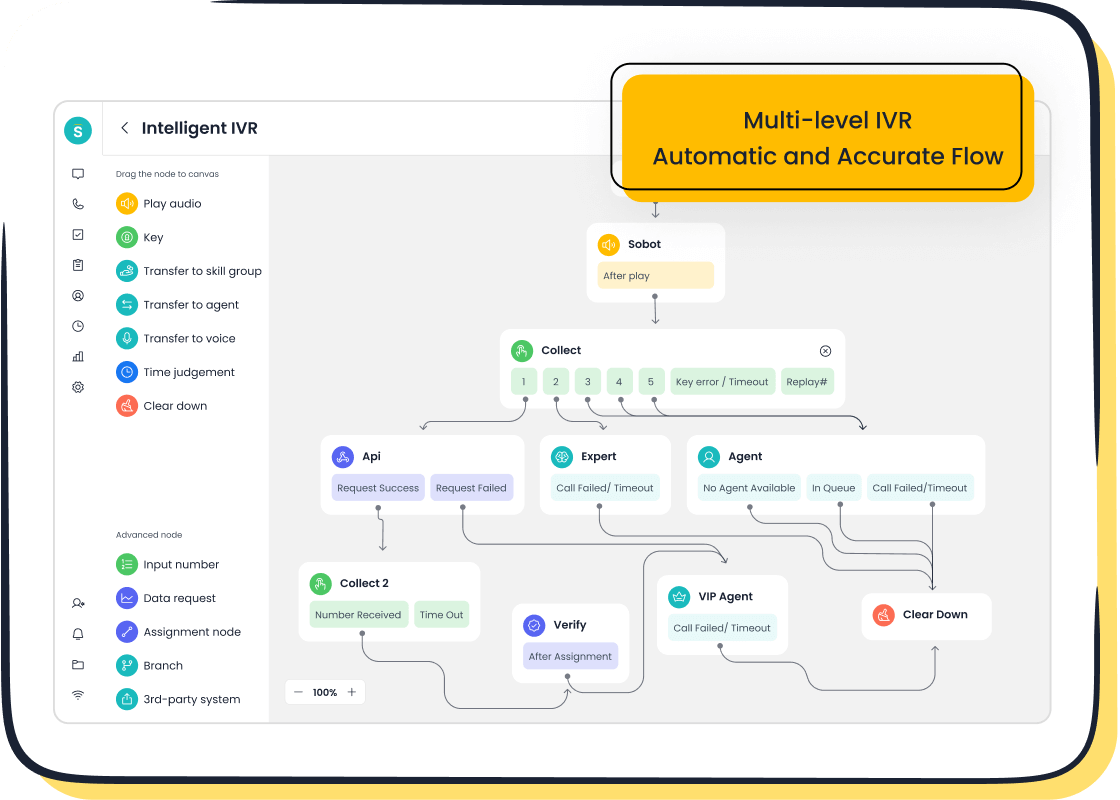
Sobot’s call center platform also includes features like intelligent IVR, smart call routing, and a unified workspace. You can use the AI-powered voicebot to answer common questions and route calls to the right agent. The ticketing system helps you track and resolve customer issues quickly. With Sobot, you get a complete solution for managing every inbound call and improving your marketing efforts.
Tip: Look for a call center solution that offers both advanced automation and strong security. This helps you protect customer data while delivering fast, accurate service.
Comparing Integration and Scalability Options
You need a call center that fits your current systems and can grow with your business. Sobot makes integration simple. You can connect the call center with your CRM, analytics tools, and other platforms. This helps your team see all customer information in one place and respond quickly to every inbound call.
Other leading platforms like Five9 and RingCentral also offer cloud-based solutions. Five9 focuses on advanced call routing for enterprises that want contact center excellence. RingCentral combines call center features with business communications for an all-in-one approach. Both options let you scale up without changing physical equipment, which is helpful if you move from older systems.
Sobot stands out with its global reach and 99.99% uptime. You can access phone numbers worldwide and support customers in different regions. The platform adapts to your needs, whether you run a small team or a large enterprise. You can add new channels, agents, or features as your business grows. This flexibility helps your marketing team launch new campaigns and reach more customers through inbound calls.
Sobot’s omnichannel solution brings together voice, chat, email, and social media. You can use the chatbot and AI Agent to handle routine questions, freeing up agents for complex issues. The live chat and ticketing system help you manage customer requests from start to finish. This unified approach improves your call center’s efficiency and supports your marketing goals.
Note: Choose a call center that integrates easily with your existing tools and can scale as your business grows. This saves time and helps you deliver better service to every customer.
Assessing Vendor Support and Reliability
Reliable vendor support is key when you choose an inbound call tracker for your enterprise. Sobot provides end-to-end encryption, GDPR and HIPAA compliance, and role-based access controls. These features protect your data and help you meet industry regulations. The platform includes intelligent IVR, global number availability, and real-time call monitoring. These tools help your call center handle high volumes and deliver consistent service.
Users praise Sobot for its ease of use and responsive customer support. You can get help quickly when you need it, which makes integration and daily operations smoother. The support team helps you set up new features, train your agents, and solve any issues that come up. This level of service is important for enterprises that rely on their call center for inbound calls and marketing campaigns.
Sobot’s reliability shows in its 99.99% uptime and global network. You can trust the system to stay online and support your business at all times. The platform’s stability means you avoid downtime and keep your call center running smoothly. This helps your marketing team stay connected with customers and respond to every inbound call.
A real-world example comes from Opay, a leading financial service platform. Opay used Sobot’s omnichannel solution to manage customer interactions across voice, chat, and email. The result was a jump in customer satisfaction from 60% to 90%, a 20% reduction in costs, and a 17% increase in conversion rates. Opay’s marketing team also used WhatsApp integration to reach more customers and boost engagement. This story shows how Sobot’s call center and inbound solutions can drive real business results.
Callout: Strong vendor support and reliable technology help your call center deliver great service every day. Choose a partner that stands by you as your business grows.
You want a call center solution that supports your inbound strategy, helps your marketing team, and keeps your data safe. Sobot offers a complete suite of products, including chatbot, AI Agent, live chat, call center, voicebot, ticketing system, and a unified customer contact center. These tools work together to help you manage every inbound call, improve customer experience, and achieve your marketing goals.
Seamless Integration with Enterprise Systems
Connecting Sobot with CRM and Analytics
You connect Sobot with your CRM and analytics tools to unlock the full power of inbound call tracking. This integration gives your team access to real-time data, helping you improve inbound customer experience and marketing outcomes. Sobot uses secure APIs to exchange data with other services, making your contact center software tightly integrated with CRM, team chat, and email. You gain actionable analytics that identify bottlenecks and show clear paths to resolution. Integrated call analytics help you see patterns in customer behavior and adjust your data-driven strategies for better results.
| Best Practice | Description |
|---|---|
| Real-time data | Solutions should provide real-time data to enhance customer experience. |
| Integration with CRM | Contact center software must be tightly integrated with CRM, team chat, and email. |
| Use of secure APIs | Cloud contact centers utilize secure APIs to exchange data with other services. |
| Actionable analytics | Analytics should identify bottlenecks and provide clear paths to resolution. |
| Omnichannel approach | A good analytics solution combines cross-channel analytics for better customer insights. |
Synchronizing Data Across Channels
You synchronize data across channels to keep your inbound call management efficient. Sobot supports methods like server-side synchronization and bi-directional sync, which reduce administration costs and keep your data accurate. Administrators can configure field-level settings to match organizational needs. You use last-write wins, priority systems, manual resolution, and custom business rules to handle conflicting changes. These methods help you maintain consistency and reliability in your inbound marketing efforts.
| Method | Description |
|---|---|
| CRM for Outlook | Uses client-side synchronization for bidirectional data sync with Outlook. |
| Server-Side Synchronization | Replaces email router, preferred for online customers, reduces administration costs. |
| Bi-directional Sync | Synchronizes changes in both directions between CRM and Outlook/Exchange. |
| Field Level Configuration | Allows administrators to configure synchronization settings at the organizational level. |
- Last-write wins keeps the most recent change based on timestamp.
- Priority system designates one system as the source of truth.
- Manual resolution lets a person review and decide on conflicting changes.
- Custom business rules apply specific logic based on field type or other factors.
Ensuring Workflow Efficiency
You improve workflow efficiency by integrating inbound call trackers like Sobot. Real-time caller data enhances customer engagement and satisfaction. Teams identify patterns in caller behavior, leading to more relevant and quality interactions. You address caller concerns immediately, transforming initial inquiries into long-term customer relationships. Recognizing common customer pain points helps you refine training modules. Targeted training improves customer service responses and decreases wait times. Workforce management tools provide visibility into agents' off-call tasks, impacting efficiency metrics like Average Wait Time. Identifying bottlenecks, such as excessive documentation, streamlines workflows. Improved agent availability leads to reduced hold times and lower call abandonment rates. You see the benefits in marketing campaigns and customer satisfaction.
Tip: Integrated call analytics and synchronized data help you deliver faster, more personalized inbound service. You build stronger relationships and drive marketing success.
Ensuring Security and Compliance in Call Tracking
Meeting Industry Standards and Regulations
You must follow strict rules when handling inbound call tracking in your enterprise. Industry standards like GDPR and HIPAA set clear guidelines for how you collect, store, and use data. These rules protect both your business and your customer. Sobot helps you meet these standards with features like end-to-end encryption and role-based access controls. You keep your inbound call records safe and ensure only the right people can access sensitive information. This builds trust with your customer and supports your marketing efforts by showing you value privacy.
Implementing Data Protection with Sobot
Protecting data is a top priority for any inbound call center. Sobot uses advanced security tools to keep your customer information safe. You benefit from encrypted data transfer and secure storage. The system tracks every inbound call and logs all access to customer records. Real-time monitoring helps you spot problems before they grow. You can also set up alerts for unusual activity. These steps help you stay compliant and protect your marketing data from risks. Sobot’s global network and 99.99% uptime mean your inbound operations stay secure and reliable.
Managing Consent and Privacy
Managing consent and privacy is essential for inbound call tracking. You need to make sure every customer understands how their data will be used. Best practices include:
- Train your team to explain the legal basis, purpose, and retention period at the start of each inbound call.
- Confirm prior consent for marketing calls, especially when renewing subscriptions, and log any refusals right away.
- Use two-step verification before exporting contact lists to reduce mistakes.
- Audit calls and data access logs often to check for privacy issues.
- Set up clear ways for employees to suggest improvements to privacy processes.
- Teach your team how to use AI tools for accurate consent management.
Tip: Clear communication about consent builds trust and helps your marketing team connect with each customer in a responsible way.
You show your commitment to privacy by following these steps. This protects your inbound call data and supports your marketing goals.
Empowering Teams for Growth and Adoption
Training Agents and Supervisors on Sobot Tools
You empower your team by providing hands-on training with Sobot’s inbound call tracking tools. Agents and supervisors learn to use features like intelligent IVR, unified workspace, and real-time analytics. Training sessions focus on practical skills that help your team handle inbound calls efficiently and improve customer satisfaction. You build confidence by offering role-specific modules and ongoing support. Supervisors monitor performance and guide agents through new workflows. This approach drives growth by making your team ready for every inbound interaction.
Tip: Use interactive training and feedback to boost engagement and help agents master inbound call handling.
Driving Cross-Department Collaboration
You drive collaboration by involving stakeholders from marketing, sales, IT, and customer service in inbound call tracking initiatives. This teamwork leads to faster project completion and supports growth across the enterprise. You create open channels for engagement, such as surveys, town halls, suggestion boxes, and recurring one-on-one meetings. These methods encourage everyone to share ideas and improve inbound processes. Collaboration enhances profitability and helps your marketing team align campaigns with customer needs.
- Involve relevant stakeholders for better outcomes.
- Use surveys for ongoing feedback.
- Host town halls for open discussions.
- Provide suggestion boxes for anonymous input.
- Schedule recurring one-on-one meetings to foster engagement.
You build a culture where every department supports inbound call tracking and marketing goals. This unity strengthens customer relationships and drives continuous growth.
Overcoming Change Management Challenges
You overcome change management challenges by setting a clear vision and defined goals for inbound call tracker adoption. Strong leadership and visible executive sponsorship motivate your team. You engage all stakeholders early to build ownership and address potential roadblocks. Change readiness assessments and structured roadmaps prepare your team for new workflows. You allocate resources to create the right conditions for adoption. Clear, consistent communication tailored to each audience keeps everyone informed.
- Establish a clear vision and goals.
- Ensure strong leadership and sponsorship.
- Engage stakeholders early.
- Conduct change readiness assessments.
- Allocate sufficient resources.
- Communicate consistently and clearly.
- Provide hands-on, role-specific training.
- Use phased rollouts or pilots.
- Address resistance openly.
- Monitor key performance indicators and maintain feedback loops.
You use phased rollouts to minimize disruption and build momentum. Address resistance by acknowledging concerns and providing transparent updates. Monitoring key performance indicators and maintaining feedback loops ensures continuous improvement. This strategy supports growth, enhances customer engagement, and strengthens your inbound marketing efforts.
Callout: Empowered teams drive inbound call tracking success, leading to measurable growth in customer satisfaction and marketing performance.
Leveraging Analytics to Enhance Customer Experience
Monitoring KPIs and Performance Metrics
You need to track the right metrics to improve inbound call strategy. Analytics help you see how your team performs and where you can make changes. Common key performance indicators include:
- Average response time
- First-call resolution rate
- Conversion rate
- Average call duration
- Call disposition
- Lead response time
- Dialing efficiency
- Pipeline velocity
- Appointment setting rate
- Follow-up rate
- Average speed of answer
- Call abandonment rate
- Customer satisfaction
- Issue resolution rate
- Call escalation rate
- Service level
- Cost per contact
You use these metrics to measure customer experience and marketing success. Monitoring performance helps you spot trends and act quickly. You collect customer feedback to understand what works and what needs improvement.
Using Insights to Optimize Inbound Call Strategy
Analytics give you insights that drive better inbound call handling. You can use technology to automate tasks and improve customer service. The table below shows how different tools help you optimize performance:
| Technology | Purpose | Impact |
|---|---|---|
| Conversational AI | Resolves routine FAQs and tasks | 40% reduction in routine call volume |
| Power Suite CX dashboards | Tracks caller sentiment and real-time SLA performance | Instant operational agility for supervisors |
| Automated workflows | Sends post-call SMS or surveys based on call outcome | Boosts first call resolution |
| Bi-directional CRM sync | Updates customer data and call notes across platforms | Removes manual entry and data silos |
You can also use call recordings for training and quality checks. Transcribing calls and running keyword analysis help you spot new issues. These insights let you adjust your inbound strategy and improve marketing campaigns. You collect customer feedback after calls to see how well your team meets customer needs.
Iterating for Continuous Growth
Continuous growth comes from using insights to refine your inbound approach. Start with pilot programs to test new features. Invest in training so your team understands how to use analytics and data. Set clear policies for managing numbers and customer information. Regularly check system health and performance to keep everything running smoothly. Plan for growth by designing your system to handle more calls and users as your marketing expands.
| Recommended Process | Description |
|---|---|
| Start with pilot programs | Test capabilities before full rollout |
| Invest in training | Teach users to get the most value from analytics |
| Establish governance | Set clear rules for data and system use |
| Monitor performance | Check system health and optimize regularly |
| Plan for scale | Prepare for more campaigns, users, and inbound call volume |
You use insights from analytics to make small changes, measure results, and repeat the process. This cycle helps you deliver better customer experiences and stronger marketing outcomes.
Measuring ROI and Success of Inbound Call Trackers
Defining Success Metrics for Enterprises
You measure the success of your inbound call tracker by tracking clear metrics. These metrics help you see how your strategy improves customer experience and marketing outcomes. You use Sobot’s analytics and reporting tools to monitor performance and share results with your team. The table below shows common metrics and global benchmarks for inbound call centers:
| Metric | Description | Global Benchmark |
|---|---|---|
| Call Abandonment Rate | Percentage of incoming calls abandoned while waiting for support. | 5% – 8% |
| Customer Satisfaction Score | Measures customer satisfaction with support, typically via post-call surveys. | 75% – 80% |
| Issue Resolution Rate | Percentage of calls where customer issues are successfully resolved. | 70% – 79% |
| Call Escalation Rate | Percentage of calls requiring escalation to higher-tier support. | 10% |
| Service Level | Percentage of calls answered within a specified target time. | 80% in 20 seconds |
You compare your results to these benchmarks to see how your inbound strategy performs. You focus on customer satisfaction, issue resolution, and service level to drive better customer acquisition results.
Tracking Cost Savings and Revenue Impact
You track cost savings and revenue impact to understand the ROI of your inbound call tracker. Sobot’s analytics show how automation and smart routing reduce labor hours and operating expenses. You see faster break-even points and higher ROI over time. The following list highlights key results from inbound call tracker adoption:
- Break-even point for enterprises: 60 to 90 days
- ROI over three years: 331%
- Reduction in labor hours: Automates tier-1 tasks
- Cut in operating expenses: Up to 45%
- Increase in customer engagement: 30%
- Improvement in conversion rates: Substantial revenue growth
- Reduction in average handling time: 12%
- Increase in interactions handled per hour by blended teams: Up to 50% more
AI-powered solutions boost productivity by 27%. You save about 11.4 hours per employee each week, which translates to $8,700 in cost savings per employee per year. AI-leading firms see a 14% increase in revenue per employee. These results show how inbound call trackers support your marketing strategy and drive revenue generation.
Reporting Results to Leadership
You report results to leadership by using Sobot’s analytics dashboards. You define key performance indicators like Average Handling Time, First Call Resolution, and Customer Satisfaction. You centralize data for detailed analysis and informed decisions. You set baseline metrics and target goals based on industry benchmarks. Real-time dashboards keep leadership updated on progress and help identify issues. You close the feedback loop by collecting customer feedback and using it to improve your inbound strategy. Most companies collect feedback, but only a few use it for actionable improvements. You make sure your marketing team uses feedback to enhance customer experience and drive better results.
Tip: Use transparent reporting tools to show leadership how your inbound call tracker delivers ROI, supports marketing goals, and improves customer acquisition results.
You can drive growth by following key best practices for inbound call trackers.
- Build a customer-focused culture and empower your agents.
- Use advanced tools like Sobot for skills-based routing and CRM integration.
- Define clear metrics to track growth and improve customer satisfaction.
- Embrace AI and automation to support growth and reduce routine tasks.
- Review your strategy often to keep up with technology and ensure lasting growth.
| Improvement Area | Impact on Growth |
|---|---|
| Agent Efficiency | 30-40% |
| Routine Inquiry Reduction | 70% |
| Conversion Rate Increase | 15-20% |
Regular evaluation and adaptation help you achieve continuous growth and deliver a better customer experience.
FAQ
What is an inbound call tracker and why do enterprises need it?
An inbound call tracker records and analyzes incoming calls. You use it to measure customer interactions, improve service, and boost marketing results. Enterprises rely on inbound call trackers to track performance, increase conversion rates, and support business growth.
How does Sobot’s inbound call tracker integrate with CRM systems?
You connect Sobot’s inbound call tracker to your CRM using secure APIs. This integration lets you view customer data in real time, automate workflows, and improve agent efficiency. You manage calls and customer records in one unified workspace.
What security features does Sobot’s inbound call tracker offer?
Sobot’s inbound call tracker provides end-to-end encryption, role-based access controls, and GDPR compliance. You protect customer data and meet industry standards. Real-time monitoring and alerts help you spot unusual activity and keep your information safe.
How can you measure ROI with an inbound call tracker?
You track metrics like call abandonment rate, customer satisfaction, and issue resolution. Sobot’s inbound call tracker shows cost savings, increased conversion rates, and improved agent productivity. You compare results to global benchmarks for clear ROI.
Can Sobot’s inbound call tracker support global operations?
Yes. Sobot’s inbound call tracker offers global number availability and 99.99% uptime. You support customers in different regions and scale your operations easily. The platform adapts to your enterprise’s needs and ensures reliable service worldwide.
See Also
Enhancing Call Center Efficiency Through Effective Monitoring Techniques
Top Strategies for Effective Quality Management in Call Centers
A Comprehensive Guide to Adopting Omnichannel Contact Center Approaches
Understanding the Efficiency of Call Center Automation Processes
Essential Insights on Choosing Omnichannel Call Center Software

