Essential KPIs for Customer Service Defined


To deliver exceptional service, you must measure what matters. With 89% of businesses now competing on customer experience, understanding your performance is critical. Key Performance Indicators (KPIs) are the essential tools for this. The right customer service kpis help you see the quality of your service. They guide your customer service team from being busy to being effective. This guide defines the most critical customer service kpis. You will learn the best customer service kpis for measuring efficiency, customer satisfaction, and business impact. Tools like the Sobot call center, powered by Sobot AI, help track every kpi for customer service, ensuring each customer receives excellent service.
Essential Customer Service KPIs for Efficiency
Efficient customer service is the backbone of a great customer experience. When your team operates smoothly, you can resolve issues faster, handle more inquiries, and keep satisfaction levels high. Tracking efficiency-focused customer service kpis helps you understand your team's capacity and identify operational bottlenecks. These key performance indicators are not just about speed; they are about creating a streamlined process that benefits both your agents and your customer. Let's explore the essential metrics for measuring your team's performance.
First Response Time (FRT)
First Response Time (FRT) measures the duration between when a customer first submits a query and when an agent provides the first human response. This kpi for customer service is critical because it sets the tone for the entire interaction.
A fast response shows the customer you are attentive and value their time. Even if you cannot solve the problem instantly, a quick acknowledgment builds trust and patience. As Jamie Edwards of Kayako notes, the first reply is vital because it confirms to the customer that their issue is being addressed. A lower FRT is directly linked to higher customer satisfaction.
How to Calculate FRT:
(Total time to first response for all tickets) / (Total number of tickets)
Your target FRT will vary by channel. Customers have different expectations for each one. Here are some common industry benchmarks:
- Live Chat: A response within 1 minute and 36 seconds is linked to a 92% customer satisfaction rate.
- Phone Support: Most customers expect to wait no more than 2 minutes to speak with an agent.
- Social Media: Expectations are high, with 78% of customers on Twitter wanting a reply within an hour.
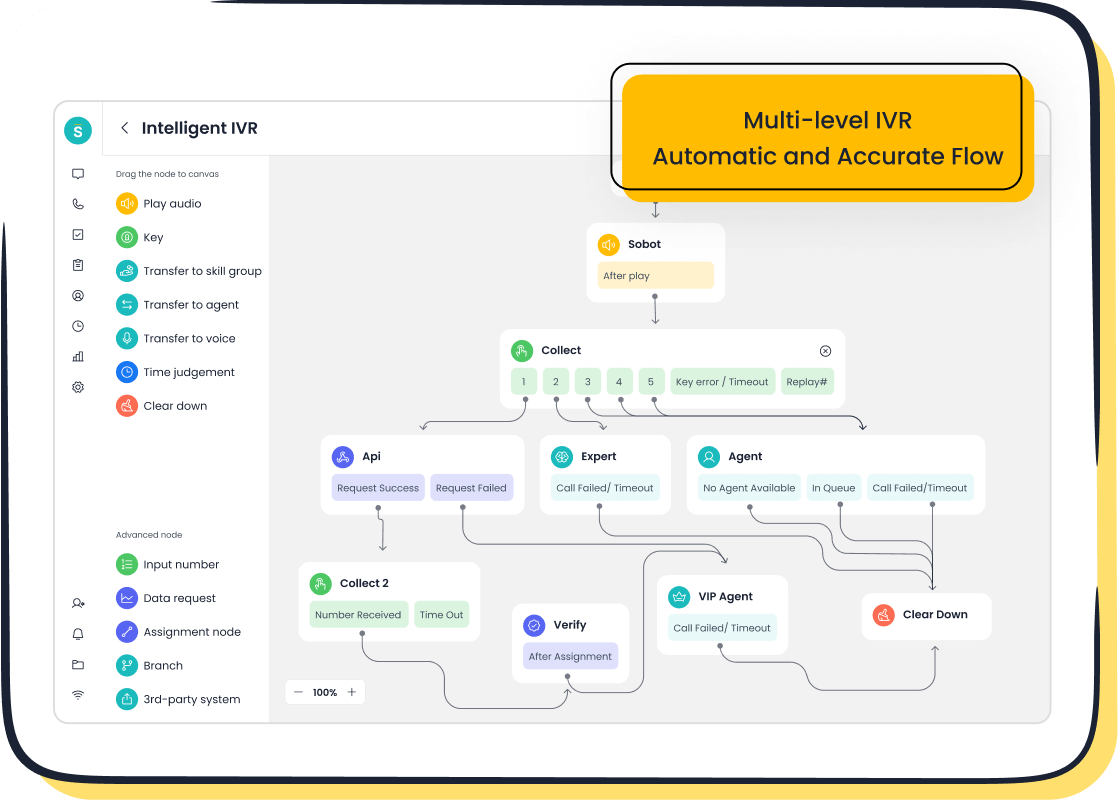
Improving this metric is a primary goal for any service team. Tools like Sobot's Voice/Call Center directly reduce FRT with features like Smart Call Routing. This technology automatically directs a customer to the most qualified agent, eliminating long waits and unnecessary transfers. This ensures your customer connects with the right person on the first try, improving one of your most important customer service kpis.
Average Handle Time (AHT)
Average Handle Time (AHT) is the average duration of a single customer interaction, from the moment it begins until all related after-call work is complete. This is one of the most common customer service kpis for measuring agent efficiency and managing operational costs.
While a lower AHT means your team can handle more customer inquiries, you must balance speed with service quality. Rushing through interactions can lead to unresolved issues and poor satisfaction. The goal is to be efficient, not hurried.
How to Calculate AHT:
(Total Talk Time + Total Hold Time + After-Call Work) / (Total Number of Interactions)
AHT benchmarks can differ significantly by industry due to the complexity of inquiries.
| Industry | Average Handle Time (minutes) |
|---|---|
| Retail/E-commerce | 2-4 |
| Business & IT Services | 7-10 |
One of the biggest drags on AHT is the time agents spend searching for information. Forrester reports that agents can spend nearly a third of their handle time looking for answers across disconnected systems. You can reduce AHT without sacrificing quality by empowering your agents.
This is where Sobot's Unified Workspace makes a difference. It brings together customer data, interaction history, and your knowledge base into a single view. When an agent receives a call, they have all the context they need on one screen. This eliminates time wasted switching between applications and allows them to deliver a faster, more accurate service. Better tools lead to better performance on your customer service kpis.
Ticket Volume
Ticket Volume is the total number of support requests your team receives over a given period. While simple, this is one of the most fundamental customer service kpis for understanding workload and resource allocation. Monitoring this metric helps you manage your team effectively.
The formula is straightforward:
Total number of support tickets in a given period
Analyzing ticket volume trends is crucial for strategic planning. Spikes in volume are often tied to specific events. Common causes include:
- New product launches or marketing campaigns
- Seasonal periods like holidays or sales events
- Service outages or product bugs
- Expansion into new markets
By tracking these metrics, you can move from a reactive to a proactive service model. For example, if you see a spike in tickets every time you release a software update, you can prepare your team in advance or work to improve the release process.
You can use ticket volume data to make smarter decisions about your service operations. Tracking these customer service kpis helps you:
- Optimize Staffing: By identifying peak hours and days, you can schedule agents more effectively to meet customer demand without overstaffing during quiet periods.
- Identify Product Issues: If you categorize tickets and notice a high volume related to a specific feature, it signals a potential problem with the product or a need for better documentation. Addressing the root cause reduces future tickets and improves the customer experience.
- Forecast Future Needs: Historical data allows you to predict future ticket volume, helping you plan hiring and resource allocation for upcoming quarters.
Effectively managing these efficiency metrics is the first step toward building a world-class service organization. By focusing on these customer service kpis, you ensure your team has the resources and processes needed to deliver high-quality support.
Measuring the Customer Experience with Quality KPIs

Efficiency metrics tell you how fast your team works. Quality metrics tell you how well your service resonates with the customer. Focusing on the quality of interactions is what builds lasting relationships and turns a good service department into a great one. These customer service kpis measure satisfaction, loyalty, and ease of experience. They give you direct feedback on your performance and show you where to improve.
Customer Satisfaction Score (CSAT)
The Customer Satisfaction Score (CSAT) is a metric that measures a customer's satisfaction with a specific interaction or experience. You typically ask a question like, "How would you rate your overall satisfaction with the service you received?" Customers respond on a scale (e.g., 1-5, Very Unsatisfied to Very Satisfied).
This KPI gives you immediate insight into the quality of a single service touchpoint. A high Customer Satisfaction Score indicates your team is meeting or exceeding customer expectations. In the e-commerce industry, for example, the average CSAT score reached 80% in 2023, showing a strong focus on the customer experience.
How to Calculate Customer Satisfaction Score:
(Number of Satisfied Customers) / (Total Number of Survey Responses) x 100"Satisfied Customers" are those who gave the top two ratings (e.g., 4 and 5 on a 5-point scale).
To get useful feedback, you need to design your surveys well. Here are some best practices:
- Keep it brief. Shorter surveys get better response rates.
- Ask at the right time. Send a survey immediately after an interaction ends.
- Use simple language. Avoid jargon so anyone can understand the question.

Tools like Sobot's Ticketing System and Live Chat can automatically trigger a CSAT survey the moment a ticket is closed or a chat ends. This ensures you capture fresh, accurate feedback to measure your customer service kpis effectively.
Net Promoter Score (NPS)
The Net Promoter Score (NPS) measures long-term customer loyalty. It asks one simple question: "On a scale of 0-10, how likely are you to recommend our company/product to a friend or colleague?"
Based on their answers, you group customers into three categories:
- Promoters (9-10): Your most enthusiastic and loyal customers.
- Passives (7-8): Satisfied but not loyal. They are vulnerable to competitors.
- Detractors (0-6): Unhappy customers who can damage your brand through negative word-of-mouth.
How to Calculate Net Promoter Score:
(% of Promoters) - (% of Detractors)
A "good" Net Promoter Score depends on your industry. The average for the telecommunications industry is 31, so a score above that is considered strong. The goal is to have more Promoters than Detractors. Companies like Zappos built their brand on exceptional service, using NPS feedback to train their teams and improve customer loyalty. This focus increased their sales by 20% through word-of-mouth referrals.
Improving your Net Promoter Score requires a consistent focus on quality. The success of OPPO with Sobot is a perfect example. OPPO used Sobot's chatbot and ticketing system to achieve an 83% resolution rate and a 94% positive feedback rate, directly impacting their CSAT and NPS. When you consistently provide a positive experience, you create more Promoters.
Customer Effort Score (CES)
Customer Effort Score (CES) measures how much effort a customer has to put in to get an issue resolved. The survey asks a question like, "To what extent do you agree with the following statement: The company made it easy for me to handle my issue." Customers usually answer on a 7-point scale from "Strongly Disagree" to "Strongly Agree."
A low-effort experience is a key driver of customer loyalty. When you make service easy, customers are more likely to return. High effort, caused by friction points like confusing websites or long hold times, creates frustration and drives customers away. A B2B tech firm, for instance, saw better client relationships after simplifying its ticket submission process and introducing a chatbot for immediate answers.
How to Calculate Customer Effort Score:
(Sum of all scores) / (Total number of responses)A higher average score indicates a lower-effort experience.
Reducing customer effort is a core goal of modern service. Sobot's AI-powered Chatbot provides 24/7 self-service, allowing a customer to get answers instantly without waiting for an agent. This dramatically lowers effort and improves satisfaction. When an issue is complex, the chatbot can seamlessly hand it off to a human agent within Sobot's Unified Workspace, creating a smooth, low-effort journey. These are vital customer service kpis for gauging the ease of your service.
First Contact Resolution (FCR)
First Contact Resolution (FCR) is one of the most important customer service kpis for both satisfaction and efficiency. It measures the percentage of inquiries that are completely resolved in the first interaction, with no need for the customer to follow up.
A high First Contact Resolution rate is a win-win. The customer is happy because their problem is solved quickly. Your team is more efficient because they spend less time on repeat inquiries. The industry average for technical support teams is around 65%, but top-performing companies achieve much higher rates. A high FCR builds customer trust and confidence in your service.
How to Calculate First Contact Resolution:
(Number of issues resolved on first contact) / (Total number of issues) x 100
The biggest barrier to a good First Contact Resolution rate is a disconnected service experience. If an agent lacks context or the right information, they cannot solve the problem on the first try. This is where an omnichannel approach becomes essential.
Sobot's Omnichannel Solution is designed to boost your First Contact Resolution. It unifies all customer interactions—from email, chat, social media, and phone—into a single, chronological timeline. When a customer calls, your agent sees their entire history instantly. This removes guesswork and eliminates the need for the customer to repeat themselves. With all the information at their fingertips, agents are empowered to solve issues on the spot. This unified view is crucial for improving one of the most impactful customer satisfaction metrics.
Strategic KPI for Customer Service: Business Outcomes
Excellent service does more than create happy customers. It directly drives business growth. Strategic customer service kpis connect your team's daily performance to high-level business goals like revenue and profitability. Tracking these outcomes shows the true value of your service department. You can prove that investing in quality service is an investment in the company's future. These customer service kpis move the conversation from operational costs to long-term value.
Customer Churn Rate as a Service KPI
Customer Churn Rate measures the percentage of customers who stop using your service over a specific period. This is a critical kpi for customer service because it often points directly to service quality issues. Poor experiences are a major reason a customer leaves. In fact, about 50% of customers will switch to a competitor after just one bad service interaction.
- Long wait times for support
- Unhelpful or rude agents
- Being transferred multiple times
- Having to repeat the same problem
For many subscription companies, an acceptable annual churn rate is between 5-7%. A high rate signals that your service is not meeting customer expectations. Reducing churn is essential for sustainable growth, making this one of the most important customer service kpis for any business.
Customer Retention Rate
The customer retention rate is the flip side of churn. It measures the percentage of customers you successfully keep over time. High customer retention is a clear sign of customer loyalty and satisfaction. Loyal customers are the foundation of a profitable business.
Improving your customer retention rate has a massive impact on your bottom line. Research from Bain & Company shows that a 5% increase in customer retention can boost profits by 25% to 95%. You can improve this kpi by focusing on the quality of your service. Strategies like personalizing every interaction and actively listening to customer feedback build strong relationships and increase loyalty. A focus on retention turns your service team into a profit center.
Customer Lifetime Value (CLV)
Customer Lifetime Value (CLV) predicts the total revenue your business can expect from a single customer account. This kpi shows the long-term financial impact of a quality customer experience. Every positive service interaction contributes to a higher CLV.
When you provide excellent service, you create more satisfaction. Research from American Express found that satisfied customers spend 14% more. Prompt and effective service makes a customer feel valued, which encourages them to stay longer and buy more. For example, Ulta Beauty increased the lifetime value of its shoppers by offering a guest-centric service experience with personalized incentives. Improving customer service kpis like response time and resolution rate directly boosts your CLV and overall business performance.
Choosing the Right Key Performance Indicators
Selecting the right customer service kpis is a strategic decision. You need a balanced set of metrics that shows the full picture of your service performance. This helps you move beyond just tracking activity and start measuring what truly impacts your customer and your business.
Aligning KPIs with Business Goals
Your customer service kpis must connect directly to your company's main objectives. If your goal is to grow your market share, your service team should focus on KPIs that support customer acquisition and satisfaction. If you want to improve profitability, focus on customer retention and loyalty.
To align your kpi for customer service with business goals, you should:
- Start with your strategy: Clearly define your company's vision and goals.
- Choose relevant metrics: Select customer service kpis that directly measure progress toward those goals.
- Engage your team: Ensure everyone understands how their performance contributes to the bigger picture.
This alignment turns your service department from a cost center into a value driver, proving the impact of a great customer experience.
Balancing Different KPI Categories
Focusing on just one type of kpi can give you a misleading view of your service quality. For example, chasing a low Average Handle Time (AHT) might cause agents to rush, leading to poor satisfaction. You must balance efficiency with quality.
The goal is to find the sweet spot where efficiency meets effectiveness.
For every efficiency kpi you track, pair it with a quality kpi. If you measure FRT, also measure CSAT. This balanced approach ensures you are not just fast, but also effective. It gives you a complete view of your service performance and helps you coach agents on both speed and quality of care for each customer.
Setting Realistic Benchmarks
How do you know if your performance is good? You need to compare your customer service kpis against benchmarks. Benchmarks can be based on your own historical performance or industry standards. They provide context and help you set achievable goals for your team. For example, a B2C eCommerce business might aim for a higher CSAT score than a B2B service provider due to different customer expectations.
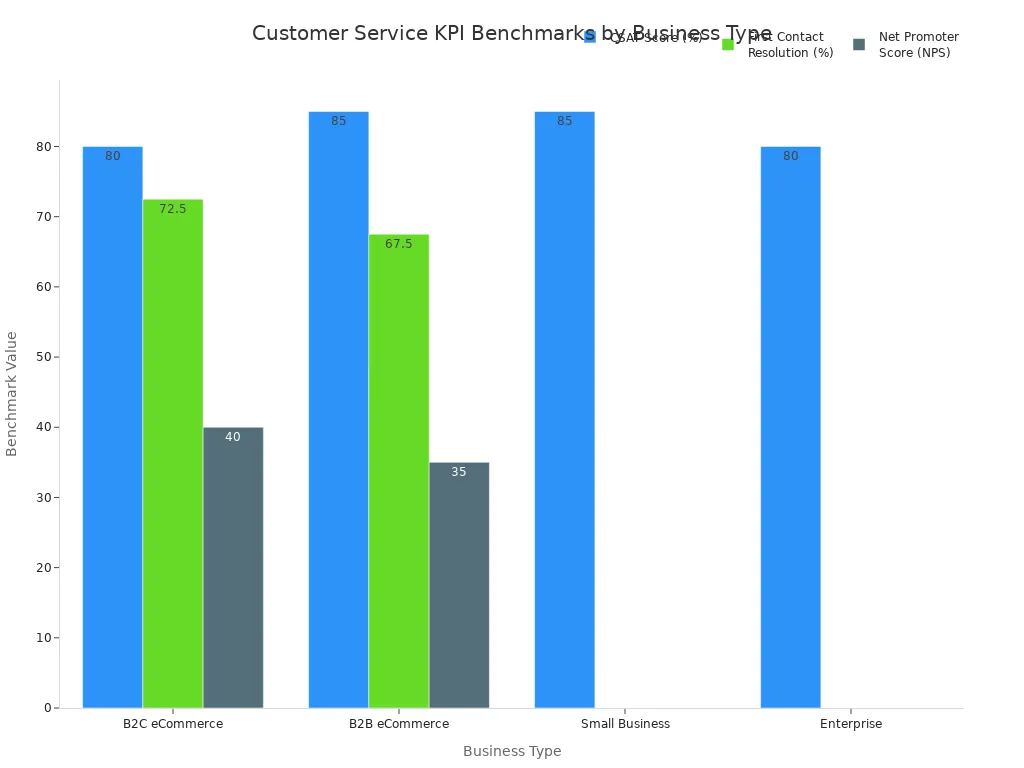
Setting realistic targets keeps your team motivated and focused on continuous improvement for every customer.
Reviewing and Adjusting Your KPIs
Your business and your customer needs are always changing. Your customer service kpis should change with them. What worked last year might not be relevant today. Regular reviews are essential for ensuring your metrics remain effective.
You should review your customer service kpis on a consistent schedule, such as monthly or quarterly. During these reviews, analyze trends and gather feedback from your team. This process helps you:
- Identify if a kpi is still relevant to your goals.
- Adjust targets to reflect new challenges or opportunities.
- Ensure your team has the tools and training to succeed.
This cycle of review and adjustment keeps your service strategy sharp and responsive to customer feedback.
Tracking a balanced set of customer service kpis is essential. You need to measure efficiency, quality, and business impact. This gives you a full view of your service performance. Sobot's all-in-one contact center solution helps you track every kpi. Our tools, like the AI-powered call center, improve your performance. This focus on quality service boosts customer satisfaction and customer loyalty. Better service for each customer leads to better customer retention. A great customer experience drives your success.
Ready to measure what matters? Embark on Your Contact Journey with Sobot and see how our solutions can transform your service performance.
FAQ
Which KPI is most important for my customer service team?
There is no single "most important" KPI. A balanced approach is best. You should track efficiency metrics like FRT alongside quality metrics like CSAT. This gives you a full picture of your customer service performance and the experience you provide for each customer. Every customer interaction matters.
How do I start tracking customer service KPIs?
Start by aligning KPIs with your business goals. Choose a few key metrics from each category: efficiency, quality, and business outcomes. Use a platform like Sobot to track data automatically. This helps you measure the service your customer receives and understand every customer journey.
How does AI improve customer service KPIs?
AI improves your customer service by automating tasks. An AI chatbot can handle simple customer questions 24/7, lowering your First Response Time. This frees up your agents to focus on more complex customer issues, improving the quality of your service for every customer.
How does Sobot help improve my customer service?
Sobot's all-in-one platform gives your team the tools to succeed. The Unified Workspace provides a complete view of every customer. Smart routing connects a customer to the right agent faster. This improves your service efficiency and boosts customer satisfaction for every single customer.
See Also
Discover The 10 Leading Customer Service Software Solutions For 2024
Boost Live Chat Satisfaction: 10 Essential Tips For Happier Customers
Mastering Call Center Quality Management Systems: A Comprehensive Principles Guide
Implementing Top Quality Management Practices For Your Call Center Success
Selecting Social Media Customer Service Software: 10 Expert Tips To Guide You

