Why Customer Service Manners Matter Now


You once treated customer service as a simple transaction. Today, you must build relationships. A single poor customer experience can be devastating, as 50% of loyal customers will leave after just one bad interaction. Great customer service is your new competitive edge. Mastering customer service manners is essential for building trust and loyalty. This guide details the customer service etiquette for creating positive customer relationships. You will see how modern tools like the Sobot call center, powered by Sobot AI, help you perfect these crucial customer interactions and drive business growth.
The New Competitive Edge
Excellent customer service manners are no longer a bonus; they are your primary advantage. In a world full of choices, you must deliver an experience that stands out. This is how you turn a simple transaction into lasting loyalty.
Differentiating in a Digital-First World
You operate in a saturated digital market where products and prices often look the same. The one true differentiator you control is the customer experience. Great customer service is your most powerful tool to stand out. When 80% of customers are more likely to buy from a brand offering a personalized experience, you cannot afford to be generic. Companies like Amazon and Zappos built empires by making service their cornerstone. You can do the same by focusing on creating positive, memorable interactions that make customers feel valued, not just processed.
Building Trust Without Face-to-Face Contact
In digital channels, you build trust through consistency and clarity. Without the benefit of a handshake or a smile, your actions must speak for you. Every prompt reply, clear explanation, and fulfilled promise strengthens the customer relationship. This is how you achieve the building trust and loyalty that is essential for growth.
The key is consistency. Customers learn to trust you when your behavior is predictable and reliable across all customer interactions. Clear, transparent communication reduces uncertainty and shows you respect their time and intelligence.
Responding quickly and showing genuine interest in customer feedback are not just polite gestures; they are fundamental parts of your customer service etiquette.
The High Cost of a Bad Interaction
A single negative interaction does more damage than you think. While 50% of customers will leave for a competitor after one bad experience, the impact spreads further. About 17% of unhappy customers will share their negative story, damaging your reputation. The entire customer journey is fragile. Poor customer service etiquette at any point can lead to:
- Lost revenue from a departing customer.
- Damage to your brand's reputation.
- Decreased customer satisfaction and lower engagement.
Investing in proper customer service manners is a direct investment in protecting your bottom line.
Foundational Customer Service Manners

You build lasting customer relationships on a foundation of respect and trust. Foundational customer service manners are the essential skills that turn a routine inquiry into a positive experience. Mastering these basics ensures every interaction reinforces your brand's commitment to the customer.
Master the First Contact
The first 30 seconds of any interaction set the tone for everything that follows. A professional, welcoming start shows customers you value their time and are ready to help. You make a great first impression by following a clear and consistent process.
A proven formula for a professional greeting includes these steps:
- State Your Identity Clearly: "Thank you for calling [Your Company Name], this is [Your Name]."
- Offer Immediate Assistance: "How may I help you today?"
- Maintain a Courteous Tone: Thank the customer for reaching out.
- Be Prompt: Aim to answer every call within three rings to show you respect their time.
When you resolve an issue in a single interaction, you significantly boost customer satisfaction. This process begins with a first contact that is both efficient and polite. However, delivering this consistency manually across a growing team is a major challenge.
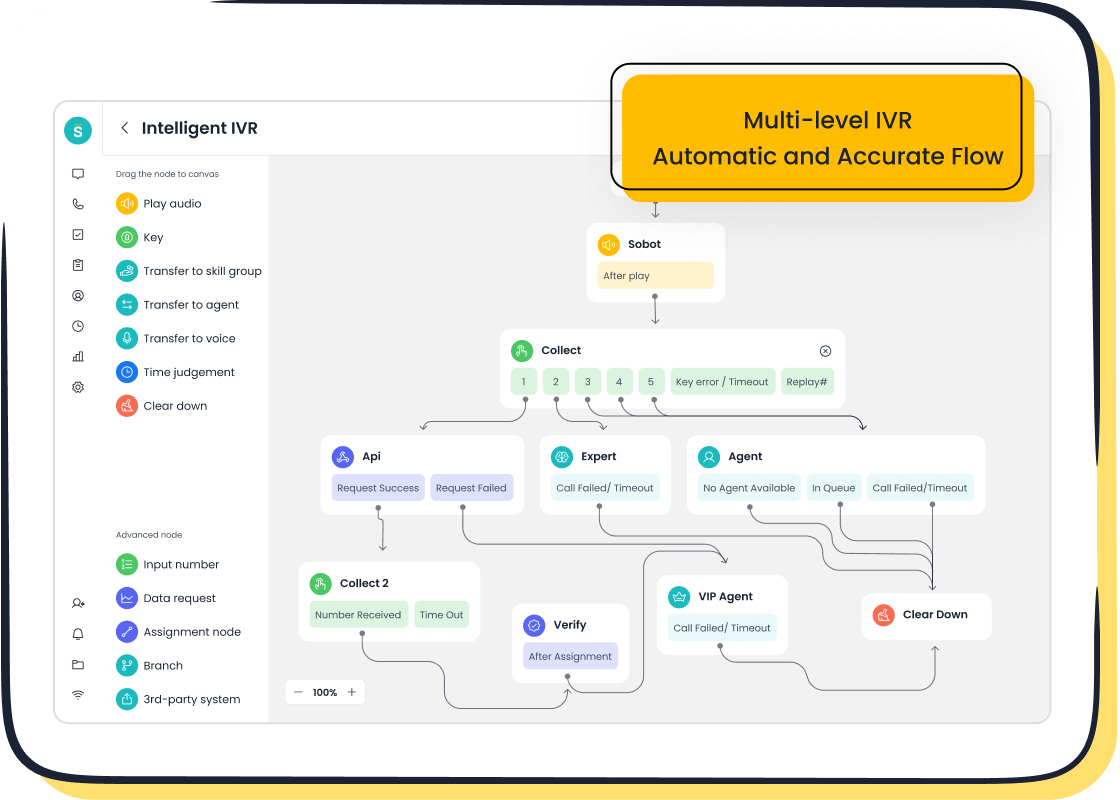
This is where technology enhances your customer service etiquette. A solution like Sobot's Voice/Call Center empowers you to perfect that first contact every time. You can use its drag-and-drop intelligent IVR to create customized, professional greetings that align with your brand voice. From there, smart call routing ensures customers connect to the right agent promptly, eliminating frustrating transfers and long wait times. You demonstrate respect for the customer from the very first second.
The Power of Active Listening
Great customer service requires you to hear what is said and understand what is meant. Active listening is the skill of focusing completely on the customer to grasp their needs, frustrations, and goals. It is a cornerstone of effective communication and shows the customer they have your full attention.
To practice active listening, you should:
- Give Your Full Attention: Eliminate distractions and focus entirely on the customer's words and tone.
- Summarize Key Points: Before offering a solution, repeat the issue back in your own words. For example, say, "So, if I understand correctly, your package hasn't arrived and the tracking number isn't updating. Is that right?" This confirms your understanding and makes the customer feel heard.
- Ask Clarifying Questions: Use open-ended questions like, "Can you tell me more about what happened when you tried to log in?" This encourages the customer to provide details you need for a quick resolution.
- Use Verbal Affirmations: On phone calls, simple phrases like "I see" or "I understand" show you are engaged and following along.
By mastering active listening, your customer support team can diagnose issues more accurately. This leads directly to higher first-contact resolution rates, as you solve the right problem the first time.
Use Positive Language to Frame Solutions
The words you choose have a powerful impact on a customer's perception. Positive language focuses on what you can do, not on what you cannot. This simple shift in framing turns a potentially negative interaction into a collaborative and productive one. You build trust by presenting yourself as an ally, not a gatekeeper.
Avoid negative, dismissive, or blaming language. Instead, you can reframe your responses to be helpful and empowering.
| Instead of This (Negative) | Try This (Positive) |
|---|---|
| "That's not our policy." | "Let me share what we can do for you." |
| "I can't help you with that." | "While I may not be the expert, I'll connect you with someone who can assist." |
| "You should have read the instructions." | "I apologize for the confusion. Let's walk through the steps together." |
| "There's nothing more I can do." | "I'll explore additional options to see how we can resolve this." |
Customers are not interested in your limitations; they want solutions. By using positive language, you focus the conversation on action and resolution. This approach avoids triggering defensive reactions and helps the customer feel that you are working on their behalf.
Exceptional customer service etiquette means choosing words that build confidence. When you frame solutions positively, you control the narrative and guide the customer toward a successful outcome, reinforcing their decision to do business with you.
Mastering Customer Service Etiquette
Once you have the fundamentals down, you can elevate your service with more advanced etiquette. Mastering customer service etiquette is about moving beyond process and into genuine connection. You build unbreakable loyalty when you show customers you understand them as individuals and respect their emotional state. This is where you transform good service into an exceptional customer experience.
Show Empathy to De-escalate Tension
Angry or frustrated customers are a reality in any business. Your reaction in these moments defines your brand. Showing empathy is your most powerful tool for de-escalating tension. Empathy is not about agreeing with the customer or accepting blame; it is about acknowledging and validating their feelings. When you show a customer you understand their frustration, you shift from an adversary to an ally.
Before you jump to a solution, you must first listen and connect. Allow the customer to express their frustration without interruption. Then, use phrases that validate their feelings and demonstrate you are on their side.
- “I understand how frustrating it is to wait longer than expected. Let me look into this for you immediately.”
- “I can see how that would be upsetting. Thank you for bringing this to our attention.”
- “Your concerns are completely valid, and I would feel the same in your situation. Let's work together to fix this.”
- “I’m really sorry to hear that you’ve had to go through this experience. We’re going to take care of this for you.”
Note: Empathy is a skill you can build across your team. Training methods like scenario-based role-playing and AI-driven simulations help agents practice their responses in a safe environment. This preparation ensures they can handle difficult conversations with grace and confidence.
By showing empathy, you disarm anger and open the door to effective communication and problem-solving. You turn a moment of crisis into an opportunity to prove your commitment to the customer.
Personalize the Experience
Customers today expect you to know them. In fact, 71% of customers expect personalized experiences, and 76% get frustrated when they do not receive them. Personalization and customization are no longer perks; they are core components of modern customer service etiquette. You achieve this by using a customer's name and, more importantly, their history with your brand. You make them feel seen and valued, not like just another ticket number.
The business impact is undeniable. Fast-growing companies generate 40% more revenue from personalization, and 62% of business leaders report that their efforts have improved customer retention. When you tailor your communication, you show respect for the customer journey and the relationship you have built over time. For example, a leading airline empowers its flight attendants with data on frequent fliers. They can offer personalized greetings or special offers, demonstrating a deep appreciation for loyalty.
But how do you provide this level of personalization and customization at scale, especially when customers contact you across different channels?
This is where the right technology becomes essential for exceptional customer service etiquette. Sobot's Omnichannel Solution provides a unified workspace that gives your agents a complete 360-degree view of every customer.
- Unified History: Your agents can instantly see a customer's entire history across all channels—voice, email, social media, and live chat—in one place.
- Informed Conversations: Instead of asking repetitive questions like "What was your last order number?", your agents already have the context. They can see past purchases, previous support tickets, and chat transcripts.
- Respectful Service: This unified view allows your team to offer truly personalized and respectful customer support. You acknowledge their history and demonstrate that you value their time and their relationship with your brand.
With a tool like Sobot, you empower your team to move beyond transactional interactions and build meaningful, personalized relationships that drive loyalty.
Maintain Professionalism in Digital Channels
Live chat and social media have a naturally casual feel, but your customer service manners must remain professional. Every digital interaction is a reflection of your brand. Inconsistent or sloppy communication can quickly damage your reputation, as 60% of millennials expect consistent experiences when dealing with brands. Effective communication in these channels requires a careful balance of being friendly and efficient without sacrificing professionalism.
To maintain a high standard of customer service etiquette online, you should follow a clear set of rules:
- Respond Promptly: Acknowledge the customer within seconds to show you are attentive.
- Use Proper Grammar and Spelling: Avoid slang and typos. Clean, professional writing builds credibility.
- Be Clear and Concise: Write short, easy-to-understand messages. Avoid jargon that might confuse the customer.
- Personalize the Greeting: Always use the customer's name to start the conversation on a positive note.
- Maintain a Positive Tone: Frame your responses around what you can do, even when delivering difficult news.
- Empathize and Acknowledge: Use phrases like, "I understand how frustrating that must be," to show you are listening.
- End the Chat Positively: Thank the customer for reaching out and ask if there is anything else you can help with.
A common mistake is sending generic, un-personalized messages. With 72% of consumers saying they only engage with personalized messaging, failing to tailor your communication makes your brand seem disconnected and uncaring. Your professionalism across all channels reinforces your brand's reliability and respect for every customer.
Advanced Manners for Lasting Loyalty
You build true customer loyalty when you handle the toughest situations with skill and care. Advanced manners go beyond basic politeness. They involve navigating conflict, taking full responsibility, and managing escalations without causing more frustration. These actions show customers you are a partner they can trust, even when things go wrong.
Navigate Conflict with Grace
Conflict is an opportunity to demonstrate your commitment to the customer. You can turn a negative experience into a positive one with the right approach. Your goal is to de-escalate the situation through effective communication and empathy. You need strong conflict resolution skills to guide the conversation toward a solution. Use structured frameworks that involve clear communication rules, such as using 'I' statements and practicing active listening. This approach reduces defensiveness and fosters understanding. Your ability to remain calm and professional shows the customer they are in capable hands, reinforcing their trust in your brand.
Take Ownership to Rebuild Trust
When a problem occurs, customers want a solution, not excuses. Taking ownership is more effective than blaming external factors. It builds trust and shows integrity. Blaming others erodes relationships and creates a toxic environment, while taking ownership shifts the focus to problem-solving. You can cultivate this by empowering your team to find solutions.
Use language that shows personal commitment. Instead of saying, "That's against our policy," try, "Let me see what I can do to make this right for you." This is where a tool like Sobot's Ticketing System becomes invaluable. It allows your team to:
- Document and track every issue from start to finish.
- Assign clear ownership so nothing falls through the cracks.
- Analyze ticket data with AI to identify root causes and prevent future problems.
This system empowers your agents to take accountability and follow through on their promises, which is a cornerstone of excellent customer service etiquette.
Escalate Respectfully and Seamlessly
Sometimes, an issue requires a higher level of authority. How you handle this escalation is critical. A clumsy handoff forces the customer to repeat their story, which is a major source of frustration. You must escalate issues respectfully and seamlessly. This means using a "warm transfer," where you introduce the customer to the next agent and provide full context. Your effective communication ensures the new agent is fully prepared. Sobot's Ticketing System supports this process by creating a detailed, unified record of the interaction. When a ticket is escalated, the entire history moves with it. This ensures the next person has all the information needed to continue the conversation without interruption, showing the customer you value their time and are working together as one team. This level of coordination requires empathy and strong conflict resolution skills.
Your customer service manners are a direct investment in your brand's value. Core skills like empathy and ownership transform routine customer interactions into relationships built on trust. While products and prices can be copied, a strong service culture cannot.
You make a fortune by investing time and good service in a customer.
Empower your team with the right mindset and the right tools. Turn every conversation into an opportunity to build loyalty. Discover how Sobot can help you achieve this at https://www.sobot.io/.
FAQ
Why are customer service manners so important today?
Good manners build trust and loyalty in a competitive digital market. You differentiate your brand through positive interactions. Excellent customer service manners turn a simple transaction into a lasting relationship, which is essential for business growth and retaining customers.
How can you train your team to be more empathetic?
You can build empathy through practice. Use role-playing for difficult customer scenarios. Review call recordings to identify opportunities for improvement. This training helps your team understand customer feelings and respond with genuine care, turning negative situations into positive outcomes.
Do technology tools replace the need for good manners?
No, tools enhance your team's ability to practice good manners. A solution like Sobot's Omnichannel platform provides customer history, so you can offer personalized service. Technology empowers your team to be more efficient and respectful, not replace their human touch.
What is the first step to improve our customer service?
You should start by mastering the first contact. Create a professional and welcoming greeting for every channel. Use tools to ensure customers reach the right person quickly. A great first impression shows you respect the customer's time and sets a positive tone.
See Also
Optimizing Call Center Performance: Essential Strategies for Quality Management Success
Elevate Live Chat: Ten Practical Tips for Boosting Customer Delight
Mastering Call Center Quality: A Comprehensive Guide to QMS Principles
AI's Impact: How Intelligent Agents Are Transforming Customer Service
Selecting Social Software: Ten Key Tips for Customer Service Excellence

