Automation's Impact on CX

The greatest customer support automation impact on customer experience is its speed. Your success, however, depends entirely on a strategic human touch. How can you leverage bots to solve problems faster without making your customers feel like just another ticket number? Rising customer expectations demand instant answers. Still, more than half of customers report frustration when they cannot reach a live agent. This dilemma highlights the need for an empathetic human touch. A solution like Sobot helps you find the right balance, blending efficiency with the essential human touch.
The Real Customer Support Automation Impact on Customer Experience
The true customer support automation impact on customer experience lies in finding a perfect balance. You must blend technology's speed with a necessary human touch. This balance directly influences customer satisfaction and brand loyalty.
The Modern CX Dilemma: Efficiency vs. Empathy
Modern customer expectations demand both speed and understanding. You want to provide instant answers, but you also need to show empathy. Customer service automation helps you deliver fast, consistent support 24/7. This availability improves customer satisfaction by reducing wait times. Customers can solve simple issues on their own, which makes the process feel easy. However, a purely automated system can feel cold. The key is to use automation for efficiency while reserving the human touch for moments that require genuine connection, which ultimately boosts customer satisfaction.
The Risk of Over-Automation: Impersonal Service
Relying too heavily on automation can harm your brand. Customers become frustrated when they feel trapped in a loop or receive robotic responses. This impersonal service can damage customer satisfaction and fails to meet rising customer expectations. Many people report frustration when they cannot easily reach a person for help.
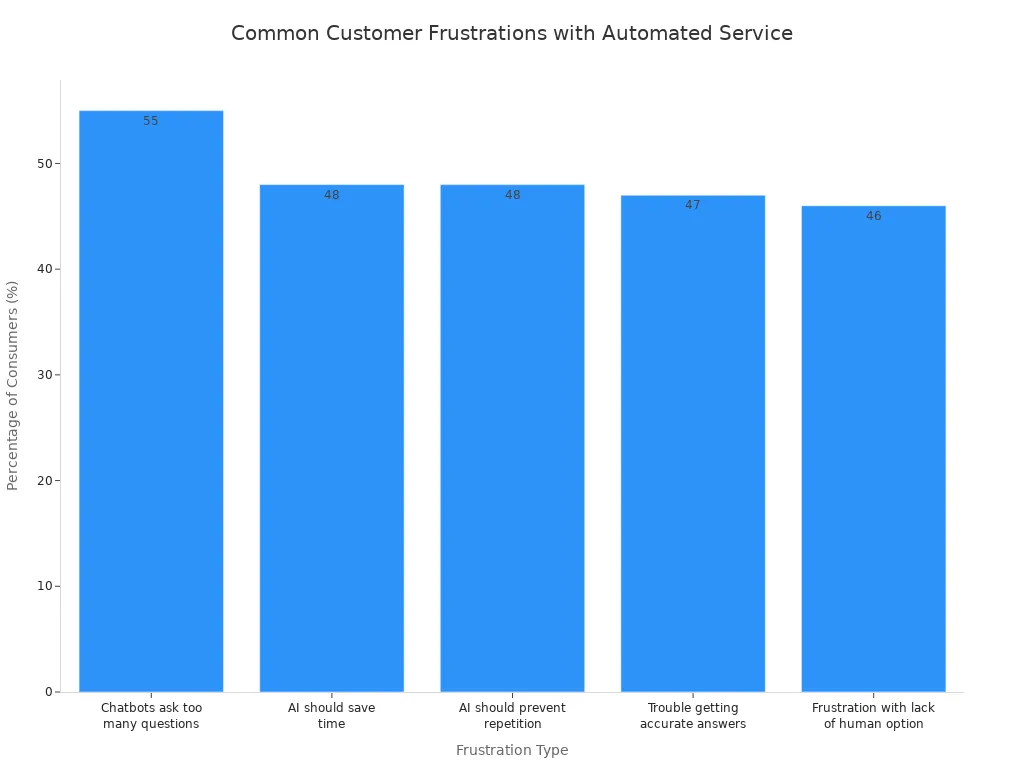
The negative customer support automation impact on customer experience is clear when bots fail on complex issues. You must offer a seamless way to connect with a human agent. This option provides a safety net and shows you value your customer's time. A thoughtful human touch is irreplaceable.
The Cost of Under-Automation: Agent Burnout
Failing to automate also carries a high cost. Your customer support agents face immense pressure. They handle repetitive questions all day, which leads to burnout.
Studies show that a staggering 74% of call center agents are at risk of burnout. When agents are overworked, their performance drops, and customer satisfaction suffers.
A significant customer support automation impact on customer experience is its ability to protect your team. By automating routine tasks, you free your agents to focus on complex problems. This approach not only improves their job satisfaction but also ensures that customers with urgent needs receive high-quality, focused help. This strategic use of automation enhances both the agent and customer experience, leading to higher overall customer satisfaction.
Strategic Automation: Where to Apply the Human Touch
Effective automation strategies do not remove the human touch. They apply it more intelligently. You can achieve this by mapping your customer journey and identifying the right moments for bots and the right moments for people. This strategic approach ensures you deliver speed where it matters and empathy where it counts, boosting both efficiency and customer satisfaction.
Identifying Ideal Touchpoints for Automation
First, you need to find the best places to use automation. Look at your entire customer journey from start to finish. You will find many interactions that are repetitive and predictable. These are perfect candidates for automation. Automating these simple tasks frees your team for more complex issues. This focus improves the overall customer support automation impact on customer experience.
Ideal touchpoints for automation often involve straightforward, high-volume questions. You can use automation to handle:
- Order Status: "Where is my package?"
- Shipping Information: "How much does shipping cost?"
- Product Availability: "Is this item in stock?"
- Return Policies: "How do I return an item?"
- Basic Product Guidance: "How do I use this feature?"
- Account Setup: "How do I create an account?"
By automating these queries, you provide instant answers 24/7. This immediate support greatly improves customer satisfaction and builds trust in your brand.
Automating Routine Inquiries with a Chatbot
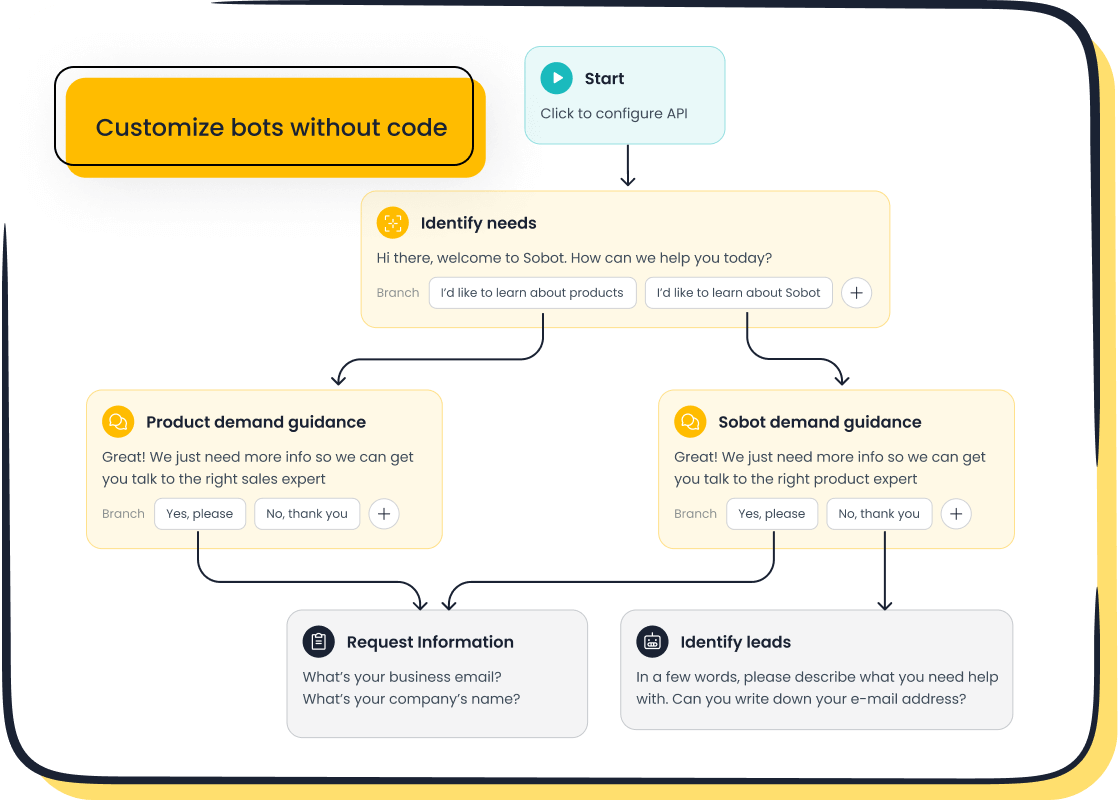
A chatbot is your best tool for handling routine inquiries. Modern AI customer service chatbots can understand and resolve common questions instantly. This allows you to build automation workflows that guide customers to solutions without needing a human agent. For example, you can use a tool like Sobot's no-code Chatbot to easily design and deploy these workflows. You do not need any coding experience to get started.
Well-designed chatbots can successfully resolve a high percentage of issues. Industry benchmarks show that AI-powered bots can handle 80% of common service questions on their own. This efficiency has a massive impact on your team's workload and your company's bottom line.
Success in Action: OPPO
The global smart device brand OPPO faced a surge in customer questions during peak shopping seasons. By implementing Sobot's chatbot, they created a powerful human-machine team. The chatbot handled repetitive queries, achieving an 83% resolution rate. This freed their human agents to focus on complex problems requiring a human touch. The result? A 57% increase in their repurchase rate, proving that smart automation directly fuels customer retention.
This success is not unique. Many businesses see powerful results from automating routine inquiries.
| Company | Problem Addressed | Key Result |
|---|---|---|
| Le Petit Croissant (Bakery) | Staff spent 3 hours/day on repetitive Instagram DMs | Cut staff workload by 70% |
| FlowMetrics (Tech Startup) | 65% of trial users dropped off during setup | Achieved an 80% deflection rate for onboarding queries |
| UrbanStitch (Fashion Retailer) | Backlogs of return requests | Saved $278K in 6 months and hit 92% customer satisfaction |
Automating these tasks improves customer satisfaction by providing instant answers. It also boosts customer retention by creating a smooth, effortless experience.
Designing a Seamless Handoff from Bot to Human
Even the best AI customer service has its limits. Some problems are too complex or emotionally charged for a bot. This is where the human touch becomes essential. A seamless handoff from bot to human is critical for maintaining customer satisfaction. You must make this transition feel like a natural continuation, not a frustrating restart.
To create a smooth handoff, follow these best practices:
- Offer a Clear Escape Hatch: Always give customers an obvious way to reach a person. A "Talk to an Agent" button or a simple command like "agent" builds trust.
- Preserve the Context: The worst experience is having to repeat yourself. Ensure the full chat history, customer name, and account details are passed directly to the human agent. This allows your agent to pick up the conversation without missing a beat.
- Set Clear Expectations: Your bot should tell the customer what is happening. Use clear automated messages like, "I'm connecting you with a support agent who can help. The wait is about 2 minutes."
- Route to the Right Team: Use the bot's understanding of the problem to send the customer to the correct department. This avoids internal transfers and gets the problem solved faster.
This is where an integrated solution shines. Your automation workflows can seamlessly transfer a conversation from a Sobot Chatbot to a live agent using Sobot's Live Chat. If an agent is not available, the system can automatically create a detailed ticket in the Sobot Ticketing System. This process preserves all context, respects the customer's time, and provides the necessary human touch to solve the problem effectively. This thoughtful blend of technology and human support is key to strong customer retention and lasting customer satisfaction.
Core Principles of Human-Centered Automation

True human-centered automation is not about replacing people. It is about making technology work for people—both your customers and your team. This approach uses AI to enhance human capabilities, creating experiences that are both efficient and empathetic. By focusing on personalization, empowerment, and a consistent brand voice, you can build automation workflows that feel surprisingly human.
Personalization at Scale with AI-Driven Data
Personalization is the foundation of a great customer experience. Customers expect you to know who they are and what they need. AI-driven data analysis makes this possible on a massive scale. AI customer service systems process huge amounts of information to find patterns in customer behavior. This allows you to deliver personalized support that makes every customer feel valued.
AI moves you beyond basic segmentation. Instead of just grouping customers by age or location, you can create segments based on their actions and preferences. This deeper understanding helps you deliver the right message at the right time.
- Create Detailed Customer Profiles: AI combines purchase history, browsing behavior, and support interactions into a single view. You can use these rich profiles to craft messages that speak directly to a customer's needs.
- Deliver Dynamic Content: Your website can show personalized product recommendations in real time. This is based on what a customer is looking at right now, which improves their shopping experience.
- Predict Future Behavior: AI algorithms can anticipate what a customer might do next. This allows you to proactively offer help, prevent issues, and reduce churn with targeted offers.
For example, the global home appliance leader BSH Group uses AI to understand customer journeys across 40 different channels. By analyzing behavior, they identify where customers drop off and what drives them to buy. This led to a 106% increase in their conversion rate, showing the power of data-driven personalization.
This level of personalization is a core part of human-centered automation. It shows customers you are paying attention, which builds trust and loyalty.
Empowering Your Customer Support Team with AI Copilots
Your human agents are your most valuable resource. Human-centered automation gives them superpowers. AI Copilots are tools that work alongside your agents, helping them perform better and faster. They handle the repetitive work so your team can focus on providing a thoughtful human touch.
An AI Copilot, like those offered in Sobot's AI Solution, acts as an intelligent assistant for your customer support team. It helps in several key ways:
- Generates Response Suggestions: The AI drafts replies based on the customer's question and historical data. Agents can use these suggestions as-is or quickly edit them, ensuring fast, accurate, and consistent answers.
- Summarizes Long Conversations: When a case is handed off, the AI can provide a quick summary. This saves the new agent from reading through a long chat history and allows them to get up to speed instantly.
- Retrieves Information Instantly: Instead of searching through a knowledge base, agents can ask the Copilot for information. The AI finds the right article, policy, or troubleshooting guide and presents it directly to the agent.
These tools have a massive impact on efficiency. By assisting agents with response generation and information retrieval, AI Copilots can improve productivity by up to 70%. This means agents can handle more conversations without feeling rushed. They have more time and mental energy to dedicate to complex problems that require empathy and critical thinking—the essential human touch. This approach transforms the customer interaction from a simple transaction into a positive, relationship-building moment.
Using NLP to Maintain Your Brand Voice
How you say something is just as important as what you say. Your brand has a unique voice, and that voice should remain consistent everywhere, including in your automation workflows. This is where Natural Language Processing (NLP) comes in. NLP is the technology that allows computers to understand and respond in human-like language.
Modern ai customer service tools use NLP to ensure automated messages sound natural and align with your brand's tone. You can train your AI to be friendly and casual, or formal and professional. This prevents your chatbot from sounding like a robot and helps you maintain a consistent customer experience.
Think about brands like Intercom. Their bots handle initial questions smoothly and then pass complex cases to a human agent with the full context. The transition feels natural because the bot's language is designed to be helpful and conversational, not robotic. This is a great example of using NLP to provide a human touch even in an automated system.
Effective customer service automation uses NLP to:
- Understand Customer Intent: NLP helps the bot figure out what the customer really wants, even if they use slang or misspell words.
- Adopt Your Brand's Tone: You can customize responses to match your brand's personality, making every interaction feel authentic.
- Create a Seamless Experience: By speaking the same language as your human agents, NLP-powered bots make the handoff process invisible.
By focusing on these core principles, you can build a human-centered automation strategy. This strategy delivers the speed customers want and the personalization they crave, all while empowering your team to provide an exceptional human touch when it matters most.
Measuring the Success of Your Automation Strategy
You need to measure your strategy to understand its true impact. Tracking the right metrics shows you where your automation workflows are succeeding and where you can improve. This data helps you prove the value of your investment and refine your customer experience.
Tracking Efficiency with FCR and AHT
Efficiency metrics show you how well your automation is working. First Contact Resolution (FCR) measures how often you solve a customer's problem on the first try. Average Handle Time (AHT) tracks how long it takes to resolve an issue. Effective automation workflows improve both metrics. They empower customers to solve simple issues themselves. This reduces the number of tickets your agents handle.
An ai customer service platform also helps your agents work faster. It reduces AHT by:
- Handling routine inquiries so agents can focus on complex cases.
- Giving agents customer context before the conversation starts.
- Automating after-call tasks like creating call summaries.
This focus on efficiency directly boosts customer satisfaction.
Gauging Sentiment with CSAT, NPS, and CES
Efficiency is only half the story. You also need to know how customers feel. Sentiment metrics like CSAT, NPS, and CES measure customer satisfaction and loyalty. Customer Satisfaction (CSAT) asks, "How satisfied were you with this interaction?" Net Promoter Score (NPS) measures long-term loyalty. Customer Effort Score (CES) asks how easy it was to get help.
Well-designed automation workflows can improve these scores. When customers get fast, easy answers, their customer satisfaction increases. This positive experience strengthens customer retention. Tracking these metrics helps you see how your ai customer service strategy impacts customer perception and supports strong customer retention.
Linking CX Metrics to Business Growth
The ultimate goal is to connect your metrics to business results. Improved efficiency and higher customer satisfaction lead to real growth. Effective customer service automation can cut operational expenses by up to 50%. It also boosts conversions and strengthens customer retention.
Studies show a clear link between automation and ROI. Some businesses report a return on investment over 300% from faster response times and higher customer satisfaction. When you reduce costs and increase sales, you prove the value of your automation workflows. This creates a powerful cycle of investment and improvement.
Effective automation augments your team instead of replacing it. The goal is to free your agents from repetitive tasks. This allows them to provide the essential human touch for complex issues, which boosts customer satisfaction. The future of customer experience combines technology with a human touch to build lasting customer relationships. This synergy creates a better customer journey and improves customer satisfaction. You can start your own customer journey today and transform your customer support. Embark on Your Contact Journey with a solution like Sobot.
FAQ
What is the main goal of customer support automation?
The main goal is to handle simple, repetitive questions instantly. This frees your human agents. They can then focus their skills on solving more complex customer problems that require a personal, human touch.
Do I need to know how to code to use a chatbot?
No, you do not need coding skills. Modern tools like Sobot's Chatbot use a no-code, point-and-click interface. You can easily design and launch automated workflows to help your customers 24/7.
How does automation help my support team?
Automation empowers your team with AI Copilots. These tools suggest answers and summarize conversations. This improves agent productivity by up to 70%, reduces burnout, and lets them provide better, more empathetic support.
Will automation make my service feel impersonal?
It will not feel impersonal if you use it strategically. You should automate routine tasks and design a smooth handoff to a human agent for complex issues. This balance ensures both efficiency and a personal touch.
See Also
Artificial Intelligence Agents Are Revolutionizing Customer Service and Support
Understanding How Call Center Automation Drives Operational Efficiency
AI-Powered Customer Service Software Significantly Boosts Business Efficiency
A Comprehensive Comparison of the Top Voice of Customer Software Solutions
Exploring the Essential Features of Leading CRM Call Center Software

