Customer Success Manager Skills That Drive Results


What makes a customer success manager stand out? You need top skills like effective communication, problem-solving, and emotional intelligence. These key csm skills boost customer retention and drive a great customer experience. Take a look at how customer success manager skills impact your business:
| Impact Area | Description |
|---|---|
| Higher retention rates | Customer success managers keep customers engaged and loyal. |
| Expansion revenue | Strong relationships lead to more upgrades and referrals. |
| Customer advocacy | Happy customers share positive reviews and stories. |
| Lower churn | Early issue detection reduces customer turnover. |
When you master customer success manager skills, you unlock the full power of Sobot, Sobot AI, and the Sobot call center for better results.
Communication Skills
Great communication skills set you apart as a customer success manager. You need to connect with customers across many channels, like phone, chat, and email. In today’s customer-centric world, strong communication helps you build trust and solve problems fast. Most customers expect smooth transitions between channels. Many use more than one channel to get help. Companies with strong omnichannel engagement keep almost 90% of their customers.
- 97% of customers want seamless transitions between channels.
- 75% have used multiple channels for a single interaction in the past year.
- Companies with strong omnichannel engagement retain 89% of customers.
Sobot’s unified workspace and Voice/Call Center make communication easier for you. You can manage calls, chats, and emails in one place. This saves time and helps you focus on customer needs. The platform uses AI to handle complex questions and reduce your workload. You get more time for personalized service.
| Feature | Benefit |
|---|---|
| All-in-One AI Contact Center | Integrates various communication channels, centralizing support and improving efficiency. |
| AI Copilot | Reduces agent workload by 60%, allowing for more personalized customer service. |
| AI & Automation | Instantly handles complex inquiries, enabling support at scale and freeing up team resources. |
Active Listening
Active listening is a must-have skill for every customer success manager. When you listen closely, you understand what the customer really wants. You solve problems faster and make customers feel valued. Customers who feel heard stay loyal to your brand. You build emotional connections and boost retention.
- Active listening helps you understand customer needs and find quick solutions.
- Customers who feel heard are more likely to stay with your company.
- Listening builds strong emotional bonds and makes customers feel respected.
Clear Messaging
Clear messaging is another key skill for customer success managers. You need to share information in a way that is easy to understand. When you set clear goals and roles, your team knows what to do. This leads to better service and happier customers. Training your staff and using a structured framework helps everyone grow and stay on track.
- Clear communication of goals helps teams understand their roles.
- Specific goals, like raising customer satisfaction by 10% in six months, give direction.
- Measurable criteria let you track progress and success.
- Setting clear roles boosts accountability and improves customer experience.
- A structured framework ensures tasks get done on time and service stays strong.
Problem-Solving Skills

As a customer success manager, you face new challenges every day. Your skills in problem-solving help you turn tough situations into opportunities. The customer success function depends on your ability to think fast and act with confidence. When you use analytics and leadership, you guide your team toward better results.
Critical Thinking
Critical thinking lets you break down complex issues and find smart solutions. You ask questions, look at data, and use analytics to spot patterns. This skill helps you understand what the customer really needs. You use leadership to inspire your team and encourage collaborative problem-solving. When you work together, you solve problems faster and build trust with customers.
Tip: Always look for the root cause of a problem. Use analytics to dig deeper and find hidden issues.
Proactive Resolution
Proactive resolution means you solve problems before they get big. Customers love it when you reach out first. Over 85% of customers prefer proactive communication from businesses. About 83% want companies to self-diagnose issues and contact them before trouble starts. When you act early, you show leadership and build loyalty.
- Proactive communication boosts customer satisfaction.
- 65% of a company’s revenue comes from repeat customers.
- Loyal customers spend 57% more.
Sobot’s AI-driven automation and analytics make proactive resolution easy. You can spot issues fast and fix them before they affect the customer. AI-powered tools can cut resolution times by up to 50%. Analytics help you track trends and improve your customer success function. In fact, 84% of organizations say AI improves speed of issue resolution (Gitnux Digital Transformation Report). With Sobot, you lead your team to deliver better service and keep customers happy.
| Feature | Benefit |
|---|---|
| AI-driven automation | Faster issue resolution |
| Real-time analytics | Early problem detection |
| Unified workspace | Smooth collaboration |
Emotional Intelligence
A great customer success manager knows that emotional intelligence is a game-changer. You need these skills to connect with customers, boost satisfaction, and build loyalty. When you show empathy and focus on relationship management, you turn everyday interactions into lasting partnerships.
Empathy
Empathy helps you see things from the customer’s point of view. When you listen and respond with care, you make customers feel valued. This skill can calm tense situations and increase satisfaction. Customers who feel understood are more likely to stay loyal and share positive feedback.
- Empathy diffuses tension and builds rapport, increasing customer satisfaction.
- It helps resolve issues while making customers feel respected and valued.
- This approach is essential for building trust and loyalty among customers.
- Empathy fosters stronger connections, making customers feel heard and valued, which enhances loyalty.
Companies that train their teams in emotional intelligence see big results. Take a look at the numbers:
| Evidence Description | Impact on Customer Retention |
|---|---|
| Companies prioritizing emotional intelligence outperform competitors in retention by up to 63%. | 63% increase in retention rates |
| A retail chain using empathetic listening saw a 47% increase in repeat customers. | 47% increase in repeat customers |
| A telecommunications company reduced complaint escalations by 38% through emotion regulation training. | 38% reduction in escalations |
| Companies with high collective emotional intelligence report 24% higher retention rates than industry averages. | 24% higher retention rates |
Relationship Building
Strong relationship management is at the heart of every successful customer success manager. You build trust by checking in regularly and offering personalized support. These skills help you spot problems early and keep satisfaction high. When you focus on building real connections, you increase customer lifetime value and create loyal fans.
Customer lifetime value grows when you invest in relationship building. Personalized onboarding builds trust from day one. Regular check-ins help customers see value and solve issues before they become problems. This approach leads to long-term satisfaction and more repeat business.
Tip: Use empathy and relationship management together to create emotional connections. Customers who feel cared for will stick with you and become your biggest supporters.
Strategic Thinking
As a customer success manager, you need strategic skills to drive growth and keep customers happy. Strategic thinking helps you see the big picture and plan for long-term success. You use these skills to set clear goals and create smart plans that match your company’s vision. When you think strategically, you help your team focus on what matters most for customer growth.
Goal Alignment
You want every customer to reach their goals. Strategic goal alignment means you connect customer needs with your business objectives. This skill helps you build trust and show customers you care about their success. HubSpot says customer success is all about delivering great outcomes and experiences. You can prepare for conversations by learning about each customer’s goals. This shows your commitment and helps you create a plan that works for both sides.
- Set clear customer success objectives that match your company’s growth plans.
- Use specific, time-bound goals to boost revenue and keep customers loyal.
- Offer proactive onboarding and training to reduce churn and increase satisfaction.
Emma, a customer success manager, hosted a brainstorming session and introduced gamified financial goals. Her strategic approach increased user engagement by 50%. Mark used support ticket data to launch a multilingual chatbot, cutting response times by 40%. Lisa worked with other teams to share resources, improving customer satisfaction without extra costs.
Proactive Planning
Proactive planning is a key strategic skill for growth. You look ahead and spot challenges before they happen. This helps you support customers and keep them happy. When you plan ahead, you reduce ticket volume and save money. Customers feel valued, which boosts satisfaction and loyalty.
| Benefit | Description |
|---|---|
| Reduced Ticket Volume | Proactive support leads to fewer customer issues, resulting in lower operational costs. |
| Higher Customer Satisfaction and Retention | Customers feel valued, leading to increased satisfaction and loyalty, reflected in higher CSAT and NPS scores. |
| Increased Expansion and Upsell Opportunities | Proactive agents can identify customer needs, facilitating upsell discussions and enhancing revenue. |
| Increased Agent Efficiency and Morale | Training boosts agent confidence and job satisfaction, reducing burnout and improving retention. |
You use strategic planning to find new growth opportunities. You train your team to spot upsell chances and help customers get more value. Strategic thinking helps you stay ahead and deliver results that matter.
Adaptability
Adaptability helps you thrive as a customer success manager. You face new challenges every day. Customers expect you to adjust quickly and deliver solutions that fit their needs. When you use adaptability skills, you solve problems faster and keep customers happy. Companies now move from a "make-and-sell" model to a "sense-and-respond" approach. This shift means you must stay flexible and ready for change.
| Statistic/Example | Implication |
|---|---|
| Faster Resolution | Quick adaptation leads to efficient issue resolution and less frustration. |
| Increased Loyalty | Personalized service builds customer loyalty. |
| Positive Word-of-mouth | Satisfied customers share good experiences, boosting your brand reputation. |
Embracing Change
You need to embrace change to succeed as a customer success manager. Change brings new opportunities and helps you grow. When you accept change, you inspire your team and encourage collaboration. You also challenge customers to try new ideas. This attitude leads to better results and a happier career.
- Embracing change lets you challenge customers to try new approaches.
- You encourage teammates to follow your lead.
- Change opens doors for career growth.
- Accepting change makes your work more fulfilling.
Change management helps teams work together. You can spot customer needs, predict problems, and create solutions before issues arise.
Continuous Learning
Continuous learning is a must-have skill for every customer success manager. You build resilience and stay ready for new challenges. When you learn new skills, you help your company grow and keep customers engaged. Companies with strong learning cultures see higher engagement and retention rates.
- Continuous learning boosts resilience and helps you handle tough situations.
- Structured learning pathways improve new hire retention by 82%.
- Companies with customer education programs see a 7.6% revenue increase.
- Organizations with strong learning cultures have 30% to 50% higher engagement and retention.
You show commitment to growth when you keep learning. Customers notice your dedication and trust you more.
Technical Proficiency with Sobot
As a customer success manager, you need strong technical skills to get the best results for your customers. Mastering Sobot’s tools, like the Voice/Call Center, helps you deliver fast, reliable support and keeps your team running smoothly.
Product Knowledge
You can’t help your customers if you don’t know your tools. When you understand Sobot’s features—like the chatbot, AI Agent, live chat, ticketing system, and WhatsApp Business API—you solve problems faster and make every interaction count. Here’s what happens when you build deep product knowledge:
- You respond to customer questions quickly, so they don’t have to wait.
- You use Sobot’s WhatsApp integration to connect with clients in real time.
- You let the chatbot handle simple requests, so you can focus on complex customer needs.
These skills help you boost efficiency and keep customers happy.
Using Voice/Call Center
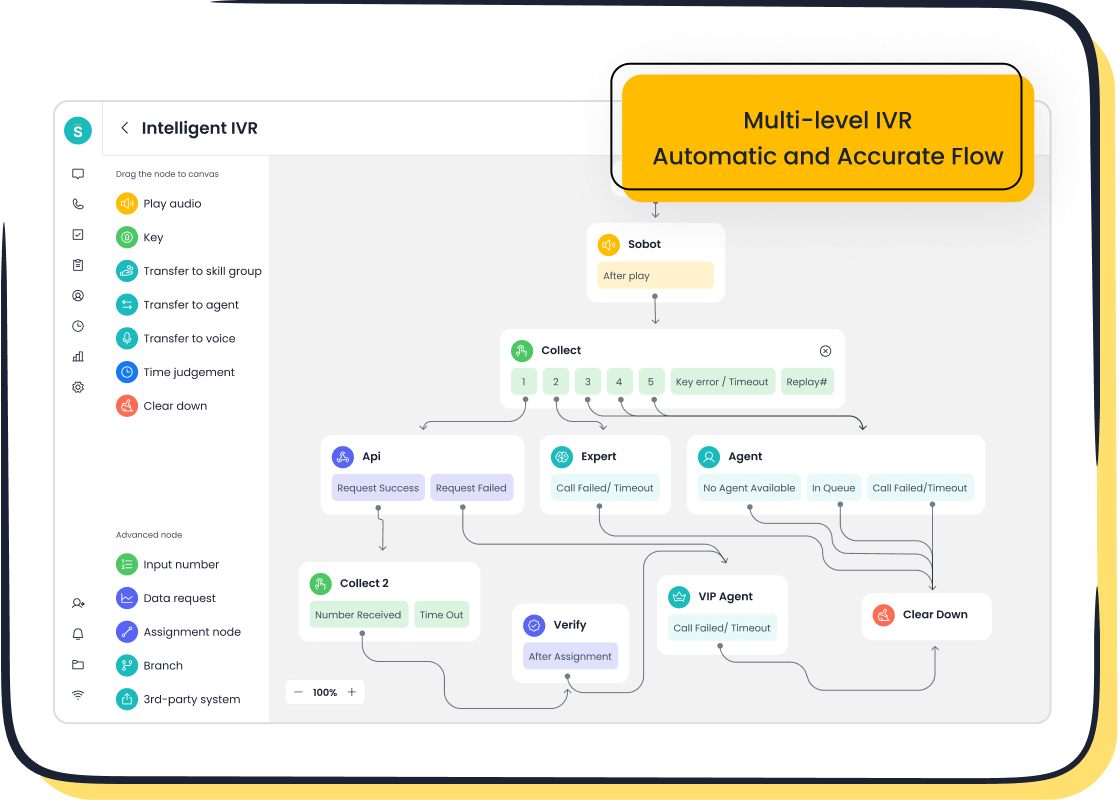
Sobot’s Voice/Call Center gives you everything you need to manage calls and customer data in one place. You can route calls, use AI-powered voicebots, and track every interaction. This makes your job easier and improves the customer experience.
| Feature | Benefit |
|---|---|
| Intelligent IVR | Customizes greetings and routes calls efficiently, reducing delays. |
| AI-Powered Voicebot | Handles repetitive queries, allowing agents to focus on complex issues. |
| Unified Workspace | Provides agents with all customer data in one place for faster responses. |
| Global Number Availability | Enables seamless support across different regions. |
| Predictive Analytics | Enables faster response times and proactive issue resolution. |
When you use these tools well, you see better results. For example, Sobot’s Voice/Call Center helps you resolve tickets 52% faster and cut operational costs by 35%. You also improve key metrics like first call resolution and customer satisfaction scores.
| Metric | Description | Impact on Customer Satisfaction |
|---|---|---|
| First Call Resolution (FCR) | Percentage of issues resolved in a single interaction. | Higher FCR rates directly drive better CSAT and lower operating costs. |
| Average Handle Time (AHT) | Average duration of a customer interaction. | Aligning AHT with customer needs helps ensure efficient calls without rushing, leading to higher satisfaction. |
| Customer Satisfaction Score (CSAT) | Measures customer satisfaction with a specific interaction. | Efficient service, empathetic agents, and thorough resolution drive higher CSAT scores. |
Tip: The more you practice with Sobot’s platform, the more confident you become as a customer success manager. Your technical skills turn every customer call into a chance to shine.
Collaboration Skills

As a customer success manager, you need strong collaboration skills to drive results for your team and your customers. When you work well with others, you solve problems faster and deliver better experiences. Many workplace failures happen because teams don’t communicate or collaborate enough. Take a look at these numbers:
| Statistic | Finding |
|---|---|
| 86% | Employees and executives cited lack of communication or collaboration as responsible for workplace failures. |
| 40% | Employees say people in their organization don’t collaborate enough. |
| 97% | Employees and executives say lack of alignment within a team impacts the outcome of a task or project. |
Cross-Functional Teams
You can’t do it all alone. Great customer success managers know how to work with cross-functional teams. When you bring together people from sales, support, and product, you create a unified goal. This teamwork ensures every customer gets a consistent, high-quality experience. You also boost efficiency and solve challenges quickly.
- Collaboration across departments leads to a unified goal.
- Ensures consistent, high-quality customer experiences.
- Drives organizational efficiency and effectiveness.
- Strong coordination resolves customer challenges effectively.
- Customer Success teams are accountable for downstream challenges, relying on upstream contributions from other departments.
- Enhances communication across teams.
- Leads to improved customer experiences and higher satisfaction.
You help everyone stay on the same page, which means customers get the answers they need faster.
Sharing Insights
Sharing insights is one of the most valuable skills you can develop as a customer success manager. When you share what you learn with other teams, you help everyone improve. Aligning customer success with financial outcomes brings teams together and leads to better strategies. Companies that fully adopt customer success principles across departments see stronger results.
- Aligning Customer Success with financial outcomes enhances collaboration across teams, leading to better customer success strategies.
- Companies that fully adopt Customer Success principles across departments ensure that all employees work towards customer success, which improves overall strategies.
- Setting aligned business objectives and shared incentives between Customer Success and sales fosters a collaborative environment that enhances customer success outcomes.
You play a key role in collaboration and cross-functional influence. When you share insights, you help your company grow and make every customer feel valued.
Customer Advocacy
As a customer success manager, you play a huge role in driving customer-led growth. You use your skills to champion customer needs and make sure every customer gets the best experience. When you advocate for customers, you help your company reach better customer outcomes and stronger business outcomes.
Championing Customer Needs
You know what your customers want. You use Sobot’s solutions to share their feedback with your team. You can show real data to support your ideas. For example, Sobot’s AI-driven chatbot helps you resolve 83% of customer issues right away. Companies like OPPO saw a 57% increase in repurchase rates after using Sobot. Predictive analytics let you boost customer retention rates by 89% and increase purchase rates by 287%. Here’s how you can use Sobot’s platform to advocate for your customers:
- Share chatbot resolution rates with your team.
- Use analytics to highlight customer-led growth.
- Show how your skills improve customer outcomes.
- Present data to support changes that benefit customers.
| Metric | Value |
|---|---|
| Chatbot Resolution Rate | 83% |
| Increase in Repurchase Rate | 57% |
| Expected Increase in Purchase Rates | 287% |
| Expected Customer Retention Rate | 89% |
Leveraging Customer Stories
Stories make your advocacy stronger. You can use real examples to show how your skills drive results. Samsung used Sobot’s multilingual platform and real-time insights to reach a 97% customer satisfaction rate. OPPO saw an 83% chatbot resolution rate and a 57% jump in repurchase rates. These stories prove that a customer success manager can create amazing customer outcomes and business outcomes.
| Company | Result Description |
|---|---|
| Samsung | Achieved a 97% customer satisfaction rate using Sobot’s multilingual capabilities and real-time insights. |
| OPPO | Implemented Sobot’s solution, resulting in an 83% chatbot resolution rate and a 57% increase in repurchase rates. |
Tip: Use customer stories in meetings to inspire your team and push for customer-led growth. Your skills and advocacy help everyone see the value of putting the customer first.
Time Management
Time management is one of the most important skills you can develop as a customer success manager. When you manage your time well, you help your team, your customers, and yourself. Labor costs make up 70% of spending for many businesses. If you spend too much time on low-value tasks, you waste resources and miss chances to help your customer. In fact, the average worker spends 51% of their day on tasks that do not move the business forward.
| Statistic | Description |
|---|---|
| Labor costs account for 70% of spending | Labor is one of the highest costs for small businesses, making effective time management crucial to avoid waste. |
| Average worker spends 51% of their day on low-value tasks | Poor time management leads to inefficiency, as employees spend significant time on tasks that do not contribute to business goals. |
Prioritization
As a customer success manager, you need to know what matters most. Prioritization helps you focus on urgent and important tasks. You can schedule important work that is not urgent, so you do not forget about long-term goals. When you use your skills to delegate or automate simple tasks, you free up time for activities that really help the customer.
- Focus on urgent and important tasks to boost productivity.
- Schedule important but not urgent work to meet long-term goals.
- Delegate or automate tasks so you can spend more time on customer success.
Workload Balance
Balancing your workload is key to staying happy and effective. Good time and load management help you reach your goals as a customer success manager. Try using strategies like time blocking, automation, and regular check-ins with your team. These methods help you avoid burnout and keep your customer at the center of your work.
| Strategy | Description |
|---|---|
| Use Automation | Minimize repetitive manual work. |
| Time Blocking | Schedule specific times to complete tasks. |
| Delegation | Allocate work based on team members' skills. |
| Monitor Workloads | Regularly check team workloads to maintain balance. |
Tip: Stay flexible and review your workload often. Talk with your team to make sure everyone feels supported and your customer always gets the best service.
You drive real outcomes when you master customer success manager skills. Sobot’s Voice/Call Center helps you deliver better outcomes for every customer.
- Net retention rates reach 99% with strong customer success initiatives.
- Existing customers buy again 60-70% of the time.
- Satisfied customers create more outcomes through referrals.
Assess your skills, take action, and explore Sobot for stronger outcomes.
FAQ
What are the most important customer success manager skills?
You need strong communication, problem-solving, emotional intelligence, and technical proficiency. These customer success manager skills help you build trust and drive results.
How do customer success manager skills impact customer retention?
When you use customer success manager skills, you solve problems quickly and build relationships. This leads to higher retention rates and happier customers.
Can Sobot help you improve customer success manager skills?
Yes! Sobot’s Voice/Call Center and omnichannel platform make it easier for you to practice customer success manager skills and deliver better service.
See Also
Essential Strategies for Effective Call Center Quality Control
Transforming Customer Support with AI-Powered Service Agents
Comparative Analysis of Leading Voice of Customer Tools

