Customer Success Agent vs Support Agent Explained


A customer success agent proactively guides your long-term customer value. In contrast, a customer support agent reactively solves immediate problems for a customer. Think of customer success as your financial advisor planning for future wealth. Customer support is the bank teller helping with one transaction. A strong customer success strategy and excellent customer support are both vital for the customer journey.
Did you know? 89% of customers are more likely to make another purchase after a positive customer experience (Salesforce Research).
Modern solutions like the Sobot call center, powered by Sobot AI, empower both teams to create these positive interactions, driving customer loyalty and growth.

Defining the Core Mission
Understanding the core mission of each role helps you see their unique value. Customer success focuses on the future health of the customer relationship. Customer support concentrates on solving problems in the present.
The Proactive Approach of Success
The mission of customer success is to deliver long-term value to your customer. This proactive approach moves beyond simply reacting to problems. Instead, it guides the customer through critical moments to ensure they achieve their goals. This focus on proactivity nurtures the relationship and drives business growth.
The primary goals of a customer success team include:
- Enhancing Customer Satisfaction: You work to understand and exceed customer expectations with personalized experiences.
- Driving Adoption: You help the customer use your product or service more deeply over time.
- Reducing Churn: You monitor account health to spot risks early and implement retention strategies.
- Identifying Growth: You find opportunities for expansion or renewal that benefit both the customer and your business.
This mission ensures the right people focus on the right customer needs at the right time.
The Reactive Approach of Support
The mission of customer support is to resolve immediate issues efficiently. This role is reactive by design. A customer has a problem, and the support agent provides the solution. Success is measured by speed and accuracy. Teams often use Service Level Agreements (SLAs) to define these targets.
While this model is essential for handling urgent needs, relying on it alone can cause frustration. If a customer repeatedly faces the same issue, their satisfaction drops. Effective customer support solves the immediate problem and documents it, creating an opportunity for the customer success team to address the root cause later.
| Aspect | Response Time SLA | Resolution Time SLA |
|---|---|---|
| Definition | Time until you first respond to a customer. | Time until you fully resolve the issue. |
| Purpose | Ensures quick acknowledgment of the problem. | Ensures timely and complete problem-solving. |
| Typical Goal | Minutes to a few hours. | Hours to a few days. |
Responsibilities of a Customer Success Agent

A customer success agent focuses on building long-term value. Your responsibilities are proactive and strategic. You aim to make the customer successful with your product, which in turn makes your business successful. This role is about partnership, not just problem-solving.
Driving Onboarding and Adoption
Your first major task is to guide a new customer through onboarding. A smooth start is critical for long-term success. You help the customer achieve their first meaningful outcome quickly. To do this, you must establish a clear communication plan and use multiple channels for engagement.
You also monitor product adoption closely. By tracking data like login frequency and feature usage, you can see how a customer is interacting with the product. This helps you identify where they might need extra guidance. Strong adoption from the start reduces future problems and builds a foundation for a healthy relationship.
Strategic Account Management
Strategic account management is about nurturing long-term customer relationships to ensure retention. A customer success agent acts as a dedicated partner for high-value accounts. You work to understand each customer's unique goals and challenges.
A key part of this strategy is the Quarterly Business Review (QBR). This is not just a check-in call. It is a strategic meeting where you review performance, demonstrate the value delivered, and align on future goals. This builds trust and reinforces the partnership.
By maintaining regular contact and offering tailored solutions, you can proactively address issues before they grow.
Identifying Growth Opportunities
Great customer success naturally leads to growth. As you monitor a customer's usage, you can spot opportunities for expansion. For example, you might notice a customer consistently hitting their usage limits or showing interest in advanced features.
These signals are your cue to start a conversation about upgrading or adding new services. These customer success initiatives are not pushy sales tactics. Instead, you are offering solutions that provide more value to a customer who is already finding success with your product.
Gathering Strategic Feedback
Customer success teams are a vital link between the customer and your product team. You gather strategic feedback through channels like surveys, user interviews, and direct conversations. This information provides deep insights into what customers love and where they struggle.
This feedback is crucial for proactive success initiatives. It helps your company improve the product, refine the onboarding process, and create a better overall experience. You turn customer insights into actionable improvements that benefit everyone.
Responsibilities of Customer Support

As a customer support agent, your primary focus is on providing immediate resolutions to customer issues. Your work is fast-paced and reactive, centered on delivering quality customer support for present needs. You are the expert problem-solver a customer turns to for help.
Resolving Technical and User Issues
You are the first line of defense when a customer encounters a technical problem. Your goal is to solve these issues quickly and accurately. To do this, you use an integrated platform like Sobot's Omnichannel Solution, which gives you a unified workspace. This system consolidates messages from all channels, including email, chat, and voice, into a single view.
A centralized knowledge base is your most powerful tool. It provides instant access to troubleshooting guides, product information, and procedures. This allows you to find answers fast, reducing the time you spend on each inquiry and helping you handle more cases efficiently.
Managing Inbound Inquiries
You handle a constant flow of inbound inquiries from every channel. Many of these questions are repetitive. An AI-powered chatbot, like the one offered by Sobot, can manage these common queries 24/7. This frees you up to focus on the more complex problems that require a human touch. This combination of AI and human expertise ensures every customer receives responsive support.
Documenting Issues and Escalations
Proper documentation is a critical part of customer support. When you cannot solve an issue yourself, you must escalate it. A good ticketing system, such as the Sobot Ticketing System, helps you automate this workflow and manage SLAs. The process is clear:
- Identify the need for escalation.
- Document the case with all relevant customer information and steps taken.
- Escalate through the proper channel, assigning the ticket to the correct team.
- Communicate the next steps to the customer.
- Follow up until the issue is resolved and the customer is satisfied.
Answering Product Questions
A large part of your day involves answering questions about your company's products or services. A customer may have simple questions before making a purchase or need help understanding a feature. Common inquiries you might handle include:
- What is your return policy?
- How long does it take to get a refund?
- Can I speak to a supervisor?
Answering these questions correctly builds trust and helps the customer feel confident in their decisions. Effective customer support turns a questioning visitor into a happy customer.
How Success and Support Collaborate
Customer success and customer support are not isolated functions. They are two sides of the same coin, working together to enhance the entire customer journey. When you align these teams, you create a powerful engine for growth. Their collaboration turns reactive problem-solving into proactive relationship-building.
Creating a Unified Feedback Loop
A unified feedback loop is the bridge between your support and success teams. Your customer support team is on the front lines, gathering valuable data with every interaction. Your customer success team uses this data to inform its long-term strategy. A shared platform, like an integrated CRM and ticketing system, makes this possible. It gives every team a complete view of the customer's history.
This unified approach helps you:
- Eliminate Guesswork: Your success team can see expansion opportunities within support requests. Your support team can prioritize high-value accounts that need immediate attention.
- Synchronize Teams: A 360-degree customer view prevents miscommunication. Everyone is on the same page, creating a seamless customer experience.
To build a proactive feedback loop from support tickets, you can use analytics to transform raw data into actionable insights.
- Use AI-Powered Sentiment Analysis. This helps you understand a customer's emotions in real time. AI can classify feedback as positive, negative, or neutral, giving you a clear view of customer satisfaction.
- Identify Trends and Recurring Themes. Thematic analysis groups feedback into common topics like bugs or feature requests. This helps you spot recurring issues before they become widespread problems.
- Predict Emerging Issues. Predictive analytics can detect early warning signs by analyzing shifts in feedback. An increase in complaints about a specific feature can be flagged, allowing you to intervene proactively.
A Real-World Example with Sobot
Collaboration between support and success delivers powerful results. Look at the story of OPPO, a leading smart device innovator. OPPO faced a major challenge with huge volumes of customer inquiries during peak shopping seasons. This led to long wait times and frustrated customers.
To solve this, OPPO implemented Sobot's chatbot and ticketing system. This created a perfect synergy between automated support and human expertise.
- The AI chatbot, a key customer support tool, became the first point of contact. It automatically resolved 83% of repetitive queries about order status, product details, and basic troubleshooting.
- This automation freed human agents from repetitive tasks. They could then focus on complex issues and work with the customer success team on more strategic, high-value customer interactions.
The results were remarkable. This collaboration led to a 94% positive feedback rate and a 57% increase in the repurchase rate. It proves that effective support empowers long-term customer success.
From Reactive Ticket to Proactive Strategy
The journey from a single support ticket to a proactive strategy shows the power of collaboration. It transforms a reactive moment into an opportunity for improvement. This process ensures you are not just fixing problems for one customer but improving the experience for all customers.
Here is how a reactive ticket becomes a proactive strategy:
| Step | Reactive Support Action | Proactive Success Action |
|---|---|---|
| 1. Ticket | A customer reports a confusing dashboard feature. The customer support team provides a quick solution and documents the issue. | The customer success team is alerted to the ticket. |
| 2. Analysis | The system flags that 15% of recent tickets are about the same dashboard feature. This identifies a clear trend. | The customer success team analyzes the trend data. They see it is a common point of friction for new users. |
| 3. Strategy | The customer support teams continue to resolve individual tickets as they arrive. | The customer success teams create a new onboarding video tutorial for the dashboard. They also provide this feedback to the product team for a future redesign. |
| 4. Outcome | The customer's immediate issue is solved. | Future customers have a better onboarding experience. The number of support tickets about the dashboard drops significantly. |
This cycle shows how customer support and customer success work together. Support handles the present, while success uses that information to build a better future for every customer.
Measuring Customer Success vs. Support Efficiency
You need to measure the performance of your success and support teams differently. Their missions are distinct, so their metrics must be too. Measuring customer success involves tracking long-term value and relationships. Measuring customer support focuses on immediate efficiency and satisfaction. Understanding these differences helps you evaluate each team's true impact.
Success Metrics: Retention and Value
You measure customer success by its impact on long-term growth and customer retention. These customer success metrics look beyond single interactions. They tell you if a customer is growing with your business over time. Strong customer success directly increases revenue and builds a loyal customer base.
Key customer success metrics include:
- Customer Lifetime Value (CLV): This metric predicts the total revenue you can expect from a single customer account. You calculate it by multiplying the average revenue per customer by their average lifespan. For example, a customer paying you $1,000 per month for five years has a CLV of $60,000. A higher CLV shows that your customer success efforts are creating lasting customer value.
- Net Revenue Retention (NRR): This metric shows you the percentage of recurring revenue you have retained from existing customers over a period. It includes upgrades (expansion) and downgrades or cancellations (churn). An NRR over 100% means your existing customers are spending more, which is a powerful sign of healthy growth.
- Customer Churn Rate: This is the percentage of customers who stop doing business with you over a specific period. You calculate it with a simple formula:
(Customers lost / Customers at start of period) x 100. A low churn rate is a primary goal of customer success.
Keeping your churn rate low is critical for sustainable growth. Churn rates vary widely by industry. For example, SaaS companies often aim for a monthly churn rate under 5%, while retail can see annual rates over 20%.
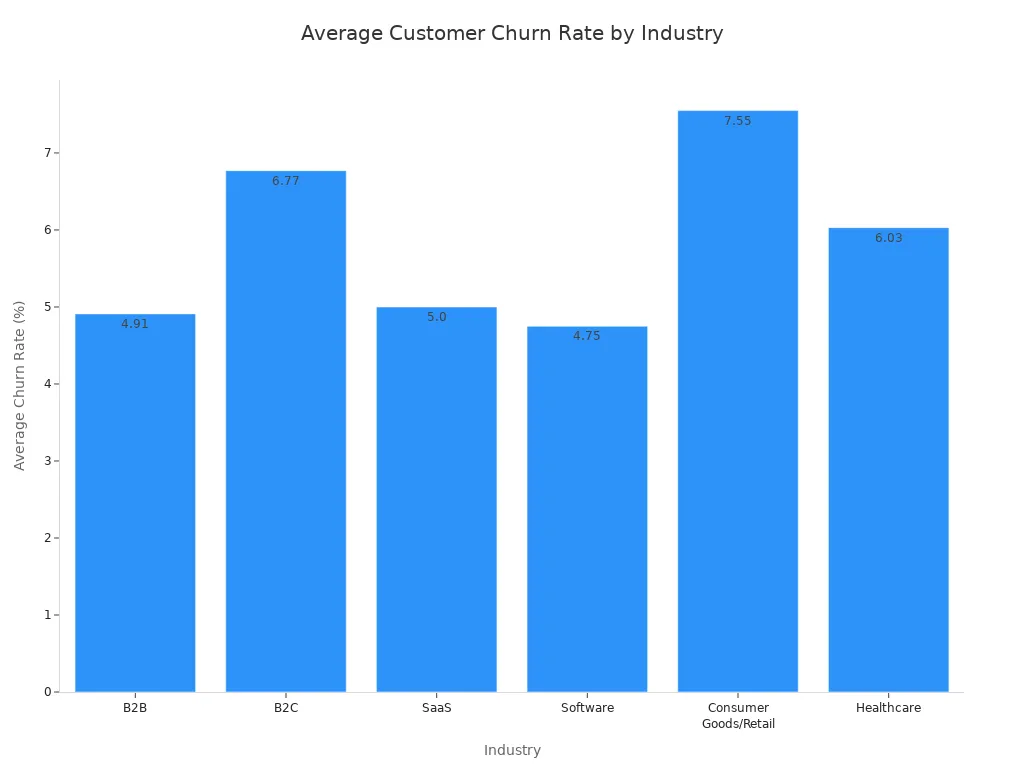
Tracking these metrics helps you prove the financial impact of your retention strategies. Effective customer success is not just about making a customer happy; it is about making them more valuable over time.
Support Metrics: Speed and Satisfaction
You measure customer support efficiency with metrics that focus on speed, quality, and resolution. The goal is to solve a customer problem as quickly and effectively as possible. These metrics help you manage your team's workload, identify areas for training, and ensure a consistent service level.
Here are the core metrics for a support team:
| Metric | Definition | How You Calculate It |
|---|---|---|
| First Contact Resolution (FCR) | The percentage of issues you resolve in the very first interaction. | (Issues resolved on first contact) / (Total eligible support tickets) |
| Average Handle Time (AHT) | The average time an agent spends on a customer interaction, including talk, hold, and follow-up work. | (Total talk + hold + follow-up time) / (Total calls handled) |
| Average Resolution Time (ART) | The total time it takes to close a ticket from the moment it is opened. | (Total duration of all resolved tickets) / (Number of resolved tickets) |
While speed is important, you must balance it with quality. A low AHT is meaningless if the customer has to call back. This is why FCR is such a powerful metric. A high FCR rate means your team is both efficient and effective.
Another critical metric is the Customer Satisfaction (CSAT) score. This measures how happy a customer is with a specific interaction. You typically measure it right after an issue is resolved.
- You ask the customer to rate their satisfaction on a scale, usually from 1 to 5.
- You calculate the score by taking the number of "satisfied" responses (ratings of 4 or 5).
- You divide that number by the total number of responses and multiply by 100 to get a percentage.
Sending this survey via email or an in-app pop-up within 24 hours of closing a ticket gives you the most accurate feedback. This helps you understand the quality of your support and its direct impact on the customer experience.
Essential Skills for Each Role
The skills you need for success and support roles are very different. A customer success agent needs strategic and relationship-focused abilities. A support agent requires deep technical knowledge and problem-solving speed. Understanding these skills helps you see why each role is unique.
Strategic Skills for a Success Agent
As a customer success agent, you build long-term partnerships. Your skills focus on strategy and communication to help each customer grow. You must think ahead to prevent problems and find opportunities.
- Relationship Building: You establish trust from the very first interaction. You need to understand the customer's business goals and show you care about their success.
- Strategic Thinking: You use data to make decisions. This involves analyzing how a customer uses your product and identifying trends. This helps you proactively guide the customer toward their goals.
- Active Listening: You must listen with empathy to understand the "why" behind a customer's request. This allows you to ask the right questions and build a stronger connection.
- Commercial Acumen: You understand how your work impacts revenue. You can spot opportunities for a customer to upgrade and can discuss business outcomes with confidence.
Technical Skills for a Support Agent
As a support agent, you are the technical expert. Your skills allow you to solve problems quickly and accurately. You need a deep understanding of your product and the tools you use to help every customer.
- Deep Product Knowledge: You must know your product inside and out. This includes its features, limitations, and pricing. This knowledge helps you answer any question a customer might have.
- CRM and Ticketing System Proficiency: You need to be skilled with your company's tools. This allows you to track customer data, manage interactions, and escalate issues efficiently.
- Technical Troubleshooting: You have the ability to diagnose a problem and guide a customer through the solution. This requires clear communication and patience.
- Data Entry Accuracy: You must enter customer information correctly. Accurate data ensures that every future interaction is smooth and informed.
You now see the clear difference between the two roles. A customer success agent builds long-term relationships focused on future value. Excellent customer support provides expert problem-solving for a customer's present needs. Both are critical for a positive customer journey.
Platforms like Sobot empower both your customer success and customer support teams. They help you create a seamless experience for every customer.
Investing in proactive customer success and reactive support is your key to building lasting customer loyalty. This dual focus drives sustainable growth for your business.
FAQ
Which role should a customer contact for help?
You should contact customer support for immediate issues like technical problems or billing questions. You should contact customer success for strategic advice, long-term goals, or feedback on how to get more value from the product.
Is customer success more important than customer support?
No, both roles are equally important for a great customer experience. Support solves urgent problems right now. Success builds a strong relationship for the future. You need both to keep a customer happy and loyal.
How can a small business manage both roles?
You can have one person handle both roles in a small business. Use an all-in-one platform to stay organized. This helps you manage reactive tickets and track proactive goals for each customer without needing a large team.
See Also
Artificial Intelligence Transforms Customer Service: A New Era of Support
Demystifying the Essential Responsibilities of an IT Call Center Agent
Achieving Excellence: Expert Strategies for Live Chat Customer Assistance
A Comprehensive Handbook for Optimally Managing Your Live Chat Team
Elevate SaaS Customer Support Through Innovative Live Chat Approaches

