Customer service staff job description and skills made easy


Working as customer service staff means assisting customers by solving their problems and answering their questions. According to a typical customer service staff job description, essential skills include clear communication, patience, empathy, problem-solving, adaptability, and strong product knowledge. These abilities are crucial for building trust, resolving customer issues efficiently, and ensuring customer satisfaction.
Modern solutions like the Sobot call center and Sobot AI are transforming the customer service staff job description by making daily tasks more efficient and effective. Sobot provides advanced tools that help you respond to customer inquiries faster and deliver higher-quality service. For example, the Sobot call center streamlines communication, while Sobot AI automates routine tasks and provides intelligent support.
Recent studies highlight how Sobot enhances customer service staff performance:
| Metric | Improvement |
|---|---|
| Average Handle Time | Reduced by 41% |
| First-Contact Resolution Rate | Improved by 54% |
| Reception Efficiency | Increased by 48% |
With Sobot and Sobot AI, customer service staff can manage more requests and achieve better results every day, making these tools an essential part of the modern customer service staff job description.
Customer Service Staff Job Description

Main Responsibilities
Your role as customer service staff centers on helping customers solve problems and guiding them through their journey. The customer service staff job description highlights several core duties. You answer questions, resolve issues, and ensure customers feel supported. You use customer service skills like empathy and clear communication to build trust. Many companies expect you to manage technical issues, coordinate with other departments, and analyze customer feedback for improvement.
Here is a table showing common responsibilities found in a customer service staff job description:
| Responsibility Description |
|---|
| Ensures that new customers are successfully integrated into the system. |
| Handles critical issues that require urgent resolution, coordinating between departments. |
| Develops programs to encourage customers to become product champions and advocates. |
| Oversees the efficiency and effectiveness of customer service operations. |
| Provides immediate assistance for common technical issues via phone or email. |
| Manages the setup and initial configuration of software systems at customer locations. |
| Combines technical expertise with account management to support customers. |
| Analyzes customer insights to identify trends and issues for service improvement. |
| Oversees all aspects of customer interaction throughout the customer journey. |
Daily Tasks
You handle many tasks each day. You answer calls, reply to emails, and chat with customers online. You use Sobot’s live chat and AI Agent to respond quickly and accurately. You may help customers set up accounts or troubleshoot problems. You track issues using Sobot’s ticketing system, making sure every customer gets a solution. You often switch between channels, using Sobot’s omnichannel workspace to keep all customer information in one place. You use customer service skills to stay patient and positive, even when customers feel frustrated.
Work Environments with Sobot
Your work environment depends on your company’s size and industry. Large companies, like Samsung, use Sobot’s call center and voicebot to manage thousands of customer interactions every day. You may work in an office, at home, or in a hybrid setting. Sobot’s cloud-based tools let you support customers from anywhere. You use WhatsApp Business API to reach customers on their favorite platforms. Sobot’s unified workspace helps you collaborate with your team and deliver fast, personalized service. You see how customer service staff job description changes when you use advanced tools. You focus on helping customers, not switching between systems.
Essential Customer Service Skills

Customer service skills help you succeed in every customer interaction. These skills let you solve problems, build trust, and create positive experiences. When you master these skills, you become a valuable part of your team. Sobot’s Voice/Call Center and omnichannel solutions give you the tools to use and improve these skills every day.
Communication
Communication is the foundation of all customer service skills. You need to speak clearly, write well, and listen carefully. Good communication helps you understand what customers want and makes them feel valued. When you answer questions quickly and use simple words, you prevent confusion and frustration.
Tip: Always check if the customer understands your answer. Ask, “Does that make sense?” or “Can I help with anything else?”
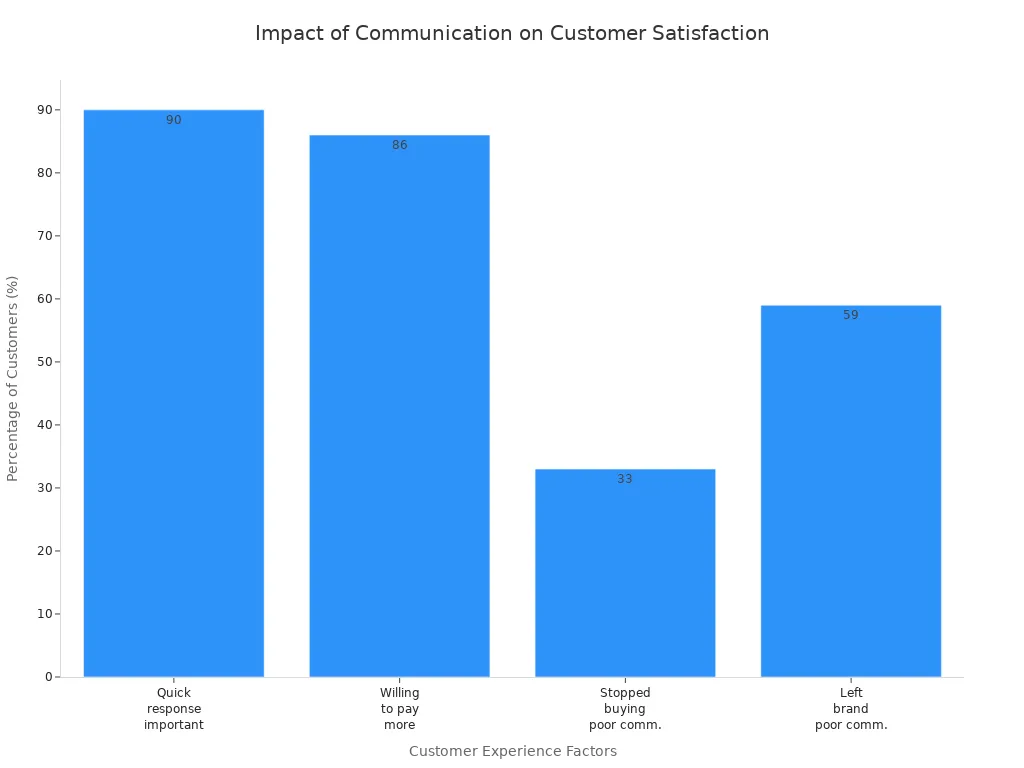
Here is a table showing how communication affects customer satisfaction:
| Statistic | Impact on Customer Satisfaction |
|---|---|
| 90% of customers | Consider quick responses and communication quality as important criteria in customer experience |
| 86% of customers | Are willing to pay more for better customer service |
| 33% of customers | Stopped buying from a brand due to poor communication |
| 59% of customers | Left a brand due to poor communication quality |
| Companies lose | $62 billion every year due to poor customer experience |
You can use several techniques to improve your communication:
- Practice active listening by repeating key points and asking questions.
- Show empathy to build trust.
- Speak clearly and avoid jargon.
- Use emotional intelligence to respond to feelings.
- Pay attention to non-verbal cues, like tone and body language.
Sobot’s omnichannel solution helps you manage all customer messages in one place. You can reply faster and keep your communication clear. The Voice/Call Center lets you track calls and review recordings, so you can learn from each conversation.
Problem-Solving
Problem-solving is one of the most important customer service skills. You face new challenges every day. You need to find answers quickly and help customers get results. Strong problem-solving means you can look at a situation, find the cause, and choose the best solution.
Here are some frameworks you can use for problem-solving:
| Framework Name | Description |
|---|---|
| CIRCLES | A 7-step method to understand the situation and customer needs. |
| Phoenix Checklist | A list of questions to see problems from different angles. |
| Lightning Decision Jam | A 9-step process to spot and fix problems fast. |
| DMAIC | A 5-stage tool for quality improvement: define, measure, analyze, improve, control. |
| Fishbone Diagram | A visual tool to find the root causes of problems. |
Sobot’s AI Agent helps you solve problems by giving you quick access to customer history and product information. The unified workspace lets you see all the details you need, so you can resolve issues on the first call. This boosts your confidence and helps you deliver top-notch customer service skills.
Empathy and Patience
Empathy and patience are key customer service skills. When you show empathy, you understand how the customer feels. Patience helps you stay calm, even when customers are upset. These skills build trust and make customers feel heard.
Note: 82% of people with a strong emotional connection to a brand will always choose that brand. Companies that connect emotionally grow sales 85% faster than others.
You can practice empathy and patience by:
- Listening without interrupting.
- Using kind words and a calm voice.
- Matching your emotional tone to the customer’s mood.
Many companies use empathy training and real-life scenarios to help staff improve these skills. For example, Zappos trains staff in empathy and sees a 75% repeat customer rate. The Ritz-Carlton gives each employee 250 hours of emotional intelligence training every year.
Sobot’s AI tools can coach you in real time. You get feedback on your tone and word choice, so you can improve your empathy and patience with every call.
Product Knowledge
Product knowledge is a must-have for customer service staff. You need to know your company’s products and services inside and out. This skill helps you answer questions quickly and solve problems on the first try.
- Product knowledge improves first-contact resolution rates.
- If you do not know the product, you may struggle to help customers.
- Knowledge management systems, like Sobot’s unified workspace, give you instant access to product details.
Sobot’s platform lets you search for answers and view customer history while you talk. This makes it easier to provide accurate information and deliver professional service.
Adaptability
Adaptability means you can handle change and stay flexible. Customer needs change fast. New tools and updates appear often. You must learn quickly and adjust your approach.
Common challenges when adapting to new technology include:
- Integration issues between different systems.
- Security risks and data protection.
- Technical glitches or outages.
- User adoption and learning curves.
- Pressure to keep up with new trends.
- Managing change within your team.
Sobot’s solutions make adaptability easier. The platform integrates with your existing systems and provides a stable, secure environment. You can use Sobot on any device, so you can work from anywhere and adjust to new workflows quickly.
Teamwork
Teamwork is another important customer service skill. You work with others to solve problems and deliver great service. Good teamwork means you share ideas, support each other, and keep a positive attitude.
- Teamwork brings together people with different backgrounds and skills.
- A healthy team culture leads to better communication and clear roles.
- Effective collaboration helps you serve customers faster and more consistently.
- Teamwork reduces burnout. 63% of agents feel burned out, but sharing the workload helps everyone.
Sobot’s unified workspace lets you chat with your team, share notes, and assign tasks. You can see what others are working on and help each other succeed.
Tech Proficiency with Sobot
Tech proficiency is now a core part of customer service job skills. You need to use digital tools, manage data, and work with AI. Sobot’s platform helps you build these skills.
| Feature | Description |
|---|---|
| Omnichannel AI | Connects every customer touchpoint for seamless communication. |
| Scenario-based AI | Gives you industry-specific knowledge for better service. |
| Multi-faceted AI | Includes AI Agent, Copilot, and Insight for different tasks. |
| Generative AI | Uses advanced technology to create fast, accurate responses. |
| Secure AI | Protects customer data and ensures privacy. |

You can use Sobot’s Voice/Call Center to manage calls, track performance, and review analytics. The omnichannel solution lets you handle chats, emails, and social media in one place. This makes you more efficient and helps you deliver professional, attentive service.
Remember: Customer service skills are not just about talking to people. They include listening, problem-solving, professionalism, and adaptability. When you use Sobot’s tools, you can develop these skills and provide excellent service every day.
Skills Impact on Performance
Customer Satisfaction
Customer service skills have a direct impact on customer satisfaction. When you use good customer service skills, you build strong customer relationships and create positive experiences. Customers feel valued when you listen, solve problems, and show empathy. This leads to higher satisfaction and better customer loyalty.
- 72% of customers share a positive experience with six or more people.
- 88% of customers are likely to buy again after receiving high-quality service.
- 75% of customers may forgive a company’s mistake if they receive good customer service.
- Companies can see a 10-15% revenue increase by improving customer experience.
You can see how quality service and strong skills help you keep customers happy and loyal. Sobot’s omnichannel solution helps you deliver consistent, high-quality support across every channel, which boosts satisfaction and strengthens customer relationships.
Efficiency and Productivity
Your skills also affect how efficiently you work. When you use good customer service skills, you solve problems faster and handle more requests. This improves both your productivity and the quality of your work.
| Metric | Description | Impact on Efficiency and Productivity |
|---|---|---|
| First-call resolution (FCR) | Measures the ability to resolve customer queries on the first contact. | Higher FCR means you handle inquiries better and reduce frustration. |
| Average Handle Time (AHT) | Tracks the average time taken to handle customer inquiries. | Lower AHT shows you work more efficiently and resolve issues quickly. |
| Customer Retention Rate (CRR) | Indicates the percentage of customers retained over time. | Higher CRR means better satisfaction and loyalty, which helps your company grow. |
Sobot’s Voice/Call Center gives you tools to track these metrics. You can review call recordings, monitor your performance, and find ways to improve your skills. This leads to better quality service and higher customer satisfaction.
Real-World Results with Sobot
Sobot’s solutions help you turn your skills into real business results. Many companies have seen big improvements after using Sobot’s platform.
| Metric | Result |
|---|---|
| Operation Efficiency | 6X increase |
| Overall Cost Reduction | 25% reduction |
| Customer Satisfaction (CSAT) | 95% |
You can see how good customer service skills, combined with Sobot’s technology, lead to higher satisfaction, better customer relationships, and stronger customer loyalty. These results show that investing in quality service pays off. When you focus on improving your skills and using the right tools, you help your company grow and build lasting customer relationships.
Remember: Good customer service is not just about solving problems. It is about building trust, delivering quality, and creating satisfaction every time you interact with a customer.
Growing in Customer Service Roles
Training and Development
You can grow your career in customer service by focusing on training and development. Many companies use customer service training programs to help you build new skills and improve your performance. These programs often include:
- Quantitative performance indicators, such as average handling time and customer service ratings, to measure your progress.
- Qualitative feedback, like customer surveys and peer evaluations, to help you understand your strengths and areas for improvement.
- Industry-specific benchmarks, so your training matches the needs of your sector, whether you work in retail, finance, or technology.
When you join a company with strong training resources, you see real benefits. Companies that invest in training report 218% higher income per employee and 24% higher profit margins. Engaged employees stay longer, which reduces turnover costs. You can track your growth using metrics that show how your skills impact customer satisfaction and business results.
Here is a table showing common career paths for customer service staff who excel in essential skills:
| Career Path | Description |
|---|---|
| Specialized Roles | Move into roles that match your interests and skills. |
| Departmental Transfers | Use your customer experience to join other departments. |
| Leadership Positions | Advance to management or executive roles, such as Chief Customer Officer. |
| Marketing and Sales | Apply your communication skills in marketing or sales. |
| Human Resources | Use empathy and onboarding experience in HR positions. |
| General Advancement | Grow your career across many industries. |
Leveraging Sobot Tools
You can use Sobot’s platform to boost your skills and make your job easier. Sobot’s Voice/Call Center gives you AI-powered sentiment analysis and real-time feedback, helping you improve every customer interaction. AI chatbots provide consistent and personalized support, so you can focus on complex issues. Real-time analytics let you see how customers feel and adjust your approach to build loyalty.
Sobot’s training resources use technology and adaptive learning to help you learn faster. You can track your progress and see how your skills improve over time. Automating tasks with AI reduces operational costs by up to 35% and improves response times. You can measure the impact of training by tracking customer success metrics, monitoring business results, and assessing learning effectiveness.
Tip: Use Sobot’s unified workspace to collaborate with your team and share best practices. This helps you learn from others and grow your customer service skills every day.
You help every customer by solving problems and answering questions. Your main responsibilities include proactive communication, advanced problem-solving, and personalized service. The table below highlights key customer service staff duties:
| Responsibility | Description |
|---|---|
| Advanced Skills | Solve customer issues with critical thinking. |
| Proactive Communication | Address customer needs before they ask. |
| Personalized Service | Tailor support for each customer. |
Customer service skills like empathy, clear communication, and adaptability keep customers loyal. Sobot’s solutions let you manage every customer interaction in one workspace, boost customer satisfaction, and increase repeat purchases. Focus on skill development and use modern tools to deliver the best customer experience.
- Show empathy and listen to every customer.
- Use feedback to improve customer service.
- Foster a customer-centric mindset in your team.
FAQ
What does a customer service staff member do each day?
You help every customer by answering questions, solving problems, and guiding them. You use tools to track each customer request. You make sure every customer feels heard and supported. You keep records of each customer interaction for better service.
How do customer service skills improve customer satisfaction?
You use customer service skills to listen, understand, and respond to each customer. You solve problems quickly. You show empathy to every customer. These actions help each customer feel valued. Satisfied customers return and share positive feedback.
Why is product knowledge important for customer service staff?
You need strong product knowledge to answer customer questions. You help each customer find the right solution. You explain features and benefits clearly. This builds trust with every customer and helps you resolve issues faster.
How does Sobot help customer service teams work better?
You use Sobot to manage every customer conversation in one place. You track customer history and see all past interactions. You respond to each customer faster. Sobot tools help you deliver a smooth experience for every customer, no matter the channel.
See Also
Transforming Support With AI-Powered Customer Service Agents
2024's Leading Customer Service Software: The Top Ten Picks
Enhancing Efficiency Through AI-Driven Customer Service Solutions
Essential Tips for Selecting Social Media Customer Service Tools

