How to Evaluate Customer Service Performance Effectively in 2026


Customer service evaluation in 2026 means you must use data, focus on the customer, and rely on smart technology. Expectations change fast. Customers want quick, personal, and seamless experiences. You need to meet these demands with accurate metrics and intelligent platforms. Look at the latest statistics:
| Statistic | Description |
|---|---|
| 81% of Consumers Want Conversations to Continue Without Repeating Themselves | Customers expect continuity in conversations without having to repeat themselves. |
| 74% of Consumers Now Expect 24/7 Customer Service | Customers assume help should be available at any time due to AI advancements. |
| 71% of Consumers Expect Personalized Interactions | Personalization is now a basic expectation, and inconsistency frustrates customers. |
| Only 14% of Customer Issues Are Fully Resolved Through Self-Service | Most self-service tools do not fully resolve customer issues. |
| 38% of Gen Z and Millennials Give Up if Self-Service Doesn't Work | Younger customers expect quick and effective digital support. |
| 67% of Consumers Expect Support Tailored to Prior Interactions | Customers want support that acknowledges their previous interactions. |
| 76% of Consumers Prefer Support That Allows Text, Images, and Video in One Thread | Customers prefer to show problems visually rather than explain them. |
| 81% of Consumers Say Brand Trust Influences Their Purchases | Trust is a significant factor in customer purchasing decisions. |
| 73% of Customers Say CX Influences Their Buying Decisions | Customer experience directly impacts purchasing behavior. |
| 65% of Customers Expect Companies to Adapt to Their Changing Needs | Customers want companies to quickly adjust to their evolving preferences. |
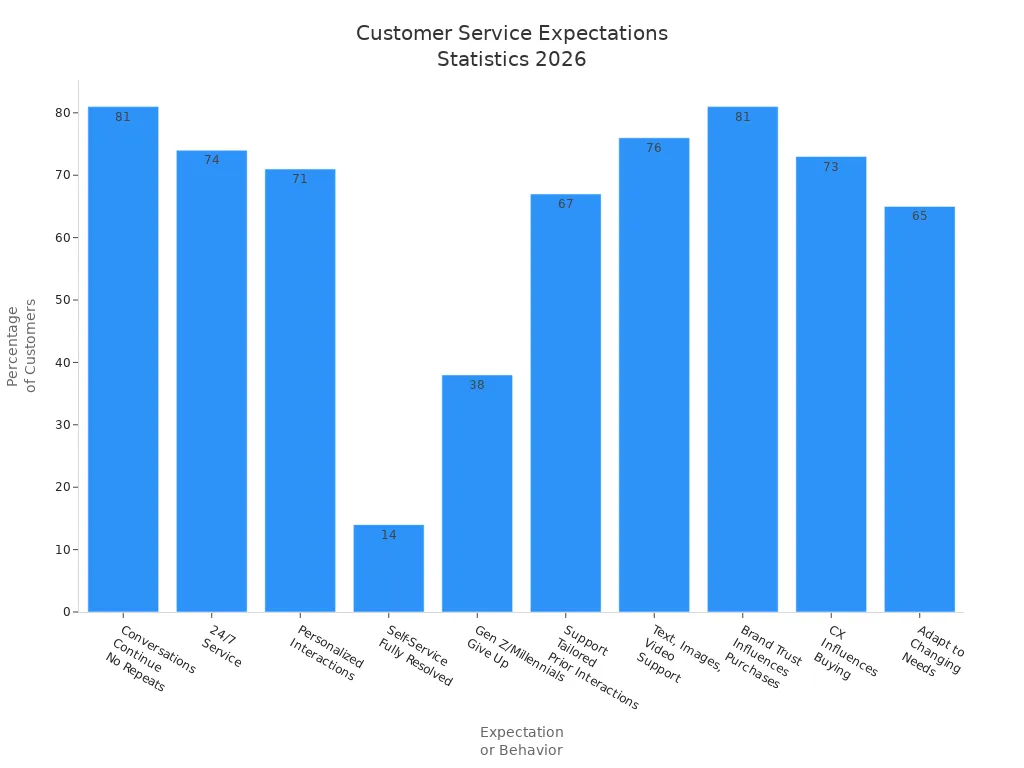
You see that modern customer service evaluation depends on understanding these needs. Data-driven insights, a customer-centric mindset, and technology like omnichannel solutions or AI help you deliver the right experience. Companies such as sobot show that with the right tools, customer service evaluation becomes more precise and effective.
Defining Customer Service Evaluation in 2026

What Makes Evaluation Effective
You need to use clear criteria to measure customer service performance in 2026. Effective evaluation means you look at what matters most to your customer and your business. You should focus on:
- Customer satisfaction metrics that show how happy your customer feels after each interaction.
- Direct measurement techniques, such as post-interaction surveys.
- Indirect measurement techniques, like analyzing chat logs or call transcripts.
- Key performance indicators (KPIs) that track important results, such as response time and resolution rate.
These methods help you see the real impact of your service. When you use tools like Sobot’s AI Agent, chatbot, or live chat, you can collect data from every customer touchpoint. This gives you a full view of the customer experience and helps you improve customer experience management.
Aligning with Customer Experience Goals
You must connect your evaluation strategy to your customer experience goals. Leading organizations use a structured approach to customer experience management. See how these components work together:
| Component | Description |
|---|---|
| Continuous data collection | You gather feedback from your customer across all channels. |
| Advanced analytics and sentiment detection | You use smart tools to analyze feedback and understand how your customer feels. |
| Root cause identification | You find out what causes problems in the customer experience. |
| Cross-functional alignment | Your teams work together to reach shared customer experience goals. |
| Impact measurement | You check how your actions affect your business and customer experience. |
You can use Sobot’s omnichannel contact center to unify data from voice, chat, and ticketing systems. This helps you track customer experience metrics and see how every part of your service supports your customer experience management plan.
Sobot’s Customer-Centric Approach
Sobot builds its customer experience management on three main principles:
| Core Principle | Description |
|---|---|
| Integration of Departments | Every team, from engineering to after-sales, works together for the customer. |
| Use of Data and Digital Tools | Sobot uses data and digital tools to personalize service and predict what your customer needs. |
| Focus on Relationships | Sobot values building strong relationships, not just making sales. |
With Sobot’s solutions, you can manage every customer interaction in one place. You can use the call center, voicebot, or ticketing system to support your customer at every step. This approach helps you deliver a better experience and improve customer experience management.
Key Metrics for Customer Support Performance
You need to measure customer support performance with the right metrics. These metrics help you see how well your team meets customer needs and drives business growth. In 2026, you must focus on data that shows real results. You can use these metrics to improve customer satisfaction, boost retention, and increase resolution rates. When you ask yourself How to Evaluate Customer Service Performance Effectively in 2026, you must start with the essentials.
Essential KPIs: CSAT, NPS, FCR, Retention, AHT, CES
You must track key performance indicators to measure customer support performance. These KPIs show how your team delivers resolution and satisfaction. Here are the most important metrics:
- Customer Satisfaction Score (CSAT): This metric shows how happy your customer feels after each interaction. You can use surveys to collect feedback and measure satisfaction. CSAT is a direct way of measuring customer satisfaction.
- Net Promoter Score (NPS): NPS tells you how likely your customer is to recommend your service. This metric reflects loyalty and brand advocacy. You can use NPS to see if your customer experience leads to growth.
- First-Contact Resolution (FCR): FCR measures how often your team solves issues on the first try. High FCR means your customer gets quick resolution and does not need to contact you again. This metric is a strong indicator of customer service satisfaction.
- Retention Indicators: Retention metrics show how many customers stay with your business over time. High retention means your customer support performance keeps customers loyal.
- Average Handle Time (AHT): AHT tracks how long it takes to resolve each issue. You must balance speed with quality. Shorter AHT can mean efficient resolution, but you must not rush your customer.
- Customer Effort Score (CES): CES measures how easy it is for your customer to get resolution. If your customer finds it hard to solve problems, they may leave even if they are not dissatisfied.
You can see industry benchmarks for these metrics in the table below. These numbers help you compare your customer support performance with others in your field. For more details, you can visit Gartner's customer service benchmarks.
| Industry | CSAT (%) | NPS | FCR (%) | AHT (minutes) | CES |
|---|---|---|---|---|---|
| Health care | 85+ | N/A | 71 | 6-8 | N/A |
| Banking | 80+ | N/A | 70-75 | 4-6 | N/A |
| Retail | 85-90 | N/A | 75-80 | 3-5 | N/A |
| Insurance | 80+ | N/A | 70-75 | 7-10 | N/A |
| Overall NPS | N/A | 30-40 | N/A | N/A | N/A |
You must use these metrics to track customer satisfaction, resolution, and retention. When you measure customer satisfaction, you can spot pain points and improve your service. NPS and CSAT help you see what works and what needs fixing. FCR shows how well your team delivers resolution on the first try. Retention indicators tell you if your customer stays loyal. AHT and CES help you balance speed and ease of resolution.
Tip: Tracking customer satisfaction metrics and first-contact resolution rates helps you uncover friction points in the customer journey. You can use this data to enhance service quality and foster brand advocacy.
You must remember that CSAT captures satisfaction at a moment in time. NPS reflects loyalty and potential for word-of-mouth promotion. CES explains why customers leave, even if they are not dissatisfied. Hyken’s research shows that two out of three customers will leave if service does not meet expectations. You must deliver consistent resolution and quality to keep your customer loyal.
Advanced Analytics and Predictive Insights
You can use advanced analytics to predict customer support performance outcomes. AI-native platforms help you analyze patterns across customer interactions. These tools let you simulate the impact of automation and forecast customer experience. You can spot when customers risk churning and identify trends in complaints and resolution rates.
| Key Area | Description |
|---|---|
| Efficiency | How quickly and effectively issues are resolved. |
| Quality | How customers perceive their experience. |
| Customer Outcomes | The impact of support on revenue retention or risk. |
| Cost Control | Maintaining financial sustainability as operations expand. |
| Predictive Tools | AI-native platforms provide customer service analytics, allowing teams to simulate automation impacts. |
You must use predictive models to analyze customer feedback and resolution patterns. These models help you identify churn risk before satisfaction declines. Leading companies forecast customer experience and resolution rates in 2026. You can use real-time data to prioritize urgent issues and deliver faster resolution.
- Predictive analytics enables proactive strategies. You can anticipate customer needs and prevent churn.
- Real-time data helps you identify and resolve urgent issues quickly. This leads to improved customer satisfaction and higher resolution rates.
- High-performing teams use customer insights to coach agents and improve access to information. This boosts customer support performance and resolution quality.
You can see how Samsung used predictive insights to improve customer service satisfaction. Samsung unified its communication channels and used real-time analytics to boost agent efficiency by 30%. The company achieved a 97% customer satisfaction rate and delivered seamless resolution across all channels. You can read more about Samsung’s story at Sobot’s customer case study.
Note: Advanced analytics help you turn customer feedback into actionable insights. You can use these insights to improve resolution rates and customer satisfaction metrics.
Avoiding Vanity Metrics
You must focus on metrics that lead to meaningful outcomes. Vanity metrics look good on a dashboard but do not reflect customer success or business growth. For example, total ticket volume may seem impressive, but it does not show resolution or customer satisfaction. High ticket volume can signal product issues, not team productivity.
- Average Handle Time can be deceptive. Shorter calls may mean rushed interactions, which can hurt long-term customer relationships and resolution quality.
- You must avoid metrics that do not show resolution or customer satisfaction. Instead, focus on first-contact resolution, customer satisfaction score, and retention indicators.
Alert: Vanity metrics can mislead you. Always choose metrics that show real resolution and customer service satisfaction.
You must use quality metrics like CSAT, NPS, FCR, and CES to measure customer support performance. These metrics help you see how well your team delivers resolution and satisfaction. You can use customer feedback to improve your service and drive business growth. When you ask How to Evaluate Customer Service Performance Effectively in 2026, you must rely on actionable metrics, not vanity numbers.
You can compare your metrics with industry benchmarks and use advanced analytics to predict outcomes. You must avoid vanity metrics and focus on resolution, satisfaction, and retention. This approach helps you build a strong customer experience and improve customer service satisfaction.
Callout: Tracking the right metrics helps you answer How to Evaluate Customer Service Performance Effectively in 2026. You can use customer satisfaction metrics, first-contact resolution rates, and predictive analytics to drive performance and business growth.
You must remember that measuring customer satisfaction and resolution rates is key to improving customer support performance. You can use feedback, quality metrics, and retention indicators to build a better customer experience. When you focus on actionable metrics, you can answer How to Evaluate Customer Service Performance Effectively in 2026 and deliver results that matter.
Leveraging Omnichannel and AI for Performance

Integrating Sobot Voice/Call Center

You can boost agent productivity and deliver a seamless customer experience by integrating Sobot Voice/Call Center into your omnichannel strategy. Sobot centralizes all support channels and customer conversations into one platform. This approach enhances efficiency and gives you a unified view of every customer interaction. You handle complex inquiries instantly across all touchpoints, which allows your business to support customers at scale and reduces response times. AI frees up human agents for more complicated tasks, improving service quality and agent productivity. Personalized interactions enhance customer experience and increase satisfaction and loyalty.
| Evidence Description | Benefit to Omnichannel Customer Service Performance |
|---|---|
| Centralizes all support channels and customer conversations into one platform. | Enhances efficiency and provides a unified view of customer interactions. |
| Instantly handles complex inquiries across all touchpoints. | Allows businesses to support customers at scale and reduces response times. |
| Frees up human agents for more complicated tasks. | Improves overall service quality by allowing agents to focus on high-value interactions. |
| Enhances customer experience through personalized interactions. | Increases customer satisfaction and loyalty. |
Unifying Data Across Channels
You need to unify customer data across channels to answer How to Evaluate Customer Service Performance Effectively in 2026. A single source of truth provides a reliable view of each customer, eliminating duplicates. Improved personalization enables tailored messaging across channels. Enhanced operational efficiency reduces manual work and reporting. Better data quality and governance ensure data integrity and compliance. Smarter data-driven decisions allow you to extract actionable insights for strategic choices. Sales enablement and collaboration support teams working from the same data. Scalability and future-proofing ensure growth without added complexity.
| Benefit | Description | Example |
|---|---|---|
| Single Source of Truth | Provides a reliable view of each customer, eliminating duplicates. | A retail brand sees a customer’s online purchases and in-store visits in one profile. |
| Improved Personalization | Enables tailored messaging across channels. | A travel company sends personalized offers based on past bookings. |
| Enhanced Operational Efficiency | Reduces time spent on manual work and reporting. | Marketing analysts focus on campaign optimization instead of merging data. |
| Better Data Quality & Governance | Ensures data integrity and compliance. | A healthcare organization maintains accurate patient data across systems. |
| Smarter Data-Driven Decisions | Allows extraction of actionable insights for strategic decisions. | An eCommerce brand reallocates ad spend based on channel performance. |
| Sales Enablement & Collaboration | Supports teams to work from the same data. | Sales reps know customer purchase history, aiding marketing efforts. |
| Scalability & Future-Proofing | Ensures growth without added complexity. | An enterprise integrates various data sources seamlessly over time. |
Real-Time Monitoring and Automation
You must use real-time monitoring and automation to improve agent productivity and customer satisfaction. Slow responses frustrate customers and damage brand reputation. Real-time data is vital for improving response times across channels. Tracking metrics like First Response Time and Average Resolution Time is essential for maintaining efficiency. Real-time data monitoring helps improve response times, which is crucial for customer retention. Key metrics tracking enables agents to maintain fast interactions, enhancing customer satisfaction.
- Real-time monitoring lets you spot issues quickly and resolve them before they escalate.
- Automation streamlines repetitive tasks, freeing agents to focus on high-value customer interactions.
- AI-driven solutions help you answer How to Evaluate Customer Service Performance Effectively in 2026 by providing actionable insights.
Samsung’s story shows the impact of omnichannel and AI-driven solutions. Samsung implemented a data-driven omnichannel messaging strategy, targeting customers across multiple channels. This approach led to a 275% increase in conversions and a 24% rise in conversion rate. Samsung’s focus on engaging customers at various touchpoints optimized content delivery and improved revenue opportunities.
“Retail media networks are leading innovative retailers to rethink their in-store digital strategy and customer journeys.” - Parrish Chapman, Senior Director, Enterprise Retail Sales, Samsung Electronics America.
You can use Sobot’s omnichannel and AI solutions to unify customer interactions, boost agent productivity, and deliver a superior customer experience. This strategy helps you answer How to Evaluate Customer Service Performance Effectively in 2026 and drive business growth.
Turning Metrics into Actionable Customer Satisfaction
Interpreting Data for Improvement
You need to turn your customer service metrics into real improvements. Start by establishing your baseline for each key performance indicator. This helps you know where your team stands. Set realistic, incremental goals for each quarter. Centralize your data using a CRM so you can track every customer interaction and measure performance. Empower your team by showing them how their work affects customer satisfaction and productivity.
- Identify trends and patterns in your data. For example, look for times when customer satisfaction drops or when escalations increase.
- Address root causes, not just symptoms. If first contact resolution is low, check for knowledge gaps instead of blaming agent performance.
- Share insights with your team. Make sure everyone can see and act on the metrics.
When you analyze trends and collaborate across departments, you build a roadmap that connects customer feedback to measurable improvements in satisfaction and loyalty. This process boosts efficiency and resolution velocity.
Linking Insights to Customer Experience
You can use your insights to enhance the customer experience. Personalize every interaction by tailoring messages and support based on customer preferences and history. Improve your products and services by using customer insights to find areas that need enhancement. Map feedback against each touchpoint to spot and fix bottlenecks in the experience. AI-driven platforms help you make real-time decisions, so you can address customer issues before they grow.
- Personalize customer experiences with AI-driven insights. Analyze sentiment to tailor messages and automate follow-ups.
- Predict customer needs before they reach out. Use real-time data to provide proactive solutions.
- Build loyalty with proactive support strategies. Engage early to address frustrations and improve satisfaction.
These steps help you answer How to Evaluate Customer Service Performance Effectively in 2026 and drive predictive csat.
Driving Operational Efficiency
You must use efficiency metrics to improve productivity and customer satisfaction. Experiential metrics help you understand how customers feel about your service. Operational metrics let you find and fix the root causes of service issues. The table below shows how these metrics impact outcomes:
| Metric Type | Purpose | Impact on Customer Service Outcomes |
|---|---|---|
| Experiential Metrics | Understand customer perception | Tailor services to meet customer expectations |
| Operational Metrics | Identify root causes of service issues | Improve service delivery and resolution velocity |
Track customer satisfaction scores, first response times, and resolution rates. These metrics show where you can boost efficiency and productivity. Customer Lifetime Value connects the quality of your service to business outcomes. When you improve efficiency and resolution velocity, you see higher predictive csat and stronger loyalty. Use these insights to answer How to Evaluate Customer Service Performance Effectively in 2026 and drive continuous improvement.
Choosing the Right KPIs for Your Business
Customizing Metrics to Fit Objectives
You need to choose KPIs that match your business goals if you want to know How to Evaluate Customer Service Performance Effectively in 2026. Start by understanding your main objectives. Review your current evaluation forms and see if they reflect what matters most for customer satisfaction and experience. Involve managers and team leaders to set the right direction. Ask frontline staff about the challenges they face with customer interactions. Design new forms that include questions linked to your company’s mission. Test these forms and adjust them based on results.
- Enhanced employee performance and motivation
- Improved customer satisfaction and retention
- Better alignment with the company's core mission
When you align KPIs with your goals, you make sure every customer interaction supports your business vision.
| Key Consideration | Description |
|---|---|
| Actionable Metrics | Focus on metrics that lead to meaningful outcomes rather than vanity metrics. |
| Alignment with Goals | Ensure KPIs align with broader business objectives like retention and customer health. |
| Efficiency and Quality | Combine both types of metrics for a comprehensive evaluation. |
Balancing Quantitative and Qualitative Data
You need both numbers and stories to answer How to Evaluate Customer Service Performance Effectively in 2026. Quantitative data shows what happened during customer service interactions. Qualitative data explains why it happened. For example, customer sentiment and pain points give you context for the numbers. AI-driven tools can help you analyze both types of data together. This approach gives you a full view of the customer experience.
- Quantitative metrics reveal trends in customer behavior.
- Qualitative feedback uncovers the reasons behind those trends.
When you balance these data types, you improve customer satisfaction and create a better experience.
Building a Culture of Accountability
You must build a culture where everyone takes ownership of customer service results. Accountability helps your team solve problems and communicate clearly. Metrics like Net Promoter Score and response times show progress toward customer satisfaction. When you measure these factors, you turn goals into actions. Use data to track performance and make sure your efforts improve the customer experience. This approach helps you answer How to Evaluate Customer Service Performance Effectively in 2026 and drive real change.
Tip: When you link accountability to specific metrics, you make customer satisfaction and experience measurable and actionable.
You can achieve better customer satisfaction by using modern, data-driven methods. These tools help you understand each customer and improve their experience. Sobot’s solutions let you track customer satisfaction, measure customer experience, and manage customer data in one place. To keep up, you should:
- Update your evaluation process with real-time feedback and AI tools.
- Review customer satisfaction scores and customer experience trends often.
- Train your team to use new technology for better customer satisfaction.
| Benefit | Description |
|---|---|
| Continuous Improvement | You adjust quickly to changing customer needs and expectations. |
| Actionable Insights | You spot problems early and improve customer satisfaction fast. |
| Customized Experience | You give each customer a better experience every time. |
Stay flexible as customer expectations change. Use insights to drive ongoing improvement and keep customer satisfaction high.
FAQ
How do you start evaluating customer service performance in 2026?
Begin by setting clear goals. Use real-time data and feedback from every channel. Track key metrics like CSAT and NPS. Sobot’s platform helps you collect and analyze this information quickly.
What tools help you measure customer service performance?
You can use omnichannel solutions, AI-powered analytics, and unified dashboards. Sobot provides these tools to help you see every customer interaction and improve your evaluation process.
Why is omnichannel data important for customer service evaluation?
Omnichannel data gives you a complete view of each customer’s journey. You can spot trends, fix issues faster, and personalize support. This approach helps you answer How to Evaluate Customer Service Performance Effectively in 2026.
How often should you review customer service metrics?
Review your metrics weekly or monthly. Regular checks help you catch problems early and make quick improvements. Use Sobot’s real-time monitoring to stay updated.
What is the best way to turn metrics into action?
Share insights with your team. Set clear goals for improvement. Use feedback to train agents and adjust workflows. This method helps you answer How to Evaluate Customer Service Performance Effectively in 2026.
See Also
Enhancing Call Center Efficiency Through Effective Monitoring
The 10 Leading Customer Service Tools for 2024
Increasing Efficiency with AI-Driven Customer Service Solutions
Essential Practices for Effective Call Center Quality Management

