Mastering Customer Service Automation in 2025


Customer service automation is transforming how businesses interact with customers in 2025. Two-thirds of leaders report significant improvements from AI investments, while 73% of customers expect better service quality. Shorter response times and scalability enhance efficiency and growth. How can businesses master customer service automation examples to stay ahead? Sobot offers solutions.
Understanding Customer Service Automation
What is customer service automation?
Customer service automation refers to the use of technology to streamline and enhance customer support processes. It minimizes human involvement in routine tasks, such as answering frequently asked questions or routing inquiries. Tools like AI-powered chatbots and automated ticketing systems are common examples. These solutions allow businesses to handle repetitive tasks efficiently, enabling human agents to focus on complex customer interactions. According to industry experts, customer service automation not only speeds up resolutions but also improves service consistency.
Why automation is essential for modern businesses
Automation has become a cornerstone for businesses aiming to deliver exceptional customer experiences. AI-powered tools, such as conversational chatbots, help customers book services or process returns without agent assistance. Self-service options, like knowledge bases, empower customers to resolve issues independently. This reduces operational costs and response times while enhancing customer satisfaction. For instance, Money View, a financial services company, achieved a 20% reduction in response times by automating repetitive tasks. By adopting customer support automation, you can improve efficiency and allocate resources to more strategic initiatives.
Key trends in customer service automation for 2025
In 2025, several trends will shape customer service automation.
- AI and machine learning will revolutionize contact centers, enabling teams to handle complex queries effectively.
- Robotic Process Automation (RPA) will automate routine tasks like data entry and call routing.
- Enhanced self-service solutions will allow customers to find answers quickly.
- Intelligent call routing will personalize customer interactions by directing calls to the most suitable agents.
- AI-powered quality management will automate call scoring, reducing manual workloads.
- Multichannel communication integration will provide seamless customer experiences.
- A focus on data security will ensure sensitive customer information remains protected.
By staying ahead of these trends, you can position your business for success in the evolving landscape of automated customer service.
Benefits of Automated Customer Service
Scalability and operational efficiency
Automated customer service allows you to scale operations effortlessly. By automating routine tasks like ticket management and data entry, you can handle a higher volume of customer interactions without increasing your workforce. For example, chatbots can manage thousands of inquiries simultaneously, ensuring no customer is left waiting. This scalability ensures your business adapts to growing demands while maintaining efficiency.
Automation also streamlines workflows, enabling you to maximize efficiency. Low-code solutions simplify the automation of complex processes, reducing the time required to implement changes. Additionally, automated tools provide real-time insights, helping you make informed decisions to enhance customer service.
Cost savings and resource optimization
Automation significantly reduces operational expenses. By automating repetitive tasks, you can lower labor costs and allocate resources to more strategic areas. The table below highlights key cost-saving benefits:
| Aspect | Benefit |
|---|---|
| Efficiency Gains | Automation eliminates human error and speeds up task completion. |
| Labor Cost Reduction | Reduces reliance on manual labor by automating repetitive tasks. |
| Improved Employee Satisfaction | Frees employees from mundane tasks, allowing focus on strategic work. |
Predictive analytics further optimizes resources by forecasting sales and demand, ensuring you allocate resources effectively. Businesses that embrace automation often experience streamlined workflows and improved accuracy, leading to long-term savings.
Enhanced customer satisfaction and loyalty
Automated customer service improves customer satisfaction ratings by delivering exceptional service consistently. Tools like chatbots and self-service channels provide personalized experiences, addressing customer needs quickly and accurately. According to data, automation can improve resolution time by 52% and first response time by 37%. These improvements directly enhance the customer experience, fostering loyalty and repeat purchases.
Automation also enables proactive support. For instance, automated notifications during software updates or shipment tracking reduce customer inquiries, improving their overall experience. By offering personalized service, you can build stronger relationships with your customers.
24/7 availability and faster response times
Automation ensures your customers receive support anytime, anywhere. AI-powered chatbots operate around the clock, providing instant responses to inquiries. This capability is especially valuable in a global marketplace where customers expect immediate assistance.
Self-service channels like knowledge bases and FAQs empower customers to find answers independently, further improving response time. Studies show that automated systems can resolve a high percentage of inquiries without human intervention, ensuring faster resolutions.
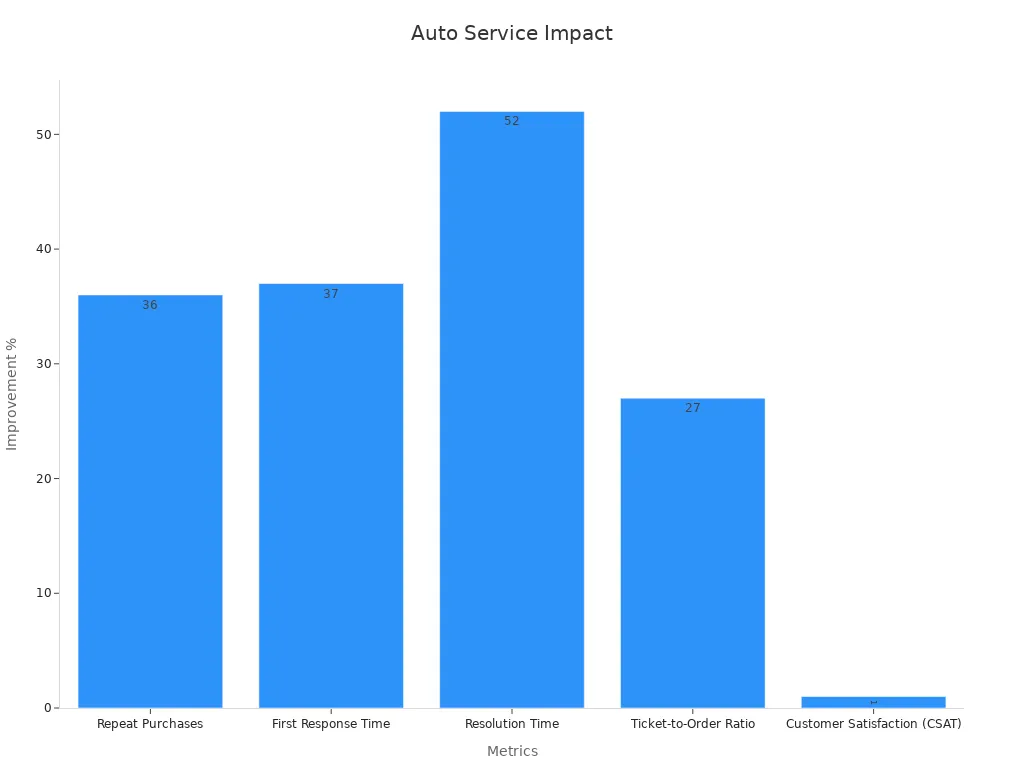
By improving response times and offering 24/7 availability, you can deliver exceptional service and meet customer expectations consistently.
Customer Service Automation Examples and Tools
Chatbots and virtual assistants (featuring Sobot Chatbot)
Chatbots and AI-powered virtual assistants have become essential in customer service automation examples. These tools handle repetitive tasks, such as answering FAQs, tracking orders, and providing basic technical support. For instance, Sobot's AI Chatbot offers advanced chatbot capabilities, including multilingual support and 24/7 availability. It autonomously resolves regular queries, improving productivity by 70% and cutting costs by up to 50%.
The impact of chatbots is evident in real-world cases. Maruti Suzuki’s AI chatbot engaged over 400,000 users, managing millions of queries and facilitating thousands of bookings. Similarly, Sobot's solutions in Southeast Asia enabled 22.2% of customer questions to be answered independently, achieving a 97% customer satisfaction score. These examples highlight how chatbots enhance operational efficiency and customer interactions.
AI-powered customer support systems
AI-powered customer support systems revolutionize how businesses manage customer interactions. These systems automate routine tasks, improve accuracy, and personalize service. For example, Sobot's automated customer service software integrates AI to streamline workflows and optimize resource allocation.
The benefits of AI systems are substantial. They reduce response times, enhance scalability, and improve customer satisfaction. Studies show that AI-powered tools can save businesses over $8 billion annually in customer support costs. Companies like Azul Airlines experienced an 84% reduction in wait times and a 59% increase in issue resolution rates using AI. By adopting AI chatbot automation, you can deliver faster, more personalized service.
Self-service portals and knowledge bases
Self-service portals and a comprehensive knowledge base empower customers to find answers independently. These tools reduce the need for human intervention, improving efficiency and customer satisfaction. Sobot’s knowledge base integrates seamlessly with its chatbot, providing instant replies based on pre-built resources.
Data supports the effectiveness of self-service options. Businesses report a 100% increase in self-service usage and a 50% improvement in productivity. However, only 15% of users are satisfied with current self-service offerings, highlighting the need for advanced solutions like Sobot's. By implementing these tools, you can enhance customer experiences and reduce operational costs.
Predictive analytics for proactive customer support
Predictive analytics enables proactive customer service by identifying potential issues before they arise. This approach improves retention rates and customer loyalty. For example, a SaaS company used predictive analytics to detect recurring software errors, allowing them to alert customers with troubleshooting solutions.
Sobot’s solutions leverage predictive insights to optimize resource management and personalize customer interactions. Proactive strategies, such as addressing at-risk customers or resolving issues preemptively, significantly enhance satisfaction. By integrating predictive analytics, you can transform your customer service into a forward-thinking, problem-solving operation.
Strategies for Implementing Automated Customer Service
Identifying and prioritizing automation opportunities
To implement automated customer service effectively, you must first identify areas where automation can deliver the most value. Focus on repetitive tasks that consume significant time and resources. For example, automating ticket prioritization ensures high-impact issues receive immediate attention. Similarly, self-service options like chatbots can handle common inquiries, improving customer satisfaction.
The table below outlines key automation opportunities:
| Evidence Type | Description |
|---|---|
| Automation and Human Interaction | Combining automation with human support enhances customer experience. |
| Self-Service Options | Self-service chat improves customer satisfaction by providing quicker support. |
| Ticket Prioritization | Automating ticket prioritization allows for efficient handling of high-impact tickets. |
| WISMO Ticket Reduction | Real-time order tracking reduces the volume of simple inquiries, freeing up support resources. |
By prioritizing these areas, you can streamline customer interactions and enhance operational efficiency.
Selecting the right tools and platforms (highlighting Sobot solutions)
Choosing the right tools is crucial for implementing automated customer service. Look for platforms that align with your business goals and offer advanced features. Sobot stands out with its AI-powered chatbot, which provides 24/7 multilingual support and integrates seamlessly with various channels.
The comparison below highlights Sobot's advantages:
| Feature | Sobot | Zendesk | Freshdesk |
|---|---|---|---|
| Response Automation | Advanced automation with AI learning | Rule-based automation | Predictive automation |
| Chatbot Capabilities | 24/7 chatbot support | Integrated chatbot | Smart chatbot |
| Query Handling | Multi-language support | Contextual understanding | Priority-based handling |
| Scalability | Highly scalable | Enterprise-ready | Adaptive scaling |
Sobot's solutions ensure scalability and efficiency, making them ideal for businesses aiming to improve customer experience.
Integrating automation with existing systems
Integrating automation tools with your existing systems ensures a seamless transition. Follow these steps for successful integration:
- Choose tools compatible with your CRM and helpdesk software.
- Integrate automation with existing platforms to unify customer data.
- Train your team to use the new tools effectively.
- Monitor performance and optimize processes continuously.
Sobot's omnichannel solution simplifies integration by consolidating customer interactions across platforms, ensuring a unified experience.
Training teams to work alongside automated systems
Automation works best when your team knows how to use it effectively. Provide training sessions to familiarize employees with new tools. For example, teach agents how to collaborate with chatbots to handle complex queries. This approach improves efficiency and ensures a smooth transition to automated systems.
Sobot offers resources like FAQs and self-service options to help your team adapt quickly. Empowering your staff enhances productivity and customer satisfaction.
Monitoring performance and optimizing continuously
Continuous monitoring is essential for optimizing automation strategies. Use metrics like throughput, cycle time, and issue resolution time to identify inefficiencies. For example, tracking issue resolution time reveals bottlenecks in your workflow.
The table below highlights key metrics for monitoring performance:
| Metric | Description |
|---|---|
| Throughput | Measures the number of tasks completed in a given time frame. |
| Cycle Time | Represents how long it takes to complete a task or project phase. |
| Issue Resolution Time | Monitors the time taken to resolve issues, revealing process inefficiencies. |
| Risk Exposure | Quantifies the potential impact and likelihood of identified risks. |
By analyzing these metrics, you can refine your automation strategies and ensure long-term success.
Real-World Success Stories in Customer Service Automation

OPPO: Scaling customer support with Sobot Chatbot
OPPO, a global leader in smart devices, faced challenges during peak shopping seasons. High inquiry volumes overwhelmed their support team, leading to delays and reduced customer satisfaction. By implementing Sobot's AI Chatbot, OPPO transformed its customer service operations. The chatbot handled repetitive queries, allowing human agents to focus on complex customer interactions. This human-machine collaboration improved efficiency and reduced response times.
Sobot also optimized OPPO's knowledge base, automating 90% of manual maintenance tasks. The results were remarkable. OPPO achieved an 83% chatbot resolution rate and a 94% positive feedback score. These improvements boosted customer satisfaction and increased repurchase rates by 57%. OPPO's success demonstrates how businesses can scale operations while enhancing the customer experience.
A SaaS company leveraging predictive analytics for proactive service
Predictive analytics has become a game-changer for SaaS companies. By analyzing customer behavior, businesses can anticipate needs and address issues before they arise. For example, automated churn prevention campaigns identify at-risk customers and provide personalized support to retain them. Proactive engagement strategies ensure customers receive resources when needed, improving satisfaction and loyalty.
SaaS companies also use predictive analytics to identify upsell opportunities and customize onboarding experiences. These strategies reduce churn and increase customer lifetime value. By shifting from reactive to proactive service, you can optimize resource allocation and deliver exceptional customer experiences. Data-driven decision-making ensures your customer service remains efficient and effective.
Lessons learned from successful implementations
Successful automation projects reveal valuable lessons. Companies that invest at least 20% of their IT budgets in automation achieve an average cost savings of 22%. Top-performing businesses save up to 37%. These results highlight the importance of prioritizing automation in your strategy.
| Category | Investment in Automation | Average Cost Savings |
|---|---|---|
| Leaders | At least 20% of IT budget | 22% |
| Laggards | Less than 5% of IT budget | 8% |
| Top Quartile Leaders | N/A | 37% |
Automation also improves customer satisfaction by streamlining workflows and reducing response times. By learning from these examples, you can implement strategies that maximize efficiency and enhance customer interactions.
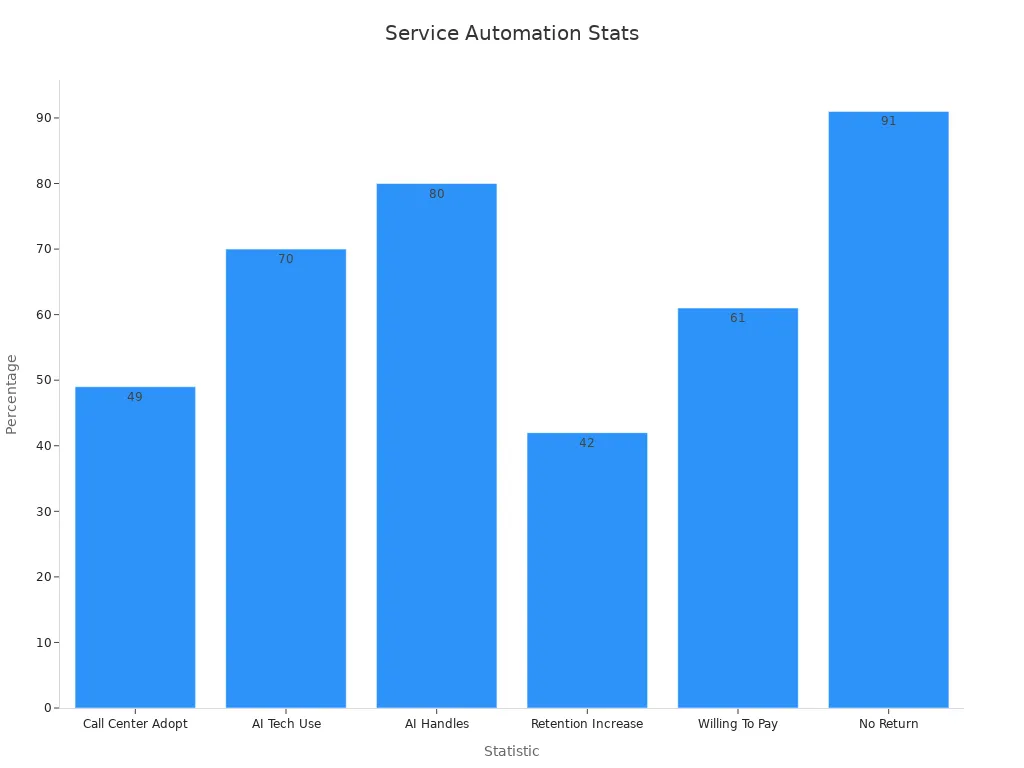
Mastering customer service automation in 2025 is essential for businesses aiming to thrive in a competitive market. Automation improves efficiency, enhances customer experience, and drives loyalty. For example, 70% of companies now use AI in call centers, and 80% of inquiries can be resolved by AI, reducing workloads significantly.
| Statistic | Implication |
|---|---|
| 49% of businesses have adopted call center software. | Indicates a growing trend towards automation in customer service. |
| 70% of companies use AI-based technologies in call centers. | Highlights the widespread adoption of AI for efficiency in customer service. |
| 80% of customer inquiries can be handled by AI. | Suggests significant potential for automation to improve response times and reduce workload. |
| Companies improving customer experience see a 42% increase in retention. | Demonstrates the direct correlation between customer service automation and customer loyalty. |
| 61% of consumers are willing to pay more for good customer experience. | Shows the financial benefits of investing in customer service automation. |
| 91% of callers with a negative experience will not return. | Emphasizes the importance of positive customer interactions facilitated by automation. |
To implement automation, focus on repetitive tasks, select the right tools, and integrate them seamlessly. Sobot’s solutions, like its AI-powered chatbot, offer scalable and efficient options to transform your customer service. Start your journey today and elevate your business to new heights.
FAQ
What is the first step to adopting customer service automation?
Start by identifying repetitive tasks that consume time and resources. Focus on areas like FAQs, ticket routing, or order tracking to maximize efficiency and improve customer satisfaction.
How can businesses ensure successful automation implementation?
Choose tools that align with your goals and integrate seamlessly with existing systems. Train your team to use these tools effectively and monitor performance for continuous improvement.
Can automation replace human agents entirely?
No, automation complements human agents by handling repetitive tasks. This allows agents to focus on complex issues, ensuring a balanced and efficient customer service approach.
See Also
Enhancing Efficiency With AI-Driven Customer Support Tools
Transforming Customer Support With AI Service Agents
Understanding The Efficiency Of Call Center Automation

