Customer Focused Culture vs Customer Centric vs Customer Obsessed


You might hear people talk about a customer focused culture, customer centric thinking, or even customer obsession. These ideas sound similar, but they mean different things for your business. A customer focused culture pays attention to what customers need right now. Customer centric companies look ahead and try to understand how customers behave over time. Customer obsession goes further and puts the customer at the center of every decision.
If you want your business to grow, you need to know which approach fits best. Companies that put the customer first see faster revenue growth and higher retention rates.
Sobot helps you build stronger customer relationships. With Sobot AI and the Sobot call center, you can meet customer needs, learn from feedback, and improve every interaction.
Customer Focused Culture

Definition
A customer focused culture means you put the customer at the heart of your business. You listen to what customers say and use their feedback to shape your products, services, and policies. This approach asks you to see things from the customer's point of view. Every interaction should meet or even exceed customer expectations. When you build a strong customer focus, you make sure your team always thinks about how to solve customer needs first. This mindset helps you deliver better customer service and build trust.
Key Traits
Organizations with a customer focused culture share some important traits. You can see these traits in how they work every day:
| Trait | Description |
|---|---|
| Anticipating customer needs | You try to understand and meet customer needs before they ask. |
| Delivering exceptional service | You aim to give service that goes beyond what customers expect. |
| Creating brand ambassadors | You help customers become loyal fans who tell others about your business. |
| Incentivizing value creation | You encourage everyone to create value for customers, not just one team. |
| Hiring for soft skills | You look for people who can connect well with customers. |
| Transparency | You stay open and honest about your products and services. |
| Prioritizing employee wellbeing | You know happy employees lead to better customer focus and satisfaction. |
A customer focused culture helps you spot trends, fix problems quickly, and keep customers coming back. You build loyalty by showing customers you care about their needs.
Sobot Voice/Call Center in Customer Focused Culture

Sobot’s Voice/Call Center gives you the tools to support a customer focused culture. You can connect with customers across many channels, like phone, chat, and WhatsApp, so you never miss a chance to meet customer needs. The platform uses AI-driven tools to help you understand what customers want and improve your service. You get over 300 reports that show how well you meet customer needs and where you can do better.
Sobot’s system is easy to use and puts the customer experience first. You can track every customer interaction, respond quickly, and make sure every customer feels heard. The Voice/Call Center supports your team with features like smart call routing, real-time monitoring, and a unified workspace. This means you can focus on solving customer needs and delivering great customer service every time.
Sobot’s full-cycle service helps you support customers from the first call to follow-up. You can learn more about Sobot’s Voice/Call Center and its benefits for customer focused culture on the official website.
Customer Centric Culture
What Sets It Apart
You might wonder how a customer centric culture stands out from a customer focused culture. The difference lies in how deeply you embed the customer into every part of your business. In a customer centric culture, you do more than just listen to feedback. You make the customer the core of every decision, process, and strategy. This approach shapes your company’s DNA.
| Characteristic | Description |
|---|---|
| Empathy | You listen to customers, understand their challenges, and see things from their perspective. |
| Customer Empowerment | You give customers control over their interactions and provide easy access to support and answers. |
| Collaboration | Your teams work together across departments to deliver seamless customer experiences. |
| Continuous Improvement | You always look for ways to improve based on customer feedback and market trends. |
A customer centric culture integrates customer focus into every action. In contrast, a customer focused culture may only address needs as they arise.
Customer Experience Emphasis
A customer-centric culture is all about prioritizing the customer’s needs and experiences in every business decision.
You make customer experience the top priority. Every employee, from leadership to support, understands their role in shaping positive outcomes. You do not just react to problems. You anticipate needs and create solutions that delight customers at every touchpoint.
- A customer-centric culture integrates customer focus into the organization's core, influencing all decisions and actions.
- In contrast, a customer-focused culture prioritizes understanding and meeting customer needs but may not fully embed this mindset across the organization.
This holistic approach ensures that customer experience becomes the standard for success.
Sobot Solutions for Customer Centricity
Sobot helps you achieve customer-centricity with advanced tools and seamless integration. The platform brings together channels like live chat, chatbot, ticketing system, and WhatsApp Business API. You can manage every customer interaction in one unified workspace. Sobot’s omnichannel AI connects all touchpoints, so you deliver a consistent customer experience.
| Feature | Description |
|---|---|
| Omnichannel AI | Connects chat, calls, WhatsApp, and more for a seamless customer journey. |
| Scenario-Based AI | Adapts to your industry, making support more relevant and effective. |
| Multi-Faceted AI | Supports agents and automates tasks, improving service quality and efficiency. |
| Generative AI | Delivers accurate, context-aware responses for better customer engagement. |
| Secure AI | Protects customer data and ensures compliance with privacy regulations. |
Sobot’s solutions help you empower customers with self-service options, fast responses, and personalized support. You can see real-time data, automate workflows, and keep improving the customer experience. Learn more about Sobot’s customer-centric solutions on the official website.
Customer Obsession

Defining Customer Obsession
Customer obsession means you put the customer at the center of everything you do. You do not just meet customer needs—you work to exceed them every time. Industry experts say customer obsession is a business philosophy. You listen to your customer, seek feedback, and adapt to changing needs. This approach builds strong relationships and helps your business grow over time.
| Core Principles of Customer Obsession | Description |
|---|---|
| Customer First | Every part of your business focuses on what benefits the customer. |
| Know Your Customer | You understand not just what customers say, but why they act a certain way. |
| Be Proactive | You solve issues before they affect the customer. |
| Never Stop Improving | You keep learning and changing based on feedback. |
| Company-Wide Alignment | All teams work together to serve the customer better. |
You make decisions based on real customer feedback. You use data to spot patterns and adjust quickly. You break down barriers between teams so everyone works toward the same goal—delighting the customer.
Culture Transformation
To build a customer obsession mindset, you need to change how your company works. You shift from focusing on products to focusing on the customer experience. Companies like Logitech and ASOS have done this by putting the customer at the heart of every process. Leaders encourage teams to experiment and innovate, always thinking about what helps the customer most.
When you move to customer obsession, employee engagement rises. Your team feels empowered to make decisions and solve problems for the customer. Open communication and regular feedback help everyone improve. Recognizing great service motivates your team and creates a positive cycle—happy employees lead to happy customers.
Sobot and Customer Obsession in Action
Sobot helps you achieve customer obsession by giving you the tools to connect with every customer, every time. Samsung used Sobot’s omnichannel platform to bring all customer service channels together. Agents could talk to customers on chat, phone, and WhatsApp without switching systems. Sobot’s AI chatbot worked with Samsung’s ordering system, giving fast, accurate answers. Samsung also used Sobot to create VIP customer groups, offering special support for their top customers.
With Sobot, Samsung saw a 30% jump in agent efficiency and reached a 97% customer satisfaction score. Pre-sales conversion rates went up by 15%. These results show how customer obsession, powered by the right tools, can transform your business. You can read more about Samsung’s story on Sobot’s website.
Comparing Cultures
Key Differences
You can see clear differences between a customer focused culture, a customer centric approach, and customer obsession. Each one shapes how you serve your customers and how your business grows. The table below shows the main distinctions:
| Culture Type | Description | Key Characteristics |
|---|---|---|
| Customer Focused | A brand that listens to customers but lacks deep understanding. | Tactical, reactive, short-term, treats all customers equally, self-serving to business goals. |
| Customer Centric | Places the customer at the center of all business decisions. | Proactive, strategic, values customer input, creates long-term relationships, enterprise-wide approach. |
| Customer Obsessed | An intense preoccupation with customer needs and experiences. | Hyper-focus on customers, may overlook other business aspects, can be impractical and risky. |
A customer focused culture listens to what customers say and tries to meet their needs as they arise. You might solve problems quickly, but you often treat every customer the same way. This approach works well for short-term goals.
A customer centric culture goes deeper. You put the customer at the heart of every decision. You look for patterns in customer behavior and use that knowledge to shape your products and services. This approach builds long-term relationships and helps your business grow over time.
Customer obsession takes things even further. You focus on every detail of the customer experience. You want to exceed expectations at every step. Sometimes, this intense focus can lead you to overlook other parts of your business, but it often creates loyal fans who keep coming back.
Tip: Think about where your company stands today. Are you reacting to customer needs, planning around them, or making them the center of everything you do?
Business Impact
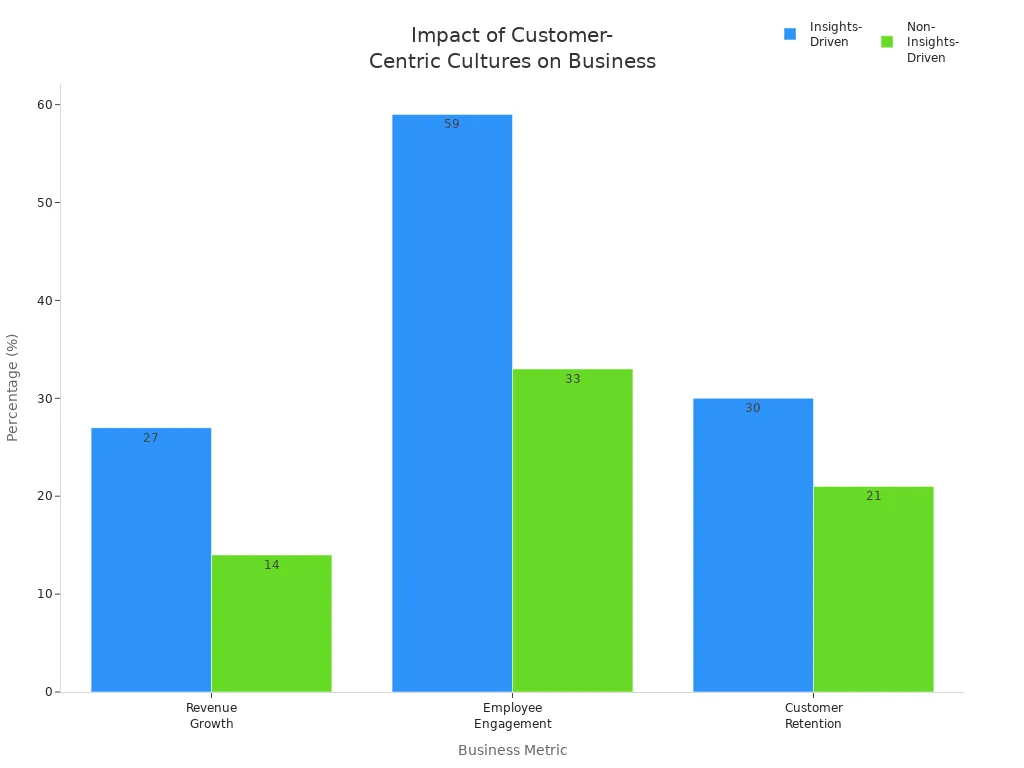
The type of culture you choose has a big effect on your business results. Companies that focus on customer experience often see faster revenue growth and stronger loyalty. Research shows that loyalty leaders can achieve about double the revenue growth compared to their peers. When you create a customer centric culture, you set your business up for long-term success.
- Companies with strong customer centric cultures experience four times the revenue growth of those with weaker cultures.
- 47% of companies with successful cultures report significant revenue increases, while only 9% of less effective cultures see the same results.
- Customers who have the best experiences spend 140% more than those with poor experiences.
You can measure the return on investment for each approach by looking at key business metrics:
| Key Metrics | Description |
|---|---|
| Increased customer lifetime value | Financial returns from long-term customer relationships. |
| Improved customer retention rates | Higher likelihood of customers returning to make purchases. |
| Higher customer satisfaction scores | Direct correlation with loyalty and repeat business. |
| Reduced customer acquisition costs | Savings from attracting new customers more efficiently. |
| Increased revenue per customer | More income generated from each customer. |
| Enhanced brand loyalty and advocacy | Customers promoting the brand, leading to new business. |
You can also calculate the financial impact of improving customer experience. For example, if you gain $100,000 from higher retention and save $50,000 from better efficiency, your total benefit is $150,000. If you spend $60,000 on customer experience initiatives, your net gain is $90,000.
Note: Customer obsession can drive even greater results, but it requires a full commitment from every part of your business.
Customer Experience Outcomes
Your approach to customer culture shapes the experience you deliver. Customer satisfaction and loyalty depend on how well you meet and exceed expectations. Two important metrics help you measure this:
| Metric | Purpose | Focus Area |
|---|---|---|
| CSAT | Measures satisfaction with specific interactions | Immediate customer feedback |
| NPS | Measures customer loyalty and likelihood to recommend | Overall customer sentiment |
- CSAT helps you see how happy customers are with each interaction.
- NPS shows how likely customers are to recommend your business to others.
- Both metrics are key for tracking customer satisfaction and loyalty.
When you build a customer focused culture, you often see quick improvements in CSAT. You fix problems fast and keep customers happy in the moment. A customer centric culture helps you raise both CSAT and NPS over time. You build trust and loyalty by making the customer part of every decision.
Customer obsession can lead to the highest scores in both areas. You create memorable experiences that turn customers into brand advocates. These customers stay longer, spend more, and tell others about your business.
Remember: Customer satisfaction is not just a number. It is a sign that your approach is working and your customers feel valued.
Real-World Examples
Sobot Case Study: Samsung
You can see the power of a customer obsessed approach in Samsung’s partnership with Sobot. Samsung wanted to improve customer engagement and satisfaction across all channels. By using Sobot’s all-in-one contact center, Samsung unified its support systems and made every customer interaction smoother. This move helped agents respond faster and offer more personalized service.
Here are some key results from Samsung’s focus on customer obsession and engagement:
- Samsung’s quality assurance led to a 40% increase in customer satisfaction, as reported by J.D. Power.
- Forrester Research found that 70% of customers are more likely to recommend brands with excellent after-sales support.
- Samsung’s devices with regular updates saw 25% longer user engagement.
- Products refined through customer feedback achieved a 15% higher user satisfaction rate.
- Qualtrics reported that 82% of consumers feel more positive about brands that act on customer feedback.
- Samsung’s investment in R&D made them 50% more likely to lead in market share, according to BCG.
- Pew Research found that 65% of consumers feel more confident when they have detailed product information.
You can see how Samsung’s customer obsessed culture, supported by Sobot, drives higher customer engagement and loyalty. Every step, from feedback collection to after-sales support, centers on the customer experience.
Other Industry Examples
Many companies have adopted customer focused culture, customer centric, or customer obsessed strategies to boost customer engagement and satisfaction. The table below shows how different brands use these approaches to improve engagement and loyalty:
| Company | Strategy/Practice |
|---|---|
| Cocunat | Strong digital marketing and community engagement for customer loyalty. |
| Amazon | Customer-centric model with easy returns and personalized recommendations. |
| Ikea | Immersive shopping experience and innovative online services. |
| L'Oréal Paris | Inclusivity in product offerings with diverse foundation shades. |
| Hilton Hotels & Resorts | Customer-centric strategy through membership programs and user-friendly apps. |
| Happy Returns | Simplified return process for e-commerce customers. |
| Coca-Cola | Personalized marketing through the 'Share a Coke' campaign. |
| Nordstrom | Utilizes analytics to personalize shopping experiences. |
You can learn from these examples. Each company puts the customer at the center of its business, whether through customer focused culture, customer centric thinking, or customer obsessed practices. These strategies help you build stronger customer engagement and long-lasting relationships.
Shifting Your Culture
Steps Toward Customer Obsession
You can move your organization from a customer focused culture or customer centric approach to true customer obsession by following clear steps. Start by making customer obsession part of your executive planning. Look at your brand promise from the customer’s viewpoint and track feedback at every stage of the journey. Empower your employees to make decisions that improve the customer journey and encourage innovation. Focus on building strong relationships instead of just growing your customer base. Add value after the sale to increase retention and understand why customers leave. Use feedback to guide changes in your service and share customer data across teams to improve every journey.
Here are the most effective steps:
- Develop a collective focus on customer obsession in leadership and planning.
- See your brand through the customer’s eyes and track their feedback.
- Give employees the power to innovate and improve the customer journey.
- Value quality relationships over quantity.
- Prioritize retention and understand customer needs after the sale.
- Let feedback drive your service changes.
- Share customer data across your organization.
- Focus only on what matters most to your customer.
- Commit to meeting customer needs in real time.
- Hire people who believe in customer obsession.
- Change your communication to reflect a collective, customer-first mindset.
Tip: Training programs that build a customer-obsessed mindset, use data-driven insights, and encourage customer advocacy help your team deliver a better experience at every journey stage.
Role of Leadership
Leadership plays a key role in driving customer obsession. Leaders must show commitment to understanding customer needs and set the tone for the entire organization. When leaders focus on the customer journey, everyone else follows. Leaders should make customer-centricity a core value and communicate this through their actions and words.
| Evidence | Explanation |
|---|---|
| Strong leadership buy-in is essential for customer-centric culture. | Leaders must champion customer obsession and lead by example, influencing the entire organization. |
| Leadership must embody customer obsession. | The entire leadership team should demonstrate commitment to understanding customer needs. |
| Customer-centricity as core values. | Consistent communication of customer-centric values through leadership behavior is crucial for internalizing this mindset. |
When you see leaders prioritize customer needs, it encourages teams to break down silos and work together. This alignment helps you deliver a seamless customer journey and a better experience at every touchpoint.
Measuring Progress
You need to measure your progress as you shift toward customer obsession. Use clear metrics to track how well you meet customer needs and improve the journey. Common KPIs include customer churn rate, Net Promoter Score, customer satisfaction, average resolution time, and customer acquisition rate. You can also look at conversion rate, cart abandonment rate, marketing campaign effectiveness, direct traffic, and pages per visit.
| KPI | Description |
|---|---|
| Customer churn rate | Measures the percentage of customers lost over time. |
| Net Promoter Score | Gauges customer loyalty and likelihood to recommend. |
| Customer Satisfaction | Assesses how products and services meet customer expectations. |
| Average Resolution Time | Tracks the average time taken to resolve customer issues. |
| Customer Acquisition Rate | Measures the rate at which new customers are gained. |
| Conversion rate | Indicates the percentage of visitors who take a desired action. |
| Cart abandonment rate | Measures the percentage of shopping carts that are abandoned. |
| Marketing campaign effectiveness | Evaluates the success of marketing efforts. |
| Direct traffic | Tracks the number of visitors who arrive directly at the site. |
| Pages per visit | Measures the average number of pages viewed per visit. |
You can also benchmark your performance against industry standards using Net Promoter Score and Customer Satisfaction Score. Comparing your cultural attributes to industry benchmarks helps you set realistic goals and track your journey toward customer obsession.
Note: Customer obsession leads to measurable business outcomes. Companies that embrace this journey report higher revenue, stronger loyalty, and increased customer retention. For example, increasing retention by just 5% can boost profits by up to 95%. The success rate of selling to existing customers is much higher than selling to new ones, making every journey more valuable.
You can see the differences between each approach in the table below:
| Culture Type | Description |
|---|---|
| Customer Focused | Designing business strategies primarily around customer needs and expectations. |
| Customer Centric | Prioritizing customer needs, preferences, and satisfaction in all business decisions. |
| Customer Obsessed | Going beyond customer satisfaction to create deep emotional connections and loyalty with customers. |
To build strong customer relationships, assess your current culture by engaging with customers, mapping their journeys, and using analytics. Many businesses report higher satisfaction and loyalty after using Sobot’s solutions.
FAQ
What is the main difference between customer focused culture, customer centric, and customer obsession?
You see customer focused culture as meeting needs as they come up. Customer centric means you plan every part of your business around the customer. Customer obsession takes it further and puts the customer at the center of every decision.
How can Sobot help my business improve customer experience?
You can use Sobot’s all-in-one contact center to connect with customers on phone, chat, and WhatsApp. Sobot’s tools help you track feedback, automate tasks, and give fast, personal support. This makes your service better and more efficient.
Why does customer obsession matter for long-term business growth?
Customer obsession helps you build strong loyalty. You listen, learn, and act on feedback. This approach keeps customers happy and coming back. Over time, you see higher retention and more referrals, which leads to steady business growth.
How do I know if my company is customer centric?
You know your company is customer centric when every team thinks about the customer first. You use feedback to improve products and services. You also measure success by customer satisfaction and loyalty, not just sales.
What steps can I take to shift toward a customer focused culture?
You start by listening to your customers and acting on their feedback. Train your team to solve customer problems quickly. Use tools like Sobot’s Voice/Call Center to track interactions and improve service at every step.
See Also
Comparative Analysis of Leading Customer Voice Software
Reviewing Leading Contact Center Solutions for 2024
Essential Practices for Quality Management in Call Centers
Comprehensive Guide to Call Center Quality Management Systems

