Customer Care Conversation Skills The Essential Handbook


Customer care conversation skills help you connect, solve problems, and build trust with every customer. In today’s world, customer service moves fast. You might chat with a friendly agent on a website, call a Sobot call center, or get instant answers from Sobot AI. These tools make customer support smoother and more personal than ever before. Companies now use Sobot and other omnichannel solutions because they improve customer engagement and boost customer satisfaction by up to 30%. Imagine you need help with an order. A quick, caring response can turn your customer service experience into something you remember. Think back—what made your last customer care interaction stand out? Was it patience, a helpful attitude, or clear answers?
Customer Care Conversation Skills

Definition
When you think about customer care conversation skills, you might picture someone who listens, understands, and helps you solve a problem. These skills are the building blocks of excellent customer service. You use them every time you talk, chat, or message with a company. But what do these skills really mean?
Let’s break it down. Customer care conversation skills are a mix of qualities and actions that help you connect with customers and make them feel valued. Here’s what top customer service organizations say you need:
- Empathy – You understand and share the feelings of your customers.
- Time management – You balance being friendly with being efficient.
- Product knowledge – You know your stuff and can explain it clearly.
- Resilience – You stay calm and positive, even when things get tough.
- Written communication – You write clearly, especially in chats and emails.
You also need to pay attention, listen without interrupting, and take responsibility for solving issues. Customer care conversation skills help you build strong personal and emotional connections. You become someone customers trust and remember.
Tip: Address customers by name and listen carefully. These small actions make a big difference in how customers feel.
Importance
Why do customer care conversation skills matter so much? The answer is simple: they shape every customer service interaction. When you use these skills, you create a positive customer experience. Customers feel heard, respected, and helped. This leads to higher customer satisfaction and loyalty.
Research shows that communication is one of the most important factors in customer satisfaction. For example, a review found that clear and informative conversations reduce confusion and make people happier with the service they receive. When you explain things well and show patience, customers trust you more. They are more likely to come back and recommend your business to others.
Let’s look at some real-world impacts:
- Agents with strong customer care conversation skills resolve issues faster.
- Customers who feel understood are less likely to leave after a bad experience.
- Companies that focus on excellent customer service see more repeat sales and referrals.
Here’s a quick look at how these skills affect business outcomes:
| Measurable Business Outcome | Metric / Indicator | Impact of Improved Customer Care Conversation Skills |
|---|---|---|
| Customer Satisfaction | Customer Satisfaction Score (CSAT) | Higher CSAT through better agent training and response quality |
| Customer Loyalty | Net Promoter Score (NPS) | Increased likelihood of customers recommending the business |
| Customer Retention | Customer Churn Rate | Reduced churn due to improved interactions |
| Response Efficiency | First Response Time (FRT) | Faster responses improving customer experience |
| Cost Efficiency | Cost Per Contact (CPC) | Lowered costs by optimizing workflows and training |
| Team Performance | Team Efficiency and Morale | Enhanced efficiency and reduced turnover through better support and recognition |
| Customer Experience Personalization | Personalized interactions | More valued customers leading to repeat sales and referrals |
| Business Growth | Repeat Sales and Referrals | Growth driven by improved customer satisfaction and loyalty |
Did you know that 76% of people stop doing business with a company after just one bad experience? That’s why every conversation counts. When you focus on customer care, you help your team work better, boost morale, and keep customers coming back.
Note: Excellent customer service is not just about solving problems. It’s about making every customer feel important and understood.
Sobot’s Approach
You might wonder how technology fits into all this. Sobot takes customer care conversation skills to the next level. Instead of relying only on human agents and scripts, Sobot uses advanced AI to make every customer service interaction smarter and more personal.
Here’s how Sobot stands out:
- Sobot’s AI Agents and Voicebots use large language models to understand what customers need. They can chat, talk, and even write emails that sound natural and friendly.
- The system gathers information from past conversations and predicts what customers might ask next. This helps you give faster, more accurate answers.
- Sobot’s omnichannel platform lets you help customers on chat, voice, email, and social media—all from one place. You never miss a message, and customers get a smooth experience.
- AI handles repetitive questions, so your team can focus on complex issues. This makes your workday easier and helps customers get answers quickly.
- Sobot’s Voicebot uses speech recognition and natural language processing to talk with customers just like a real person. If the bot can’t help, it transfers the call to a human agent who already knows the customer’s problem.
- The platform learns from every conversation. It adapts to new questions and customer emotions, so your service keeps getting better.
Did you know? Sobot’s solutions helped OPPO achieve an 83% chatbot resolution rate and a 94% positive feedback rate. That’s the power of combining technology with a customer-centric mindset.
Sobot believes in ethical and transparent AI. The system avoids misleading answers and always puts the customer first. With Sobot, you get a scalable, efficient, and customer-centric service that grows with your business.
If you want to deliver excellent customer service, you need more than just good intentions. You need the right tools and a customer-centric mindset. Sobot gives you both, helping you build stronger relationships and drive business growth.
Essential Customer Service Skills
Great customer service starts with the right skills. When you talk to customers, you need more than just product knowledge. You need to connect, understand, and solve problems. Let’s look at the five most important customer service skills you need to master.
Active Listening
Active listening is the heart of excellent customer service. When you listen closely, you show customers that you care about their concerns. You don’t just wait for your turn to speak. You focus on what the customer says, ask questions, and repeat back what you heard to make sure you understand.
Here’s why active listening matters:
- Customers feel respected when you listen before you apologize or offer solutions.
- Scenario-based experiments show that active listening can boost customer satisfaction, even after a service failure.
- Customers who feel heard are more likely to tip more and return in the future.
- Listening first, then apologizing, leads to better results than the other way around.
- Customers often see active listening as a sign of preferential treatment, which makes them feel special.
Imagine a customer calls your Sobot-powered call center with a problem. You listen carefully, take notes, and repeat their issue back to them. This simple act can turn a frustrated caller into a loyal fan. Sobot’s unified workspace helps you keep track of every detail, so you never miss a beat.
Tip: Try not to interrupt. Let the customer finish speaking before you respond. This builds trust and shows you value their input.
Active listening is not just about hearing words. It’s about understanding feelings and needs. When you practice this skill, you make every customer feel important.
Empathy
Empathy means putting yourself in the customer’s shoes. You try to feel what they feel and see things from their point of view. This skill is key to building strong relationships and delivering excellent customer service.
Here’s how empathy helps you and your business:
- Empathy creates personalized and satisfying interactions. Customers feel like you truly understand them.
- It builds trust and loyalty. When customers feel heard, they come back and tell others about your service.
- Empathy improves problem-solving by helping you get to the root of the issue.
- It reduces customer churn. When people feel valued, they stay with your brand.
You can build empathy by:
- Training your team to develop empathy skills.
- Practicing active listening to understand customer perspectives.
- Putting yourself in the customer’s shoes.
- Showing genuine care and compassion in every interaction.
- Asking for feedback and improving based on what customers say.
Emotional intelligence plays a big role here. When you recognize your own feelings and those of your customers, you solve problems faster and build stronger connections. Sobot’s AI-powered chatbots can even detect customer emotions and respond with empathy, making every conversation feel more human.
Note: Empathy is not just a nice-to-have. In a crowded market, it sets you apart. Brands that show empathy attract and keep more customers.
Effective Communication
Effective communication is the backbone of customer service. You need to share information clearly, honestly, and with confidence. When you use the right communication skills, you avoid misunderstandings and make customers feel comfortable.
Some proven techniques for effective communication include:
- Use an assertive style. Be honest, polite, and confident. Avoid being passive or aggressive.
- Personalize your interactions. Make customers feel like they are talking to a real person, not a script.
- Use positive language. Stay away from negative words. End conversations on a good note.
- Repeat customer issues back to them. This shows you understand and helps avoid confusion.
- Create a seamless experience across all channels. Sobot’s omnichannel solution lets you talk to customers on chat, voice, email, and social media, all from one place.
- Combine automation with live agents. Let chatbots handle simple questions, so you can focus on complex issues.
When you communicate well, you set the tone for the whole customer journey. Customers remember how you made them feel, not just what you said. Sobot’s unified workspace helps you keep your messages clear and consistent, no matter which channel you use.
Callout: Always check for understanding. Ask, “Did I explain that clearly?” or “Is there anything else I can help you with today?”
Problem-Solving
Problem-solving is where you turn a bad situation into a good one. Customers come to you with issues. Your job is to find solutions quickly and make things right. Strong problem-solving abilities are a must for anyone in customer service.
You can use different frameworks to solve problems:
- McKinsey’s 7-Step Problem Solving Framework
- Root Cause Analysis (RCA)
- The CIRCLES method
- The Phoenix Checklist
- Lightning Decision Jam (LDJ)
- DMAIC from Six Sigma
- Fishbone Diagram
These frameworks help you:
- Understand the problem by collecting data from surveys, interviews, or customer feedback.
- Brainstorm solutions with your team.
- Pick the best solution and put it into action.
- Train your team and prepare customers for any changes.
- Collect feedback after you fix the problem to see if it worked.
For simple problems, quick methods like the 5 Whys or Fishbone Diagram work well. For bigger issues, use a more detailed approach. Sobot’s analytics tools help you track issues, spot trends, and find root causes faster.
Tip: Always follow up after solving a problem. Ask the customer if they are satisfied with the solution. This shows you care and helps you improve your service.
Problem-solving skills help you handle tough situations with confidence. When you solve problems well, you turn unhappy customers into loyal ones.
Patience & Adaptability
Patience and adaptability go hand in hand in customer service. Every customer is different. Some need more time to explain their problem. Others may be upset or confused. You need to stay calm and adjust your approach to fit each situation.
Patience means you give customers the time they need. You don’t rush them or get frustrated. Adaptability means you can change your style or solution based on what the customer needs.
Here’s how you can practice patience and adaptability:
- Take a deep breath when things get stressful.
- Listen without interrupting, even if you’ve heard the problem before.
- Stay positive, even when customers are upset.
- Use different tools and channels to help customers in the way they prefer. Sobot’s omnichannel platform lets you switch between chat, voice, and email with ease.
- Learn from each interaction. If something doesn’t work, try a new approach next time.
Customers notice when you stay patient and flexible. They feel respected and valued. This leads to better reviews, more repeat business, and a stronger brand reputation.
Note: Patience and adaptability are not just for handling difficult customers. They help you grow as a customer service professional and make your job more rewarding.
Mastering these essential customer service skills—active listening, empathy, effective communication, problem-solving, and patience & adaptability—will set you apart. You’ll build trust, solve problems, and create memorable experiences for every customer. With tools like Sobot’s unified workspace and AI-powered solutions, you can take your customer service to the next level.
Effective Communication in Customer Service
Clear Language
Clear language is the foundation of great customer service. When you use simple words and short sentences, you help customers understand you right away. Confusing language or technical jargon can make people feel lost or frustrated. Studies show that clear language reduces confusion and increases satisfaction. For example, in healthcare and retail, using plain language helps people follow instructions and feel more confident about their choices. Customers who understand your message are more likely to trust you and feel happy with your service.
You can practice effective communication by:
- Speaking slowly and clearly.
- Avoiding slang or complicated terms.
- Checking if the customer understands.
- Using the same words for the same things every time.
Sobot’s omnichannel platform makes it easy to keep your messages clear across chat, email, and voice. You can use templates and AI suggestions to make sure every customer gets the same high-quality support. When you focus on clear language, you set the stage for excellent customer service.
Tip: Always ask, “Does that make sense?” or “Can I explain anything further?” This shows you care about the customer’s understanding.
Personalization
Personalization takes customer service to the next level. When you use a customer’s name or remember their last order, you make them feel special. Personalized messages and recommendations show that you see each customer as an individual, not just a number. Research proves that personalization boosts engagement, increases loyalty, and keeps people coming back. For example, when companies use personalized onboarding, customers complete tasks faster and feel more satisfied.
Here’s how personalization impacts customer engagement:
| Engagement Metric | Impact of Personalization |
|---|---|
| User Engagement Rate | Higher active usage and satisfaction |
| Feature Adoption Rate | More customers try new features |
| Average Session Duration | Customers spend more time interacting with your service |
| Retention | Fewer customers leave after a good, personalized experience |
Sobot’s unified workspace helps you track customer history and preferences. You can greet customers by name, remember their past issues, and offer solutions that fit their needs. This kind of exceptional communication builds trust and makes your customer service stand out.
Positive Attitude
A positive attitude can turn a tough situation into a win. When you stay upbeat and respectful, even with upset customers, you help calm things down. Experts say that a positive attitude helps you listen better, avoid arguments, and keep the conversation on track. For example, saying, “I understand how you feel, and I’m here to help,” can make a big difference. This approach helps you de-escalate tense moments and keeps customers from getting angrier.
Here’s how a positive attitude helps in customer service:
- You stay calm and avoid taking things personally.
- You listen actively and show empathy.
- You use kind words and avoid blaming the customer.
- You keep the conversation focused on solutions.
- You build trust and encourage customers to return.
Sobot’s AI-powered chatbots and voicebots are designed to keep a friendly tone, even in stressful situations. This ensures every customer gets exceptional communication, no matter how they reach out. When you combine great communication skills with a positive attitude, you deliver excellent customer service every time.
😊 Remember: A smile—even over the phone—can be heard in your voice!
Customer Service Training & Development
Training Methods
You want your customer service team to shine, right? The best way to do that is with strong customer service training. There are many ways to help customer service representatives learn and grow. Some people learn best by doing, while others like to watch or listen. Mixing up your customer service training keeps things interesting and helps everyone improve.
Here’s a quick look at popular customer service training methods:
| Training Method | Description |
|---|---|
| Classroom Training | Face-to-face lessons with interactive exercises and role-playing. |
| E-Learning | Online modules for self-paced, consistent customer service training for employees. |
| On-the-Job Training | Learning by doing, guided by experienced team members. |
| Simulations & Role-Playing | Practice real-life customer service scenarios in a safe space. |
| Microlearning | Short, focused lessons delivered regularly. |
| Video Training | Watching examples of good and bad customer service. |
| Gamification | Using games, points, and leaderboards to boost engagement. |
| Peer-to-Peer Learning | Sharing tips and stories among team members. |
| Workshops & Seminars | Deep dives into specific customer service topics. |
| Mentoring Programs | Pairing new staff with experienced mentors for customer service coaching. |
You can make customer service training more effective by using videos, games, and hands-on practice. Try role-playing to act out tough customer service situations. Give feedback after each session so everyone knows what went well and what to work on. Keep training fresh with regular updates and quick refresher courses.
Tip: Use feedback loops. Ask your team what works and what doesn’t. Adjust your customer service training for employees to fit their needs.
Sobot Voice/Call Center Tools
Sobot’s Voice/Call Center tools make customer service training easier and smarter. You can track how fast agents answer calls, how long customers wait, and how much time each call takes. Real-time dashboards let you see what’s happening in your call center, even if you’re working from home.
Sobot records calls and checks quality, so you can review real conversations during customer service coaching sessions. The AI Copilot gives agents real-time suggestions, summaries, and even creates tickets automatically. This helps customer service representatives learn on the job and get better every day.
- Sobot’s AI-powered system gives feedback and coaching based on real customer service calls.
- You spot training needs quickly and help agents build new skills.
- Real-time feedback helps agents solve customer service problems faster.
- Companies using Sobot see fewer errors and need fewer extra staff during busy times.
- Automated monitoring keeps your team on track and improves compliance.
With Sobot, you can make customer service training for employees more personal and effective. Your team learns faster, and your customers get better service.
Self-Assessment
Self-assessment is a big part of customer service training. It helps you see what you do well and where you can improve. Here’s a simple way to check your customer service skills:
- Collect data about your work—look at customer satisfaction scores, how fast you solve problems, and how many calls you handle.
- Reflect on your strengths and weaknesses. Be honest!
- Set SMART goals (Specific, Measurable, Achievable, Relevant, Time-bound) for your customer service training.
- Use feedback from customers, peers, and managers to get a full picture.
- Track your progress and adjust your goals as you grow.
Note: Self-assessment helps you become a better customer service representative. It also makes customer service coaching more focused and helpful.
Studies show that self-assessment boosts job performance and helps you set better goals. When you combine self-assessment with strong customer service training, you build a team that’s always improving.
Handling Challenging Conversations

Difficult Customers
You will meet all kinds of people in customer service. Some customers feel angry or upset. Others expect you to know everything or want discounts you cannot give. Sometimes, you get a rush of tickets during a crisis, and the pressure rises. Here are some common challenges you might face:
- Angry customers venting their frustrations.
- Customers who expect instant answers to every question.
- High ticket volumes, especially during outages.
- Requests for things outside your authority, like special discounts.
- Customers who refuse to listen or act unreasonably.
- Feeling burned out from handling too many tough cases.
When you face these situations, your conflict resolution skills matter most. Stay calm, listen closely, and show empathy. Use phrases like, “I understand how you feel,” to let customers know you care. If a customer becomes too difficult, sometimes it’s best to protect your team and move on.
Tip: Personalize your approach. Customers want to feel heard, not just processed.
Complaints & Escalations
Complaints are part of customer service. You need a clear plan for handling them. Start by using your conflict resolution skills to calm the situation. Offer solutions or alternatives when you can. If you cannot solve the problem, follow these escalation steps:
- Send the issue to a specialist if it needs expert help.
- Escalate to a supervisor for bigger problems or special approval.
- Use automatic escalation if a ticket breaks your service promise.
- Prioritize urgent issues, like fraud or public complaints.
Keep customers updated during the process. Explain what will happen next and when they can expect a reply. Sobot’s ticketing system helps you track escalations and makes sure nothing falls through the cracks. Regularly review feedback and update your training to handle future complaints better.
Stress Management
Handling tough conversations can wear you down. Stress builds up when you deal with angry customers or high workloads. To stay healthy and do your best work, try these tips:
- Take short breaks between calls or chats.
- Talk with teammates or supervisors for support.
- Use Sobot’s AI tools to automate simple tasks and reduce your workload.
- Practice empathy, but remember to set boundaries.
- Focus on problem-solving, not just the problem itself.
Remember: You cannot control every situation, but you can control your response. Good conflict resolution skills and self-care help you stay strong in customer service.
Omnichannel Customer Service with Sobot
Today, you expect customer service to be fast and easy, no matter how you reach out. Sobot’s omnichannel solution brings all your customer support channels together in one place. This makes every customer experience smoother and more personal.

Voice/Call Center Integration
When you call a company, you want answers right away. Sobot’s Voice/Call Center connects all your calls, chats, and messages in a single dashboard. This means agents see your whole history and help you faster. Here’s how it helps:
- Agents manage all customer service requests from one platform.
- You get quick answers because agents have all your info in front of them.
- Smart call routing sends you to the right person, so you don’t wait on hold.
- Automation tools, like voicebots, handle simple questions and free up agents for complex issues.
This setup boosts agent productivity and cuts down on response times. You don’t have to repeat yourself, and your problems get solved faster.
Chat & Messaging
Many people prefer to chat or message instead of calling. Sobot lets you reach customer support on WhatsApp, website chat, or other messaging apps. All your conversations stay in one place, so agents always know your story. Here’s what you get:
- Seamless support across chat and messaging platforms.
- Agents handle many chats at once, so you get help quickly.
- Automated chatbots answer common questions, saving time for everyone.
- Your chat history follows you, so you never have to start over.
This approach keeps customer engagement high and makes customer service more efficient.
Email & Social Media
You might send an email or post on social media when you need help. Sobot brings these channels into the same workspace. Agents see your full history, so you get consistent answers. Studies show companies with strong omnichannel strategies keep 89% of their customers (Invesp). Sobot’s AI tools help agents reply faster and personalize every response. OPPO used Sobot to connect their website, app, and social media. They saw an 83% chatbot resolution rate and a 57% jump in repeat purchases. This shows how unified customer support can boost satisfaction and loyalty.
With Sobot, you get a connected customer service experience—no matter how you reach out.
Real-World Examples
Industry Scenarios
You see customer care conversation skills in action every day across different industries. These skills help you handle tough situations and keep customers happy. Here are some common scenarios where these skills matter most:
- Active listening helps when a customer calls about a delayed delivery. You listen first, then respond with a solution.
- Effective communication is key when you explain why a website setup is taking longer than expected.
- Creative thinking comes in handy in retail. If a customer wants a refund, you suggest another product they might like.
- Problem-solving is part of your daily routine. You help customers use products and answer their questions with patience.
- Continuous training through workshops and feedback keeps your team sharp.
Let’s look at how different industries use these skills:
| Industry Sector | Common Customer Care Scenario | Importance of Conversation Skills |
|---|---|---|
| Technology | Handling product recalls (like smartphone issues) | You need empathy and clear guidance to keep customers safe and calm |
| Retail | Managing returns and refunds | You resolve problems and offer alternatives to keep customers coming back |
| General Services | Addressing dissatisfaction and churn | You listen, offer solutions, and help with customer retention |
| Logistics/Retail | Fixing delayed deliveries or product issues | You use active listening and problem-solving to help customers quickly |
Training with role-play and real-life examples helps you prepare for these moments. You build confidence and improve the customer experience every time you practice.
Sobot Customer Stories
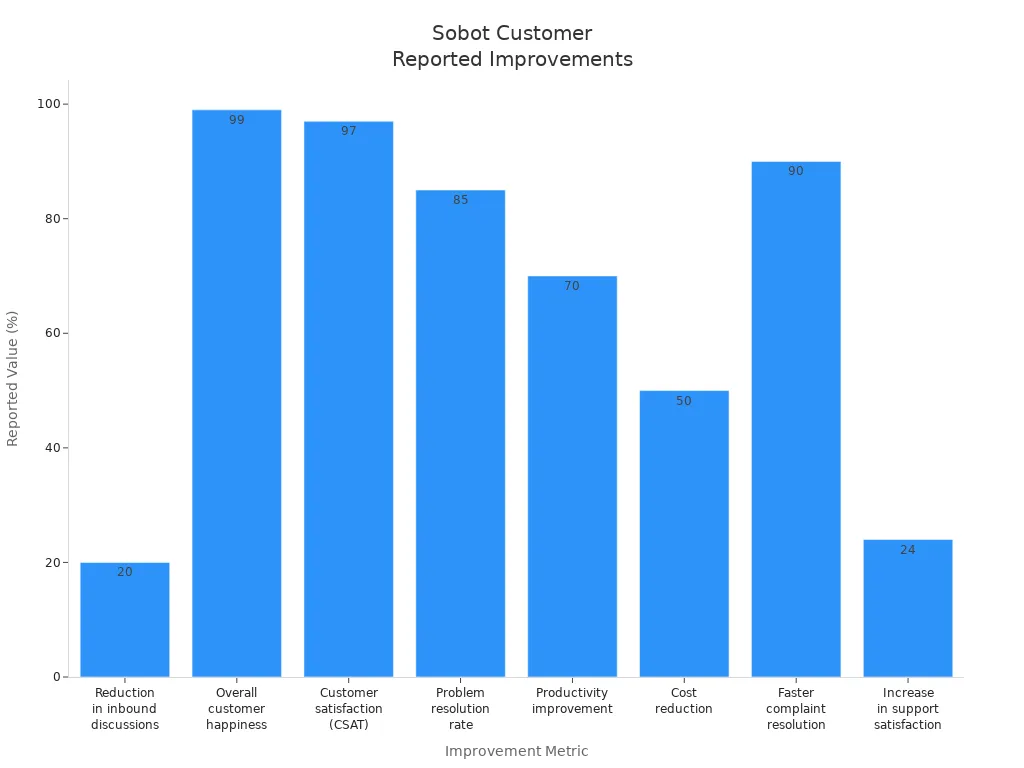
Sobot’s solutions make a real difference for businesses like yours. After switching to Sobot, companies report big improvements in customer service and customer support. You can see the results in the numbers:
| Measurable Improvement | Reported Value |
|---|---|
| Reduction in inbound discussions | 20% |
| Overall customer happiness | 99% |
| Customer satisfaction (CSAT) | 97% |
| Problem resolution rate | 85% |
| Productivity improvement | Up to 70% |
| Cost reduction | Up to 50% |
| Faster complaint resolution | 90% |
| Increase in support satisfaction | 24% |
One standout story comes from OPPO, a global tech brand. OPPO used Sobot’s AI-powered chatbots and unified workspace to handle more questions without hiring extra staff. They reached an 83% autonomous query resolution rate, a 94% positive feedback rate, and a 57% increase in repurchase rate. This shows how better customer service leads to higher customer retention and loyalty.
When you use Sobot, you give your team the tools to deliver a great customer experience and keep customers coming back. You can learn more about OPPO’s story here.
Mastering customer care skills gives you a real edge. When you invest in customer service training, you help your team exceed expectations, boost retention, and turn happy customers into loyal fans. Ongoing training, like Sobot’s AI coaching, keeps your skills sharp and ready for any challenge. Try self-assessment, ask for feedback, and explore new tools. Every step you take helps you grow and deliver better service. Ready to level up your customer service training? Start today and watch your impact grow!
FAQ
What are customer care conversation skills?
Customer care conversation skills help you connect with customers, solve problems, and build trust. You use these skills every time you talk, chat, or message with someone who needs help. Strong skills lead to better customer experience and higher satisfaction.
How can customer service training improve my team’s performance?
Customer service training gives your team real-life practice. You learn how to listen, show empathy, and solve problems. Sobot’s tools let you track progress and give feedback. Teams with regular training see up to 30% better customer support results (source).
Why does a positive attitude matter for a customer service representative?
A positive attitude helps you calm upset customers and find solutions faster. Customers remember how you made them feel. When you stay upbeat, you create a better customer experience and boost loyalty. Sobot’s AI even helps keep your tone friendly in every chat.
How does Sobot support omnichannel customer support?
Sobot brings all your customer support channels—voice, chat, email, and social media—into one workspace. You see every customer’s history and respond faster. This unified approach improves customer care conversation skills and makes every customer experience smoother.
See Also
Effective Strategies For Managing Quality In Call Centers
Comprehensive Overview Of Quality Management Systems In Call Centers
How To Excel At Live Chat Support In Retail
Expert Techniques For Live Chat Customer Service Success
Step-By-Step Guide To Deploy Omnichannel Contact Center Systems

