Conversational AI Chatbot for Ecommerce A 2026 Guide


Does your store lose sales from abandoned carts? The average rate hit 73.12% in 2024. You can leverage conversational AI in ecommerce to win back customers and boost loyalty. This guide provides a clear path to implementing a powerful conversational AI chatbot solution for ecommerce. Using conversational chatbots and conversational commerce strategies with a tool like Sobot will prepare your business for success by 2026. This conversational approach is key.
The Strategic Role of Conversational AI in Ecommerce

To win in 2026, you need to see conversational AI as more than just a pop-up window on your site. It is a core part of your business strategy. Understanding the technology helps you unlock its true potential for conversational commerce. This involves moving beyond basic chatbots and embracing a truly intelligent conversational system.
Beyond Basic Bots: AI vs. Rule-Based
Not all chatbots are created equal. Early bots were rule-based, following a strict script like a flowchart. Modern AI chatbots are far more powerful. They use machine learning to understand, adapt, and personalize the conversational experience. Your choice impacts everything from customer satisfaction to scalability.
| Feature | Rule-Based Chatbots | AI Chatbots |
|---|---|---|
| Functionality | Follows predefined scripts. | Understands and generates human-like text. |
| Intelligence | Cannot learn or adapt. | Learns from each conversational interaction. |
| Personalization | Offers very limited personalization. | Provides highly personalized experiences. |
| User Experience | Can feel rigid and impersonal. | Offers a natural and engaging conversation. |
Understanding Natural Language Processing
The magic behind smart AI is Natural Language Processing (NLP). NLP gives messaging chatbots the ability to understand human language. This process turns complex customer questions into actions. It generally works in a few key stages:
- Understanding: The AI first breaks your customer's sentence into words and analyzes the grammar.
- Analysis: It then figures out the contextual meaning and the customer's true intent (e.g., tracking an order).
- Generation: Finally, the AI constructs the most relevant and helpful response in natural language.
This technology allows for a more effective conversational commerce strategy.
From a Support Tool to a Strategic Asset
The role of AI in ecommerce has evolved. It has moved from a simple support tool to a strategic business asset. Basic bots answered FAQs to reduce agent workload. Today’s AI agents do much more. They act as virtual employees who drive business goals.
A modern conversational AI chatbot solution for ecommerce doesn't just save you money on support costs—it actively makes you money. It achieves this by creating personalized shopping experiences, recovering abandoned carts, and upselling relevant products.
You can use them to proactively engage customers and gather valuable data. This transforms your customer service from a cost center into a powerful revenue driver. This conversational approach is vital for growth.
Key Benefits of a Conversational AI Chatbot
A conversational AI chatbot solution for ecommerce offers more than just automated replies. You can use it to increase revenue, delight customers, and streamline your operations. This conversational tool becomes a central part of your growth strategy.
Drive Revenue with Personalized Selling
You can transform every conversational interaction into a sales opportunity. AI chatbots act as personal shoppers for your customers. They provide personalized recommendations based on browsing history and past purchases. This level of tailored service makes customers feel understood and valued. A strong conversational commerce strategy helps you guide shoppers to the perfect products, which can increase revenue.
Studies show that this personalized approach is highly effective. Businesses using AI for conversational commerce have seen conversion rates climb by up to 20%.
Enhance Customer Experience with 24/7 Support
Modern shoppers expect answers instantly, day or night. You can meet this demand with 24/7 customer support. AI chatbots provide immediate assistance around the clock, even on holidays. They can also communicate in multiple languages, breaking down barriers for your global customers. This constant availability improves the customer experience significantly. When you answer simple questions quickly, you build trust and satisfaction. This excellent customer support keeps shoppers happy.
Improve Efficiency and Reduce Operational Costs
You can make your customer support team more powerful. AI chatbots handle common and repetitive questions automatically. This frees up your human agents to focus on complex issues that require a personal touch. This efficiency has a direct impact on your budget.
- Improve team productivity by up to 70%.
- Save up to 50% on agent costs by letting chatbots manage routine queries.
By automating these tasks, you can reduce support costs while improving service quality. This allows you to scale your customer support without a proportional increase in headcount.
Boost Loyalty Through Proactive Engagement
You can build lasting relationships with your customers through proactive conversational outreach. Instead of waiting for customers to contact you, your chatbot can initiate helpful conversations. It can notify shoppers about new arrivals, offer exclusive discounts, or remind them about items left in their cart. This proactive engagement shows you care about their needs. It creates a positive customer experience that fosters loyalty and boosts customer satisfaction. This turns one-time buyers into lifelong fans of your brand, increasing revenue over time.
Top Use Cases for Your Ecommerce Chatbot
You can use a conversational AI chatbot in many ways. It can guide customers, automate tasks, and gather important data. These use cases transform your site into a dynamic, conversational commerce platform.
Guiding Shoppers with Product Discovery
You can turn your chatbot into a virtual sales assistant. It helps customers find exactly what they need. This process of ai-driven product discovery creates better ai-powered shopping experiences. The chatbot asks questions about preferences, budget, and needs. Then, it provides personalized recommendations.
For example, LEGO's chatbot helps you find the perfect gift by asking about the recipient's age and interests. This conversational guide simplifies shopping and makes customers feel understood.
This conversational approach helps shoppers who know what they want but struggle to find it.
Automating Order Tracking and Returns
You can save your team valuable time. Let chatbots handle routine questions about orders and returns. Customers can get instant updates on their order status 24/7. You can also automate the returns process.
A conversational chatbot can:
- Ask for the order number and reason for the return.
- Connect to your order system to verify the purchase.
- Initiate the return or refund process automatically.
This frees up your human agents to handle more complex issues.
Recovering Sales with Cart Abandonment Flows
You can win back customers who leave items in their cart. A conversational chatbot can proactively engage these shoppers. It can offer a discount or answer last-minute questions about shipping or security. This simple conversational interaction can make a big difference.
Studies show that this strategy can reduce cart abandonment by 18%. Answering security questions alone can lower abandonment, as it builds trust right before a purchase and boosts your revenue.
Collecting Customer Feedback and Data
You can gather valuable insights with every conversation. Your chatbot can ask for feedback at key moments in the customer journey. For example, it can ask about the checkout experience right after a purchase. This conversational method provides real-time data. You can use this information to improve your products, website, and overall conversational commerce strategy.
Implementing Your Conversational AI Chatbot Solution for Ecommerce
Putting a powerful conversational AI chatbot solution for ecommerce into action is a clear, manageable process. You can transform your customer interactions by following a structured plan. This six-step guide will walk you through building and launching a chatbot that drives results.
Step 1: Define Your Goals and Key Performance Indicators
Before you build anything, you must define what success looks like. Your primary business goal might be to reduce the workload on your human support staff. This frees up your team and helps manage costs. You can then set specific Key Performance Indicators (KPIs) to track your progress.
Clear goals guide your entire strategy. They help you measure the return on your investment in conversational commerce.
Common goals and the KPIs to measure them include:
- Improve Customer Happiness: Track your Resolution Rate (how often the bot solves a problem) and Customer Satisfaction (CSAT) scores.
- Reduce Operational Costs: Monitor your Containment Rate (conversations handled only by the bot) and Human Handover Rate (how often a human agent is needed).
- Increase Sales Revenue: Measure your chatbot’s Conversion Rate and its impact on Average Order Value (AOV).
- Boost Efficiency: Keep an eye on the Average Response Time and the Fallback Rate (when the bot fails to understand a query).
Step 2: Choose the Right No-Code AI Platform
The right platform makes implementation simple and scalable. You need a tool that grows with your business. Look for a no-code platform so your team can build and manage conversational flows without writing a single line of code.
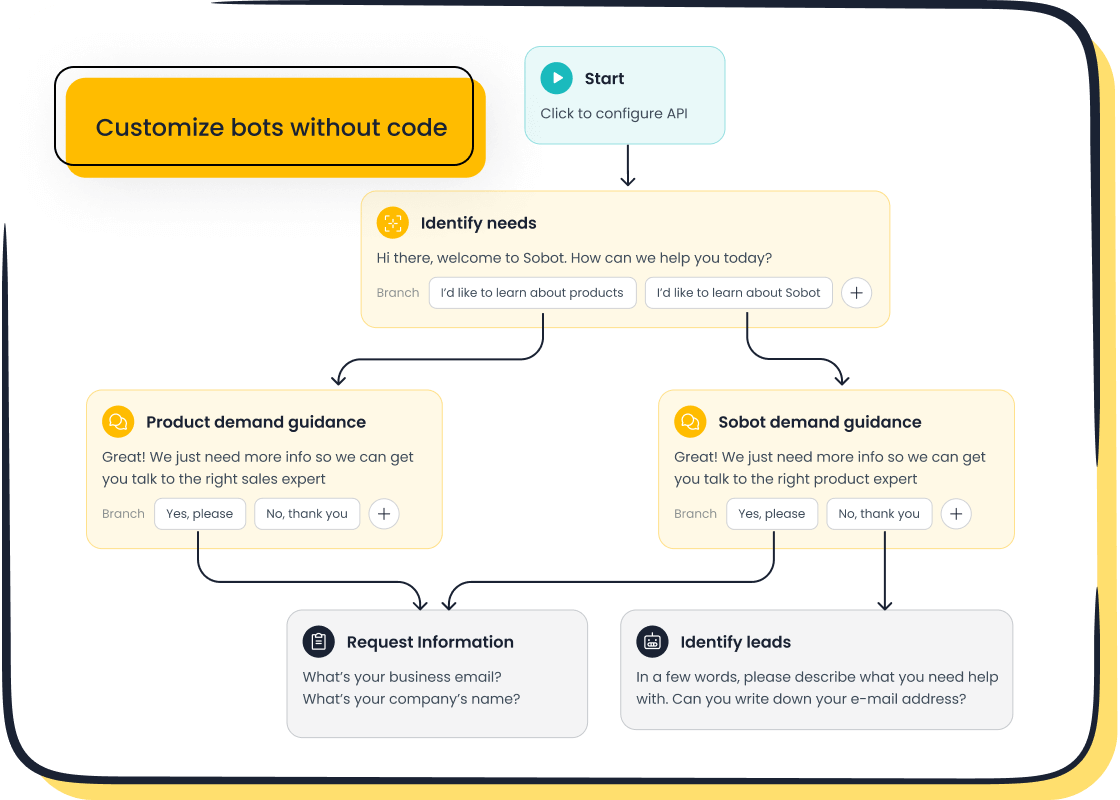
A comprehensive solution like Sobot provides an all-in-one contact center platform. It goes beyond basic chatbots to include:
- AI Chatbot and AI Agent: For intelligent, automated conversations.
- Live Chat: For seamless human agent handoffs.
- Call Center/Voice and Voicebot: To unify your voice and digital channels.
- Ticketing System: To manage complex customer issues efficiently.
When choosing your platform, prioritize these essential features:
- No-Code Interface: A visual, point-and-click builder makes creating conversational flows easy for anyone.
- Omnichannel Support: Your platform must connect with customers where they are, including your website, WhatsApp, SMS, and social media.
- Robust Integration Capabilities: The ability to connect with your CRM, payment systems, and marketing tools is critical.
- Advanced Analytics: You need a dashboard to track your KPIs and understand user behavior.
Step 3: Design Your Conversation Flows with Sobot
Now you can start designing the actual conversations. A good conversational flow feels natural and helpful, not robotic. Using a platform like Sobot with its straightforward building blocks, you can map out user journeys visually.
Best Practice: Always think from the user's perspective. Prioritize their needs over your internal processes to create a smooth and satisfying customer experience.
Follow these tips to design effective conversational flows:
- Craft an Engaging Welcome: Your first message sets the tone. Greet the user and clearly state what the chatbot can help with.
- Balance Automation and Human Help: Design clear rules for when the conversation should be handed over to a human agent. Offer an opt-in for human support to avoid user frustration.
- Plan for the Unknown: Users will ask unexpected questions. Create helpful fallback responses that guide them back on track or offer to connect them with an agent.
- Personalize the Experience: Use customer data to address users by name and remember their preferences. This personal touch builds a stronger connection and increases satisfaction.
Step 4: Integrate with Your Ecommerce Stack like Shopify
Your chatbot becomes truly powerful when it connects with your other business systems. Integrating your conversational AI with platforms like Shopify and your CRM unlocks a new level of automation and personalization. This is a core part of a successful conversational commerce strategy.
For example, an integration with Shopify allows your chatbot to access order data in real time. This enables powerful capabilities directly within the chat.
| Capability | Why It Matters for Your Store |
|---|---|
| Product Recommendations | Your bot can suggest items based on a customer's browsing history. |
| Order Tracking | You can provide instant order status updates without human help. |
| Cart Recovery | The bot can proactively offer a discount to shoppers with abandoned carts. |
| Pricing & Discount Queries | You can answer questions about promotions and product availability instantly. |
These integrations turn your chatbot from a simple Q&A tool into one of your most effective conversational commerce tools.
Step 5: Train, Test, and Launch Your Chatbot
Before your chatbot meets your customers, you must train and test it thoroughly. The quality of your training data will directly impact its performance. Use real examples from past live chat logs, support emails, and FAQs to teach your bot how customers talk.
Next, you need to test for a wide range of scenarios. This includes:
- Core Functionality: Does the bot complete key tasks correctly?
- Integration Points: Does it pull data from Shopify or your CRM accurately?
- Error Handling: What happens when a user types a misspelled word or an unexpected phrase?
- Human Handoff: Is the transfer to a live agent smooth and seamless?
Luxury brand Michael Kors saw incredible results after implementing an all-in-one solution. By unifying their channels and deploying an intelligent conversational system, they achieved an 83% reduction in response time and a 95% customer satisfaction rate. This shows the power of a well-executed strategy. You can read more about their success here.
Step 6: Monitor Performance and Continuously Optimize
Launching your chatbot is just the beginning. The final step is to monitor its performance and continuously make it smarter. Your platform's analytics dashboard is your best friend here. You should regularly review key metrics to find areas for improvement.
Look for patterns in your data:
- High Fallback Rate: If your bot frequently fails to understand users, its knowledge base may need more training on those topics.
- Low Conversion Rate: If users are not completing purchases, you can use A/B testing to experiment with different cart recovery messages or offers.
- Negative User Feedback: Pay close attention to conversations where users express frustration. These interactions often reveal friction points in your conversational flows.
By turning this data into actionable insights, you can refine your conversational AI chatbot solution for ecommerce over time. This iterative process ensures your bot continues to meet customer expectations and drive business growth. These conversational commerce tools and conversational AI solutions are key to future success.
Future-Proofing Your Strategy: AI Trends for 2026
To stay ahead, you need to prepare for the future of ecommerce. The conversational AI trends of tomorrow will redefine how you interact with customers. Understanding these shifts helps you build a strategy that lasts.
The Rise of Hyper-Personalisation
By 2026, you will move beyond basic personalization. The future is hyper-personalisation. This means using AI to deliver deeply relevant experiences in real time. Your conversational AI will act as an autonomous shopping agent. It will use customer data to predict intent and offer tailored product recommendations. This level of service makes every conversational interaction unique and valuable. You can create these experiences by:
- Using AI to analyze customer behavior across all your channels.
- Leveraging data customers share willingly to build trust.
- Offering dynamic pricing and promotions based on loyalty.
Voice Commerce and Smart Speaker Integration
Your customers will shop more with their voices. Voice commerce is growing rapidly, with sales projected to soar. Integrating with smart speakers like Amazon Alexa and Google Home will become essential for your conversational commerce strategy. This allows for hands-free, convenient shopping.
| Metric | Projected Value by 2030 |
|---|---|
| Global Voice Commerce Market | USD 186.28 billion |
| Smart Speaker Revenue Share | Over 44% (in 2023) |
This trend makes the shopping journey faster and more seamless. A conversational approach is key to succeeding in this voice-first world.
Predictive and Proactive Customer Support
Your customer support will become proactive instead of reactive. AI will use predictive analytics to anticipate customer needs before they even ask. By analyzing purchase history and browsing behavior, your chatbot can identify potential issues. For example, it might notice a customer struggling on the checkout page and proactively offer help. This predictive conversational ability solves problems early and improves the customer experience.
Seamless Human and AI Agent Collaboration
The best systems will blend AI and human strengths. Your AI will handle most routine questions, freeing up your team for complex issues. A successful conversational commerce model requires a seamless handoff between the AI and a human agent. When a conversation is escalated, the human agent will receive the full context of the AI interaction. This ensures the customer never has to repeat themselves. This hybrid approach makes your support team more efficient and keeps customer satisfaction high.
You now see that conversational AI is a non-negotiable part of your future ecommerce success. Implementing a solution is an achievable process. You can follow the steps in this guide with a powerful platform to transform your customer experience. To gain a competitive edge by 2026, you must start building your conversational strategy today.
Ready to begin? Embark on Your Contact Journey.
FAQ
What is the main purpose of an e-commerce chatbot?
You use a chatbot to automate customer conversations. It solves common questions on its own and helps your support agents. This improves your team's productivity and makes your customer service more efficient.
How can a chatbot reduce my store's costs?
A chatbot works 24/7 to answer customer questions. This reduces the need for you to hire more support agents for night shifts or peak hours. You can save up to 50% on agent costs.
Do I need coding skills to build a chatbot?
No, you do not need coding experience. Modern platforms like Sobot offer a point-and-click interface. You can use simple building blocks to design and launch your conversational AI chatbot for ecommerce without writing any code.
Can a chatbot serve my international customers?
Yes, it can. AI chatbots are multilingual. You can set them up to interact with shoppers in their preferred language. This helps you provide excellent support to your global customer base and expand your market reach.
See Also
Best Live Chat Platforms for Online Stores This Year
Elevating E-commerce Customer Happiness Through Smart Chatbot Solutions
Driving E-commerce Revenue Growth with Live Chat Solutions

