The Best Contact Center for Ecommerce In-House or Out?


Choosing the right contact center for ecommerce is a major decision for your brand. The global ecommerce market is expanding rapidly, making excellent customer service essential for success.
- Global B2C ecommerce revenue may reach USD 5.5 trillion by 2027.
- The global B2B ecommerce market is set to grow 14.5% annually through 2026.
This guide helps you select the best ecommerce support model for your goals. You can build an in-house team for control, use an outsourced service for flexibility, or try a hybrid model with a solution like Sobot. Your choice between an in-house or outsourcing model depends on your budget, growth stage, and desired customer experience. This decision shapes your entire ecommerce support structure.
Why Choose an Outsourced Model for Ecommerce
Outsourcing your ecommerce support can be a powerful strategy for growth. An outsourced contact center offers flexibility and expertise that can be difficult to build in-house. This model is especially useful if you have rapid growth and expansion goals. Let's explore why an outsourced call center might be the right choice for your ecommerce business.
To Scale Support for Holidays and Sales
Your ecommerce business likely sees huge spikes in customer questions during holidays and sales events. Support ticket volume can increase dramatically, putting a strain on your resources. For example, fashion and consumer tech brands see the biggest jumps.
| Category | Increase in Support Tickets |
|---|---|
| eCommerce (average) | 79% |
| Fashion brands | 182% |
| Consumer tech brands | 173% |
| Home furnishings | Almost no change |
An outsourced call center helps you manage these peaks without hiring temporary staff. Outsourcing allows you to scale your support up or down as needed. One health tech business used outsourced customer support to reduce response times from 7.5 hours to just 18 minutes during a busy period. This flexibility ensures you provide high-quality service and maintain customer satisfaction year-round.
To Reduce Operational Costs
Building an in-house team comes with significant costs. You have to pay for salaries, benefits, office space, and expensive technology. These operational costs can make up a large part of your budget. Labor expenses alone can be 60-75% of your total spending.
Outsourcing your ecommerce support turns these fixed costs into a more manageable variable expense. You can achieve major cost savings, often between 30% and 60%, by working with an outsourced contact center. This makes outsourcing a cost-effective way to manage your support budget and reallocate funds to other areas of your ecommerce business. The lower cost does not mean lower quality; it means smarter resource allocation.
To Provide 24/7 Support
Modern shoppers expect help whenever they need it. In fact, 51% of people believe a business should be available around the clock. Providing 24/7 support with an in-house team is challenging and expensive.
An outsourced call center makes around-the-clock customer service a reality. This constant availability can directly boost your sales. Studies show that customers who use live chat are 2.8 times more likely to make a purchase. Outsourced support meets your customer service needs at any hour, improving customer satisfaction and driving revenue for your ecommerce brand.
To Focus on Core Business Growth
Managing a contact center for ecommerce takes time and attention away from your main goals. When you handle all ecommerce support yourself, you have less time for critical tasks like product development, marketing, and brand building.
By outsourcing, you free up your internal resources. This allows you to focus on what you do best: growing your business. Outsourced customer support handles the day-to-day inquiries, so you can concentrate on strategic initiatives. This shift in focus is a key reason why many fast-growing ecommerce brands choose outsourcing to accelerate their expansion.
When to Build an In-House Contact Center
Outsourcing offers flexibility, but an in-house contact center gives you unparalleled control. For established ecommerce brands with specific needs, building your own team is often the best long-term strategy. This approach allows you to cultivate a support experience that is deeply integrated with your brand identity and product expertise. Let's look at when an in-house model makes sense for your ecommerce business.
For Absolute Control Over Brand Voice
Your brand voice is a critical part of your identity. An in-house team lives and breathes your company culture, ensuring every customer interaction is consistent. This consistency builds trust and loyalty. In fact, 32% of customers will leave a brand after just one bad experience. An in-house team helps you maintain high-quality service and control the narrative.
- You can train agents on your exact tone and values.
- This direct oversight helps maintain a uniform voice across all support channels.
- A consistent brand connection can turn customers into powerful brand ambassadors.
To Build Expert In-House Customer Support
Some ecommerce products are complex and require deep knowledge. An in-house customer support team becomes a group of product specialists. They work closely with your product and marketing departments, gaining a nuanced understanding that an outsourced agent cannot match. This expertise is vital for resolving complicated issues effectively and improving customer satisfaction. Your in-house team can provide detailed, contextual ecommerce support that builds customer confidence.
For Handling Highly Sensitive Customer Data
Data security and compliance are non-negotiable in ecommerce. If your business handles sensitive information like payment details, an in-house call center provides maximum security. You have direct control over your data security and compliance protocols, such as the Payment Card Industry Data Security Standard (PCI DSS). Managing this in-house minimizes the risk of data breaches and costly fines, giving both you and your customers peace of mind.
When Volume is Stable and Predictable
An in-house team is a significant investment with high fixed costs. This model works best when your ecommerce support volume is stable and predictable. You can staff your team appropriately without worrying about sudden, unmanageable spikes. While the initial cost is high, you can maximize the value of your in-house customer support team.
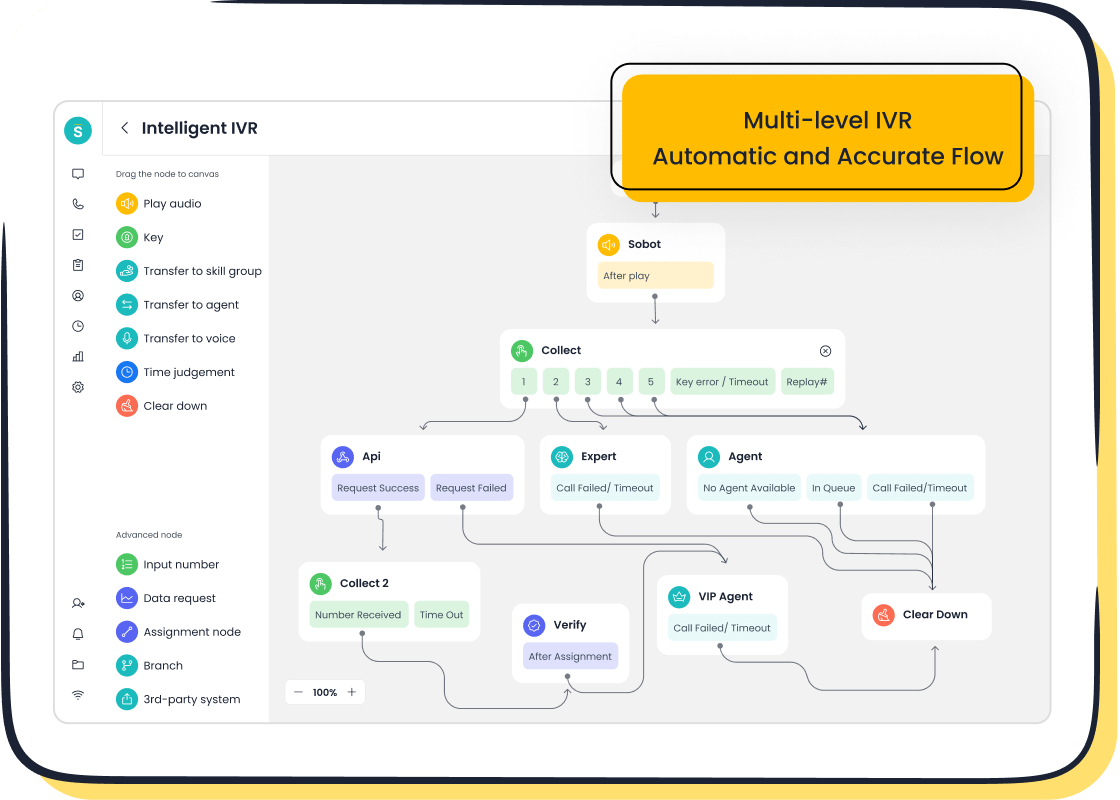
Tip: An in-house call center has high fixed costs, but its effectiveness can be maximized with the right tools. Solutions like Sobot's Voice/Call Center empower your in-house team by turning this investment into a high-value asset. Features like a Unified Workspace and drag-n-drop Intelligent IVR boost efficiency, while real-time monitoring gives you the control needed to ensure quality and optimize performance.
Using a Hybrid Model with Sobot's Omnichannel Solution
What if you could have the control of an in-house team and the flexibility of outsourcing? The hybrid model offers the best of both worlds for your ecommerce business. You combine your in-house customer support experts with an outsourced team or AI to create a powerful and efficient ecommerce support system. This approach gives you a scalable and cost-effective solution for your contact center for ecommerce.
To Handle Overflow During Peak Hours
Your ecommerce brand faces busy seasons. A hybrid model helps you manage these demand spikes without the high costs of overtime or temporary staff. Your in-house team can focus on high-value tasks that drive revenue. An outsourced partner handles the overflow. This strategy offers several benefits:
- You avoid expensive overtime or last-minute hiring.
- Your in-house team stays focused on core business activities.
- Your business can adapt to demand in real-time without financial strain.
This approach ensures you deliver prompt, high-quality support even during your busiest sales events, boosting customer satisfaction.
For Cost-Effective After-Hours Support
Providing 24/7 support is crucial for ecommerce, but staffing an in-house team around the clock is expensive. A hybrid model offers a cost-effective solution. You can use an outsourced team in a different time zone to cover off-hours. This method provides significant cost savings. Automations and AI chatbots can also handle routine questions after your in-house team has gone home. This ensures your customers always get the help they need, which builds loyalty and trust in your ecommerce brand.
To Tier Support by Inquiry Type
A tiered support structure makes your ecommerce support more efficient. You can route simple, repetitive questions to an outsourced team or a chatbot. This frees up your expert in-house team to handle complex issues that require deep product knowledge. This division of labor lowers support costs and improves resolution times. Your in-house customer support can focus on high-priority tasks, which improves overall customer satisfaction.
The success of a hybrid model depends on seamless integration. Sobot's Omnichannel Solution unifies all your support channels and teams. It brings voice, chat, email, and social media into a single workspace. This allows your in-house and outsourced teams to work together perfectly.
Success in Action: OPPO's Hybrid Model Leading tech brand OPPO used a human-machine hybrid model with Sobot to transform its ecommerce support. By using chatbots for common questions and human agents for complex issues, OPPO achieved an 83% chatbot resolution rate and saw a 57% increase in repurchases. This proves how a well-integrated hybrid model can boost efficiency and drive growth.
A Direct Comparison for Your Contact Center for Ecommerce

Choosing between an in-house or outsourced model for your ecommerce support involves a trade-off. Each path has unique benefits and challenges. This direct comparison will help you weigh the most important factors: cost, scalability, brand control, and launch speed. Understanding these differences is key to building the right support structure for your ecommerce brand.
Cost: Outsourced vs. In-House
The cost comparison between an in-house and outsourced call center is a major factor for any ecommerce business. An in-house model requires a large upfront investment and has high ongoing costs. An outsourced model converts many of these fixed expenses into a more predictable variable cost.
An in-house call center comes with many hidden costs beyond just salaries. You are responsible for the entire infrastructure. These expenses add up quickly.
- Acquisition Costs: This includes software subscriptions, on-premise licenses, and hardware like computers and headsets.
- Implementation Costs: You will pay for installation, configuration, and integration services. You also lose productivity during employee training.
- Hiring and Training: Attracting talent may require perks and covering moving costs. Training a new agent can cost at least $1,000, and this process takes weeks.
- Ongoing Maintenance: You must budget for software updates, support contracts, and operating costs like electricity and bandwidth.
Outsourcing your ecommerce support simplifies your budget. You pay a predictable fee, which makes financial planning easier. This approach is often more cost-effective, especially for growing ecommerce brands. Outsourcing helps you avoid the high fixed costs of an in-house team, freeing up capital for marketing or product development.
Scalability: Outsourced vs. In-House
Your ecommerce business needs to adapt to changing demand. Scalability is about how quickly you can grow or shrink your support team. Outsourcing offers far more flexibility than an in-house model.
Building an in-house team is a slow process. Finding, hiring, and training agents takes time.
| Team Type | Setup Time |
|---|---|
| In-house | 2-3 months minimum |
| Outsourced | 2-3 weeks |
This delay means an in-house team cannot respond quickly to sudden sales spikes. Rapidly scaling an in-house customer support team also presents other challenges. You might face a decline in service quality as agents get overwhelmed. Your existing processes may not work for a larger volume of inquiries, leading to chaos.
An outsourced call center provides on-demand staffing. They can add trained agents with as little as a 15-day notice to handle massive fluctuations in support volume. This instant scalability ensures you can manage peak seasons without sacrificing customer satisfaction. After the busy period, you can scale back down, reducing your costs. This flexibility is a major advantage for any ecommerce business with seasonal sales cycles.
Brand Control: Outsourced vs. In-House
Maintaining your brand voice is essential for building customer loyalty. An in-house team gives you the most direct control over your brand's message and quality. However, you can also achieve consistency with an outsourced partner through careful planning.
With an in-house team, your agents are immersed in your company culture. They understand your values and can communicate them in every interaction. This direct oversight helps ensure a consistent and high-quality customer experience. You have full control over training, quality assurance, and performance management.
When you choose outsourcing, you give up some direct control. An outsourced team may serve multiple clients, which can lead to divided attention. Poor service from an outsourced call center can damage your brand's reputation and erode customer trust.
However, you can maintain brand control with the right outsourcing partner. Success depends on clear communication and strong processes.
- Create Detailed Guidelines: Develop a brand book that explains your values, mission, and tone of voice. Provide real-world examples for greetings, apologies, and handling complex issues.
- Invest in Training: Implement a brand immersion program for the outsourced team. Use role-playing scenarios to help agents practice your brand voice.
- Establish Quality Checks: Conduct regular audits of customer interactions. Use customer feedback and performance metrics to identify any inconsistencies and provide corrective training.
By taking these steps, you can ensure your outsourced customer support team acts as a true extension of your ecommerce brand.
Speed to Launch: Outsourced vs. In-House
How quickly can you get your support operations running? The answer is very different for in-house and outsourced models. If you need to launch your support quickly, outsourcing is the clear winner.
Setting up an in-house call center is a long-term project. You have to find and lease office space, purchase and install hardware and software, and recruit an entire team. This process can easily take several months from start to finish. This slow timeline can hinder your expansion plans and leave customers without support.
Partnering with an outsourced contact center allows you to launch much faster. These providers already have the infrastructure, technology, and trained agents in place. The onboarding process typically takes just a few weeks.
For example, many business process outsourcing (BPO) services, including call centers, have an onboarding timeline of 60 to 90 days. Some specialized providers can get you started in as little as six to eight weeks.
This speed allows your ecommerce business to offer professional support almost immediately. You can meet customer needs faster, improve customer satisfaction, and focus on your core business growth without the delays of building an in-house operation.
The best contact center for ecommerce depends on your unique business needs. Your choice between an in-house or outsourced model for your ecommerce support is critical. For a growing ecommerce business, outsourcing provides flexible support. An established ecommerce brand should consider an in-house model for its ecommerce support. You can power your in-house support with solutions like Sobot. A clear value proposition influences 74% of consumers, so evaluate your ecommerce stage. Explore how Sobot’s solutions can support your in-house team and your entire ecommerce support strategy.
Embark on Your Contact Journey.
FAQ
What is the first step to decide on a support model?
First, you should evaluate your business needs. Consider your budget, sales volume, and brand goals. A growing brand may need a flexible option. An established brand might prefer an in-house team for total control over its customer support.
How does Sobot help an in-house team?
Sobot empowers your in-house support team with powerful tools. Our Voice/Call Center solution includes a Unified Workspace and an Intelligent IVR. These features improve efficiency and give you full control over your in-house support operations.
Can a small ecommerce business use a hybrid model?
Yes. A hybrid model is great for small businesses. You can use your in-house team for business hours. Then, you can use AI chatbots for after-hours support. This approach provides 24/7 coverage without the high cost.
Is it hard to switch from an outsourced to an in-house model?
The transition requires careful planning. You will need to hire and train your own support staff. You also need to set up the right technology. A solution like Sobot makes this process easier by providing a ready-to-use platform for your new team.
See Also
Best Contact Center Platforms: An In-Depth Review for 2024
Your Essential Guide to Omnichannel Call Center Software Solutions
Implementing Omnichannel Contact Centers: A 10-Step Practical Guide
Leading Live Chat Software Options for E-commerce Businesses in 2024
Evaluating the Best Cloud Contact Center Services: 2024 Reviews

