Run a Compliant Telemarketing Business


Your telemarketing business must strictly follow federal and state telemarketing laws. Ensuring telemarketing law compliance with rules like the TCPA and TSR is essential for your operations. With a vast majority of Americans—72% as of one survey—on the National Do Not Call Registry, you must prioritize consumer privacy and proper consent. This guide offers a framework for telemarketing compliance. Achieving compliance protects you from large fines and builds a trustworthy reputation with every consumer. Tools like the Sobot AI-powered Sobot call center can streamline your telemarketing and help maintain TCPA compliance.
Understanding Core Telemarketing Laws
You must understand the core telemarketing laws to achieve telemarketing compliance. Federal and state regulations create a complex legal landscape for your business. Two primary federal laws govern your telemarketing activities: the Telephone Consumer Protection Act (TCPA) and the Telemarketing Sales Rule (TSR). Your compliance with these telemarketing laws is not optional.
| Law | Enforcing Agency | Primary Focus |
|---|---|---|
| Telephone Consumer Protection Act (TCPA) | Federal Communications Commission (FCC) | Technology used for contact (autodialers, prerecorded messages) |
| Telemarketing Sales Rule (TSR) | Federal Trade Commission (FTC) | Content and practices during calls (preventing deceptive/abusive tactics) |
The TCPA Explained
The Telephone Consumer Protection Act (TCPA) provides significant protection for every consumer. The TCPA places restrictions on the use of autodialers and prerecorded messages for telemarketing calls. You risk fines of $500 to $1,500 per violation of the TCPA. This law gives a consumer the right to sue your company directly for unsolicited calls. The TCPA is a key piece of legislation for telemarketing compliance.
The Telemarketing Sales Rule (TSR)
The Telemarketing Sales Rule (TSR) focuses on preventing deceptive telemarketing practices. The TSR requires you to make specific disclosures during telemarketing calls. You must identify yourself and the purpose of your call promptly. Unlike the TCPA, the TSR does not allow a consumer to sue you directly. Instead, the FTC enforces the TSR through government actions, ensuring consumer protection from fraudulent telemarketing.
The National DNC Registry
You must respect the National Do Not Call Registry. This is a cornerstone of do not call telemarketing laws and consumer protection. Your business must scrub its calling lists against the National Do Not Call Registry at least every 31 days. This process removes any consumer who has opted out of receiving telemarketing calls. Certain organizations, like charities and political groups, are exempt from these specific restrictions. However, your for-profit telemarketing business must follow the National Do Not Call Registry rules for all unsolicited calls to a consumer.
State-Specific Regulations
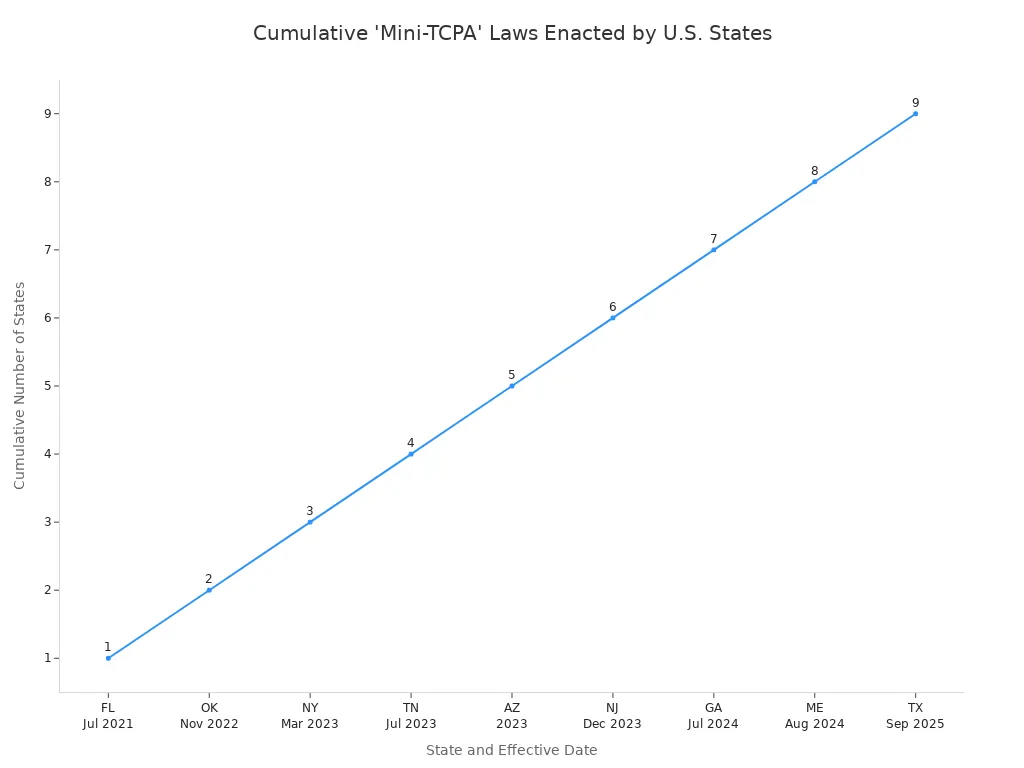
Federal and state regulations often overlap. Many states have their own "mini-TCPA" laws that create stricter telemarketing regulations. For example, some states have shorter calling time restrictions than the federal 8 a.m. to 9 p.m. window. These state-level telemarketing laws, including cell phone telemarketing laws, add another layer of compliance you must manage. The number of states with these enhanced consumer protection rules is growing. Your telemarketing compliance plan must account for these varied federal and state regulations.
Key Actions for Telemarketing Compliance
You must take specific actions to ensure your telemarketing operations are lawful. Understanding the laws is the first step. Implementing them is what ensures telemarketing compliance. This involves a strict focus on how you get permission, what you say, and when you call. Following these core actions will protect your business from penalties and build trust with every consumer.
Mastering Consumer Consent
Obtaining consent is the foundation of compliant telemarketing. You cannot contact a consumer using an autodialer or prerecorded message for marketing without their permission. The TCPA requires you to get "prior express written consent" for these types of telemarketing calls. This is a high standard for telemarketing compliance. Your agreement with a consumer must be clear and specific.
For your consent to be valid, you must include several key elements:
- You must identify the specific company receiving consent.
- You must get the consumer’s phone number.
- The consumer must take an affirmative action, like checking a box that says "I agree."
- You must clearly state that the consumer is authorizing telemarketing offers.
- You must disclose that calls may use automated technology.
- You must make it clear that consent is not a condition of any purchase.
- You need a written signature from the consumer, which can be electronic.
Properly documenting this permission is crucial for your telemarketing compliance. You should store proof of consent with a third party to prevent any changes. This practice demonstrates your commitment to the privacy and consent rules. The FCC's one-to-one consent rule further tightens these restrictions. This rule means a consumer must give consent to your specific business directly. You can no longer rely on generic consent obtained from a lead generator for multiple businesses. Your process for obtaining consent must be direct and transparent.
Honoring Do Not Call Provisions
You must respect a consumer's right to not receive telemarketing calls. This involves managing two types of lists: the National Do Not Call Registry and your own internal DNC list. Honoring do not call provisions is a non-negotiable part of telemarketing.
Your business must scrub its calling lists against the National Do Not Call Registry at least every 31 days. This removes any consumer who has opted out of telemarketing calls nationwide. However, an "Established Business Relationship" (EBR) creates an exception to some do not call provisions. You may call a consumer on the National Do Not Call Registry if they:
- Purchased or leased from you within the last 18 months.
- Inquired about your goods or services within the last 3 months.
Note: This EBR exception only applies to live telemarketing calls. It does not permit you to use prerecorded messages.
Beyond the National Do Not Call Registry, you must also maintain your own internal DNC list. When a consumer asks you to stop calling, you must honor that request. The TSR and TCPA require you to follow a specific process for these do not call provisions.
- Create a Written Policy: You must have a written policy for maintaining your internal list, and it must be available on demand.
- Train Your Staff: Your employees must be trained on how to use the list and honor a consumer's request.
- Record Requests Immediately: You must add the consumer to your list at the time they make the request.
- Honor Requests Promptly: You must honor the request within a reasonable timeframe, which is currently 30 days but is shortening under new restrictions.
- Maintain Records: You must keep a record of each consumer's DNC request for at least five years.
Failure to follow these do not call provisions can lead to significant fines. Diligent list management is essential for your telemarketing compliance.
Mandatory Call Disclosures
The TSR sets strict rules for what you must say during telemarketing calls. These disclosures protect the consumer from deceptive practices. Your scripts must include this information at the beginning of every call to ensure compliance. Using professional scripting consultation to ensure telemarketing law compliance can help you meet these requirements.
The TSR requires you to provide truthful and prompt disclosures. Here are the key details you must include in your scripts and required disclosures for telemarketing law compliance:
| Disclosure Requirement | What You Must State |
|---|---|
| Identity of the Seller | The name of the company on whose behalf the call is made. |
| Purpose of the Call | A prompt statement that the purpose of the call is to sell goods or services. |
| Nature of the Goods/Services | A description of the goods or services being offered. |
If your telemarketing call includes a prize promotion, you face additional restrictions and disclosure requirements. You must tell the consumer that no purchase is necessary to win and that a purchase will not increase their chances of winning. You must also accurately state the odds of winning any prize. These privacy and consent rules are designed to ensure transparency in all telemarketing.
Calling Time and Procedure Rules
Federal telemarketing laws also dictate when and how you can make telemarketing calls. These restrictions are designed to protect a consumer's privacy. Violating these rules can undermine your telemarketing compliance efforts.
No member or person associated with a member shall initiate any outbound telephone call to: Any residence of a person before the hour of 8 a.m. or after 9 p.m. (local time at the called party's location)...
This rule applies unless you have an established business relationship or prior express permission from the consumer. You must track the local time zone for each consumer you call to ensure compliance.
The TSR also has rules for using predictive dialers to prevent "abandoned calls." An abandoned call happens when your dialer connects to a consumer but no agent is available to speak with them. To fall within the TSR's safe harbor, you must meet several conditions, including:
- You must use technology that ensures your abandoned call rate does not exceed 3% of all calls answered by a live person.
- This 3% rate is measured over a 30-day period.
- You must play a recorded message with the seller's name and phone number if a call is abandoned.
Adhering to these time and procedure restrictions is a critical component of running a compliant telemarketing business. It shows respect for the consumer and keeps your operations within legal boundaries. Following these privacy and consent rules is essential for long-term success.
Using Technology for Better Compliance
You can use modern call center technology to manage your telemarketing compliance obligations. Manual processes create risks. Automation helps you follow the rules for every telemarketing call you make to a consumer. Proper technology is essential for your telemarketing business.
Centralizing Consent Records
You must manage consumer consent records carefully. A centralized platform for consent eliminates data silos and gives you a single, accurate view of each consumer's permissions. This system helps you prove you have the proper consent for every telemarketing communication. Centralizing this data builds consumer trust and is a key part of your telemarketing compliance strategy. It ensures you honor the preferences of every consumer.
Automating DNC List Scrubbing
You must scrub your telemarketing lists against the National Do Not Call Registry. Manual scrubbing invites human error. Automated technology reduces this risk by scrubbing lists in real time against the National Do Not Call Registry. This automation closes compliance gaps and creates timestamped audit trails. These records are vital for proving your telemarketing operation adheres to TSR rules regarding the National Do Not Call Registry. This is a critical step for telemarketing compliance.
Standardizing Scripts with IVR
Your telemarketing agents must deliver mandatory disclosures on every call. An Interactive Voice Response (IVR) system ensures every consumer hears the required information. You can configure an IVR to play back TSR disclosures verbatim. This guarantees consistency and creates a log that the disclosure was delivered to the consumer. This practice safeguards your telemarketing business against TSR violations and is a pillar of telemarketing compliance. The TSR requires these disclosures for each consumer.
Leveraging Sobot for Efficiency
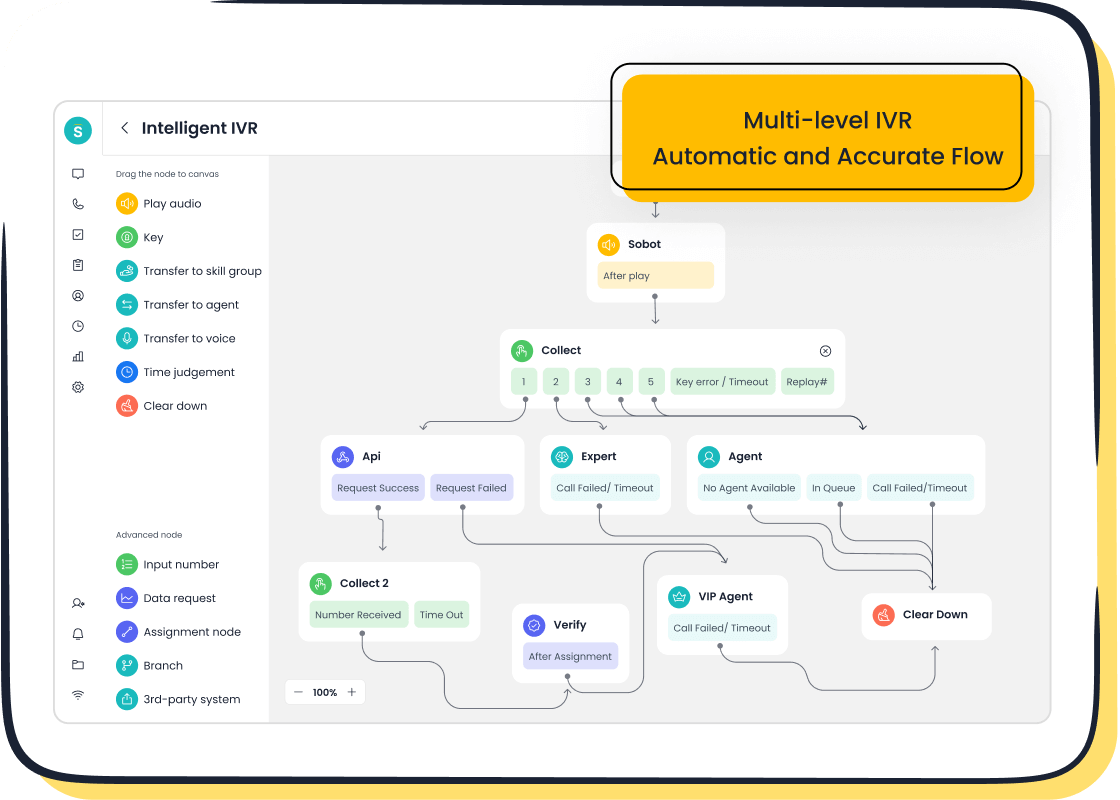
You can use a solution like Sobot's Voice/Call Center to streamline your telemarketing compliance. Sobot helps you meet legal requirements with powerful features.
- Call Recording: You can store recordings as proof of consumer consent.
- Intelligent IVR: You can standardize the delivery of mandatory TSR disclosures.
- Bulk Outbound Task: You can manage calling lists efficiently according to National Do Not Call Registry and TSR rules.
Sobot's platform offers 99.99% uptime and global number availability, supporting large-scale, compliant telemarketing operations. As seen with the online supermarket Weee!, Sobot’s integrated systems improve agent efficiency and call management. This foundation is crucial for running a well-managed telemarketing operation that respects the National Do Not Call Registry and TSR guidelines for every consumer. This level of compliance builds a trustworthy telemarketing business.
Avoiding Pitfalls in Your Telemarketing Business
You must actively avoid common mistakes to protect your telemarketing business. Overlooking telemarketing laws leads to severe consequences. Understanding the legal risks of non-compliance, key rule differences, and best practices for documentation is essential for your long-term success and telemarketing compliance.
The High Cost of Non-Compliance
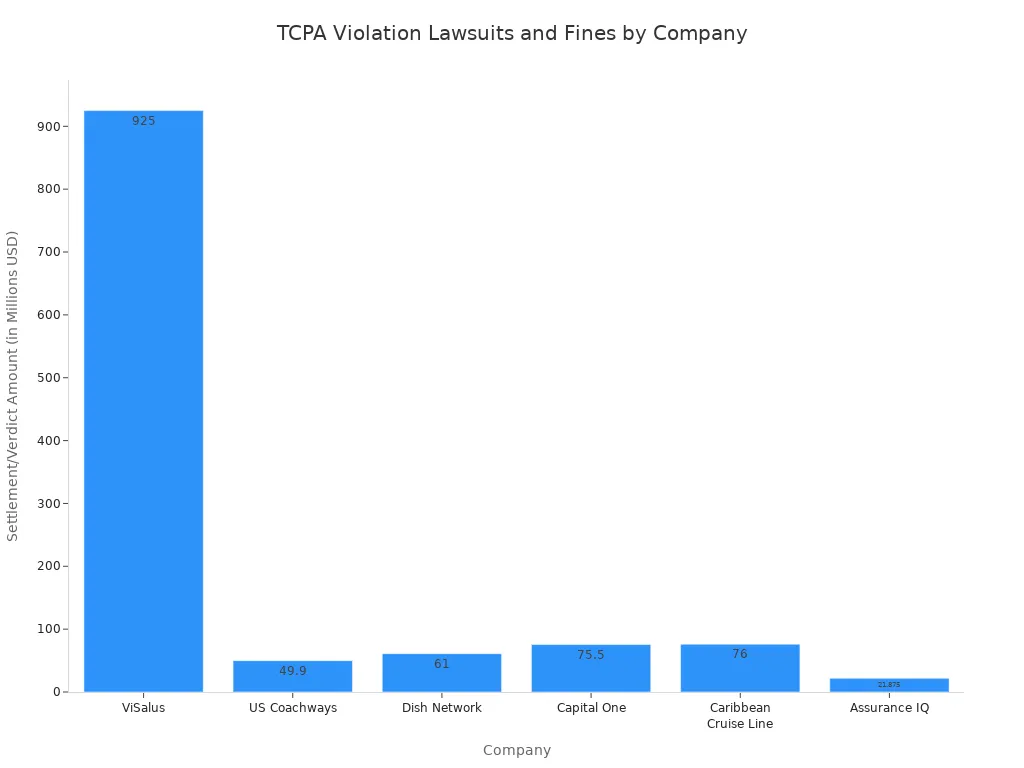
Non-compliance with telemarketing laws carries a massive financial risk. Fines for TCPA violations can be staggering, with penalties reaching millions of dollars. For example, shoe retailer Steve Madden paid $10 million for sending text messages to a consumer without proper consent. These legal risks of non-compliance can cripple a telemarketing business. Your telemarketing compliance program is your best defense against such outcomes.
B2B vs. B2C Rule Differences
You need to understand that the rules for business-to-business (B2B) telemarketing calls differ from those for business-to-consumer (B2C) calls. While B2B telemarketing calls are exempt from some TSR provisions like the National DNC Registry rules, they are not completely unregulated. The TCPA's restrictions on using autodialers for telemarketing calls to wireless numbers apply to every consumer, whether B2B or B2C, requiring prior express written consent. Furthermore, the TSR was updated to prohibit misrepresentation and telemarketing fraud in B2B telemarketing, holding your telemarketing business accountable for deceptive practices against any consumer.
Best Practices for Record-Keeping
Meticulous record-keeping is fundamental to proving your telemarketing compliance. In an audit, you must be able to show you followed the TSR. Your documentation is your proof. Proper compliance training requirements and record keeping protect your telemarketing business from accusations of fraud.
Tip: You should maintain detailed logs for every telemarketing call. This demonstrates your commitment to transparency and helps you defend your practices if questioned. A consumer record should be clear and accessible.
| Record Type | Details to Maintain |
|---|---|
| Call Details | Agent ID, seller name, purpose of the telemarketing, called number, date, time, duration, and script used. |
| DNC Compliance | Date your list was scrubbed against the registry, your subscription account number, and the specific telemarketing campaign. |
Establishing a Safe Harbor
The TSR provides a "safe harbor" defense against accidental DNC violations. To qualify for this protection, you must prove that your violation was an isolated error within a robust compliance framework. You must implement and document four key practices for all telemarketing calls to a consumer.
- Written Policies: You must establish and maintain written procedures for telemarketing compliance with the TSR.
- Employee Training: You must train your personnel on these TSR policies.
- Internal DNC List: You must maintain an internal DNC list for any consumer who asks you to stop calling.
- National DNC Access: You must access and scrub lists against the National DNC Registry at least every 31 days before making telemarketing calls.
Following these steps shows you made a good-faith effort to respect the choices of every consumer.
Your telemarketing compliance rests on understanding the TCPA and TSR. Your telemarketing must respect every consumer. Regular audits ensure your telemarketing compliance with the TSR. This telemarketing compliance protects the consumer. Use technology to streamline your telemarketing compliance. This builds a trustworthy telemarketing business that respects the consumer, the consumer, the consumer, the consumer, the consumer, and the consumer. Your telemarketing must follow the TSR, TSR, TSR, TSR, TSR, TSR, and TSR. This ensures TCPA and telemarketing compliance. This is your path to compliance.
FAQ
What is the main difference between the TCPA and the TSR?
The TCPA governs the technology you use, like autodialers. The TSR focuses on your sales practices to protect the consumer. The TSR prevents deceptive tactics during calls. The TSR ensures every consumer receives fair treatment. The TSR sets rules for every consumer interaction.
Can I call a consumer on the National DNC list if we have a business relationship?
Yes, you can call a consumer on the DNC list if you have an Established Business Relationship (EBR). The TSR allows this for live calls. However, the TSR does not permit autodialed or prerecorded calls to a consumer without express consent, even with an EBR.
How often must I scrub my calling lists?
You must scrub your lists against the National DNC Registry at least every 31 days. This TSR rule ensures you do not call any consumer who has opted out. The TSR requires this to protect each consumer. The TSR is clear on this timeline for every consumer.
What happens if I violate the TSR?
Violating the TSR can lead to significant fines from the FTC. The TSR is designed to protect every consumer from fraud. Non-compliance with the TSR damages your reputation and risks costly penalties. The TSR holds you accountable for protecting the consumer.
Does the TSR apply to B2B calls?
Some TSR rules do not apply to B2B calls, but the TSR was updated to prohibit misrepresentation in B2B telemarketing. The TSR protects every business consumer from fraud. You must be truthful with every consumer, whether B2B or B2C, under the TSR.
See Also
Discovering the Best Free CRM Solutions for Call Centers This Year
Essential Principles: A Comprehensive Guide to Call Center QMS
Implementing Omnichannel Contact Center Solutions: A 10-Step Practical Guide
Achieving Excellence: Best Practices for Call Center Quality Management
Exploring the Leading 10 Call Centers in the Philippines for 2024

