Finding Your Inbound Contact Centre Match Made Easy

You want the best inbound contact centre for your business needs. Start by choosing a provider that matches your goals and delivers strong customer experience. Technology drives results—AI will power 95% of customer interactions by 2025, boosting productivity and personalization. Reliable systems keep you connected, while 73% of customers switch brands after poor service. Sobot AI and Sobot call center unify every channel, helping you create seamless, efficient support that your customers expect.
Define Your Needs

Business Goals
You want your inbound contact centre to support your business needs and drive growth. Start by identifying your main objectives. Do you want to boost customer retention rate, increase sales, or improve customer satisfaction? Clear goals help you measure success and choose the right solution. If you focus on customer retention rate, you need a provider that delivers consistent, high-quality customer communication. Strong communication builds trust and loyalty, which leads to repeat business. Set targets for your team and track progress to make sure your contact centre supports your vision.
Tip: Write down your top three business goals before you start searching for a provider. This step keeps you focused and helps you compare options.
Contact Volume and Channels
Estimate how many customer inquiries you receive each day, week, or month. You need a provider that can handle your volume without delays. Think about the channels your customers use. Do they prefer phone calls, live chat, email, or social media? Choose a contact centre that offers seamless customer communication across all channels. Omnichannel support lets your customers reach you in the way they like best. This flexibility improves satisfaction and helps you respond quickly to every inquiry.
- List your busiest times and peak seasons.
- Note which channels get the most traffic.
- Ask providers about their capacity and scalability.
Service Expectations
Set clear standards for service quality. High-performing contact centres meet updated benchmarks for speed, efficiency, and satisfaction. Use the table below to compare current standards with new expectations for 2025:
| Benchmark Metric | Previous Standard | Updated Benchmark (2025) | Explanation |
|---|---|---|---|
| First Call Resolution (FCR) | 70% | 80% or higher | Higher FCR reduces repeat calls, improves customer satisfaction, and lowers operational costs. |
| Customer Satisfaction (CSAT) | 75% | 85% or higher | Reflects improved customer experience expectations based on direct feedback surveys. |
| Average Handle Time (AHT) | ~6 minutes | Focus on efficiency without rushing | Emphasis on resolving issues effectively, even if it takes longer, to enhance satisfaction. |
| Net Promoter Score (NPS) | N/A | Important additional metric | Measures likelihood of customers recommending the business. |
| Average Speed of Answer | N/A | Important additional metric | Tracks how quickly calls are answered, impacting customer wait times. |
| Call Abandonment Rate | N/A | Important additional metric | Percentage of calls ended before connection, often due to long waits. |
| Customer Effort Score (CES) | N/A | Important additional metric | Measures customer effort in resolving issues; lower effort correlates with better service. |
You should expect personalized experiences, proactive engagement, and advanced technology like AI and IVR. Ongoing agent training helps your team meet these benchmarks. When you set high standards, you create a better experience for your customers and build a strong reputation.
Inbound Contact Centre Criteria
Experience and Industry Fit
You want an inbound contact centre partner who understands your industry and your customers. Experience matters. Providers with a proven track record in your field deliver better results and fewer headaches. When you choose a partner with industry expertise, you get faster call handling, lower abandonment rates, and improved customer experience.
- Providers with direct industry involvement design their contact center solution to fit your unique needs. For example, a large healthcare practice saw faster call answering, fewer transfers, and a 7.7% drop in costs after switching to an internal, industry-aligned call center.
- Specialized training and integration with your business processes lead to higher quality service.
- Companies like American Express and T-Mobile show that engaged, experienced providers create a culture that puts customers first, which boosts satisfaction and loyalty.
You should always ask about a provider’s experience with businesses like yours. Look for case studies, customer stories, and references. Sobot serves over 10,000 brands across retail, finance, gaming, and more. Companies such as OPPO, Samsung, and Michael Kors trust Sobot to deliver inbound services that match their industry needs. This broad experience means you get a contact center solution that fits your business, not a one-size-fits-all approach.
Tip: Ask for real-world examples of how the provider improved customer experience and operational efficiency for similar companies.
Technology and Integration
Technology drives every modern inbound contact centre. You need a provider who offers advanced tools and seamless integration with your existing systems. The right technology makes your team faster, smarter, and more efficient.
- Cloud-based telephony lets you make and receive high-quality calls from anywhere—desk phones, mobile devices, or apps. This flexibility replaces old PBX systems and cuts costs.
- Deep CRM integration (like Salesforce or HubSpot) gives agents instant access to customer data, reducing time spent switching between platforms.
- IVR and ACD systems automate call routing and self-service, so customers get help quickly.
- AI powers real-time transcription, agent assist, chatbots, sentiment analysis, and predictive insights. These tools boost efficiency and personalize every interaction.
- Omnichannel support brings together voice, chat, SMS, and social media in one workspace. Agents see the full customer journey and deliver consistent, high-quality service.
- Cloud migration supports remote and hybrid teams, giving you workforce flexibility and secure access.
- Integration with help desk and knowledge base systems gives agents the context they need to solve problems fast.
- Advanced analytics and reporting provide real-time insights into agent performance and customer behavior.
Sobot leads in technology and integration. The Sobot Cloud Call Center offers 99.99% uptime, global number availability, and a unified workspace for agents. You get AI-powered voicebots, drag-and-drop IVR, and seamless CRM integration. Sobot’s omnichannel solution unifies all your customer touchpoints, so you never miss a message. With over 110 global network points and support for mobile devices, Sobot keeps your team connected and your customers happy. Learn more about Sobot’s technology at Sobot Voice/Call Center.
Note: AI integration can cut costs, speed up response times, and improve customer experience. For example, Memorial Healthcare System reduced call abandonment rates by three times and increased service levels by 30% after adding AI to their inbound call center (source).
Scalability and Flexibility
Your business changes. Your inbound contact centre must keep up. Choose a provider who can scale up or down as your needs shift. The best contact center solution adapts to busy seasons, new products, or sudden spikes in customer inquiries.
- Top providers use outsourcing and advanced technology to adjust staffing quickly during peak times, so you never leave customers waiting.
- Access to specialized talent means you get agents who know your industry and your platforms.
- AI-powered monitoring, chatbots, and automated workflows help manage high volumes without sacrificing quality.
- Multilingual and omnichannel support lets you serve customers in their language and on their preferred channel.
- Secure, compliant infrastructure supports fast changes without risk.
- Transparent reporting and analytics help you track performance and respond to demand in real time.
- Outsourcing reduces overhead and lets you scale efficiently, improving both customer satisfaction and operational efficiency.
Sobot’s contact center solution is built for scalability. You can add or remove agents, channels, and features as your business grows. Sobot’s cloud platform supports global operations, so you can serve customers anywhere. The AI-powered tools and unified workspace help your team handle more inquiries with less effort, keeping your customer experience strong even during peak times.
Callout: Look for providers who offer flexible contracts and easy onboarding. This makes it simple to test new features or expand your team as your business evolves.
Security and Compliance
Security is non-negotiable. Your inbound contact centre handles sensitive customer data, so you must choose a provider who meets the highest security standards. Compliance protects your business and builds trust with your customers.
The Payment Card Industry Data Security Standard (PCI DSS) is critical for any contact center solution that processes payments. Providers must use access controls, secure networks, and encrypted data to protect cardholder information. PCI-certified IVR payment processing lets customers enter card details securely, keeping agents away from sensitive data. This reduces the risk of human error and data breaches. Providers must also update systems regularly, monitor for threats, and maintain strict security policies.
Sobot’s contact center solution uses encrypted data transfer, secure dialing, and global compliance standards. With 99.99% system uptime and a proven track record, Sobot protects your business and your customers. You can trust Sobot to keep your data safe, whether you operate in retail, finance, or any other industry.
Tip: Always ask about a provider’s security certifications and compliance policies. Make sure they meet PCI DSS and other relevant standards for your industry.
Evaluating Contact Center Solutions

Choosing the right contact center solution can transform your business. You want to make sure every step leads you closer to a provider who delivers results, reliability, and growth. Let’s break down how you can evaluate options and find your perfect match.
Research and Shortlisting
Start your search with a clear plan. You want to find a call center service that fits your business goals and values. Use these steps to guide your research:
- Search online for top-rated providers. Look at industry directories and ask for recommendations from trusted peers.
- Make a shortlist of providers that match your needs. Focus on those with experience in your industry.
- Contact each provider. Ask about their call center service, responsiveness, and professionalism.
- If possible, visit their operations. Watch how agents interact with customers and see their technology in action.
- Request detailed proposals. Review their services, pricing, technology, and extra benefits.
- Check references. Speak with current clients to learn about their satisfaction and experience.
- Review contracts carefully. Make sure terms protect your business and meet your needs.
- Try a trial period. Test the contact center solution before making a long-term commitment.
- Set up regular performance reviews. Track service quality and look for ongoing improvements.
You want a provider who listens, responds quickly, and shows a commitment to your success.
When you research, focus on your specific needs. Do you need technical support, order processing, or help with customer inquiries? Look for a call center service with proven experience in your field. Assess their technology, scalability, agent training, multichannel support, quality assurance, language compatibility, security, and analytics. These factors help you build a shortlist of providers who can deliver a strong contact center solution.
Feature Checklist
You need a contact center solution with features that drive efficiency and customer satisfaction. Use this checklist to compare providers:
| Feature | Purpose | Key Components |
|---|---|---|
| Omnichannel Communication | Improve customer satisfaction by offering multiple communication channels. | Omnichannel dashboard, VoIP calling, SMS, webchat, video, email, messaging apps, social media |
| User-Friendly Dashboard | Streamline operations and enhance agent efficiency. | Call controls, communication channels, customer info, analytics, call queues |
| Call Routing System | Automatically route inbound calls/queries to the best-suited agent. | IVR, auto attendant, call queueing, skills-based routing, ring groups, ACD, caller ID |
| Customer Self-Service Tools | Enable customers to accomplish tasks autonomously, saving agent time. | Chatbots, intelligent virtual agents, drag-and-drop designer, NLU, CRM integrations, knowledge base |
| Call Monitoring | Assist supervisors in monitoring agents and calls in real-time. | Supervisor portal, listen/whisper/barge/takeover, live queue and agent status, feedback forms, AI flagging |
| Workforce Management (WFM) | Support agent evaluation and coaching. | Call recording, customizable evaluation forms, interaction analytics, AI feedback, CRM integration |
| Security and Compliance | Protect data and ensure compliance with standards. | HIPAA compliance, messaging standards, device connectivity tracking, network monitoring, user activity visibility |
| Interactive Voice Response | Provide customers a self-service menu to reach intended departments. | IVR menu, auto attendant, extensions, ring groups, call queues, drag-and-drop call flow builder |
| Analytics and Reporting | Track call activity, agent performance, and customer service trends. | Real-time analytics, customizable reports, call metrics, visual displays, queue and interaction analytics |
| Integration Capabilities | Connect contact center with other applications like CRM and unified communications. | APIs, SDKs, CRM integrations, UC integrations, ticketing/helpdesk integrations |
| Coaching and Evaluation Tools | Streamline agent training, evaluation, and feedback. | Call recording, evaluation forms, interaction analytics, AI-powered feedback, CRM integration |
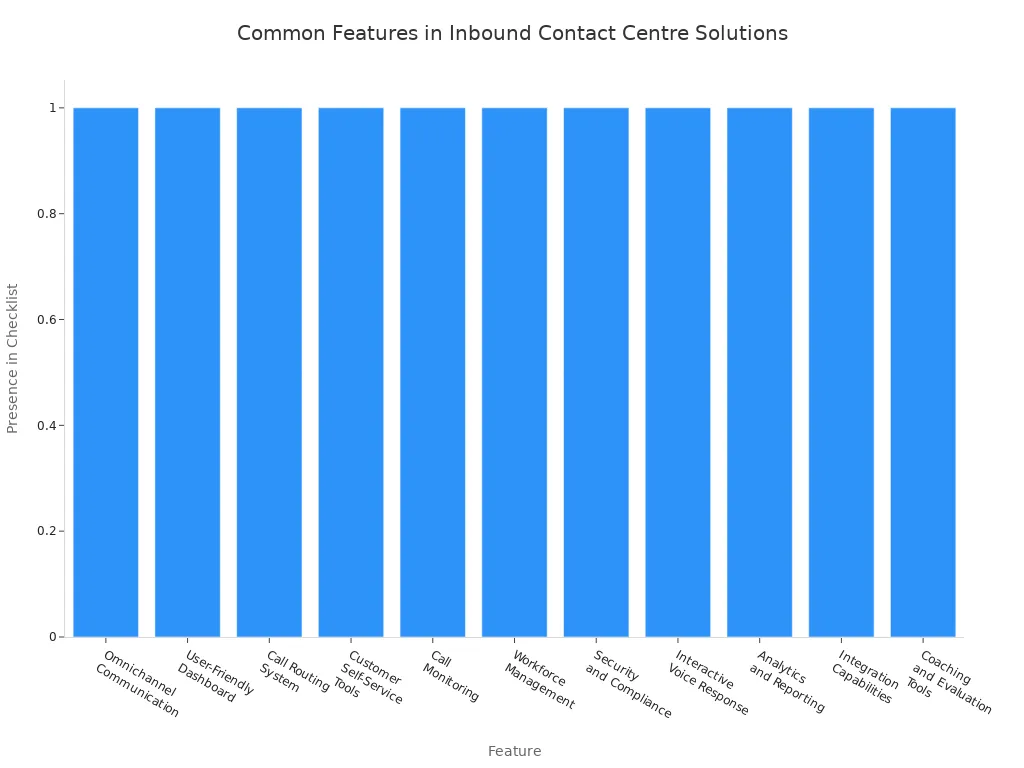
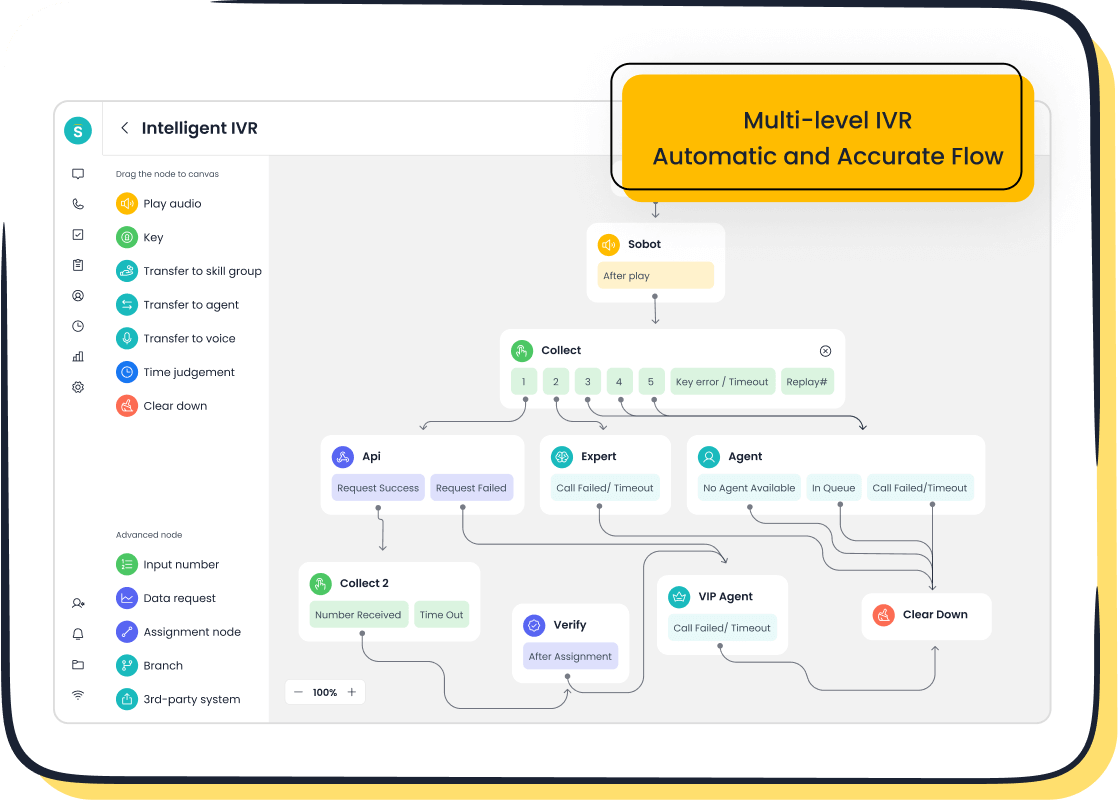
You want a contact center solution that covers all these bases. Sobot’s Voice/Call Center stands out with intelligent IVR, unified workspace, real-time monitoring, bulk outbound tasks, call tracking, and seamless integration. You get 99.99% uptime, global number availability, and AI-powered voicebots. These features help you deliver fast, reliable, and personalized service to every customer. Learn more about Sobot’s features at Sobot Voice/Call Center.
Requesting Demos
A demo shows you how a contact center solution works in real life. You want to see the technology, interface, and agent experience before you commit. Request demos from your shortlisted providers and pay attention to these points:
- How easy is it to use the dashboard and manage calls?
- Does the call center service offer smooth integration with your CRM and other systems?
- Can you customize IVR menus, call routing, and agent workflows?
- Is the system stable and responsive during peak times?
- Are analytics and reporting tools easy to access and understand?
- Does the provider offer mobile compatibility for remote teams?
- How does the provider handle security and compliance?
During the demo, ask for a walkthrough of the contact center solution’s main features. Test the system’s speed, reliability, and flexibility. You want a provider who can adapt to your business and deliver a seamless experience for your team and customers.
Tip: Invite your IT and customer service managers to join the demo. Their feedback helps you spot strengths and weaknesses.
Sobot offers live demos of its Voice/Call Center and omnichannel solutions. You can see how AI-powered voicebots, drag-and-drop IVR, and unified workspaces work together to improve customer interactions. Sobot’s team will show you how easy it is to integrate with your existing systems and scale as your business grows.
Assessing Fit with Sobot
You want a contact center solution that fits your business now and in the future. Sobot’s inbound contact center features give you scalability, flexibility, and security. Here’s how you can assess the fit:
- Sobot’s scalable design lets you expand resources as your customer base grows. You improve response times and service quality.
- Flexible customization options, such as intelligent IVR and unified workspaces, help you tailor the system to your business processes.
- Modular system design allows you to add or remove features as your needs change. You stay competitive and efficient.
- Seamless integration with CRM and ERP systems streamlines data flow and improves customer interactions.
- Advanced security features, including data encryption and access controls, protect your customer data and support compliance with regulations like GDPR and HIPAA (GDPR compliance).
- Sobot’s cost-effective approach balances investment with long-term savings. Automation and reliable support deliver measurable improvements in customer satisfaction and operational efficiency.
- Multiple deployment models—cloud, on-premise, and hybrid—give you control, flexibility, and cost management.
Sobot’s contact center solution adapts to your business, not the other way around.
Real-world results matter. OPPO, a global smart device leader, partnered with Sobot to handle high volumes of customer inquiries during peak shopping periods. Sobot’s chatbot and ticketing system improved service efficiency, reduced agent workload, and boosted customer satisfaction. OPPO achieved an 83% chatbot resolution rate, a 94% positive feedback rate, and a 57% increase in repurchase rate (OPPO case study). These results show how a strong contact center solution can drive growth and loyalty.
| Evidence Type | Description | Impact on Real-World Use of Inbound Contact Centre Solutions |
|---|---|---|
| Client Testimonials | Managers from retail, legal, and healthcare sectors praise courteous, adaptable, and professional agents. | Shows how contact center solutions improve customer experience and adaptability. |
| Partnership & Communication | Clients highlight seamless communication and fast response to feedback. | Demonstrates operational efficiency and strong client relationships. |
| AI and Workforce Management | AI optimizes training, productivity, and quality assurance, leading to faster onboarding and improved CX. | Illustrates technology-driven efficiency and enhanced customer satisfaction. |
| Performance Metrics | Low attrition, high employee satisfaction, and client satisfaction metrics indicate a stable workforce. | Supports sustainable operational success. |
| Cost Reduction & Efficiency | Case studies emphasize cost savings and efficiency improvements across industries. | Validates economic and operational benefits in real scenarios. |
You want a contact center solution that delivers these benefits. Sobot’s proven track record, advanced technology, and flexible design make it a top choice for businesses that value customer experience and operational excellence.
Choose a provider who can show real results, not just promises.
Questions for Customer Service Call Center Providers
When you choose a customer service call center, you want answers that build trust and confidence. Asking the right questions helps you find a call center service that matches your goals and delivers high quality. Use these questions to guide your decision and improve your customer satisfaction rate.
Service Levels and SLAs
You need clear service level agreements (SLAs) to measure performance. Ask providers about their commitment to quality and how they track results. Here are key questions to ask:
- What SLA metrics do you track and commit to? (average handle time, first call resolution, abandonment rate, queue time, average speed of answer)
- How do you manage high call volumes to ensure SLA compliance?
- How do you handle complex customer issues that may impact SLA performance?
- What resources do you have in place to meet SLAs?
- How do you monitor and improve service quality to meet SLA targets?
- What technology tools do you use to support SLA achievement?
- How do you set realistic expectations for agents regarding SLA performance?
- What training and support do you provide to agents to help them meet SLA goals?
- How do you measure and report SLA performance and customer satisfaction?
- How do you prioritize different customer segments or call types in your SLA commitments?
Tip: Strong SLAs lead to higher customer satisfaction rate and better results for your business.
Technology and Support
Technology drives every customer service call center. You want a call center service with advanced tools and skilled support teams. Use this table to compare what providers offer:
| Category | Components / Features |
|---|---|
| Technology Infrastructure | Automatic Call Distribution (ACD), Interactive Voice Response (IVR), CRM software, call recording, multichannel support, self-service options, callback functionality, real-time analytics, AI-powered agent assistance |
| Human Resources | Contact center agents, supervisors, trainers, quality assurance teams |
| Support Processes | Call scripting, escalation management, customer feedback tools, security and compliance |
A customer service call center with strong technology and support improves your customer satisfaction rate and delivers consistent quality. Ask about integration, analytics, and security standards.
Pricing and Contracts
Pricing models shape your costs and flexibility. You want a customer service call center that fits your budget and business needs. Review this chart to understand common pricing models:
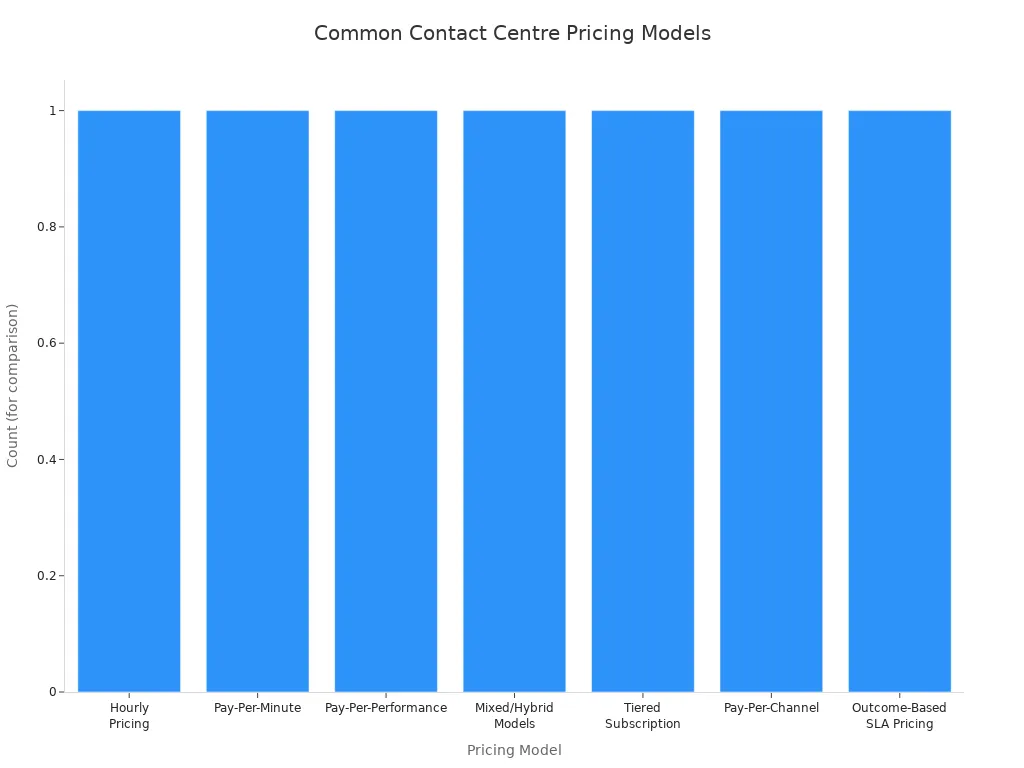
| Pricing Model | Description | Pros | Cons | Best For / Use Case |
|---|---|---|---|---|
| Hourly Pricing | Fixed rate per staffed agent hour. | Predictable costs, dedicated agent availability | Pay for idle time, less efficient during low volume | Consistent call volumes, complex issues |
| Pay-Per-Minute | Charges based on actual talk time. | Scales with usage, flexible for seasonal fluctuations | Less predictable expenses, potential cost spikes | Fluctuating volumes, seasonal operations |
| Pay-Per-Performance | Payment tied to outcomes like sales or issue resolution. | Aligns costs with business results | Higher per-transaction cost, complex tracking | Sales-focused, measurable outcomes |
| Mixed/Hybrid Models | Combines fixed base plus variable usage or performance elements. | Stability with flexibility, tailored to needs | Complex billing, minimum commitments | Balance of predictability and flexibility |
| Tiered Subscription | Bundled features at fixed monthly rates. | Simplicity, predictable expenses, scalable | Less flexible for usage spikes | Simplicity and predictable expenses |
| Pay-Per-Channel | Pricing based on communication channels. | Supports omnichannel strategies | Complexity in comparing channel costs | Omnichannel customer engagement |
| Outcome-Based SLA Pricing | Pricing tied to service level achievements. | Financial alignment with customer experience goals | Requires clear SLA definitions, complex to implement | Service quality and customer experience metrics |
Ask providers about contract terms, minimum commitments, and flexibility. You want transparency and a pricing model that supports your growth.
Note: The right customer service call center helps you control costs, improve quality, and boost your customer satisfaction rate.
Making the Final Choice
Weighing Pros and Cons
You have gathered all the facts. Now, you need to compare your options side by side. Make a simple list of what each inbound contact centre provider offers. Look at technology, customer support, pricing, and flexibility. Think about how each contact center solution matches your business goals.
- Does the provider offer reliable uptime and global reach?
- Can you scale up or down as your needs change?
- Are advanced features like AI, omnichannel support, and analytics included?
- How easy is it to integrate with your current systems?
- What do real customers say about their experience?
Sobot stands out for reliability, innovation, and proven results. Brands like OPPO have seen higher satisfaction and efficiency after switching to Sobot’s call center service.
Trial Periods
A trial period gives you real insight. You can test the inbound contact centre in your daily operations. Watch how the system handles your call volume. Check if agents find the dashboard easy to use. See if the technology delivers on its promises.
- Use the trial to measure response times and customer satisfaction.
- Ask your team for feedback on the tools and support.
- Track if the contact center solution meets your service level goals.
Tip: Choose a provider who offers a flexible trial. This shows confidence in their service and helps you make a risk-free decision.
Contract Review
Before you sign, review the contract with care. Protect your business by checking for clear terms and legal compliance. Look for these important points:
- Legal compliance with data privacy rules like PCI, SOC-2, HIPAA, and GDPR.
- Clear service level agreements (SLAs) and performance standards.
- Rights for contract termination and dispute resolution.
- Protection of your intellectual property and business processes.
- Industry-specific compliance, especially for healthcare or finance.
- Jurisdiction and location details for offshore or nearshore services.
- Regular audits and compliance checks.
A strong contract keeps your business safe and builds trust with your inbound contact centre provider.
When you choose a provider like Sobot, you get a partner focused on reliability, security, and innovation. Sobot’s transparent contracts and proven technology help you deliver the best customer experience. Take your time, ask questions, and make the choice that will drive your business forward.
You can find your perfect inbound contact centre by following each step with care. Aligning provider strengths with your business needs leads to better customer experience, higher efficiency, and a stronger customer retention rate.
- Define your goals and match them with the right partner.
- Focus on providers with proven experience and strong communication channels.
- Set clear SLAs and ensure data security for a smooth customer experience.
- Technology, scalability, and customer experience shape your long-term success.
- Advanced tools and skilled teams help you deliver a standout customer experience every time.
Ready to boost your customer experience? Reach out to a trusted brand like Sobot for a demo or consultation.
FAQ
What is an inbound contact centre?
An inbound contact centre handles incoming customer calls, chats, or messages. You use it to answer questions, solve problems, and support your customers. This service helps you improve customer satisfaction and build loyalty.
How do I know if my business needs an inbound contact centre solution?
If you receive many customer inquiries or want to boost your customer experience, you need an inbound contact centre. You gain faster response times, better service, and more efficient operations.
What features should I look for in a contact center solution?
You should look for omnichannel support, AI-powered tools, real-time analytics, and easy integration with your systems. These features help you deliver seamless customer service and grow your business.
How does an inbound contact centre improve customer satisfaction?
You give customers quick answers and personalized support. This reduces wait times and solves problems faster. Happy customers stay loyal and recommend your brand.
Can I scale my inbound contact centre as my business grows?
Yes! You can add more agents, channels, or features as your needs change. A scalable contact center solution grows with your business and keeps your service strong.

