Call Center Help What It Is and How It Works


A call center connects you to real people who help solve your questions about a product or service. Today, call center help matters more than ever. Over 53% of customers choose phone calls as their main way to reach support, and 54% say talking to a live agent fixes problems fastest. Companies like Sobot use Sobot AI and advanced solutions to make your customer service experience smoother. With features like AI chatbots and voice agents, you get faster answers and better service every time you reach out for support.
Call Center Help Defined
What Is a Call Center?
A call center is a place where trained agents handle phone calls from customers who need help or information. You can think of it as a central hub that connects you to a company’s support team. Call centers can handle incoming calls (inbound), make outgoing calls (outbound), or do both. Many modern call centers now work as part of larger contact centers, which use not just phones but also chat, email, and social media to reach customers.
Here is a table that shows some important facts about call centers and their impact:
| Aspect | Evidence | Impact |
|---|---|---|
| Definition of Call Center | Call centers are centralized hubs handling customer support, functioning as inbound or outbound centers, and part of broader contact centers with omnichannel capabilities (75% offer omnichannel). | Establishes a clear, concise definition and scope of call centers. |
| Market Size | Global contact center market valued at $340 billion in 2020, projected to reach $496 billion by 2027. | Shows the large economic impact and growth. |
| Customer Satisfaction | U.S. customer satisfaction index at 77.8/100 (2023), with 95% of contact center professionals rating customer satisfaction as the top metric. | Proves the importance of call centers in improving customer experience. |
| Operational Benchmarks | Industry standard: answering 80% of calls within 20 seconds, aiming for 90% within 15 seconds; average cost per call ranges from $2.70 to $5.60. | Reflects efficiency and cost management. |
| AI Adoption | Over 92% of companies invest in AI-driven personalization to improve service accuracy and efficiency. | Highlights the role of technology and innovation. |
| Customer Behavior | 95% of customers say great service increases repeat purchases; 1 in 3 customers leave after one bad experience; 56% become repeat buyers after personalized experiences. | Shows how call center help affects loyalty and business growth. |
| Customer Expectations | 71% expect businesses to know their reason for calling; 53% have to repeat their issue multiple times. | Shows the need for better systems and CRM integration. |
You can see that call centers play a big role in customer service and business success. [Source: Statista, Grand View Research, American Customer Satisfaction Index]
Main Functions
Call center help covers many important tasks that keep customer service running smoothly. When you call for support, you expect quick answers and helpful solutions. Here are some main functions you will find in a call center:
- Answering customer questions about products, orders, or services.
- Solving problems and handling complaints.
- Providing support for technical issues or troubleshooting.
- Processing orders, payments, or returns.
- Following up with customers to make sure they are satisfied.
- Collecting feedback to improve service quality.
Call center help also uses data and teamwork to improve how agents work and how you experience support. Here are some ways call centers enhance customer service:
- Teams analyze key performance indicators (KPIs) to spot trends and fix issues before they grow.
- Agents join regular training and role-playing to stay prepared and improve customer satisfaction.
- Managers share KPI results with teams to encourage accountability and teamwork.
- Call centers use speech and voice analytics to monitor calls and coach agents for better service.
- Agents follow up with customers to gather feedback and build trust.
- Many centers now use an omnichannel approach, so you can get help by phone, chat, email, or even video.
Tip: When you reach out for help, you benefit from these behind-the-scenes efforts that make your experience smoother and more personal.
Sobot’s Approach
Sobot stands out as an innovator in the call center industry. If you use Sobot’s solutions, you get access to advanced technology that makes customer support faster and more reliable. Sobot’s all-in-one contact center platform brings together voice, chat, email, and social media in one place. This means you can reach support through your favorite channel, and agents can see your history and preferences for a more personal touch.
Sobot’s Voice/Call Center offers features like:
- Intelligent IVR (Interactive Voice Response) that greets you and routes your call to the right agent or team.
- A unified workspace where agents manage calls and customer information in real time.
- AI-powered voicebots that understand your needs and provide instant answers.
- Real-time monitoring and analytics to keep service quality high.
- Global number availability, so you can get help wherever you are.
Sobot’s focus on innovation, customer-centricity, and efficiency helps businesses deliver better customer service. Companies like OPPO have used Sobot to handle large volumes of customer inquiries, improve chatbot resolution rates, and boost customer satisfaction. Sobot’s solutions help you get the answers you need quickly, while businesses benefit from improved efficiency and happier customers.
How Call Centers Work

Processes and Technology
When you look at how a call center works, you see a step-by-step process that helps customers get answers quickly. Every call center operation follows a clear path to make sure you get the help you need. Here is how it usually works:
- You call the support number or reach out through another channel.
- The system greets you, often using an intelligent IVR (Interactive Voice Response) that asks about your needs.
- The system routes your call to the right call center agent based on your answers.
- The agent listens to your problem and uses effective communication to understand your issue.
- The agent checks your information in the system and gives you a solution.
- After the call, the agent finishes any after-call work, like taking notes or updating your account.
- The system tracks important metrics, such as how long you waited, if your issue was solved on the first try, and how satisfied you felt.
Note: Call centers use many metrics to measure success. These include call abandonment rate, agent utilization, average speed of answer, and first contact resolution. High first contact resolution means you get your problem solved the first time you call, which makes you happier and reduces repeat calls.
Call centers also use technology to make things faster and easier. AI and automation help capture data, analyze trends, and spot problems early. For example, Sobot’s platform uses AI to monitor calls and provide real-time coaching to agents. This helps agents improve their skills and deliver better service.
Here is a table showing some key metrics in call center operation:
| Metric | What It Measures |
|---|---|
| Call Abandonment Rate | % of callers who hang up before reaching an agent |
| First Contact Resolution | % of issues solved on the first call |
| Average Speed of Answer | How fast agents answer calls |
| Agent Utilization | How efficiently agents use their time |
| Cost Per Call | Average cost to handle each call |
| Customer Satisfaction | How happy customers feel after the call |
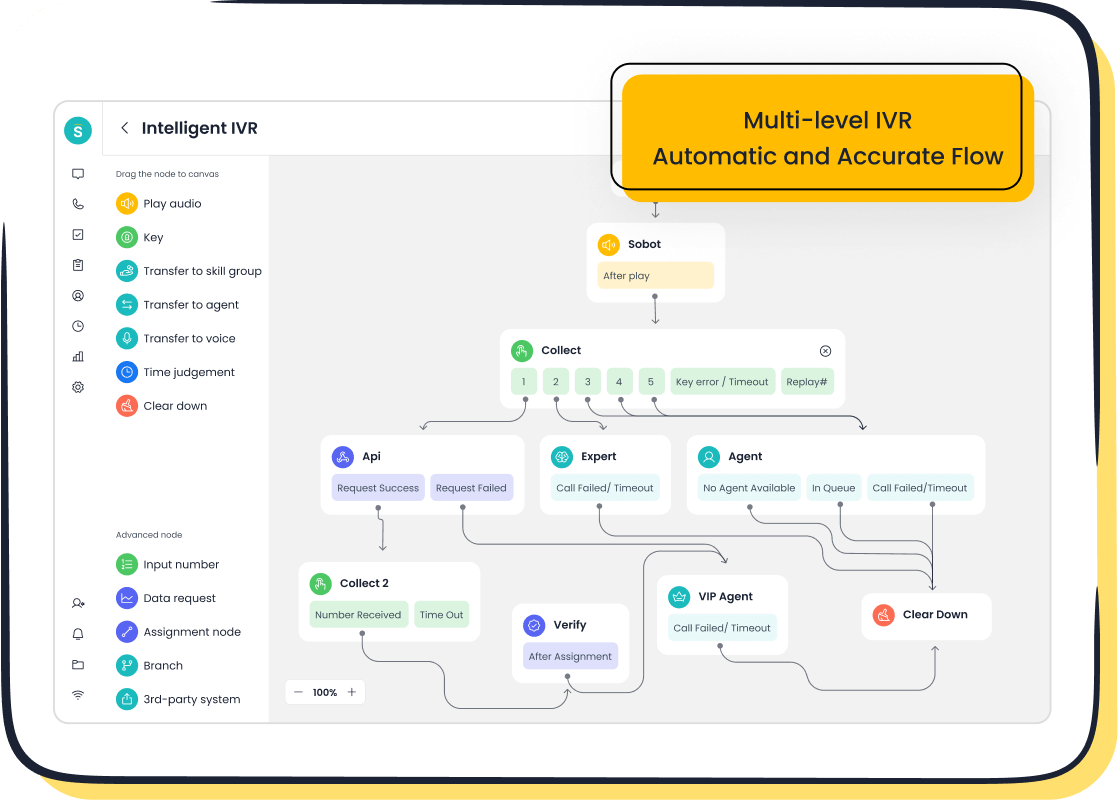
Sobot Voice/Call Center Features
When you use Sobot’s Voice/Call Center, you get access to advanced tools that make working in a call center smoother and more efficient. Sobot’s intelligent IVR greets you and helps you reach the right person without long menus. This system uses natural language processing, so you can say what you need instead of pressing buttons.
Sobot’s unified workspace gives every agent a complete view of your history and details. This means agents can solve your problems faster and with fewer mistakes. The platform also uses AI-powered voicebots that answer simple questions and handle routine tasks. This lets human agents focus on more complex issues.
- 81% of customers prefer companies that offer self-service options. Sobot’s AI and automation make this possible by handling many requests without human help.
- Unified workspaces connect front and back office teams, making working in a call center more organized.
- Real-time analytics show managers how agents perform and where they can improve.
- Sobot’s system supports global numbers, so you can get help from anywhere.
Tip: Sobot’s platform helps agents work better and helps you get answers faster. Research shows that companies using AI and unified workspaces have customer satisfaction scores twice as high as those that do not. Source: MIT CISR
Agent Roles
When you think about working in a call center, you see many different roles that help the whole system run smoothly. The main role is the call center agent. This person answers your calls, listens to your questions, and solves your problems. Agents use effective communication to make sure they understand your needs and give you clear answers.
Other important roles include team leaders, quality assurance specialists, and trainers. Team leaders help agents stay motivated and follow best practices. Quality assurance specialists listen to calls and give feedback to improve service. Trainers teach new agents how to use the system and handle different types of calls.
Technology plays a big part in working in a call center. Agents use software to see your information, track your history, and record notes. AI tools help agents by suggesting answers or flagging urgent issues. This teamwork between people and technology makes working in a call center more efficient and helps you get better service.
Remember: Working in a call center means helping people every day. Agents need patience, good listening skills, and the ability to solve problems quickly. With the right tools, like those from Sobot, agents can focus on what matters most—helping you.
Types of Call Centers
Inbound and Outbound
You will find two main types of call center operations: inbound and outbound. In an inbound call center, you call for help or information. Agents answer your questions, solve problems, and guide you through issues. For example, when you call a company to ask about your order, you reach an inbound call center.
Outbound call centers work differently. Here, agents call you. They might check on your satisfaction, offer new products, or remind you about appointments. According to Statista, outbound call centers help companies reach more customers and grow sales. Both types play a big part in customer service.
Tip: Many companies use both inbound and outbound call center services to cover all customer needs.
Blended and Virtual
A blended call center combines both inbound and outbound tasks. You might answer calls from customers and also make calls to follow up or share updates. This setup helps companies use their teams better and respond faster to changing needs.
Virtual call centers use cloud technology. You can work from anywhere with an internet connection. This model became popular during the COVID-19 pandemic. Virtual call centers help companies hire talent from different places and keep service running even when offices close.
| Type | Main Feature | Example Use Case |
|---|---|---|
| Blended | Handles both call types | Customer support & sales |
| Virtual | Remote, cloud-based agents | 24/7 global support |
Omnichannel Solutions by Sobot
You want a call center that does more than just answer phones. Sobot’s omnichannel solution lets you connect with support through voice, chat, email, and social media—all in one place. Sobot’s unified workspace gives agents a full view of your history, so you get faster and more personal help.
Sobot uses AI-driven chatbots and voicebots to handle simple questions. This frees up agents to solve complex problems. With Sobot, you can reach support any time, from anywhere. Businesses see up to 30% higher productivity when they use Sobot’s omnichannel call center tools. You can learn more about these features on Sobot’s official website.
Note: Omnichannel call center solutions help you get answers quickly, no matter how you choose to reach out.
Who Uses Call Centers
Industries and Businesses
You see many industries relying on working in a call center to meet customer needs. Retailers use these centers to answer questions about products and orders. Banks and financial services depend on working in a call center to help customers with accounts and security. Gaming companies use call centers to solve technical issues and keep players happy. Education, healthcare, and enterprise services also depend on working in a call center to support students, patients, and business clients.
Here are some facts that show how important working in a call center is for different industries:
- 61% of consumers prefer phone support as their main way to get help.
- 59% of customers expect better support than last year.
- The global call center market could reach $407.1 billion by 2022.
- 73% of consumers will switch brands after several bad experiences.
Companies invest in working in a call center to keep customers loyal and improve service quality.
Customer Needs
You want fast answers and personal support. Working in a call center helps meet these needs. Many customers expect agents to know their history and solve problems on the first call. A 1% improvement in first call resolution can save a business hundreds of thousands of dollars each year. You also want to use your favorite channel, like phone, chat, or email.
Today, working in a call center means using AI and CRM tools. These tools help agents see your information and give you better service. By 2025, AI will help with every customer interaction. This makes working in a call center more efficient and helps you get the answers you need.
| Customer Expectation | Why It Matters |
|---|---|
| Fast, accurate answers | Saves time and builds trust |
| Personal service | Makes you feel valued |
| Multiple contact channels | Gives you more choices |
Sobot Customer Stories
You can see how working in a call center brings real results by looking at Sobot’s customers. OPPO, a global smart device brand, used Sobot’s chatbot and ticketing system to handle more customer questions during busy times. The chatbot solved 83% of issues without human help. OPPO saw a 94% positive feedback rate and a 57% increase in repeat purchases. Sobot helped OPPO connect all customer channels and business systems, making working in a call center smoother for agents and better for customers.
Sobot’s solutions help you get quick answers and help businesses grow. You can read more about OPPO’s story here.
Customer Journey

Contacting a Call Center
You start your journey by reaching out for help. You might call a support number, use a website chat, or send a message through social media. Many companies use systems that greet you with a friendly voice or a menu. This helps you get to the right person faster. Emirates Airline, for example, uses a virtual contact center platform to connect you with agents across the world. This system uses both technology and real people to make sure you get help quickly. You can see how call centers fit into every step of your experience, from booking to check-in and beyond.
Tip: Always have your account or order details ready. This helps agents solve your problem faster.
Typical Interactions
When you talk to an agent, you expect clear answers and quick solutions. Your interaction often starts with a simple question or request. The agent listens, checks your information, and works to solve your issue. Companies like Uber and Starbucks map out each step of your journey. They use feedback to improve service and make sure you feel heard. Many call centers now use tools that let agents see your full history. This helps them give you better answers and makes your experience smoother.
- You might ask about an order, report a problem, or give feedback.
- The agent may follow up to make sure you are happy with the solution.
- Some systems use chatbots for simple questions, saving you time.
Sobot’s Customer Experience
Sobot makes your journey easier by bringing all your support channels together. You can reach out by phone, chat, email, or social media. Sobot’s unified workspace gives agents a full view of your history and needs. This means you get faster, more personal help. Sobot uses AI to handle simple questions, so agents can focus on complex issues. This approach leads to higher customer satisfaction and better service. Sobot’s platform helps businesses track your feedback and improve every step of your journey.
Note: Companies that use Sobot see more repeat customers and higher satisfaction scores.
Benefits and Challenges
Business Advantages
You gain many advantages when you use a modern call center for your business. Companies see higher employee engagement and lower turnover when they use AI tools. Gallup research shows a 34% increase in engagement and a 29% drop in turnover. This means your team stays motivated and delivers better service. Data-driven optimization can boost your efficiency by up to 25% and raise customer satisfaction by 10-15%. Deloitte found that new call center technologies can save businesses 25-45% in costs. When you use analytics, you resolve issues 35% faster and see higher satisfaction scores. Trained agents solve problems quickly, which leads to happier customers and fewer repeat calls.
Tip: A strong call center helps your business recover faster from disruptions and keeps your focus on core goals.
Customer Benefits
You want fast, friendly, and accurate support. A good call center gives you all three. Professionally trained agents resolve your issues 37% faster and achieve 28% higher satisfaction. You get answers on your first call more often, which saves you time and reduces frustration. Integrated systems let agents see your history, so you do not have to repeat yourself. Proactive engagement increases your loyalty and makes you feel valued. When companies use specialized solutions, customer satisfaction rises by 42%. You also benefit from better compliance, which means your information stays safe and your problems get solved quickly.
| Benefit | What You Get |
|---|---|
| Faster answers | Less waiting, more help |
| Personal service | Agents know your needs |
| Secure support | Safe and private data |
Sobot’s Solutions
Sobot helps you and your business overcome common challenges in customer service. Its all-in-one platform brings together voice, chat, email, and social media. Agents use a unified workspace to see your full history and give you personal support. Sobot’s AI-powered voicebots and chatbots handle simple questions, so agents can focus on complex issues. Real-time analytics help managers spot trends and improve service quality. Sobot’s solutions boost productivity by up to 30% and help businesses achieve high customer satisfaction. You get quick, accurate answers, and companies see better results with less effort. Learn more about Sobot’s features at Sobot’s official website.
You now know that call center help connects you with real people who solve your problems and answer your questions. Today, advanced solutions like Sobot’s unified workspace and AI-powered tools make customer service faster and more personal. Companies see lower costs and higher satisfaction when they use smart technology. Predictive analytics and efficient routing reduce wait times and improve results. As more businesses adopt AI and omnichannel platforms, you can expect even better support in the future.
The future of customer support looks bright, with smarter tools and more ways to get help when you need it.
FAQ
What is call center help and why do you need it?
Call center help connects you with trained agents who answer questions and solve problems. Over 53% of customers prefer phone support for quick solutions. You get fast answers and personal service, which builds trust and loyalty. Source
How does Sobot improve call center help?
Sobot uses AI-powered tools, like intelligent IVR and voicebots, to make call center help faster and more accurate. You reach the right agent quickly. Sobot’s unified workspace lets agents see your history, so you get personal support every time.
Can you use call center help from anywhere?
Yes! Many companies, including Sobot, offer cloud-based call center help. You can get support from any location, even on your phone. Sobot’s global network covers over 50 countries, so you always have access to help.
What types of issues can call center help solve?
Call center help can answer questions about orders, fix technical problems, process returns, and collect feedback. Sobot’s call center help also uses chatbots to handle simple requests, so you get solutions faster.
How does call center help keep your information safe?
Sobot’s call center help uses encrypted data transfer and secure systems. Your personal details stay private. The platform meets high security standards, so you can trust your information is safe during every interaction.
Tip: Always check if your call center help provider uses secure technology to protect your data.
See Also
The Efficient Functioning Of Call Center Automation Systems
Defining The Concept Of A Remote Call Center
Exploring Medical Call Center Services And Their Advantages

