Call Center Customer Satisfaction Metrics You Need to Track in 2026


You see a new era for call center customer satisfaction metrics in 2026. Businesses like yours now focus on quality, loyalty, and long-term value—not just speed. You track first call resolution, customer satisfaction, and quality assurance to meet rising customer expectations. The table below shows how industry leaders value these metrics:
| Metric | Importance (%) | Description |
|---|---|---|
| Quality Assurance (QA) | 29% | Measures quality and consistency of agent interactions. |
| Customer Satisfaction | 48% | Indicates how satisfied customers are with each interaction. |
| First Contact Resolution | 41% | Tracks issues solved on the first try, building loyalty. |
Advanced technologies, omnichannel solutions, and AI-driven analytics shape customer experience trends. Sobot leads the way, helping you build a future-ready contact center strategy.
Key Call Center Customer Satisfaction Metrics for 2026
Call centers in 2026 rely on a new set of metrics to measure success. You need to track these metrics to stay ahead of industry trends and deliver exceptional customer service. The table below shows the most important metrics and their benchmarks for the year:
| Metric | Definition | Benchmark (2026) |
|---|---|---|
| First Call Resolution (FCR) | Percentage of customer issues resolved in a single interaction. | 80% or higher |
| Average Handle Time (AHT) | Average time taken to resolve a customer concern, including all interactions. | Focus on efficiency, not a strict time limit |
| Customer Satisfaction (CSAT) | Direct feedback from customers on their satisfaction with interactions. | 85% or higher |
| Net Promoter Score (NPS) | Likelihood of customers recommending the business, calculated from detractors and supporters. | Not specified |
| Sentiment Analysis | Evaluation of customer emotions and attitudes based on interactions. | Not specified |
First Call Resolution (FCR)
First call resolution stands out as the most critical metric for call centers in 2026. You measure the percentage of customer issues solved during the first interaction. High FCR rates mean fewer repeat calls and happier customers. The industry average for FCR has reached 80% or higher. When you resolve issues quickly, you boost customer satisfaction and reduce operational costs.
For every 1% increase in FCR, customer satisfaction rises by roughly 1%. Contact centers also see a 1% drop in operating costs for each 1% gain in FCR.
You want to avoid negative experiences. Studies show that 87% of customers will avoid a brand after just one poor service interaction. High FCR rates help you retain customers and build loyalty. You can use advanced technologies like AI-powered call routing and unified workspaces to improve FCR. Sobot’s solutions help you achieve these benchmarks by streamlining workflows and providing agents with real-time information.
- High FCR rates:
- Increase customer satisfaction
- Reduce repeat calls
- Lower operational costs
- Build customer loyalty
Average Handle Time (AHT) in Context
Average handle time measures how long it takes to resolve a customer concern. You track AHT to understand efficiency, but you must balance speed with quality. In 2026, the focus shifts from strict time limits to optimizing both efficiency and customer experience. Industry averages vary:
- Telecommunications: 528 seconds
- Retail & eCommerce: 324 seconds
- Business/IT services: 282 seconds
- Healthcare: 149 seconds
- Financial services: 208 seconds
Shorter AHT usually leads to higher customer satisfaction because customers spend less time waiting. However, you should not sacrifice quality for speed. You need to combine AHT with FCR and CSAT to get a complete picture. When you empower agents with training and technology, you streamline workflows and improve both efficiency and service quality.
Balancing AHT with quality ensures you deliver fast and effective customer service. You should evaluate AHT alongside other metrics to avoid misguided incentives.
Tips for optimizing AHT:
- Provide regular agent training
- Use AI-driven tools for faster issue resolution
- Optimize processes to reduce unnecessary steps
Net Promoter Score (NPS) and CSAT
Net Promoter Score and customer satisfaction scores are essential for understanding how customers feel about your brand. NPS measures the likelihood that customers will recommend your business. CSAT captures direct feedback on their satisfaction with each interaction. These metrics evolve with AI, which now analyzes sentiment and predicts satisfaction.
Industry benchmarks for CSAT in 2026:
| Industry | Average CSAT Benchmark |
|---|---|
| SaaS / Technology | 78% |
| Retail & eCommerce | 76% |
| Healthcare | 80% |
| Financial Services | 80% |
| Energy & Utilities | 74% |
| Social Media Platforms | 73% |
| Internet Service Providers | 68% |
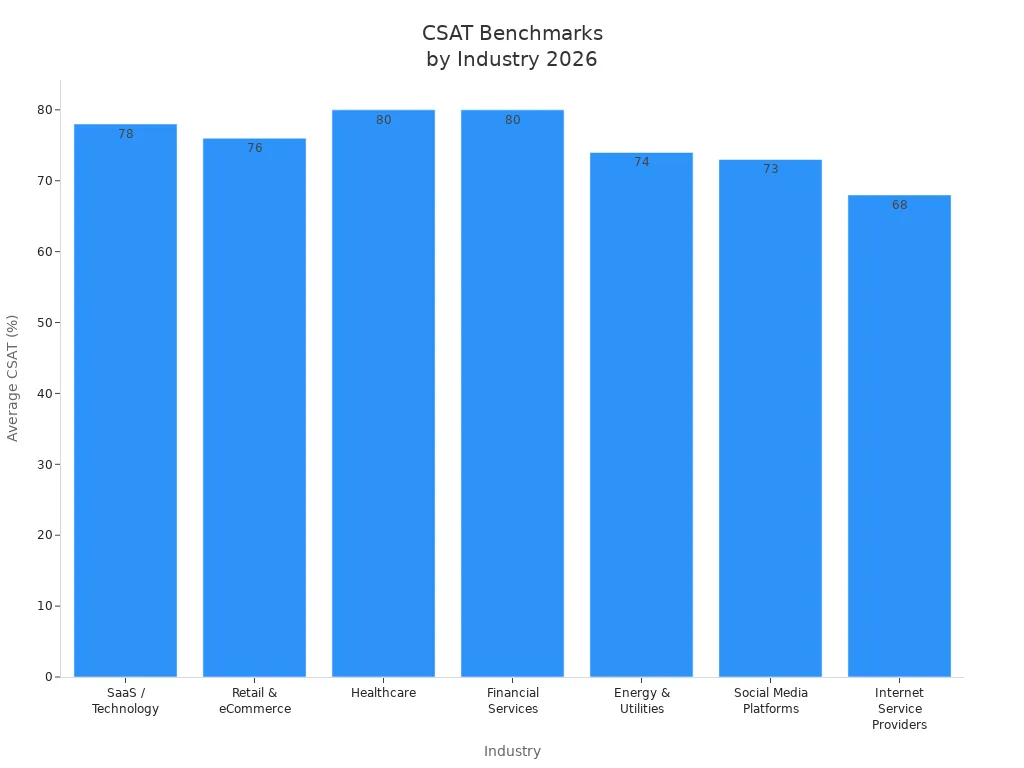
You want to aim for a CSAT score of 85% or higher. High NPS scores predict long-term business growth and identify brand advocates. Companies with higher NPS often see 2.5 times more revenue growth. Customers who rate their experience as a 9 or 10 show a 90% higher retention rate than detractors.
- High CSAT and NPS scores:
- Indicate strong customer satisfaction
- Predict customer loyalty
- Drive revenue growth
- Identify brand ambassadors
You can use AI-driven analytics to monitor these scores and take action when satisfaction drops. Sobot’s omnichannel solutions help you collect feedback across all channels and provide a unified view of customer interactions.
Sentiment and Effort Analysis
Sentiment analysis is a new trend in call center metrics. You use AI to evaluate customer emotions and attitudes during interactions. This technology analyzes tone of voice, keywords, and speech patterns. Predictive customer satisfaction tools use transcripts to estimate satisfaction scores. Voice and speech intelligence track sentiment and emotion changes throughout the conversation.
- AI-driven sentiment analysis:
- Analyzes tone and keywords
- Predicts satisfaction scores
- Tracks emotion changes
Sentiment analysis helps you understand how customers feel. You can tailor responses and improve service delivery. Real-time monitoring allows you to adjust strategies immediately. By identifying recurring issues, you address pain points proactively and enhance customer satisfaction.
Sentiment and effort analysis enable you to deliver proactive customer service. You can use these insights to improve agent training, optimize workflows, and personalize customer interactions.
Key benefits:
- Understand customer emotions
- Identify pain points
- Make real-time adjustments
- Improve customer loyalty
You need to integrate these metrics into your strategy to stay ahead of industry trends. Sobot’s AI-driven analytics provide accurate sentiment tracking and predictive insights, helping you deliver exceptional customer service in 2026.
Measuring Interaction Depth and Complexity
Understanding how deep and complex your customer interactions are is essential for improving satisfaction and agent performance. You can use advanced tools to analyze every conversation and gain valuable insights. Modern call centers rely on several methods to measure interaction depth and complexity. Here is a table showing the most effective methods:
| Method | Description |
|---|---|
| AI for Sentiment Analysis | Measures the intensity of sentiment and tracks changes throughout interactions. |
| Omnichannel Analytics | Analyzes 100% of customer interactions across all channels in a unified platform. |
| Predictive NPS | Automatically predicts customer loyalty for every interaction, identifying at-risk customers. |
| Speech-to-Text Transcription | Provides accurate transcription tailored to business terminology, supporting multiple languages. |
| Text-Based Analysis | Captures and analyzes text from various channels, including chat, email, and social media. |
Advanced Call Detail Records
You can use advanced call detail records to gain deeper insights into every customer interaction. These records offer features that help you review, tag, and analyze calls. The table below highlights key features and their benefits:
| Key Feature | Benefit Description |
|---|---|
| Advanced Playback | Lets you fast-forward, rewind, and jump to specific timestamps in call recordings. |
| Tagging | Adds contextual information to parts of the call, making it easier to search and review. |
| Enhanced Call Review and Searchability | Allows you to mark key segments and retrieve them instantly through tag-based search. |
| Improved Agent Training | Identifies high-quality interactions and areas for improvement, enabling focused feedback sessions. |
| Streamlined Compliance Management | Categorizes conversations that include compliance-related disclosures. |
| Data-Driven Decision Making | Organizes calls through tags for analytics to spot recurring patterns or trends. |
| Optimized Call Quality Assurance | Tags based on QA criteria streamline the review process for agent performance. |
You can use Sobot’s Voice/Call Center to access these features. The platform provides real-time monitoring, tagging, and playback controls. You can improve agent training and compliance management with these tools.
Contextualizing Customer Journeys
Personalizing each customer journey is important for delivering tailored experiences. You need to understand the context of every interaction and use centralized data management. The table below explains how contextualization enhances personalization:
| Aspect | Explanation |
|---|---|
| Contextualization | Decisions and processes are based on customer circumstances and interactions at the time. |
| Personalization | Takes into account all previous engagements across channels to deliver tailored experiences. |
| Data Management | Requires centralized data management and analytics to effectively personalize customer interactions. |
You can use interaction analytics to track every step of the customer journey. Sobot’s omnichannel solution unifies customer data from voice, chat, email, and social media. This helps you deliver consistent and personalized service.
Proactive issue resolution enhances overall customer experience. Improved satisfaction leads to better customer retention.

Sobot Voice/Call Center Capabilities
Sobot Voice/Call Center offers powerful tools for tracking and improving customer satisfaction metrics. You can monitor CSAT, NPS, containment rates, abandonment rates, and agent retention. The table below shows how these metrics impact your business:
| Metric | Description |
|---|---|
| Customer Satisfaction (CSAT) | Measures customer satisfaction with the service provided. |
| Net Promoter Score (NPS) | Gauges customer loyalty and likelihood to recommend the service. |
| Containment Rates | Indicates how often AI resolves issues without human intervention. |
| Abandonment Rates | Tracks the percentage of callers who hang up before reaching an agent, indicating service efficiency. |
| Agent Retention | Measures how well the AI system helps retain employees by reducing burnout from repetitive tasks. |
You can use Sobot’s AI-powered voicebot, live chat, chatbot, and ticketing system to automate workflows and provide consistent responses. AI ensures 100% accurate answers, which builds trust and improves satisfaction. For example, BuyaCar saw a 33% decrease in call abandonment rates after implementing conversational AI. A 5% increase in customer retention can lead to a profit increase of up to 95%.
High FCR rates correlate strongly with customer loyalty and positive word-of-mouth. Low FCR creates frustration that compounds with each additional contact attempt.
You can use Sobot’s customer contact center to unify all communication channels and analyze every interaction. This helps you optimize agent performance and deliver exceptional customer service.
Omnichannel Resolution and Experience

Unified Customer View
You need a unified customer view to deliver fast and accurate support. When you see all customer interactions in one place, you can solve problems quickly. This approach improves customer engagement because you understand each customer’s journey. The table below shows how a unified view helps you resolve issues faster:
| Evidence Description | Impact on Issue Resolution |
|---|---|
| Customer journey analytics helps organizations identify issues and fix them. | Reduces complaints and saves time, leading to faster resolutions. |
| A unified view allows quick access to customer interactions and experiences. | Enables you to address issues quickly and improve efficiency. |
| Tools for analyzing unified data provide actionable insights. | Helps you build strategies that enhance customer experiences. |
You can use Sobot’s omnichannel platform to centralize all customer data. This makes it easier to track every conversation and improve customer engagement.
Cross-Channel Consistency
Customers expect the same quality of service on every channel. Only 7% of contact centers provide seamless transitions between channels. This low adoption means many customers do not get the integrated experience they want. When you lack cross-channel consistency, customer satisfaction drops. The table below highlights common challenges and solutions:
| Challenge | Solution |
|---|---|
| Meeting customer expectations | Use advanced CRM systems and AI-driven analytics to anticipate needs. |
| Personalization shortfalls | Analyze customer data to tailor every interaction. |
| Lack of proper technology | Integrate cloud-based solutions and connect CRM with omnichannel tools. |
You can overcome these challenges by using Sobot’s unified workspace. This tool lets you manage all channels in one place, which boosts customer engagement and ensures consistent service.
Sobot Omnichannel Solution
Sobot’s omnichannel solution brings all your support channels together. You can manage voice, chat, email, and social media from a single platform. The system uses AI to automate tasks and improve communication. The table below shows key features:
| Feature | Description |
|---|---|
| Centralization | Combines all support channels and conversations into one platform. |
| AI-Powered | Uses AI to enhance communication and automate processes. |
| Seamless Communication | Supports smooth interactions across all customer service channels. |
You can connect Sobot with popular CRM systems, e-commerce platforms, and communication tools. This integration helps you track customer engagement and improve satisfaction metrics. When you use Sobot, you give your team the tools to deliver a seamless experience and build stronger relationships with your customers.
Note: The limited adoption of seamless omnichannel experiences suggests that customer satisfaction may be lower when you do not use integrated solutions. Sobot helps you close this gap and improve customer engagement across every channel.
AI-Driven Analytics and Proactive Support
Real-Time Sentiment Tracking
You can now track customer emotions as they happen. Real-time sentiment tracking lets you see how customers feel during every call or chat. This technology helps you spot problems early and step in before issues grow. Many call centers use AI to monitor conversations and alert agents when a customer sounds upset or frustrated. With this insight, you can act fast and improve outcomes.
- Real-time tracking helps you:
- Monitor emotions and interactions as they occur
- Identify dissatisfaction early
- Respond quickly to prevent escalation
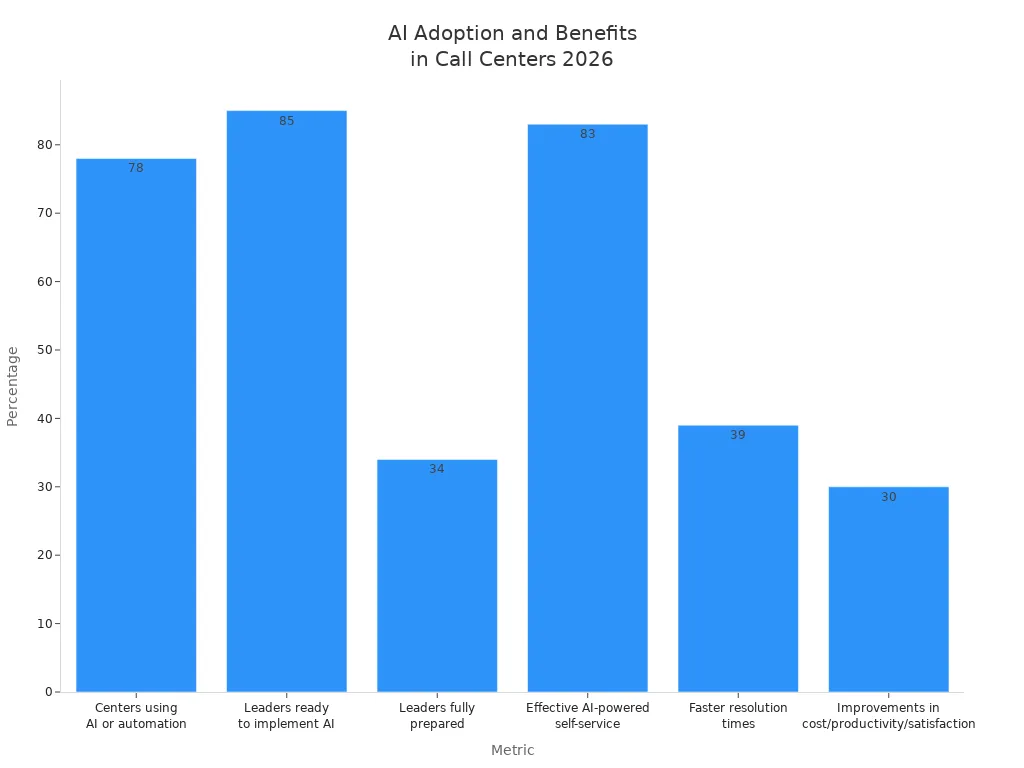
Most call centers now use AI-driven analytics. In 2026, 78% of contact centers analyze customer conversations with AI. Over 85% of customer experience leaders feel ready to use AI, and 83% say AI-powered self-service works well. You can see the adoption rates and benefits in the chart below:
Predictive Customer Needs
Predictive analytics tools help you understand what customers want before they ask. These tools collect data from every channel and find patterns in customer behavior. You can use this information to predict satisfaction and solve problems faster. For example, some platforms suggest the best responses to agents in real time.
- Steps in predictive analytics:
- Collect data from calls, chats, and emails
- Analyze trends and patterns
- Predict satisfaction and future needs
Sobot’s AI-driven analytics give you a complete view of each customer journey. You can use these insights to improve call center customer satisfaction metrics and deliver proactive support.
Automation with Sobot AI
Automation changes how you manage call center customer satisfaction metrics. Sobot AI handles up to 70% of inquiries instantly, reducing agent workload by 60%. Your team can focus on complex issues while Sobot’s AI-powered voicebot and chatbot provide fast answers. Businesses using Sobot report a 35% increase in Net Promoter Score and resolve most issues in under one minute.
| Metric | Impact |
|---|---|
| Percentage of inquiries handled | Up to 70% instantly |
| Reduction in agent workload | 60% workload slashed |
| Improvement in NPS | 35% uplift reported by businesses |
| Average resolution time | Under one minute |
| Return on Investment (ROI) | 234% ROI |
Sobot’s all-in-one contact center solution uses AI to automate workflows, track key metrics, and deliver consistent service. You can measure, analyze, and improve call center customer satisfaction metrics with ease. This approach helps you stay ahead in 2026 and ensures your customers always receive the best support.
Agent Experience and Augmentation
Agent Engagement Metrics
You measure agent engagement with several key metrics. These metrics help you understand how well your team connects with customers and how their actions impact call center customer satisfaction metrics. Engaged agents deliver better service, which leads to happier customers. The table below shows important metrics you should track:
| Metric | Description |
|---|---|
| Click-through rate (CTR) | Measures how often people click on specific links or calls to action, showing content relevance. |
| Conversion rate | Tracks how many visitors take a desired action, reflecting customer engagement. |
| Net promoter score (NPS) | Assesses how likely customers are to recommend the service, correlating with overall customer satisfaction. |
| Customer lifetime value (CLV) | Indicates total revenue a customer generates, suggesting their engagement level. |
| Customer acquisition cost (CAC) | Reflects the cost of acquiring new customers, indicating engagement strategy effectiveness. |
| Social media engagement | Measures interactions on social media, showing brand engagement. |
| Customer satisfaction score (CSAT) | Directly measures satisfaction, influenced by agent engagement. |
| Retention rate | Indicates how well you retain customers, often linked to engagement levels. |
| Churn rate | Measures the rate at which customers stop using the service, inversely related to engagement. |
| Customer effort score (CES) | Assesses how easy it is for customers to interact with the service, impacting satisfaction. |
AI-Powered Knowledge Tools
AI-powered knowledge tools transform agent performance in call centers. You use these tools to improve call center customer satisfaction metrics by providing agents with instant support and guidance. Here are some ways AI enhances your team:
- AI tools provide real-time guidance, helping agents solve customer issues faster.
- Agents receive contextual assistance and automated suggestions, accessing relevant information instantly.
- Sentiment analysis lets AI monitor customer emotions, helping agents maintain productive interactions.
- AI-driven coaching accelerates learning for new agents by giving immediate feedback during live calls.
- Continuous improvement happens as AI analyzes call data trends to identify training needs.
Tip: When you equip agents with AI-powered tools, you empower them to deliver consistent and high-quality service.
Impact on Customer Satisfaction
Agent experience directly affects call center customer satisfaction metrics. You see higher satisfaction scores when agents resolve issues quickly and communicate effectively. The table below highlights the relationship between agent actions and customer outcomes:
| Evidence | Description |
|---|---|
| First Contact Resolution (FCR) | Resolving issues on the first try leads to positive experiences and stronger satisfaction. |
| Customer Satisfaction Score (CSAT) | Acting on customer survey feedback improves satisfaction. |
| FCR as a KPI | Solving issues in the first call reduces frustration and enhances happiness. |
You improve customer satisfaction by focusing on agent training and empathy. Effective communication is a critical factor in creating positive experiences. When you invest in agent support and technology, you see better call center customer satisfaction metrics and stronger customer loyalty.
Trust, Security, and Data Privacy Metrics
Measuring Customer Trust
You build customer trust by protecting their information and respecting their privacy. In 2026, trust stands as a key part of call center customer satisfaction metrics. Customers want to know that you keep their data safe. When you show strong security, you build your brand reputation and loyalty. Customers feel confident when they see you follow strict rules for data protection. You also lower the risk of data breaches, which helps you keep customer trust high.
Note: Customers are more likely to stay with your business if they trust you to protect their information.
Security Standards in 2026
You need to follow the latest security standards to meet customer expectations and improve call center customer satisfaction metrics. These standards help you show that your call center takes data privacy seriously. Here are the main certifications you should know:
| Certification | Description |
|---|---|
| SOC 2 Certified | Validates security, availability, and confidentiality controls |
| ISO 27001 Certified | International standard for information security management |
| PCI DSS Certified | Ensures secure handling of payment card information |
| HIPAA Compliant | Compliance with U.S. healthcare data protection standards |
When you meet these standards, you reduce the compliance burden for your business. You also manage risks better and show customers that you care about their privacy. These actions help you improve call center customer satisfaction metrics and build long-term loyalty.
- Demonstrable security builds brand reputation and loyalty.
- Reduced compliance burden gives you more confidence in your operations.
- Enhanced risk management protects you from data breaches.
Sobot’s Secure Solutions
Sobot puts security and privacy at the center of every solution. You get encrypted data transfer, secure dialing, and compliance with global standards. Sobot’s call center customer satisfaction metrics include trust and data protection as core values. The platform supports SOC 2, ISO 27001, and PCI DSS standards. You can handle sensitive information with confidence. Sobot’s 99.99% uptime and secure cloud infrastructure keep your operations running smoothly. You give your customers peace of mind and show them that their data is safe. This commitment to security helps you achieve higher call center customer satisfaction metrics and strengthens your brand.
Leveraging Metrics for Business Growth
Integrating Data into Strategy
You can turn call center customer satisfaction metrics into powerful tools for business growth. Start by collecting data from every customer interaction. Use these insights to spot trends and make smart decisions. Sobot’s all-in-one contact center solution gives you a unified dashboard. You see real-time metrics like CSAT, NPS, and FCR in one place. This helps you set clear goals and measure progress. When you track call center customer satisfaction metrics, you find out what works and what needs improvement. You can adjust your strategy quickly and stay ahead of the competition.
Tip: Use Sobot’s analytics to compare your performance with industry benchmarks. This helps you set realistic targets and motivate your team.
Continuous Improvement
Continuous improvement means you never stop getting better. Review your call center customer satisfaction metrics often. Look for patterns in customer feedback and agent performance. Sobot’s AI-driven tools highlight areas where you can improve. For example, if your FCR drops, you can provide extra training or update your scripts. When you act on these insights, you boost customer loyalty and reduce churn. Small changes add up over time. You build a culture where everyone aims for excellence.
- Steps for continuous improvement:
- Review metrics weekly.
- Identify weak spots.
- Take action and measure results.
- Celebrate wins with your team.
Sobot Success Story: Samsung
Samsung used Sobot’s platform to transform its customer service. The company unified all channels and tracked key call center customer satisfaction metrics. With Sobot, Samsung improved agent efficiency by 30% and reached a 97% customer satisfaction rate. Agents accessed customer data in real time, which helped them solve problems faster. Sobot’s AI-powered chatbots handled routine questions, so agents focused on complex issues. This approach led to higher FCR and better customer experiences. Samsung’s story shows how you can use call center customer satisfaction metrics to drive real business growth.
When you leverage the right tools and focus on metrics, you create a winning strategy for your business.
You need to track advanced metrics to improve customer satisfaction in 2026. Sobot’s solutions help you manage every channel and analyze real-time data. Start by reviewing your current metrics and set clear goals for your team. Use Sobot’s technology to automate tasks and boost agent performance. You gain a competitive edge when you focus on customer satisfaction and leverage innovative tools.
FAQ
What are call center customer satisfaction metrics?
Call center customer satisfaction metrics are measurements you use to track how happy your customers feel after interacting with your support team. These metrics include CSAT, NPS, and first call resolution. You use them to improve service and grow your business.
Why should you track call center customer satisfaction metrics in 2026?
You should track call center customer satisfaction metrics to understand what your customers need. These metrics help you spot problems, improve agent performance, and boost loyalty. In 2026, advanced analytics make tracking easier and more accurate.
How do call center customer satisfaction metrics impact business growth?
When you monitor call center customer satisfaction metrics, you see where to improve. High scores mean happy customers who stay longer and buy more. Companies like Samsung increased satisfaction rates and agent efficiency by using these metrics.
Which call center customer satisfaction metrics matter most?
You should focus on first call resolution, CSAT, NPS, and sentiment analysis. These call center customer satisfaction metrics give you a clear view of service quality, customer loyalty, and areas for improvement.
How can you improve your call center customer satisfaction metrics?
You can improve call center customer satisfaction metrics by training agents, using AI tools, and collecting feedback. Automate simple tasks and personalize service. Review your metrics often and make changes based on what you learn.
See Also
Effective Strategies for Managing Call Center Quality
Best Reviewed Contact Center Solutions for the Year 2024
Leading Call Center Analytics Tools to Consider in 2024
Enhancing Call Center Efficiency Through Effective Monitoring
