2026 AI Customer Solution Predictions


The year 2026 will redefine the customer solution landscape. Leaders must prepare for three core AI trends. First, AI evolves from simple bots into an autonomous agent that owns complete outcomes. Second, this shift drives a contact center transformation, turning them into proactive value hubs. Third, new roles and foundational data work become essential to govern these advanced AI systems. Sobot leverages Sobot AI to pioneer these trends, showing the path forward for the Sobot call center.
Projections underscore the speed of this change:
- Customer support is expected to reach 80% autonomous resolution.
- Companies like Shoe Carnival anticipate AI will manage 40% of customer call volume.
The Rise of the Autonomous AI Agent

The next wave of customer solutions moves beyond simple conversation. We are entering the era of the autonomous agent. This new type of AI will not just answer questions. It will understand goals, create plans, and execute tasks to deliver complete outcomes. This shift marks one of the most significant trends for 2026.
Beyond Basic Conversational AI
Traditional conversational AI has served a valuable purpose. Chatbots could answer basic questions and guide users through simple flows. These systems function as conversational tools. They lack the ability to perform complex actions like rebooking a flight or processing a refund. The intelligence is limited to its programming.
The future, however, belongs to agentic AI. This next-generation AI is goal-oriented and proactive. It uses multi-step reasoning to complete tasks from start to finish.
| AI Generation | Capabilities | Action | Outcome-Owning |
|---|---|---|---|
| Conversational AI (Gen 2) | Understands user intent, responds | Limited to programming | No |
| Generative AI (Gen 3) | Creates content (e.g., emails, code) | 'Read-only', requires human execution | No |
| Agentic AI (Gen 4) | Goal-oriented, proactive, adaptive | 'Read-write', executes tasks autonomously | Yes |
| Autonomous Agents (2026) | Runs core business operations | Full autonomy, machine-to-machine collaboration | Yes |
This evolution is powered by key technological advancements.
- Large Language Models (LLMs): These models give machines a deep ability to understand natural language.
- Frameworks for AI agents: These allow an agent to use digital tools and carry out multi-step tasks.
- Memory Modules: An agent stores information to maintain context for consistent, personalized interactions.
The return on investment for this advanced AI is already clear. Businesses see major improvements in efficiency and sales.
| Case Study | Application | ROI |
|---|---|---|
| Healthcare | Automating patient query responses | Reduced response time by 90% |
| Eye-oo | Enhancing customer interactions | Wait times reduced by 86%, 25% increase in sales |
| ADT | Integrating AI support tools | Customer satisfaction increased by 30% |
Orchestrating Multi-Agent AI Systems
By 2026, a single agent will often not work alone. Businesses will deploy teams of specialized AI agents. Each agent will perform a specific task perfectly. One agent might analyze a customer's call. Another might update the CRM. A third could process a payment. Together, they handle complex workflows to achieve business outcomes.
Several industries are already adopting this multi-agent approach to improve customer experience.
| Industry | Application of Multi-agent AI Systems |
|---|---|
| Financial services | Individualized financial advisory and wealth management |
| Consumer | Dynamic pricing and personalized promotions |
| Various industries | Personalized customer service automation |
Note: Orchestrating these systems presents new challenges. Companies worry about vendor lock-in and interoperability. Integrating different agents into existing software can be difficult.
The solution lies in a strong orchestration layer. This layer acts as a manager for the AI workforce. It assigns tasks to the right agent and ensures workflows run smoothly. It also allows for human-in-the-loop checkpoints. A human can approve a decision when an agent's confidence is low or the stakes are high. This hybrid approach provides control and improves reliability.
Human-Like Interactions with Sobot Voicebot
The ultimate goal of these trends is to create better experiences. The autonomous agent must communicate effectively. It needs to handle complex and emotional conversations. This requires a new level of conversational intelligence.
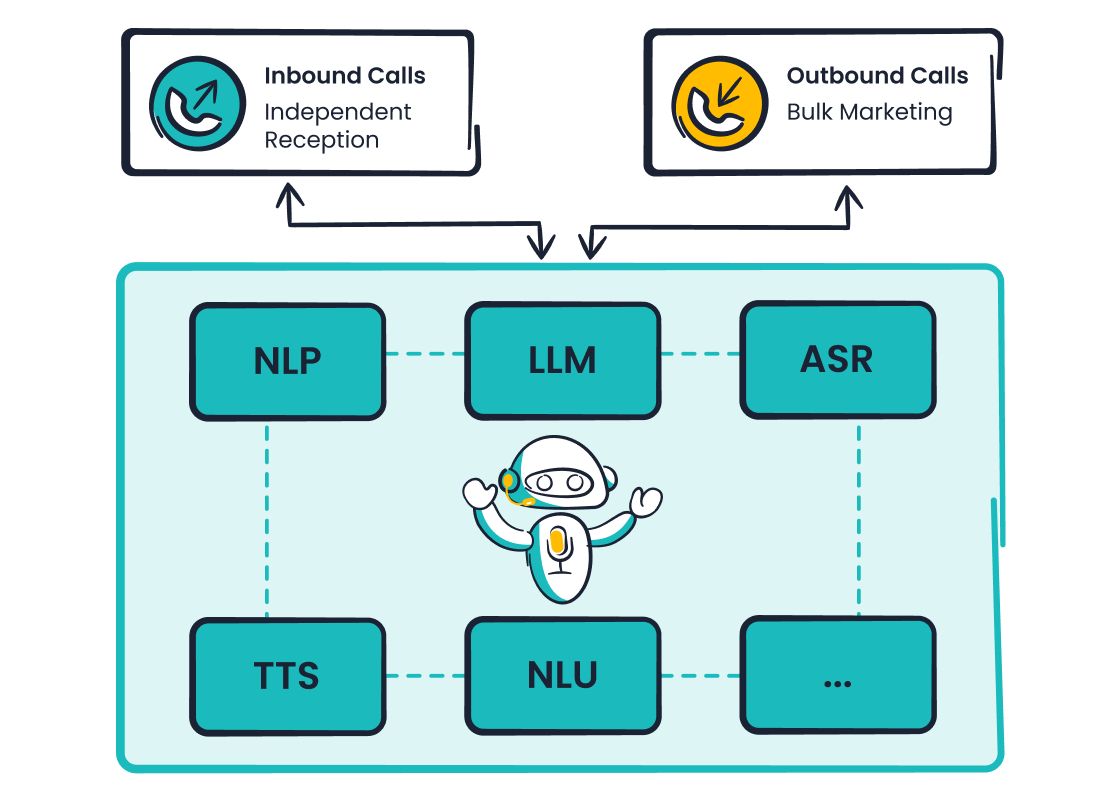
Sobot's Voicebot is a prime example of this technology in action. It moves far beyond basic chatbots to deliver truly human-like interactions. The voicebot uses advanced natural language processing and multiple LLMs, including ChatGPT. This powerful intelligence allows it to achieve high-accuracy speech recognition. It understands not just words, but also patterns and emotions in human speech.
This capability is critical for delivering satisfying outcomes. The agent can adapt its tone and style based on the caller's mood and urgency. This creates a more empathetic and effective conversation. Sobot's technology supports multiple languages and dialects, making it a global solution.
A key advantage is the ease of deployment. Sobot’s Voicebot includes a no-code visual flow builder.
- This drag-and-drop interface allows non-technical teams to design and launch powerful AI agents.
- What once took months can now be done in weeks. For example, a contact center project was reduced from 14 weeks to just 4 weeks by using a no-code builder.
- This empowers businesses to quickly automate inbound and outbound calls, freeing human teams for more strategic work.
This level of advanced conversational AI is no longer just a concept. It is a practical tool that delivers real results. It is the foundation for the autonomous agent of 2026.
The AI-Powered Contact Center Transformation

The rise of autonomous agents is driving a fundamental business transformation in the contact center. For years, contact centers operated as cost centers. Their main goal was to resolve issues as cheaply as possible. By 2026, this model will be obsolete. AI-powered solutions are turning these departments into proactive value hubs that generate revenue and build customer loyalty. This shift is not just about technology. It is about rethinking the entire purpose of customer support.
Driving Contact Center Automation
Contact center automation is the engine of this transformation. It involves using AI to handle tasks that were once done only by humans. The market for this technology is growing rapidly. It was valued at $1.95 billion in 2024 and is expected to surpass $10 billion by 2032. This growth shows how quickly businesses are adopting AI to improve their operations.
Today, AI agents already handle 30–60% of routine tasks in many contact centers. This frees up human agents to focus on more complex and valuable interactions. The goal of contact center automation is to create a system that is both efficient and effective. It helps businesses achieve key goals:
- Improve the overall customer experience.
- Increase operational efficiency and reduce costs.
- Drive new revenue growth.
Leading companies are already seeing impressive results from this strategy. They use AI to resolve a high percentage of queries automatically. This reduces call volume and increases customer satisfaction.
| Company | AI Application | Results |
|---|---|---|
| Vodafone | AI-powered virtual assistant (TOBi) | 80% of customer queries resolved by TOBi, 50% reduction in call center traffic, 20% increase in customer satisfaction. |
| KLM Royal Dutch Airlines | AI-driven chatbot (BlueBot) | 50% of customer queries handled by BlueBot, 30% reduction in response time, 15% increase in customer satisfaction. |
| T-Mobile | AI-powered virtual assistant (T-Mobile Assistant) | 60% of customer queries resolved by T-Mobile Assistant, 40% reduction in call center traffic, 25% increase in customer satisfaction. |
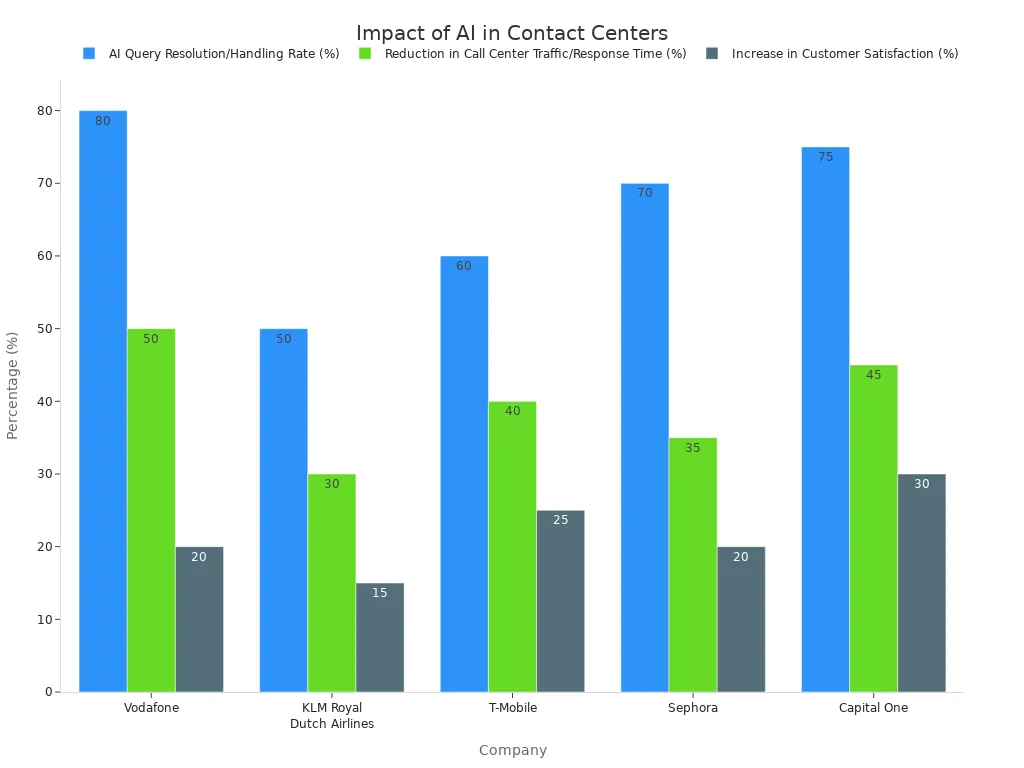
These examples show a clear trend. Effective contact center automation turns customer service delivery from a necessary expense into a competitive advantage.
AI and Agent Automation as a Copilot
The most successful contact center automation strategies do not replace humans. They empower them. By 2026, the concept of an AI copilot for every agent will be standard. This form of AI and agent automation creates a powerful partnership between human expertise and machine efficiency. The AI copilot works alongside the human agent in real time. It provides the agent with the tools and intelligence needed to deliver exceptional service.
An AI copilot helps an agent by:
- Surfacing Knowledge Instantly: The AI pulls relevant policies, product details, and customer history into a single view. The agent spends less time searching and more time solving problems.
- Automating Repetitive Work: The copilot handles tasks like summarizing calls and filling out tickets. This dramatically reduces after-call work time and lets the agent move to the next customer faster.
- Providing Real-Time Guidance: During a call, the AI can suggest responses or next steps. This helps ensure consistency and compliance, especially for new agents.
The story of OPPO, a leading smart device brand, shows this partnership in action. OPPO used Sobot's AI-first customer service platform to manage high inquiry volumes. By combining chatbots for simple questions with human agents for complex issues, they achieved incredible results. This human-machine cooperation led to:
- An 83% chatbot resolution rate, which is on par with the highest industry benchmarks.
- A 57% increase in repurchase rate, proving that great service drives revenue.
- A 94% positive feedback rate, showing a direct impact on customer satisfaction.
This success is built on a foundation of smart AI and agent automation. The AI handles the predictable work. The human agent provides the empathy and critical thinking needed for a great experience. This hybrid approach is the future of the customer solution.
Unifying Intelligence Across Channels
A great customer experience must be consistent. Customers interact with brands across many channels, including chat, email, voice, and social media. They expect a seamless experience no matter how they make contact. By 2026, true omnichannel integration will be a requirement, not a luxury. Siloed systems create fragmented customer experiences and inefficient operations.
The solution is a platform that unifies intelligence from every channel. Sobot's AI Solution for retail is a perfect example of this trend. It provides a comprehensive customer solution that brings all channels into a single, AI-enhanced workspace.
- An agent can see a customer's entire history, from a recent email to a social media message, all in one place.
- This unified intelligence allows for deep personalization and proactive customer engagement.
- The AI can analyze data from all channels to identify trends and predict customer needs.
This omnichannel approach is what powers modern self-service capabilities. When an AI chatbot has access to unified intelligence, it can answer more complex questions and provide a better experience. This creates a virtuous cycle. The AI handles more inquiries, which frees up the agent to provide high-touch service. The intelligence gathered from every interaction then makes the AI even smarter. This is how leading companies will build and maintain their competitive edge in customer support. They will master the flow of intelligence across their entire organization to create truly seamless customer journeys.
New AI-Centric Roles and Structures
The shift to autonomous AI requires more than new technology. It demands new organizational structures and roles. Companies must build teams to manage, govern, and support their AI systems. This foundational work ensures that AI operates safely, ethically, and effectively. Success in 2026 depends on getting this human infrastructure right.
The Emergence of the AI Workforce Manager
As AI takes on more complex tasks, organizations need people to manage it. This has led to the creation of new, specialized roles. These positions are not just technical. They blend expertise in data, ethics, and user experience. The goal is to guide the AI workforce and ensure it aligns with business objectives.
New roles emerging to manage AI include:
- AI Decision Designer: Shapes the frameworks for how an AI agent makes high-stakes choices.
- AI Ethicist: Ensures AI systems are fair and unbiased, preventing legal and reputational damage.
- AI Data Curator: Manages data quality to improve model performance and avoid the "garbage in, garbage out" problem.
Prioritizing AI Trust and Governance
Without strong governance, AI introduces significant risks. Ungoverned systems can expose sensitive data, violate privacy regulations, and produce biased outcomes. This erodes customer trust and creates legal exposure.
Research shows a major gap in AI oversight. While 89% of organizations have some policies, only 52% have comprehensive controls to monitor sensitive data access by AI.
To build trust, companies must establish a clear AI governance framework. This involves several key practices. Organizations should emphasize information security with role-based access controls. They must also promote transparency by outlining AI decision-making processes. Finally, implementing AI risk management through regular audits helps ensure compliance and accountability.
The Foundational Work of Data and Reskilling
A successful AI strategy rests on two pillars: clean data and a skilled workforce. AI models are only as good as the data they are trained on. Organizations must prioritize data hygiene. This includes processes like cleaning data to remove errors, aggregating it from various sources, and transforming it into a usable format.
At the same time, companies must reskill their employees to collaborate with AI. This involves identifying skill gaps and creating targeted training programs. Effective strategies embed learning into daily workflows and focus on uniquely human skills like critical thinking and adaptability. This prepares the workforce for new roles centered on human-AI collaboration.
The Customer-Side AI Challenge
The rise of AI is not limited to businesses. Customers will soon use their own personal AI assistants to manage their lives. This creates new challenges and opportunities for companies. These emerging trends require a new approach to customer interactions and security. Businesses must prepare for a future where their AI systems communicate directly with customer AI.
Preparing for Bot-to-Bot Communication
By 2026, a new type of interaction will become common: bot-to-bot communication. A customer's personal AI agent will contact a company's support AI to resolve issues. This means companies need systems with robust intelligence that can negotiate, verify, and execute tasks without human help. The entire experience will be automated. This shift demands a technical infrastructure built for machine-to-machine dialogue, changing the definition of a seamless customer experience.
A New Strategy for the AI-Empowered Customer
Companies must adapt their strategies for customers who use AI tools. An AI-empowered customer has higher expectations for speed and personalization. To meet these demands, businesses should:
- Leverage AI for better knowledge management. This empowers the human agent with instant access to information.
- Personalize every interaction. AI can analyze customer history and sentiment to tailor responses.
- Invest in training. Human teams need to learn how to work alongside AI to handle complex issues.
This approach uses internal intelligence to match the external intelligence of the customer's tools, creating a more efficient and satisfying experience.
Verifying Identity in the Age of Deepfakes
Greater AI capability also brings greater security risks. Deepfake technology makes it easy to create fake video and audio. This poses a serious threat to customer service and security.
In one high-profile case, fraudsters used deepfake technology to impersonate a company executive on a video call. They tricked an employee into transferring $25 million.
These incidents show the urgent need for better identity verification. Biometric face verification is becoming the most reliable method. Advanced systems use liveness detection to confirm a person is real and physically present. This technology analyzes subtle cues that deepfakes cannot replicate, such as micro-expressions and natural head movements. Strong verification is essential to build trust in the age of AI.
The year 2026 will bring a major business transformation. An autonomous agent will deliver complete outcomes. The contact center will become a value hub. New roles will manage this change. This year marks a foundational shift in customer solution design. Competitive advantage will come from mastering operational changes, clean data, and human-AI collaboration. Forward-thinking companies using solutions like Sobot show this is the path to better outcomes.
Firms perform better when they integrate technical and social assets. Human judgment, common sense, and creative thinking are aspects AI systems struggle to imitate, making this partnership a crucial source of competitive advantage.
This hybrid approach creates a superior customer solution.
FAQ
What is an autonomous AI agent?
An autonomous AI agent is an advanced system that understands goals and completes multi-step tasks on its own. It moves beyond simple conversation to own entire outcomes, such as rebooking a flight or processing a complex order without human intervention.
How does an AI copilot help human agents?
An AI copilot works alongside human agents in real time. It instantly finds information, automates repetitive work like summarizing calls, and suggests responses. This partnership boosts agent efficiency and helps them deliver faster, more accurate service to customers.
Why is omnichannel intelligence important for AI?
Omnichannel intelligence unifies customer data from every channel, including chat, email, and voice. This gives AI a complete customer view. It enables more effective AI-powered customer solutions that deliver consistent and personalized experiences, no matter how a customer makes contact.
How can businesses start with AI-powered customer solutions?
Businesses can begin by automating specific, high-volume tasks. User-friendly platforms like Sobot's Voicebot offer no-code visual builders. This allows non-technical teams to design and deploy effective AI agents quickly, providing a clear path to starting their automation journey. 🚀
See Also
Leading AI Solutions Transforming Enterprise Contact Centers: A Top 10 List
Unlocking Peak Efficiency: The Power of AI in Customer Service Software
An In-Depth Look at AI-Powered Enterprise Call Center Solutions
Discovering the Best Voice of the Customer Software for 2024
Analyzing Performance: Top 10 Call Center Analytics Software for 2024

