Future-Proof Your Customer Satisfaction


Future-proofing your customer satisfaction demands a strategic transformation. You must move from reactive customer support to a proactive, predictive model. This shift uses AI. Today’s customer expects speed. In fact, 90% of consumers believe an immediate response from customer service is essential. You need the right AI tools to meet this demand. These AI tools improve both self-service and your team's abilities. Using a powerful customer satisfaction improvement tool like Sobot's AI chatbot helps you deliver excellent customer service. This AI-powered approach ensures high satisfaction and prepares your business for the future of customer interactions.
Core AI Tools for Customer Service

To build a future-proof strategy, you need the right tools. Core AI innovations transform your customer service from a cost center into a value driver. These tools empower both your customers through self-service and your agents through intelligent support. Let's explore the essential AI tools that create these exceptional conversational interactions.
The Chatbot as a Customer Satisfaction Improvement Tool
Your first line of defense is often a chatbot. Modern chatbots are a powerful customer satisfaction improvement tool. They are not just simple Q&A bots anymore. Today's conversational AI can handle complex queries, understand intent, and provide instant, 24/7 support. This is crucial because customers expect immediate answers, no matter the time zone.
Your global customers also want to communicate in their own language. AI makes this possible without hiring a massive multilingual team. Consider these facts:
- 65% of customers prefer content in their language.
- 40% of shoppers will not buy from a website in another language.
- 73% of customers want product reviews in their native language.
An AI chatbot that offers multilingual support breaks down these barriers. It creates better customer interactions and builds trust.
You can implement this technology without a team of developers. Leading solutions offer no-code platforms. This empowers your customer service and marketing teams to build and deploy conversational AI agents quickly.
No-code chatbot builders close that gap. They give teams the power to build chatbots and launch AI agents fast, without engineering help. With visual workflows and drag-and-drop design, your teams can deploy agents quickly, test ideas, and refine them as they grow.
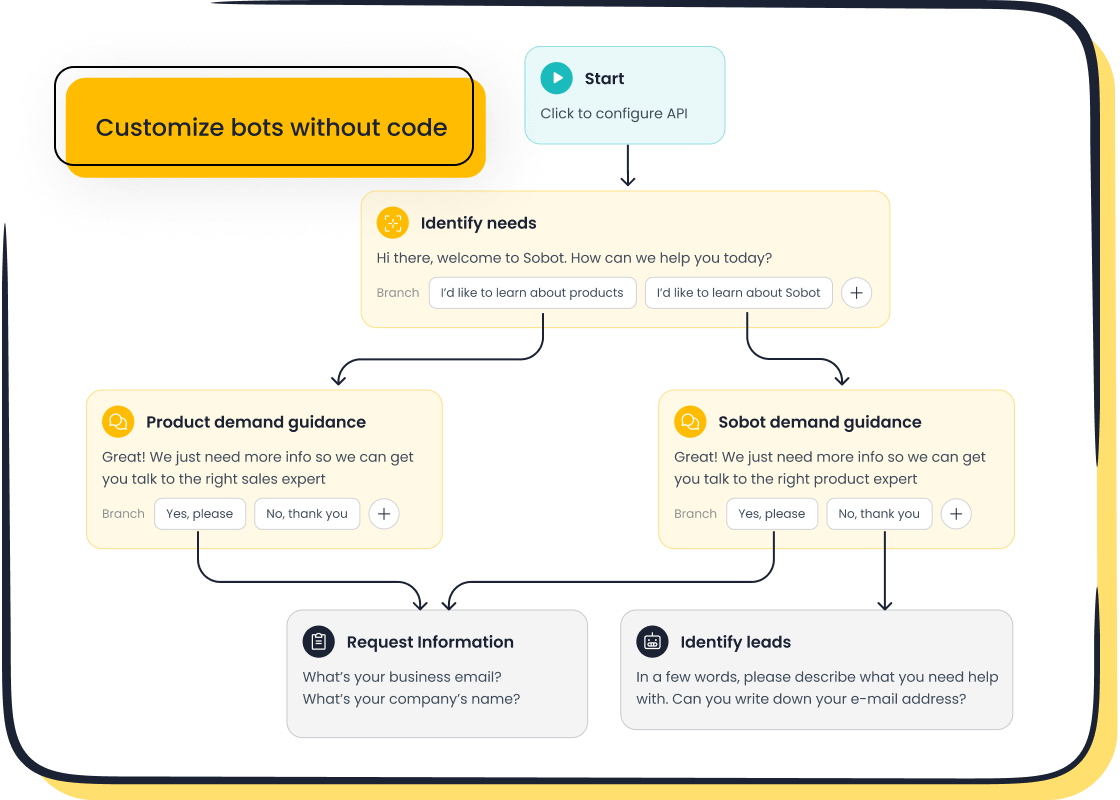
For example, Sobot’s AI Chatbot is a leading customer satisfaction improvement tool. It provides 24/7 multilingual support across all your channels. Its no-code, point-and-click setup allows you to go live the same day. Businesses using Sobot's AI see incredible results. They improve productivity by 70% and cut operational costs by up to 50%. This AI-driven automation turns your support into a streamlined, efficient engine for higher customer satisfaction.
AI-Powered Agent Assistance for Complex Issues
AI-driven automation excels at handling common questions. This frees your human agents to focus on what they do best: solving complex problems and building relationships. Certain situations require the empathy and critical thinking that only a human can provide. These include:
- Emotionally charged or sensitive problems.
- Complex issues that require creative problem-solving.
- High-value customer interactions where building rapport is key.
In these moments, AI shifts from a self-service tool to a powerful assistant. AI-powered agent assistance, or an AI Copilot, works alongside your human agents. It gives them the information they need to resolve issues quickly and effectively. This real-time assistance is a game-changer for any customer service team.
An AI Copilot enhances your agent's abilities by:
- Generating Suggested Responses: The AI analyzes the conversational context and suggests accurate, on-brand replies.
- Surfacing Knowledge: It instantly pulls relevant information from your knowledge base, saving agents from searching for answers.
- Summarizing Interactions: The AI creates concise summaries of long conversations, which is perfect for escalations or follow-ups.
This human-machine cooperation leads to faster resolutions and higher customer satisfaction. A great example is OPPO, a global leader in smart devices. During peak shopping seasons, OPPO faced a surge in customer inquiries. By implementing Sobot’s solution, they used a chatbot to handle most questions. This allowed their agents to focus on more complex customer needs. The results were remarkable. OPPO achieved an 83% chatbot resolution rate and a 94% positive feedback rate. This proves that the right customer satisfaction improvement tool combines AI automation with empowered human agents. Sobot's AI Copilot provides this exact support, turning every agent into an expert.
Predictive Analytics and Proactive Personalization
The final piece of the puzzle is moving from reactive to proactive support. Predictive analytics uses AI to analyze historical and real-time data. It identifies patterns to forecast future customer behavior and potential service issues. Instead of waiting for a customer to report a problem, you can address it before it happens. This is the future of customer service.
Predictive customer analytics allows you to:
- Identify customers who are at risk of churning.
- Anticipate product or service issues.
- Forecast peak demand periods to optimize staffing.
This proactive approach is closely tied to personalization. When you understand a customer's history and predict their needs, you can deliver AI-driven personalization at scale. This creates a unique and memorable experience. Many leading brands already use this strategy to build loyalty.
| Brand | Proactive Personalization Strategy |
|---|---|
| Amazon | Offers personalized product recommendations and uses AI chatbots for instant support. |
| Chewy | Sends personalized emails with product recommendations and helpful pet care tips. |
| Netflix | Provides personalized content recommendations and sends notifications about new releases. |
| Starbucks | Uses its app to offer personalized promotions and product suggestions. |
These companies use data to create seamless customer interactions. You can achieve this same level of personalization. An all-in-one platform with strong AI capabilities gives you the real-time insights needed for effective proactive support. By analyzing conversational data and customer behavior, you can build a customer satisfaction improvement tool that not only solves problems but also anticipates them. This deep level of engagement and personalization is what drives long-term loyalty and higher customer satisfaction.
Strategic AI Implementation: From Theory to Reality
Adopting the right AI tools is the first step. The next is turning your strategy into a reality. This requires careful planning and a commitment to a full business transformation. You must prepare your operations, reshape your workforce, and navigate complex data challenges. This strategic implementation is what separates successful AI adoption from a failed experiment. It is the bridge from theory to tangible results in customer service.
Preparing Your Operations for AI Integration
You cannot build a new structure on a weak foundation. Before you introduce any AI, you must understand your current customer service workflows. A thorough audit helps you identify where AI can deliver the most impact. This initial assessment is critical for a smooth transformation.
Start by mapping your existing processes. You need to see exactly how your team handles inquiries from start to finish. This helps you find the biggest opportunities for improvement. Follow these steps to prepare your operations:
- Document Current Processes: Map out every task in your customer service workflow. Note who is involved and what systems they use.
- Identify Bottlenecks: Look for manual processes that cause delays or errors. This could be agents manually routing tickets or entering data.
- Assess Potential ROI: Calculate the return on investment for automating different tasks. Consider time saved, error reduction, and improved customer satisfaction.
- Prioritize Automation Opportunities: Use your ROI analysis to decide which areas to automate first. Focus on changes that offer the highest impact on your customer and your business.
This audit gives you a clear roadmap. You will know exactly where an AI-powered platform can streamline operations, cut costs, and improve the customer experience.
Reshaping Your Workforce for the AI Era
Many employees worry that AI will replace them. You can address this fear by showing them how AI acts as a partner, not a replacement. The goal of this transformation is to elevate your team, not eliminate it.
Employee resistance is often a rational response to complex, confusing tools. Employees are not resisting innovation. They are resisting "black box" technologies that are done to them, not built for them. The friction is not with the idea of AI; it is with the experience of using it.
To build a successful partnership, you must involve your team from the start. Choose AI tools that are transparent and easy to use. When your team understands how an AI works, they are more likely to trust it. This collaborative approach shifts the focus from replacement to partnership.
This new human-AI collaboration creates new roles within your customer service team. Your agents will evolve from simple problem-solvers to strategic thinkers. Some emerging roles include:
- Knowledge Manager: This person curates the information the AI uses. They analyze bot conversations to ensure the AI provides high-quality answers.
- Conversation Designer: This role focuses on crafting natural and effective interactions for the AI.
- Conversation Analyst: This expert reviews AI conversations to find areas for improvement and optimize performance.
To prepare your team for these new responsibilities, you need a targeted training program. You can design effective training by following a clear plan. First, assess your team's current skills to find knowledge gaps. Then, create training modules with real-world scenarios. Finally, implement live training sessions that start with basic AI features and move to more advanced tools. This gradual approach helps your team build confidence and master the new technology.
Navigating Data Privacy and Accuracy Challenges
AI runs on data. To build trust with your customer, you must handle their data responsibly. Navigating data privacy is a non-negotiable part of any AI strategy. Regulations like GDPR and CCPA set clear rules for how you collect, use, and protect personal information. Your AI platform must be compliant.
These regulations share common goals for protecting customer data. Understanding them is key to your business transformation.
| Aspect | Shared Goals of CCPA and GDPR |
|---|---|
| Personal Data Security | Both laws require you to protect personally identifiable information. |
| Data Minimization | You should only collect the data that is necessary for your AI model. |
| User Rights | You must give users the ability to see, delete, and learn about their data. |
| Data Sharing | Both laws limit the sharing or selling of personal information to third parties. |
| Transparency | You must tell users how their data is stored, used, and shared. |
Beyond privacy, you must also ensure the accuracy of your AI. Biased or inaccurate data leads to a poor customer experience and erodes trust. You can reduce bias and improve accuracy with a few key practices.
- Use Diverse Training Data: Your AI should be trained on data that represents all your customers. This includes varied voices, accents, and demographics.
- Conduct Regular Audits: Continuously monitor your AI systems for bias. Regular testing helps you find and correct any unintended patterns.
- Maintain Human Oversight: Keep a human in the loop for important decisions. This ensures that your AI makes fair and accurate choices.
By prioritizing data privacy and accuracy, you build a trustworthy and effective AI-powered customer service operation. This commitment shows your customer that you value their security as much as you value their business.
The Business Impact of AI on Customer Loyalty

Implementing AI is not just about technology. It is about creating real business value. A smart AI strategy boosts customer loyalty by improving efficiency and personalizing every customer experience. This directly impacts your bottom line and secures long-term growth.
Measuring ROI: Cost Reduction and Efficiency Gains
You need to measure the success of your AI investment. The Return on Investment (ROI) shows you the financial impact of your new tools. You can calculate it with a clear formula.
ROI = (Annual Financial Benefits + Monetized CX Benefits – Total Costs) ÷ Total Costs × 100 (%)
This formula helps you see the full picture.
- Financial Benefits include direct savings from automation.
- Monetized CX Benefits are the value of a better customer experience, like higher retention.
- Total Costs cover the setup and maintenance of the AI system.
This human-machine cooperation leads to impressive results, such as a 30% reduction in Average Handle Time. When your team resolves issues faster, you save money and make every customer happier.
Enhancing the Customer Journey with Sobot
A seamless customer journey creates lasting loyalty. Your customer wants to feel understood at every touchpoint. Sobot's AI platform makes this possible by unifying all your channels. The Five-AI system provides intelligence across the entire customer experience.
- AI Agent and AI Chatbot automate routine questions.
- AI Copilot assists your human team with complex issues.
- AI Insight gives you data to optimize performance.
This integrated approach gives your team a complete view of every customer. They see past purchases and previous conversations in one place. This eliminates the need for customers to repeat themselves and creates a smooth, positive engagement.
Driving Repurchases and Long-Term Value
Happy customers come back. A high repurchase rate is the clearest sign of customer satisfaction and strong brand trust. A positive experience is the foundation for this loyalty. When you provide fast, effective service, you encourage customers to choose you again.
AI helps you build this long-term value. It can analyze behavior to predict which customers might leave. This allows you to launch targeted retention campaigns before they churn. This proactive engagement shows your customer you value their business. By personalizing follow-ups and anticipating needs, your AI becomes a powerful tool for driving repurchases and building a loyal customer base.
Your business transformation is within reach. Future-proofing your customer satisfaction depends on a dual strategy. You must adopt the right AI tools and evolve your operations. Solutions like Sobot offer a clear path to turn this theory into reality. Acting now gives you a competitive advantage. You can:
- Increase agent productivity with real-time guidance.
- Enhance personalization by anticipating customer needs.
- Streamline operations for greater efficiency.
Explore an all-in-one contact center solution today. Secure your competitive edge and build lasting customer loyalty.
FAQ
How does AI improve customer satisfaction?
AI improves your customer satisfaction by providing instant, 24/7 support. Chatbots answer common questions immediately. This speed and availability meet modern customer expectations. Your customers get the help they need without waiting, which builds trust and loyalty.
Will AI replace my human customer service agents?
No, AI empowers your agents. It handles repetitive questions, freeing your team for complex issues. An AI Copilot assists agents with response suggestions and data. This human-machine partnership elevates your team's skills and allows them to focus on high-value interactions.
Is it difficult to set up an AI chatbot?
You can set up a powerful AI chatbot without any coding. Modern platforms like Sobot offer a no-code, point-and-click interface. This allows your team to design and deploy a chatbot quickly. You can start improving your customer service the same day.
How does AI help with different languages?
AI chatbots provide seamless multilingual support. They can instantly communicate with your global customers in their native language. This breaks down communication barriers and creates a more personalized experience. You can expand your reach without hiring a large multilingual team.
See Also
Elevate Live Chat Experience: Ten Strategies for Customer Delight
Discovering the Premier Voice of Customer Platforms for the Year 2024
A Comprehensive Comparison of Leading Voice of Customer Solutions
Essential Guide: Optimizing Call Center Quality with Assurance Software
Unlocking Peak Performance: AI Customer Service Software Enhances Operational Efficiency

