AI in Your Contact Center Transformation Guide

A successful contact center transformation turns your service center into a growth engine. You want to enhance customer experience, boost agent efficiency, and improve operations. AI-driven automation is the key. AI transforms contact centers by using powerful ai solutions. This guide explores how AI in contact centers and contact center automation can help you achieve your goals.
For example, Sobot provides all-in-one ai call center solutions. The Sobot call center and Sobot AI platform use advanced automation and AI to deliver exceptional results.
How AI Transforms Contact Centers

AI transforms contact centers by introducing smart automation that redefines how you serve customers. Implementing AI is the core of a modern contact center transformation. It moves you from a reactive service model to a proactive, efficient, and intelligent operation. Let's explore how AI in contact centers achieves this.
The Role of Contact Center Automation
Contact center automation uses technology to handle repetitive tasks. This frees your agents to focus on complex customer issues. The primary goals of automation are to:
- Handle routine inquiries 24/7 with chatbots.
- Reduce operational costs and improve resolution times.
- Scale your support capacity without hiring more agents.
- Increase agent productivity and job satisfaction.
This automation lays the foundation for more advanced AI applications.
AI-Powered Self-Service with Sobot
You can empower customers with instant, 24/7 support using AI-powered chatbots. These tools handle common questions and guide users to solutions without agent intervention. For example, Sobot’s AI Chatbot is multilingual and ChatGPT-enabled, allowing you to serve a global audience anytime. This AI-powered self-service improves first-contact resolution and enhances the customer experience.
Intelligent Routing and IVR
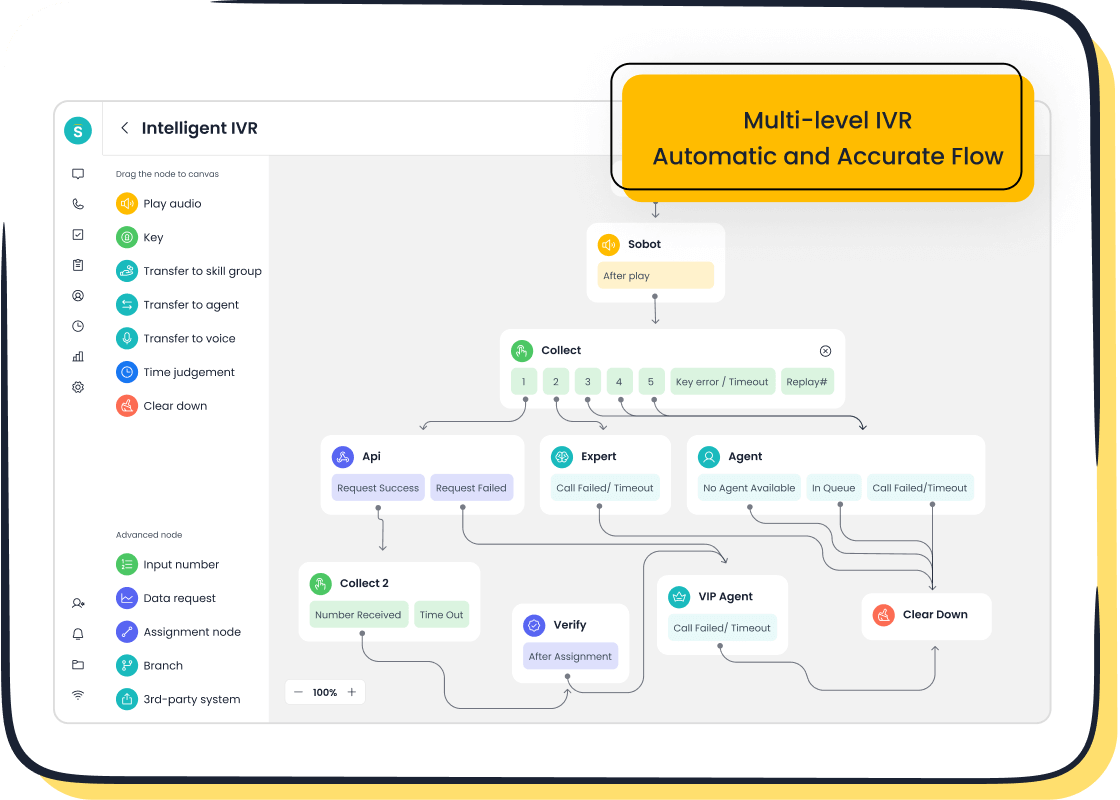
Intelligent routing ensures customers connect to the right agent on the first try. AI analyzes caller data to direct them to the agent best equipped to help. With an AI-powered voice system, you can build sophisticated workflows easily. Sobot’s Voice/Call Center includes a drag-and-drop IVR builder, which lets you create and modify call flows without any coding. This smart automation reduces wait times and eliminates frustrating transfers.
Agent Assist and AI Co-pilots
You can boost agent performance with AI-powered guidance. An AI co-pilot works alongside your agents in real-time. It provides instant access to information, suggests responses, and automates post-call work. Sobot’s AI copilot features help agents generate accurate replies and summarize customer interactions automatically. This support helps agents resolve issues faster and improves the quality of every conversation.
Automated Quality and Sentiment Analysis
AI offers a powerful way to manage quality assurance. Instead of manually reviewing a small sample of calls, AI can analyze 100% of customer interactions. It scores agent performance against your quality standards and ensures compliance. This AI also performs sentiment analysis to gauge customer emotion, giving you deep insights into satisfaction levels. This level of quality assurance helps you identify coaching opportunities and continuously improve service. Implementing AI for quality assurance provides consistent and unbiased feedback.
Key Benefits of AI in the Contact Center
Implementing AI in your contact center delivers clear, measurable advantages. You can create better experiences for customers and agents while improving your bottom line. This contact center transformation is driven by four key benefits.
Elevate Customer Experience and Satisfaction
You can significantly improve customer satisfaction by delivering personalized interactions. AI analyzes customer data like purchase history and browsing behavior to provide relevant recommendations. This creates a seamless customer experience across all your channels.
AI-powered chatbots offer instant, 24/7 support. This immediate assistance boosts customer satisfaction and ensures your customers feel valued and understood at every touchpoint.
Increase Agent Efficiency and Empowerment
AI empowers your agents by automating repetitive work. This automation frees them to handle more complex customer issues. Support agents using an AI assistant can boost their productivity by 14%, handling more inquiries per hour. AI also provides real-time guidance and personalized coaching. This support helps agents feel more confident and leads to higher job satisfaction. Boosting efficiency with AI turns your agents into expert problem-solvers.
Improve Operational Efficiency and Reduce Costs
Contact center automation directly lowers your operational costs. AI handles routine inquiries at a fraction of the cost of a live agent. This efficiency allows you to scale support without increasing headcount.
- Live Agent Call: $4–$7
- AI Agent Call: ~$1 This cost difference can lead to millions in annual savings. Implementing AI is a strategic investment that delivers a strong return.
Gain Deeper Insights with AI Analytics
AI in contact centers provides powerful real-time analytics. AI analyzes 100% of customer interactions, not just a small sample. It uses natural language understanding to identify customer sentiment, emerging trends, and recurring pain points. These deep insights help you proactively address issues and improve your products or services. Gaining this level of understanding is crucial for a successful business. AI in contact centers gives you the data to make smarter decisions.
A 5-Step Guide to Contact Center Transformation
Embarking on your contact center transformation requires a clear, actionable plan. This five-step guide provides a practical roadmap for implementing AI successfully. Following these steps will help you navigate the process, from defining your vision to scaling your success, ensuring a smooth transition that delivers measurable results.
Step 1: Define Clear Goals and KPIs
Before you introduce any new technology, you must define what success looks like. Start by setting clear, measurable goals for your project. Do you want to reduce Average Handle Time (AHT), improve First Call Resolution (FCR), or increase Customer Satisfaction (CSAT)? Your goals will guide your strategy for implementing AI.
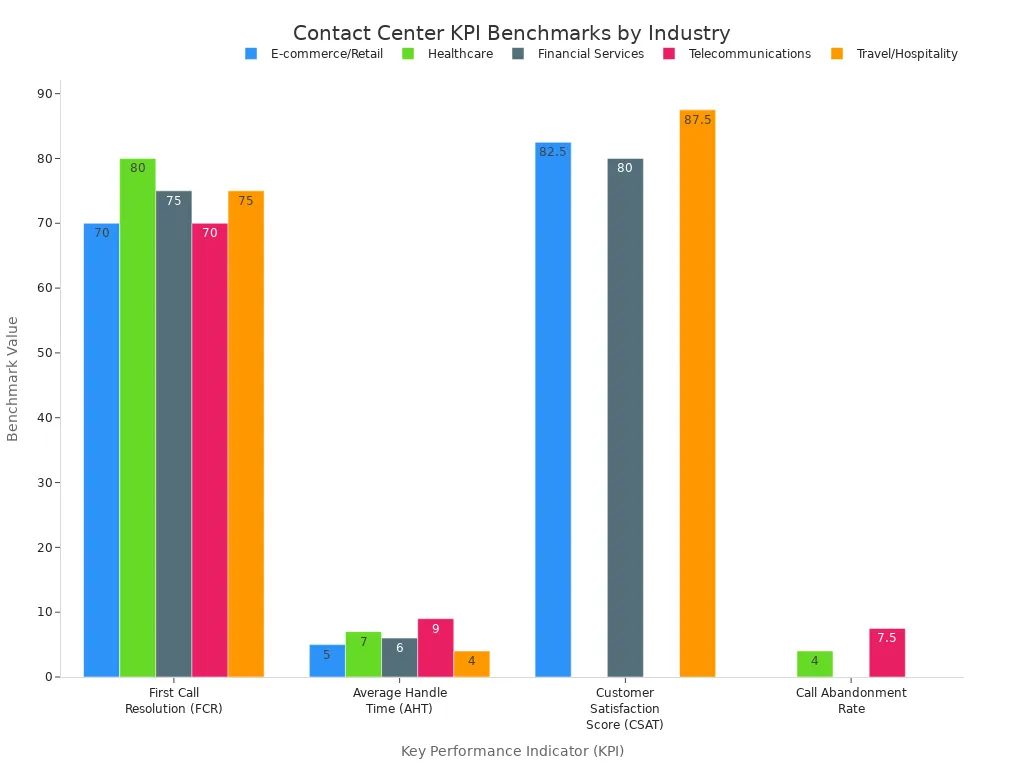
Key Performance Indicators (KPIs) are essential for tracking progress. You can use industry benchmarks to set realistic targets, but remember to tailor them to your specific operations. For example, a retail business might prioritize CSAT, while a financial services firm may focus more on FCR due to compliance needs.
Here are some common industry benchmarks for AI in contact centers:
| KPI | General Benchmark | E-commerce/Retail | Financial Services | Telecommunications |
|---|---|---|---|---|
| First Call Resolution (FCR) | 75% – 80% | 65% – 75% | 70% – 80% | 65% – 75% |
| Average Handle Time (AHT) | 6 minutes | 4 – 6 minutes | 5 – 7 minutes | 8 – 10 minutes |
| Customer Satisfaction (CSAT) | N/A | 80% – 85% | 78% – 82% | N/A |
| Call Abandonment Rate | 5% – 8% | N/A | N/A | 6% – 9% |
Step 2: Choose the Right AI Partner and Tools
With your goals defined, you need the right partner and tools to achieve them. Choosing a provider for your AI call center solutions is a critical decision. You should evaluate potential partners based on several key factors:
- Customer Reviews and Testimonials: Look for authentic feedback from current customers.
- Case Studies and References: Ask for real-world examples of their success.
- Industry Recognition: Check for certifications, awards, and analyst reports.
- Customer Support: Ensure they offer robust support to guide you through implementation and beyond.
- Financial Stability: Choose a vendor you can trust for a long-term partnership.
A partner like Sobot excels in these areas, offering a proven and reliable platform. Trusted by over 10,000 brands, Sobot provides an all-in-one solution that unifies your Voice, Chat, Chatbot, and Ticketing systems. This integrated approach eliminates data silos and creates a seamless experience for both agents and customers. With an industry-leading 99.99% system stability, you can count on Sobot to support your operations without interruption.
Why an Official WhatsApp BSP Matters Sobot is also an official WhatsApp Business Solution Provider (BSP). This is crucial because only official partners can guarantee compliance, security, and full functionality. A BSP helps you get your account verified, provides a unified inbox for managing conversations, and offers analytics to track performance, ensuring you can connect with customers on their favorite channel safely and effectively.
Step 3: Prepare and Train Your Team
Technology is only effective if your team knows how to use it. A successful AI integration is as much a cultural shift as it is a technological one. You must prepare your team by communicating the benefits of the new tools and addressing any concerns.
Frame the AI as a co-pilot designed to help agents, not replace them. This approach fosters a culture of openness and encourages adoption. Your training program should be hands-on and practical.
- Develop training that mirrors real customer interactions.
- Create structured learning paths with short, focused micro-learning sessions.
- Implement peer mentoring, where experienced agents coach others.
- Organize collaborative problem-solving sessions to build confidence.
By investing in your team, you ensure that implementing AI empowers your agents and amplifies their skills.
Step 4: Launch a Pilot and Gather Feedback
Instead of a risky, full-scale launch, you should start with a small, manageable pilot project. A pilot allows you to test your AI solution in a controlled environment, gather feedback, and prove its value before rolling it out across the entire organization.
Begin by identifying a clear use case. For example, you could launch one of your new chatbots to handle common, repetitive inquiries or use an AI tool to automate after-call work for a small group of agents. During the pilot, you must track performance closely. Key metrics to monitor include:
- Resolution Rates: The percentage of issues resolved by the AI without human help.
- User Adoption: How often customers and agents use the new tool.
- Time Efficiency: The amount of time saved compared to traditional methods.
- User Satisfaction: Feedback from both customers and agents on the AI's usefulness.
This iterative approach allows you to learn, make adjustments, and build stakeholder support for a wider rollout.
Step 5: Monitor, Analyze, and Scale Your Automation
A successful pilot is the first step, not the final destination. The world of AI is constantly evolving, and your system requires ongoing attention to remain effective. You must continuously monitor performance, analyze the results, and use those insights to make improvements.
This continuous feedback loop is what drives long-term success. By analyzing interaction data, you can identify gaps in your knowledge base, refine AI responses, and uncover new opportunities for automation. Once you have proven the value of your initial use case, you can begin to scale.
- Implement a synergy where AI handles routine tasks and agents manage complex issues.
- Identify more repetitive, time-consuming tasks to automate.
- Use real-time dashboards to track KPIs and refine workflows.
- Ensure your contact center automation solution is flexible enough to adapt to higher volumes and new service areas.
By monitoring, analyzing, and scaling, you transform your initial success into lasting operational excellence.
Real-World AI Success Stories

Theory is valuable, but seeing AI in action provides the clearest picture of its impact. You can achieve remarkable results by implementing AI strategically. These real-world examples show how companies are transforming their operations and boosting key metrics.
Reducing Handle Time with Agent Assist
You can empower your agents to resolve issues faster with AI co-pilots. These tools provide real-time guidance and automate tasks, directly reducing Average Handle Time (AHT). For example, a major telecom company used AI to reduce agent errors by up to 80% and cut AHT by 20%. This automation allows agents to focus entirely on the customer, not on manual data entry.
Boosting FCR with Intelligent Routing
You can improve your First Contact Resolution (FCR) by ensuring customers reach the right expert on their first attempt. Intelligent routing uses AI to analyze customer needs and direct them appropriately. One financial services provider boosted its FCR by 16% after implementing AI, saving over $1.4 million annually. In another case, a telecom company saw its AI chatbot achieve a 42% FCR, resolving a third of all inbound contacts automatically.
Increasing Self-Service Rates with OPPO and Sobot
Leading brands use AI-powered chatbots to manage high inquiry volumes and improve the customer experience. Global innovator OPPO faced this exact challenge during peak shopping seasons. By implementing AI with Sobot's chatbot and ticketing system, they created a powerful human-machine partnership. This contact center automation allowed chatbots to handle repetitive questions, freeing agents for complex issues.
The results were transformative. OPPO achieved:
- An 83% chatbot resolution rate.
- A 94% positive feedback rate, boosting customer satisfaction.
- A 57% increase in its repurchase rate.
This success story shows how AI in contact centers turns a service function into a powerful driver of business growth and customer loyalty.
Your AI-driven contact center transformation is an achievable strategy. It delivers a clear return on investment. You can enhance efficiency, empower agents, and create a superior customer experience. The use of AI in contact centers improves every step of the customer journey. Partners like Sobot provide the integrated AI call center solutions you need for this journey. Our AI solutions help you deliver an excellent customer experience.
Ready to begin? Embark on Your Contact Journey today. Explore Sobot's AI solutions or request a demo to see the power of AI firsthand.
FAQ
How long does it take to implement AI in a contact center?
You can deploy AI solutions surprisingly quickly. With a partner like Sobot, you can launch a pilot project in just a few weeks. The full implementation timeline depends on your specific goals and the complexity of your operations.
Will AI replace my human agents?
No, AI empowers your agents, it does not replace them. Contact center automation handles repetitive tasks. This allows your team to focus on complex customer issues where their expertise adds the most value, improving job satisfaction and performance.
Can small businesses benefit from AI contact center solutions?
Yes, absolutely. AI solutions are scalable for businesses of all sizes. You can start with a specific use case, like an AI chatbot for your website. This allows you to improve efficiency and customer experience without a large upfront investment.
How reliable are AI-powered systems like Sobot?
You can depend on top-tier system stability. For example, Sobot guarantees 99.99% uptime for its AI call center solutions. This ensures your customer service operations run smoothly and without interruption, providing a consistent experience for your customers.
See Also
A 10-Step Guide to Deploying Omnichannel Contact Center Solutions Effectively
Optimizing Call Center Performance: Essential Quality Management Best Practices
Understanding QMS: A Comprehensive Guide to Call Center Principles
The Best Contact Center Solutions: An In-Depth Review for 2024
Evaluating Leading Cloud Contact Center Services: A Comprehensive Review for 2024

