15 Call Center Capabilities for Peak Performance


To achieve peak performance in 2025, you need a strategic blend of foundational, agent-focused, and AI-driven call center capabilities. Successful contact centers now use AI primarily to empower human agents, enhancing the overall customer experience. These 15 essential features create a powerful ecosystem for any modern operation.
- Omnichannel Communications Hub
- Core Call Center Features: IVR & ACD
- Proactive Outbound Engagement
- Cloud-Native Infrastructure
- Global Number Availability
- Unified Agent Desktop
- AI-Powered Agent Assist
- Integrated Workforce Management (WFM)
- Gamification & Performance Dashboards
- Automated Call Disposition
- Real-Time Speech & Text Analytics
- Predictive Behavior Analysis
- Automated Quality Management
- Customer Journey Mapping
- Voice of the Customer (VoC) Analytics
This guide helps you invest in the right call center tools, like the Sobot call center with Sobot AI, to deliver measurable results in efficiency and customer satisfaction.
Foundational Call Center Capabilities
Your call center's foundation determines its strength and ability to grow. Before you can leverage advanced AI or optimize agent workflows, you must establish a core set of technologies. These foundational call center capabilities ensure your operation is reliable, scalable, and ready to meet modern customer expectations. Without them, even the best agents and strategies will struggle.
Omnichannel Communications Hub
Today’s customers expect to connect with you on their terms, whether through a phone call, email, live chat, or social media message. An omnichannel communications hub unifies every interaction into a single, continuous conversation. This approach is no longer a luxury; it's a necessity for delivering excellent service.
Separate systems for different channels create frustrating information silos. Your agents waste time switching between screens, and your customers are forced to repeat themselves. An omnichannel platform, like the one offered in Sobot's Omnichannel Solution, solves this by integrating all customer interactions. This gives your team a complete view of the customer's history.
The benefits of this unified approach are significant. Companies that adopt strong multi-channel strategies see much higher customer retention.
- Businesses with robust multi-channel communication achieve 91% greater year-over-year customer retention rates.
- Companies with strong multi-channel engagement retain an average of 89% of their customers, compared to only 33% for those with weak strategies.
This proves that a seamless multi-channel communication experience is directly linked to customer loyalty and business growth.
Core Call Center Features: IVR & ACD
Interactive Voice Response (IVR) and Automatic Call Distribution (ACD) are two of the most critical call center features. Think of them as the brain and central nervous system of your phone support.
An IVR system greets callers and allows them to self-serve or be directed to the right place using their voice or keypad. However, a poorly designed IVR is a major source of frustration. In fact, 67% of customers hang up when they can't navigate a difficult IVR menu. You can avoid this by using intuitive call center tools. For example, Sobot’s Voice/Call Center includes a drag-and-drop IVR builder that lets you design and launch user-friendly call flows in real-time without needing a developer.
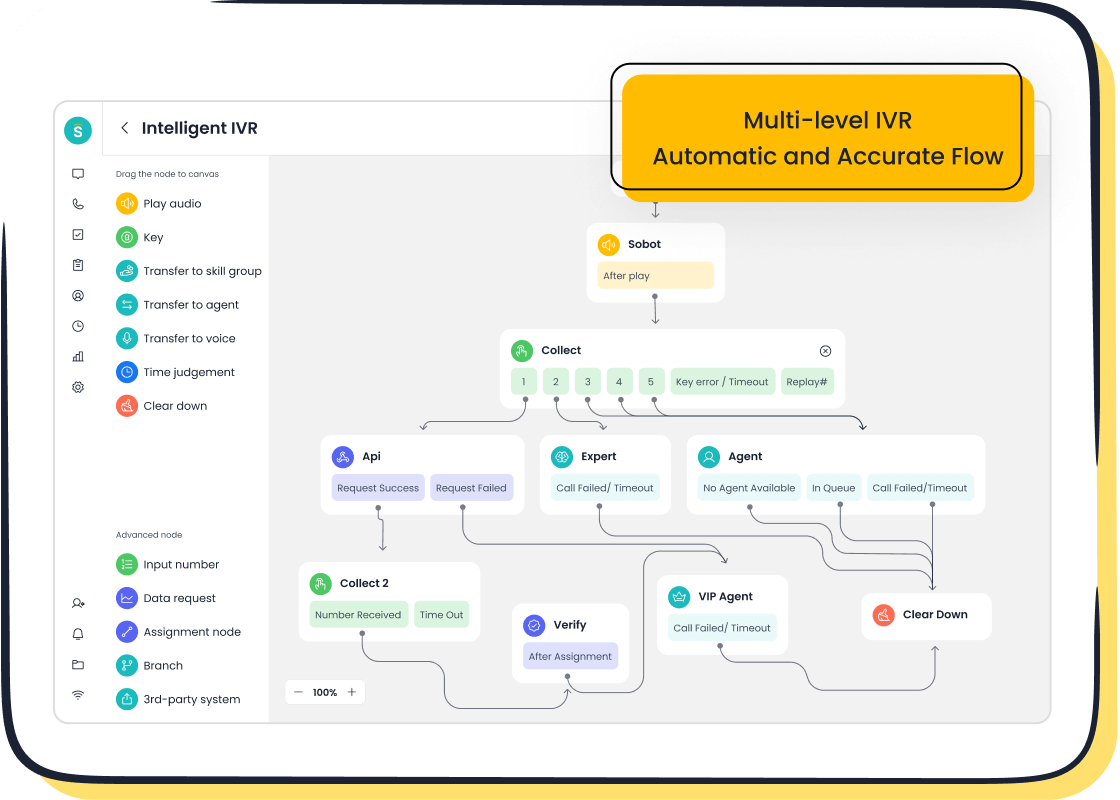
Once the IVR identifies a caller's need, the ACD system takes over. It intelligently routes the call to the best-suited agent based on rules you define. This can include:
- Skill-based routing: Connecting a customer with a technical question to an agent with product expertise.
- Language-based routing: Sending a Spanish-speaking caller to a fluent agent.
- Priority-based routing: Moving a VIP customer to the front of the queue.
Effective skill-based routing dramatically improves efficiency. A modern ACD system can reduce average wait times by 42% and decrease call abandonment by 35%. By implementing smart, rule-based skill-based routing, you ensure every customer connects with the right person on the first try.
Proactive Outbound Engagement
Modern customer support is not just about reacting to problems. Proactive outbound engagement allows you to connect with customers before they even need to reach out. You can use this capability for appointment reminders, service updates, satisfaction surveys, or promotional offers. This simple call center phone system features transforms your call center from a cost center into a value-driving engine.
Automating these outbound tasks saves your team valuable time and improves the customer experience. For example, a dental clinic that implemented an automated reminder system saw incredible results.
| Metric | Before Implementation | After Implementation |
|---|---|---|
| No-Show Rate | 30% | 15% |
| Client Satisfaction Score | 75% | 92% |
| Appointment Confirmations | 70% | 85% |
Platforms like Sobot's Voice/Call Center include features for creating and managing bulk outbound tasks, making it easy to assign leads or reminders to agents based on priority and service level agreements (SLAs).
Cloud-Native Infrastructure
The days of housing massive, expensive servers on-site are over. A cloud-native infrastructure is essential for any modern call center. Cloud-based call center systems offer unmatched flexibility, scalability, and cost-efficiency compared to traditional on-premise solutions. You no longer need to worry about upfront hardware investments or paying an IT team for constant maintenance.
The financial benefits are clear. Large call centers have reported 43% in operational cost savings after moving to the cloud. With a subscription model, your costs are predictable, and the vendor handles all the maintenance and updates.
Tip: Stability is the most important feature of a cloud platform. Even a few minutes of downtime during peak hours can damage customer trust.
The industry standard for uptime is 99.99%, which allows for only 4.5 minutes of downtime per month. This is why Sobot guarantees a 99.99% uptime SLA for its Voice/Call Center, ensuring your operation remains stable and accessible when your customers need you most.
Global Number Availability
If your business serves customers in different countries, providing local and toll-free numbers is crucial for building trust and encouraging contact. Customers are far more likely to call a number they recognize. In fact, a global study found that companies using a mix of toll-free and local numbers achieved a 19% higher average customer satisfaction score.
Different numbers serve different psychological purposes.
| Psychological Cue | Local Number | Toll-Free Number |
|---|---|---|
| Initial Emotional Response | Familiar, relatable, often tied to community | Professional, established, associated with national presence |
| Trust Signal | High in local service contexts or known area codes | High in industries like finance, healthcare, or customer support |
| Spam Association (Perception) | Lower—perceived as more personal | Higher if unsolicited, but expected from recognized brands |
One business owner shared a powerful story about this effect.
Matt Bowman, Founder of Thrive Local, shared an experience where a client struggling with cold calls using an 800 number saw their answer rates double within two weeks after switching to local Phoenix numbers, using the same script and team.
A comprehensive contact center software solution should give you access to numbers worldwide. Sobot's Voice/Call Center provides global number availability, allowing you to establish a local presence anywhere and manage all your customer interactions from a single platform. This is one of the most effective call center features for global expansion.
Essential Call Center Tools for Agent Productivity

A great customer experience begins with a great employee experience (EX). When your agents are frustrated with clunky, inefficient systems, that frustration inevitably spills over into their customer interactions. Equipping your team with the right call center tools is one of the most direct ways to boost both productivity and morale. Highly productive agents save money by resolving issues efficiently, which inspires customer loyalty and improves the overall customer experience. These essential call center features empower your team to deliver exceptional service.
Unified Agent Desktop
Your agents shouldn't have to juggle a dozen browser tabs to help one customer. A unified agent desktop is a single-interface solution that eliminates this chaos. It consolidates all communication channels, customer history from your CRM, and support tools into one clean workspace.
A unified agent desktop, like Sobot’s Unified Workspace, gives your team a complete view of every customer interaction. This allows them to focus on the customer, not on fighting with technology. The results are powerful:
- Reductions in Average Handle Time (AHT) by 10% to 70%.
- Higher agent satisfaction and lower turnover.
As one manager noted after implementing a unified interface, “Our agents have reported increased satisfaction... They feel really empowered by having information at their fingertips.”
AI-Powered Agent Assist
Imagine giving every customer service agent a personal coach who provides answers and guidance during a live interaction. That’s the power of AI-powered agent assist. This technology uses AI to listen to conversations in real-time and suggest relevant knowledge base articles, provide compliance checklists, or offer next-best-action recommendations. Over 50% of early adopters are already using generative AI to support agents in real-time, making it a fast-growing capability. This AI support helps agents resolve issues faster and more accurately.
Integrated Workforce Management (WFM)
Effective workforce management ensures you have the right number of agents with the right skills working at the right times. Integrated WFM software automates this complex process. It uses advanced algorithms and historical data from your CRM integrations to create highly accurate forecasts for call volume. This level of automation helps you avoid both understaffing and overstaffing. Proper staffing can dramatically reduce unbudgeted overtime costs, with some companies saving hundreds of thousands of dollars annually.
Gamification & Performance Dashboards
Turning work into a game can have a massive impact on motivation and performance. Gamification features use leaderboards, badges, and friendly competition to make achieving KPIs more engaging. The data is clear: 90% of employees report that gamification makes them more productive. These call center tools, combined with real-time performance dashboards, give agents immediate feedback on their progress, fostering a culture of continuous improvement and boosting key metrics.
Automated Call Disposition
After every interaction, agents must log notes and categorize the call—a repetitive but necessary task. Automated call disposition uses automation to handle this for them. The system can automatically tag calls based on keywords from the conversation or the outcome of the interaction. This small feature saves a few minutes after every call, which adds up to significant time savings across your team and improves the accuracy of your reporting and analytics.
AI-Driven Features for a Better Customer Experience
While a strong foundation and productive agents are crucial, AI-driven features are what will set your contact center apart. AI is no longer a futuristic concept; it is a practical tool that delivers a significant return on investment. The global contact center market is projected to grow at a rate of 24% annually, reaching a value of $148 billion by 2030. This growth is fueled by AI.
This shift means traditional metrics like Average Handle Time (AHT) are evolving. When AI handles simple queries, your agents are left with more complex issues, which can increase AHT. Therefore, you need to focus on new metrics that measure AI's true impact, such as intent recognition accuracy and AI resolution rates. These AI-powered call center features help you understand your customers on a deeper level and dramatically improve the customer experience.
Real-Time Speech & Text Analytics
Imagine knowing exactly how a customer feels during a live interaction. Real-time speech and text analytics makes this possible. This technology analyzes conversations as they happen, detecting keywords, tone, and sentiment. It gives your agents instant feedback and coaching, helping them turn a negative experience into a positive one.
Real-time analytics helps you reduce customer churn by:
- Detecting Dissatisfaction: The system can identify early signs of frustration or confusion in a customer's voice, alerting the agent to change their approach.
- Providing On-the-Spot Guidance: AI can suggest helpful knowledge base articles or next steps, empowering agents to resolve issues faster.
- Ensuring Compliance: Real-time monitoring helps agents follow required scripts and legal disclaimers.
Many businesses have used analytics to uncover critical pain points. For example, the utility company Watercare used text analytics to learn that customers were more upset about poor communication than actual service failures. This insight helped them improve proactive updates and reduce complaints. This kind of real-time monitoring is essential for a great customer experience.
Predictive Behavior Analysis
What if you could anticipate what your customers need before they even ask? Predictive behavior analysis uses AI to forecast future customer actions. By analyzing past interactions, purchase history, and browsing habits, you can identify which customers are likely to buy, which are at risk of leaving, and what they might need next.
This technology works by using powerful modeling techniques:
- Behavioral Segmentation: AI groups customers with similar behaviors, allowing you to create highly targeted campaigns.
- Predictive Modeling: Algorithms like decision trees and neural networks process historical data to predict future outcomes, such as a customer's lifetime value or their likelihood to churn.
- Purchase Propensity Modeling: The AI scores customers based on their probability to make a purchase, helping your sales team focus on the most promising leads.
By using predictive analytics, you can identify churn risk factors like declining engagement or negative sentiment. This allows you to build a churn prediction model and launch personalized retention campaigns to keep your valuable customers. This proactive approach to customer interaction is a hallmark of modern customer support.
Automated Quality Management
Manually reviewing calls for quality assurance is time-consuming and inefficient. Most teams can only listen to 1-3% of all interactions, leaving a massive gap in performance oversight. Automated Quality Management (AQM) solves this problem by using AI to analyze 100% of your customer interactions.
This comprehensive analysis provides unbiased, data-driven insights into agent performance. The automation scores every interaction against your predefined criteria, such as script adherence, politeness, and problem resolution. This gives you a complete picture of your team's strengths and weaknesses.
Case Study Spotlight: Weee! America's largest online Asian supermarket, Weee!, needed to improve its customer service operations. By implementing Sobot's AI-powered voice solution, they were able to analyze interactions more effectively. This automation contributed to a 20% increase in agent efficiency and a 50% reduction in resolution time, showing the direct impact of smart call center tools on performance.
Customer Journey Mapping
A customer journey map visually represents every touchpoint a customer has with your brand. However, static maps quickly become outdated. AI-powered customer journey mapping tools create dynamic, real-time maps that evolve with every customer interaction.
These tools pull data from your CRM, website analytics, and call center to show you exactly how customers are moving between channels. You can see where they encounter friction, where they drop off, and what paths lead to the best outcomes. This level of insight is invaluable for optimizing the customer experience. For example, you might discover that customers who watch a video tutorial are 40% less likely to call for support on that topic. You can then use this information to promote your video content more effectively. This is one of the most strategic call center analytics features you can adopt.
Voice of the Customer (VoC) Analytics
Your customers are constantly giving you feedback through calls, chats, surveys, and reviews. Voice of the Customer (VoC) analytics uses AI, particularly Natural Language Processing (NLP), to gather and analyze this feedback from all channels. It helps you understand what customers are saying at scale, identify trends, and pinpoint root causes of dissatisfaction.
Leading companies use VoC analytics to drive major improvements.
| Company | How They Used VoC Analytics | The Result |
|---|---|---|
| Amazon | AI-native recommendation engine | Increased customer satisfaction and boosted annual revenue. |
| H&M | AI-powered chatbots for feedback | Reduced response times and lowered operational costs. |
| Cisco | AI platform for B2B feedback | Enhanced loyalty through proactive customer service. |
By implementing a strong VoC program, you can move from reacting to problems to proactively improving your products and services. The success of Weee! underscores this point. Their focus on improving the customer experience, guided by insights from their new call center features, led to an incredible 96% customer satisfaction score. This proves that listening to your customers with the right AI tools delivers measurable results in satisfaction and loyalty.
Achieving peak performance requires more than just one of these features. You must integrate all 15 call center capabilities into a cohesive ecosystem like the Sobot Omnichannel Solution. This strategy builds a strong foundation, empowers each customer service agent with AI, and uses AI analytics to improve customer satisfaction. These AI features help you understand every customer. See how this can boost your team's performance.
🚀 Embark on Your Contact Journey Ready to see these capabilities in action? Contact us at
marketing@sobot.ioto learn more.
FAQ
How do I know which call center features to start with?
Start by evaluating your biggest challenges. If you have long wait times, focus on IVR and ACD. If your agents seem overwhelmed, a unified desktop is a great first step. A good plan addresses your most urgent needs first to deliver quick value to your team and every customer.
Can small businesses benefit from these advanced capabilities?
Yes, absolutely. Cloud-based solutions like Sobot make these tools affordable and scalable. You can start with foundational features and add more advanced capabilities as your business grows. This allows you to improve the customer experience without a large upfront investment.
How long does it take to implement a new call center system?
Implementation time varies, but modern cloud platforms are designed for speed. With a solution like Sobot's Voice/Call Center, you can get foundational features running quickly. The drag-and-drop interfaces and simple integrations help you see results in weeks, not months.
See Also
Optimizing Call Center Excellence: Essential Quality Management Strategies
Elevate Call Center Performance Through Effective Monitoring Techniques
Discovering Key Features of Leading CRM Software for Call Centers
The 10 Best Call Center Analytics Software Solutions for 2024
A Comprehensive Guide to Quality Management System Principles for Call Centers

