Picture this: A customer chats with your bot in the morning, calls your support line in the afternoon, and sends a follow-up email before dinner — fully expecting every agent along the way to already know the story.
This is no longer an edge case. It’s daily reality.
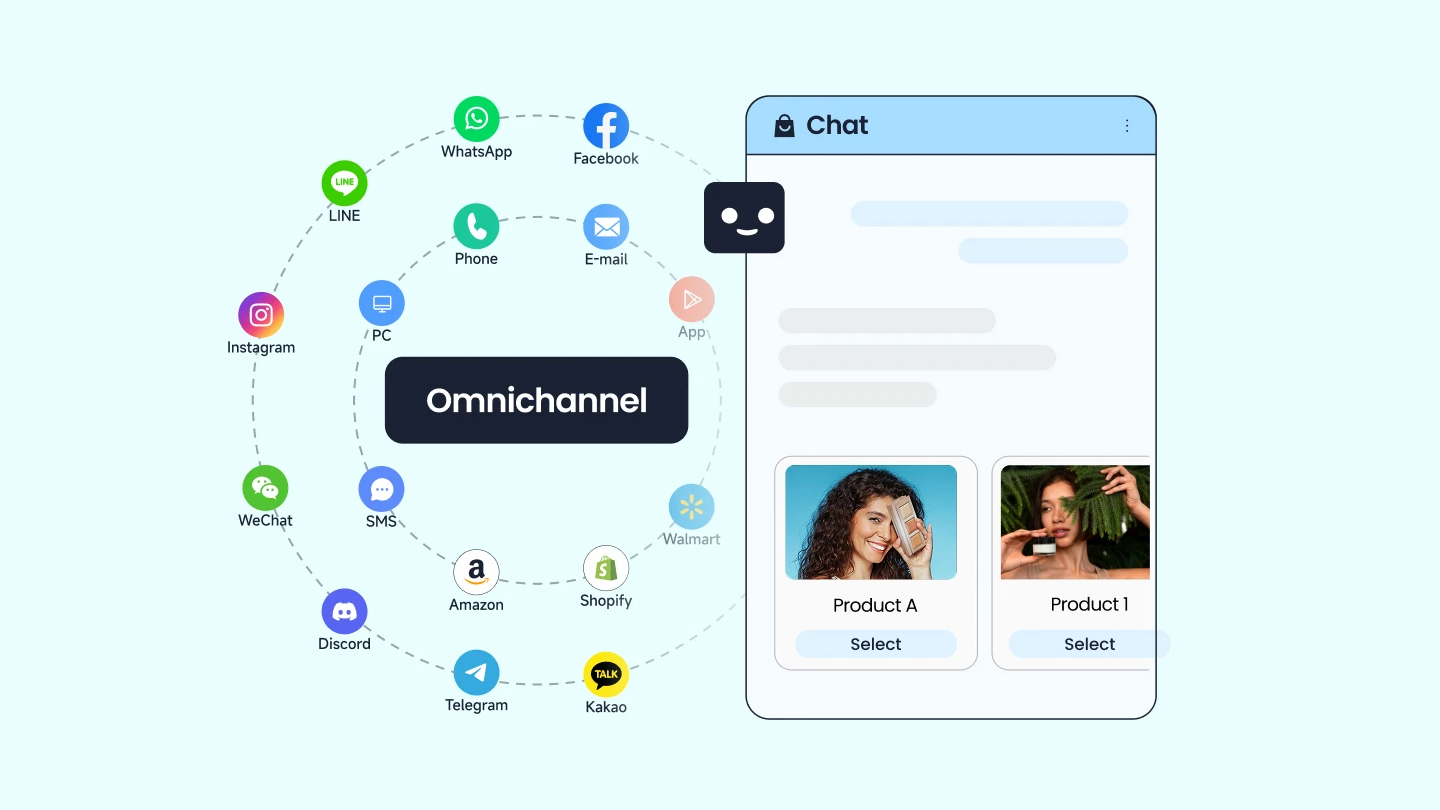
Customer expectations have evolved well beyond “quick replies”. Today’s consumers demand continuous, connected experiences across channels. Omnichannel customer support is no longer a competitive advantage; it has become the baseline and foundational infrastructure.
A robust omnichannel platform unifies customer data, synchronizes conversations, and enables AI and human agents to collaborate within a single system. The result: lower operational costs, faster resolution times, higher CSAT, stronger retention, and measurable revenue impact through consistent experiences across every touchpoint.
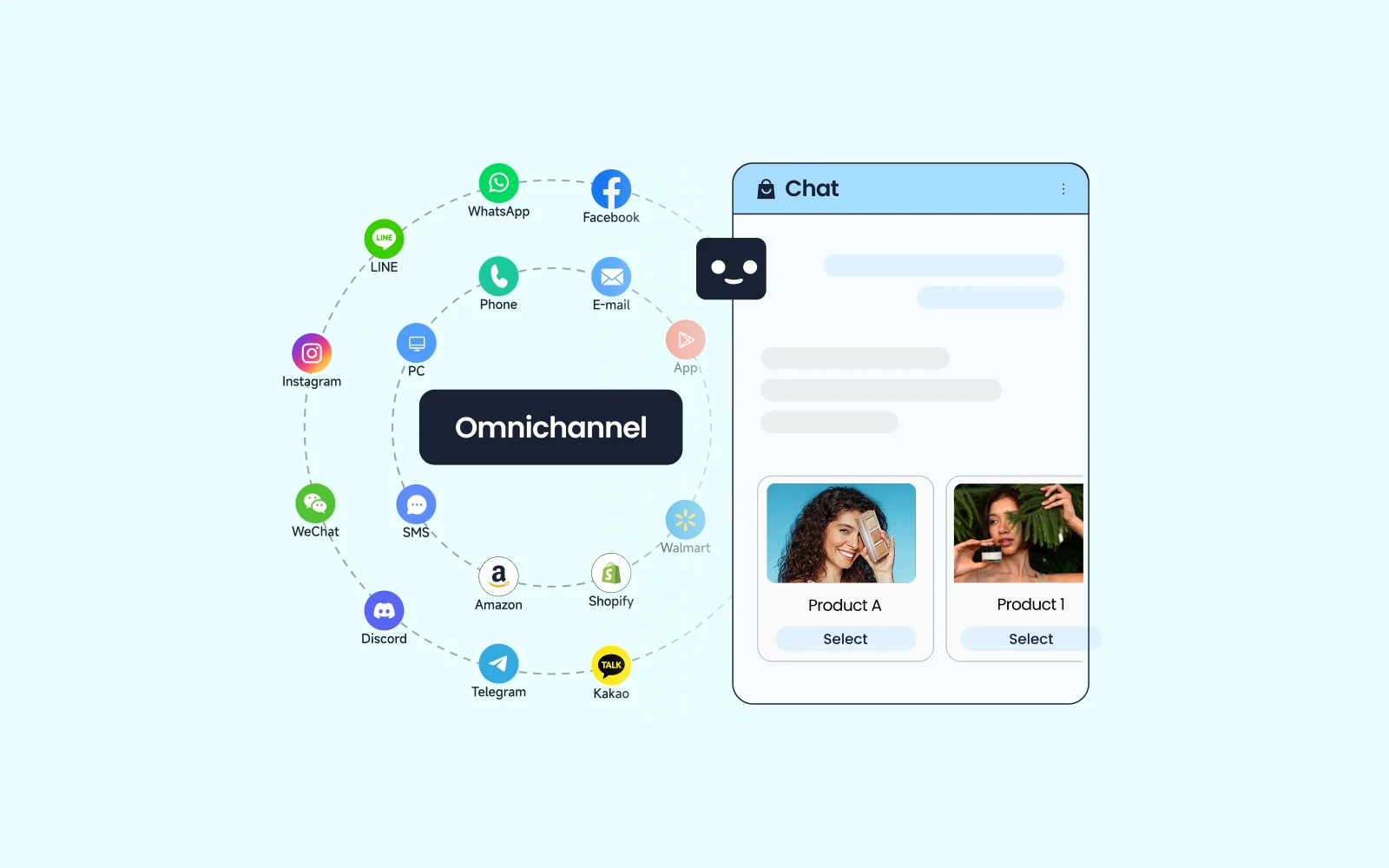
But with dozens of omnichannel tools claiming similar capabilities, how do you determine which one truly fits your business best?
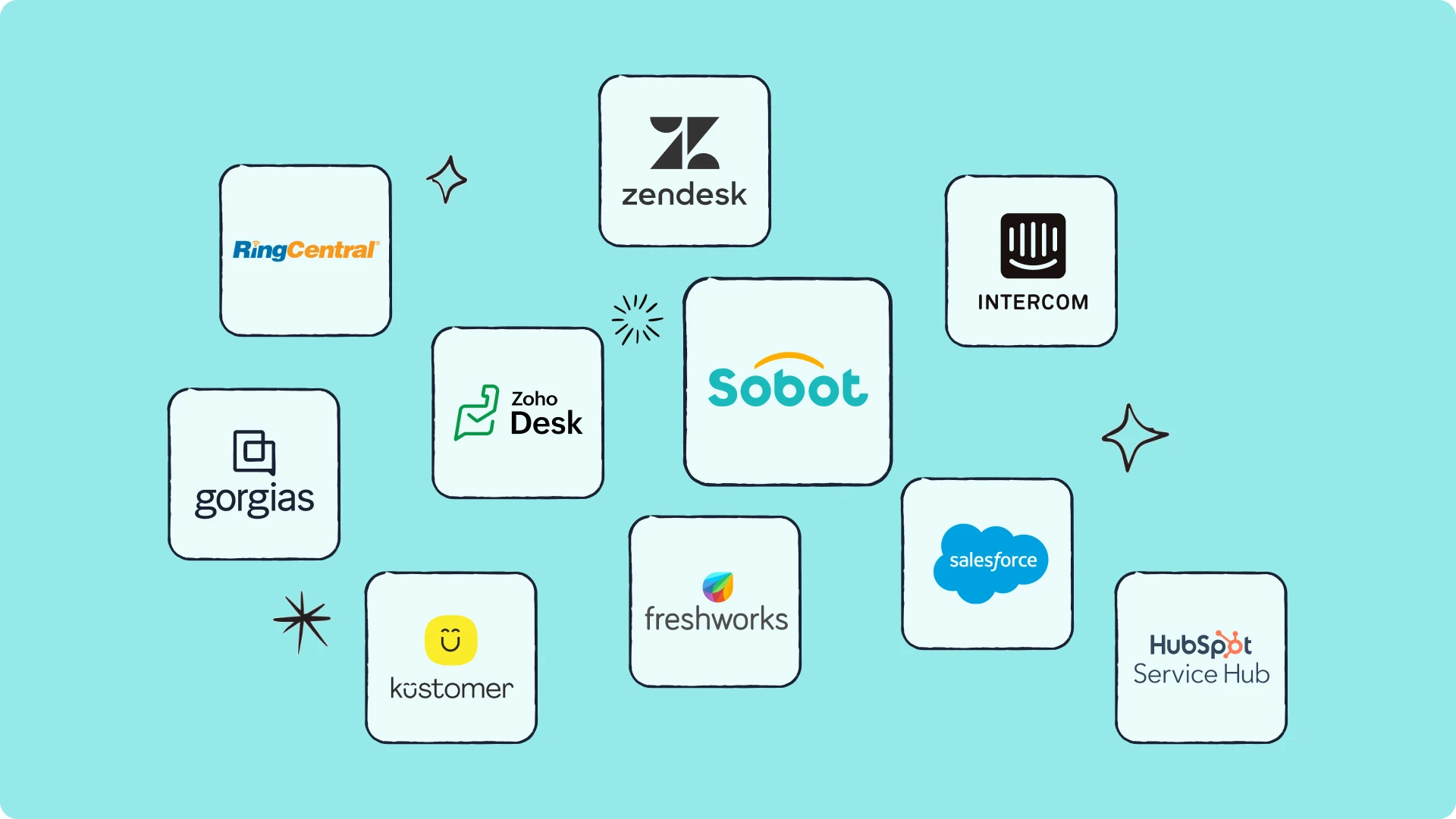
That’s exactly what this guide is for. It explains why omnichannel customer support matters in 2026 and provides a structured evaluation of 10 leading platforms — including Sobot, Zendesk, and others — so you can make a confident, future-proof decision.
Customer Support Trends Defining 2026
AI is Taking on a Much Bigger Role in Customer Support
Modern AI agents in customer service do far more than just answering FAQs. They can:
- Recognize customers’ intent and context
- Retrieve valuable information from multiple systems
- Trigger workflows automatically without any human intervention
- Resolve repetitive tickets independently at scale
According to McKinsey & Company, generative AI can automate 60–70% of repetitive work, which directly reduces operational costs in customer support.
The Demand for Unified Customer Context is Increasing
Unlike agents who used to classify customers based on “channels” they come from, customers are more likely to think in “conversations”. Research from Zendesk indicates that customers use an average of five channels to contact support. And they are expecting agents to get the context and understand them immediately without repeating their demands.
Channel Convergence Has Become the Standard
Modern customer support platforms should go far beyond a single function. Based on how customers actually reach out today, that means coverage across:
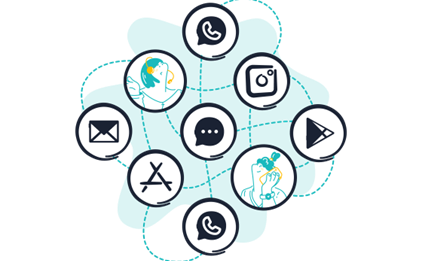
- Live chat
- Social media messaging
- Voice
According to a Gartner report, businesses leveraging analytics and automation across both voice and digital channels can achieve significant efficiency improvements, including up to a 25% improvement in resource allocation and reduced handling times.
Support Acts as a Revenue Driver
Support isn’t just a cost center anymore — it’s a growth lever. PwC reports that 32% of customers would stop buying from a brand they love after one bad experience, underscoring support’s strategic importance. In 2026, customer support is evolving beyond traditional metrics like ticket resolution or response times. Support teams are increasingly recognized as a strategic part of the business, influencing customer satisfaction, retention, and overall revenue. Modern platforms enable support to contribute directly to long-term customer relationships, turning what was once seen as a cost center into a value-generating function.
Why Omnichannel is Business-Critical
As customers no longer interact with businesses in a single channel, they expect the entire conversation history to remain intact. That’s why omnichannel customer support has become business-critical. It determines whether customer experience and interactions are unified or fragmented.
When support channels operate in silos:
- Customer data is stored in separate systems
- Agents cannot access complete interaction history
- Customers must repeat information
- Resolution time becomes longer
- Reporting lacks cross-channel visibility
When support is managed through an integrated omnichannel system:
- Customer data is centralized in one platform
- Agents see full conversation history across channels
- Customers receive consistent responses
- Resolution time becomes shorter
- Reporting provides unified performance insights
This difference affects more than service quality. It influences retention, operational cost, and the effectiveness of AI-driven automation.
How We Evaluate the Top Tools
Usually, we assess omnichannel customer support platforms from 6 perspectives:
- Channel Coverage – Number and type of supported touchpoints
- AI & Automation – Depth of intelligence and workflow capabilities
- Integration Ecosystem – CRM, ecommerce, and third-party connectivity
- Analytics & Reporting – Insights and operational visibility
- Scalability – Global and high-volume suitability
- Implementation – Speed and complexity of deployment and running
These criteria significantly influence both businesses’ and customers’ experience during customer support, thus becoming critical factors when choosing a platform. Based on the 6 criteria, we recommend the top 10 platforms that perform well in omnichannel customer support.
Top 10 Omnichannel Customer Support Tools for 2026
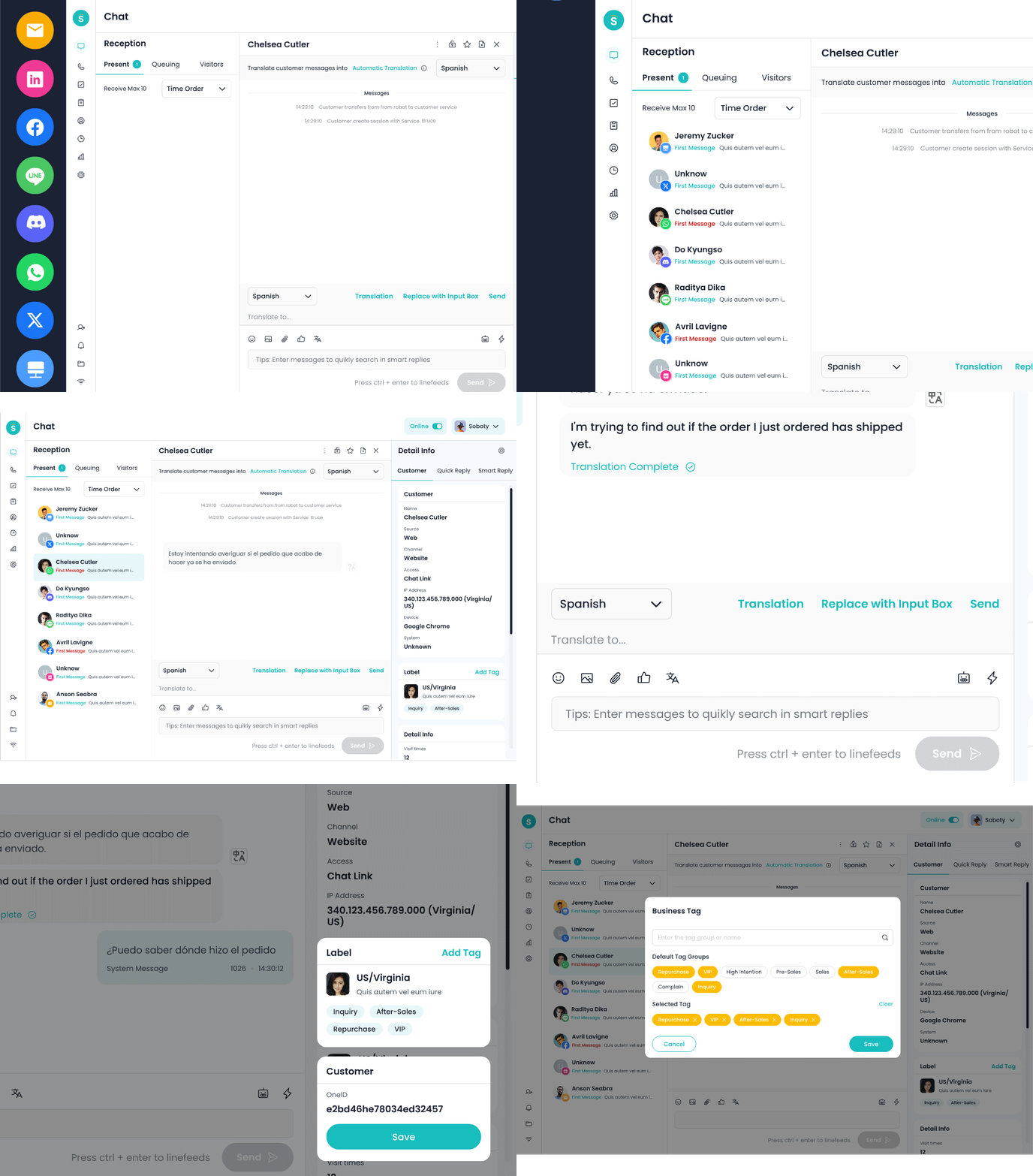
1. Sobot
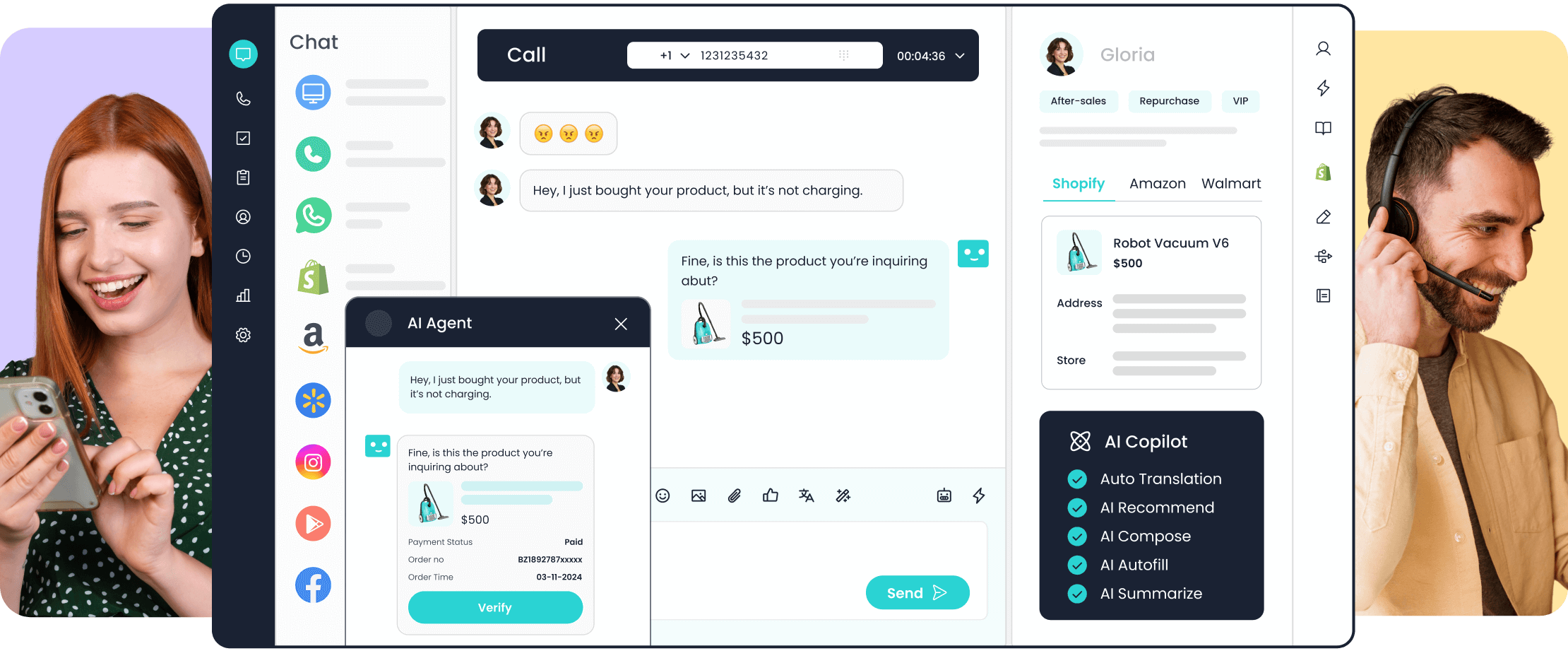
Overview: A fully integrated omnichannel platform combining live chat, AI agent (chatbot), voicebot, call center, ticketing, and WhatsApp Business API.
✅Strengths:
- AI-first approach: Sobot’s AI agents can handle repetitive tickets, triage complex requests, and provide instant recommendations to human agents. AI performance data from internal benchmarks shows that Sobot can automate up to 60% of standard support requests for ecommerce clients.
- All-in-one architecture: All modules are developed in-house, ensuring seamless data flow, consistent automation rules, and a single customer view. No reliance on third-party connectors reduces potential downtime or data mismatches.
- Cross-channel integrations: Native connectors for popular CRMs and ecommerce platforms, including Amazon, Walmart, Lazada and custom APIs. Agents can see the full customer journey in one interface.
- Scalability: Proven in global deployments, supporting thousands of simultaneous interactions in over 19+ languages.
⭕Limitation: Brand recognition in certain Western enterprise markets is still growing.
★Best Fit: Ecommerce brands and fast-growing enterprises looking for AI-first, all-in-one solutions and businesses of all sizes with customized needs.
2. Zendesk

Overview: Established platform used across industries globally.
✅Strengths:
- Broad omnichannel coverage including email, chat, social messaging, voice, and help center
- Large marketplace with hundreds of third-party integrations
- Advanced analytics and customizable dashboards for performance tracking
- AI-powered features such as automated triage, suggested replies, and bots
⭕Limitation: Advanced configurations, add-ons, and enterprise-grade features can significantly increase total cost of ownership. The features are too complicated for startups to use.
★Best Fit: Mid-sized and large-sized enterprises needing a customizable, widely-adopted solution with strong ecosystem support.
3. Freshdesk
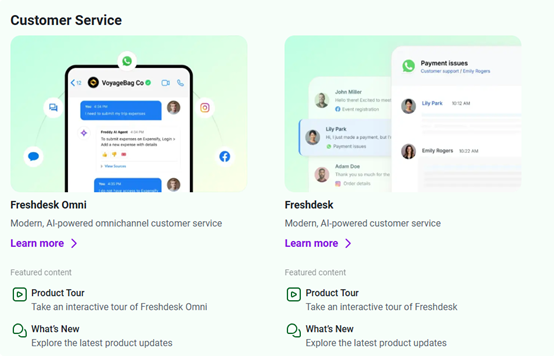
Overview: Cloud helpdesk focused on accessibility and structured workflows.
✅Strengths:
- User-friendly interface that supports fast onboarding
- Omnichannel support including email, chat, phone, and social
- Freddy AI for automated ticket categorization and response suggestions
- Strong SLA management and workflow automation tools
⭕Limitation: More advanced AI and analytics capabilities are limited to higher-tier plans. Some integrations with internal systems are complex, and support is not efficient enough.
★Best Fit: SMBs and growing teams transitioning from basic ticketing systems to structured omnichannel environments.
4. Intercom
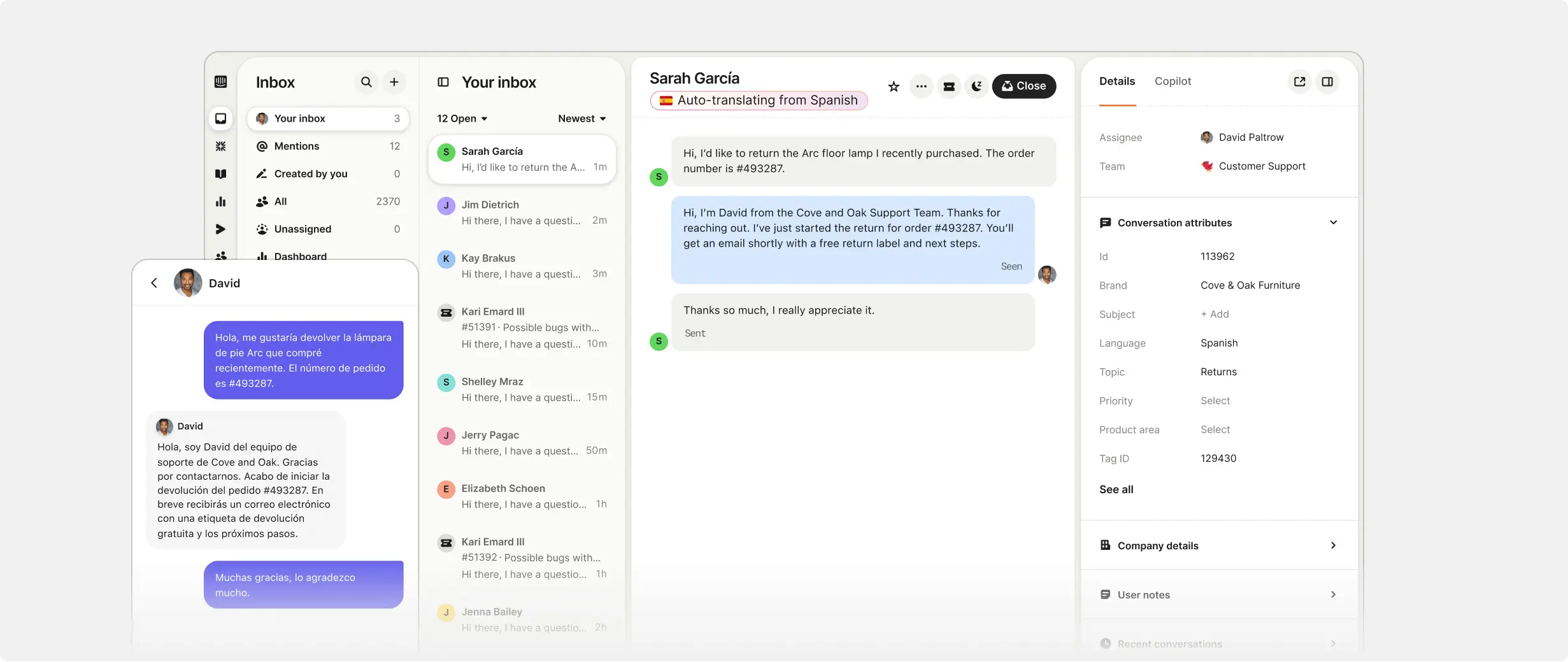
Overview: Conversational platform for chat-first engagement.
✅Strengths:
- Advanced AI chatbot capabilities for customer conversations and self-service
- Strong in-app messaging and proactive support campaigns
- Product-tour integration and user behavior tracking
- Designed for high-engagement SaaS and digital products
⭕Limitation: The system lacks flexibility, and its AI learning ability is limited. The reporting and analytics functions are not powerful enough.
★Best Fit: Product-led SaaS companies prioritizing real-time engagement and in-app support experiences.
5. Gorgias
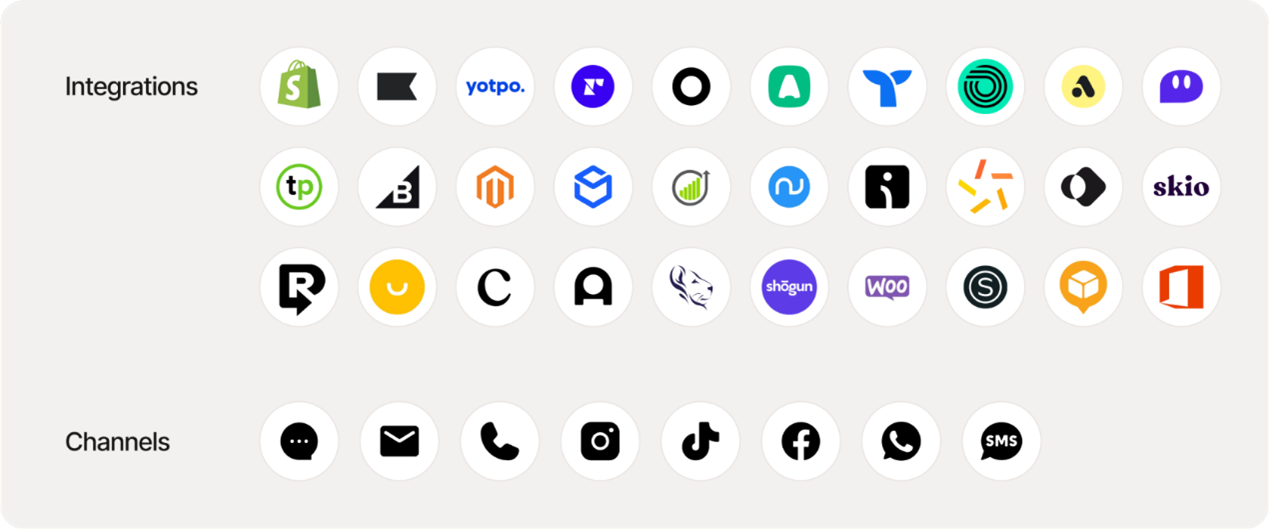
Overview: Ecommerce-focused helpdesk with Shopify and BigCommerce integrations.
✅Strengths:
- Deep ecommerce integrations enabling agents to edit orders, issue refunds, and manage subscriptions directly within tickets
- Automation rules tailored for common ecommerce scenarios
- Revenue attribution reporting that links support interactions to sales outcomes
- Strong alignment with Shopify ecosystem
⭕Limitation: Limited built-in voice capabilities and less suitable for complex B2B environments.
★Best Fit: DTC brands and Shopify-centric retailers seeking tight integration between support and order management.
6. Salesforce Service Cloud
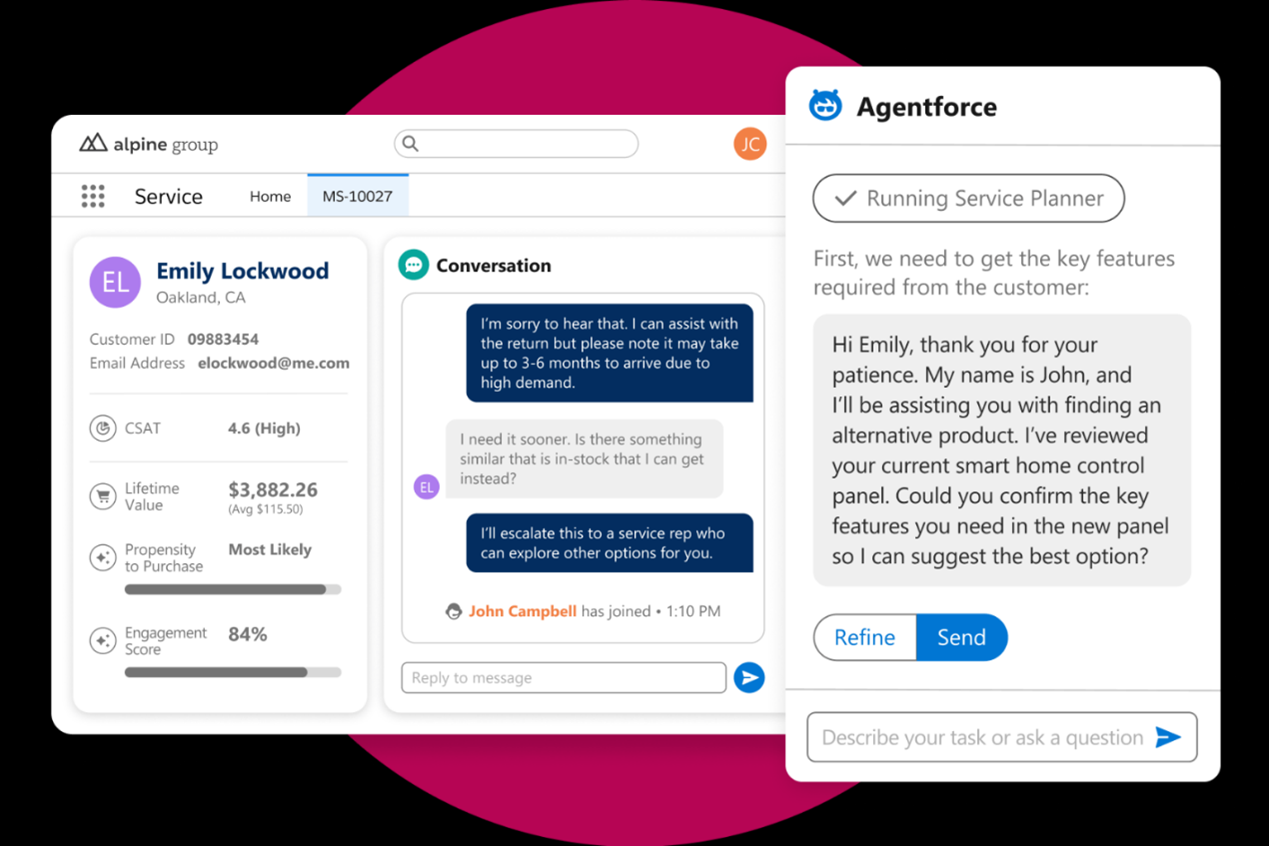
Overview: Enterprise-grade solution tightly integrated with Salesforce CRM.
✅Strengths:
- Unified customer data across sales, service, and marketing
- Advanced case management and workflow automation
- AI-powered Einstein features for predictions and recommendations
- Highly customizable for complex enterprise requirements
⭕Limitation: Implementation can be resource-intensive and may require certified administrators or consultants.
★Best Fit: Large enterprises already embedded in the Salesforce ecosystem that require deep customization and scalability.
7. HubSpot Service Hub
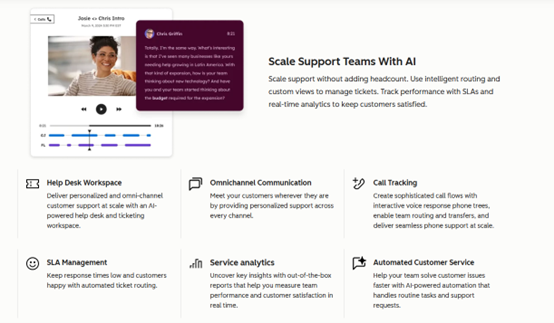
Overview: Service solution integrated within HubSpot CRM.
✅Strengths:
- Shared CRM database across marketing, sales, and support
- Ticketing, live chat, knowledge base, and automation tools
- Reporting aligned with lifecycle and revenue data
- Simple setup for teams already using HubSpot
⭕Limitation: Less robust in advanced contact center features such as complex voice routing.
★Best Fit: Growing businesses that want tight alignment between marketing, sales, and customer service operations.
8. Zoho Desk
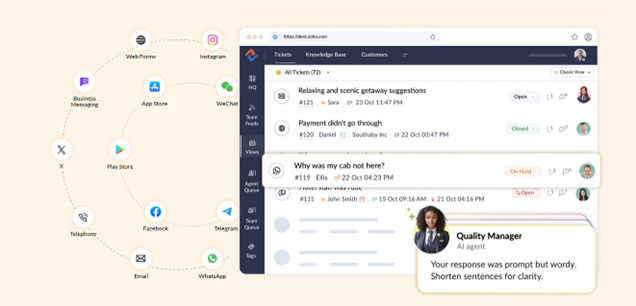
Overview: Cost-effective platform in Zoho ecosystem.
✅Strengths:
• Omnichannel support including email, chat, telephony, and social
• Context-aware ticketing with customer history visibility
• Strong integration within Zoho’s broader business suite
• Competitive pricing for small and mid-sized teams
⭕Limitation: May lack depth in advanced AI automation and enterprise-scale customization.
★Best Fit: SMBs or cost-conscious teams already operating within the Zoho ecosystem.
9. Kustomer
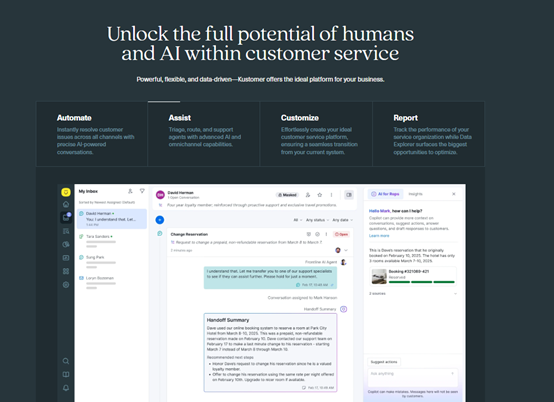
Overview: Conversation-centric platform with unified customer timeline.
✅Strengths:
- Single chronological timeline showing all interactions and transactions
- Omnichannel messaging including social and chat
- Workflow automation for case routing and tagging
- Designed for high-volume digital-first brands
⭕Limitation: Smaller marketplace compared to larger legacy vendors. The AI capabilities can’t meet customers’ expectations, and voice capabilities rely on third-party infrastructure.
★Best Fit: Retail and digital brands prioritizing contextual, conversation-driven support.
10. RingCentral Contact Center
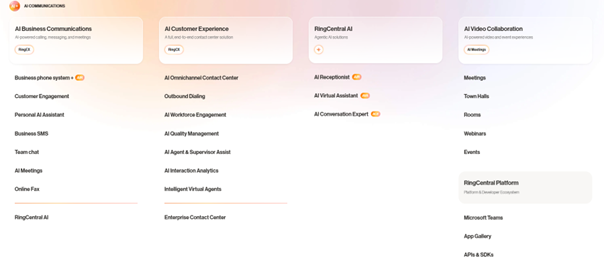
Overview: Cloud contact center with strong voice infrastructure.
✅Strengths:
- Enterprise-grade telephony and call routing
- Workforce management and performance monitoring tools
- Omnichannel routing across voice and digital channels
- High reliability for call-heavy operations
⭕Limitation: Digital messaging and AI automation may not be as central as voice capabilities.
★Best Fit: Organizations where voice remains the primary support channel and call performance is mission-critical.
Side-by-Side Comparison Table
| Platform | Channel Coverage | AI & Automation | Integration Ecosystem | Analytics & Reporting | Scalability | Implementation |
| Sobot | Live chat, chatbot, voice, email, social media | AI Chatbot, AI Agent, AI Copilot, AI Insight | CRM systems, ecommerce platforms, messaging channels | Real-time dashboards and reporting | Supports mid-size to large enterprises (as stated) | Cloud-based SaaS |
| Zendesk | Email, live chat, voice, social media, help center | AI agents, bots, automation workflows | 1,000+ marketplace integrations | Advanced analytics and reporting | Enterprise-grade scalability (as stated) | Cloud-based SaaS |
| Freshdesk | Email, live chat, phone, social media | Freddy AI (bot & assist), automation rules | Marketplace integrations | Reporting dashboards | SMB to enterprise plans | Cloud-based SaaS |
| Intercom | Messenger, email, help center, social integrations | Fin AI Agent, workflow automation | CRM, Stripe, Salesforce, Slack integrations | Reporting dashboards | Designed for scaling SaaS companies | Cloud-based SaaS |
| Gorgias | Email, live chat, social media, SMS | AI-powered responses, automation rules | Shopify, Magento, BigCommerce integrations | Ecommerce-focused analytics | Built for ecommerce brands (as stated) | Cloud-based SaaS |
| Salesforce Service Cloud | Phone, chat, email, social media | Einstein AI, workflow automation | Native Salesforce ecosystem integrations | Advanced analytics via Salesforce platform | Enterprise-level scalability | Cloud-based SaaS |
| HubSpot Service Hub | Email, live chat, help desk, knowledge base | AI email writer, chatbot builder | HubSpot CRM ecosystem integrations | Reporting dashboards | Best for HubSpot-based businesses | Cloud-based SaaS |
| Zoho Desk | Email, live chat, phone, social media | Zia AI assistant, automation rules | Zoho ecosystem integrations | Customizable analytics reports | SMB to mid-market focus | Cloud-based SaaS |
| Kustomer | Email, live chat, voice, messaging apps, social media | AI automation, intelligent routing | CRM and ecommerce integrations | Built-in analytics dashboards | Enterprise retail positioning | Cloud-based SaaS |
| RingCentral Contact Center | Voice, chat, email, social media, SMS | AI-powered virtual agents, automation | CRM integrations including Salesforce | Contact center analytics dashboards | Enterprise contact center solution | Cloud-based SaaS |
Omnichannel Tool Selection Decision Matrix
| Key Business Priority | Recommended Platforms |
| AI-driven automation & self-service | Sobot, Freshdesk, Intercom |
| Large-scale operations & high volume | Salesforce Service Cloud, Zendesk, RingCentral Contact Center |
| Multi-channel coverage & workflow consistency | Sobot, Zendesk, Salesforce Service Cloud |
| Ecommerce & order management integration | Sobot, Gorgias, Kustomer |
| SaaS / product-led engagement | Intercom, HubSpot Service Hub |
| Cost-effective SMB solution | Sobot, Zoho Desk, Freshdesk |
| Deep CRM & marketing integration | Salesforce Service Cloud, HubSpot Service Hub |
How to Choose Your Platform in 2026
❶ Start with your channel reality. Look at where you provide services and where your customers actually reach out. For example, messaging-heavy supports need a platform with strong capabilities in chat and WhatsApp, while voice-dominant customer bases need serious telephony depth.
❷ Define your AI ambition clearly. There’s a meaningful difference between AI that assists agents and AI that autonomously resolves tickets. Decide which direction your team is heading, then choose a platform designed to meet that long-term automation goal.
❸ Audit your current stack. The best platform in isolation is still a problem if it doesn’t integrate with your CRM, ecommerce tools, or other internal systems. So verify compatibility before you fall in love with a demo.
❹ Plan for Future Growth. Consider multi-language support, global compliance requirements, volume scalability, and AI expansion capabilities. The platform you choose today will be much harder to replace after using it for several years.
Conclusion
For businesses, the real competitiveness in 2026 comes from choosing an omnichannel customer support tool that unifies every channel into one consistent experience. Customers move freely between chat, email, voice, and social media, and they expect the conversation to continue without repetition.
A strong omnichannel platform connects these touchpoints through shared data, intelligent routing, and integrated AI support. When AI and human agents operate within one system, resolution becomes faster, context is never lost, and operational efficiency improves across the board.
The platform you choose today is more than a support tool—it is core customer experience infrastructure. Make sure it aligns with your growth plans, automation goals, and long-term service strategy.
FAQs
What is the difference between omnichannel and multichannel support?
Multichannel support allows customers to contact businesses through multiple channels, but those channels operate independently.
Omnichannel support integrates all channels into one unified system, ensuring:
- Shared customer history
- Consistent messaging
- Seamless channel switching
- Centralized reporting
The key difference is integration and continuity.
How does AI improve omnichannel customer support?
AI enhances omnichannel support through:
- AI chatbots for instant self-service
- AI agents for automated ticket handling
- AI copilot tools for agent assistance
- AI insights for performance analytics
This reduces manual workload, shortens resolution time, and improves first-contact resolution (FCR).
Which omnichannel tools are best for ecommerce?
For ecommerce brands, the top-rated choices are Sobot and Gorgias. Sobot is highlighted for its AI-first, all-in-one architecture that automates high volumes of requests across 19+ languages. Gorgias is specifically optimized for DTC brands using Shopify and BigCommerce, allowing agents to manage orders and refunds directly within the support ticket.