The Conversation That Should Never Happen
Picture this: You start a chat on a brand’s website asking about a product. The agent emails you a spec sheet. You reply to that email with a follow-up question. The next day, you call their support line and have to start from scratch, repeating everything to a new agent who has no idea what you’ve already discussed.
Frustrating? Absolutely. And completely unnecessary.
This broken experience happens because the company is using a multichannel setup, not a true omnichannel customer service platform. They have connected the doorways (chat, email, phone), but the rooms behind those doors remain siloed. Customer data does not flow between them.
In 2026, as artificial intelligence moves to the center of every customer service platform, this fragmentation comes with a steep price: AI is only as smart as the data it can access. Disconnected data means mediocre AI. And mediocre AI means frustrated customers and burned-out agents.
True omnichannel is no longer a nice to have. It is the foundation of AI-powered customer service.
This guide will first clarify what omnichannel actually means (and no, it is not what most vendors claim). Then we will take a deep, unbiased look at over 15 leading platforms from AI-native disruptors to enterprise giants to help you find the right customer care platform for your unique needs.
Part 1: Setting the Record Straight: What Omnichannel Really Means in 2026
1. Multichannel vs. Omnichannel: The Fundamental Difference
Many platforms claim to be omnichannel. Most are simply multichannel. Here is the distinction:
| Multichannel | Omnichannel | |
|---|---|---|
| Design Philosophy | Channel-centric | Customer-centric |
| Data Architecture | Siloed per channel; data does not sync automatically | Unified customer data layer; real-time synchronization |
| Customer Experience | Customers restart conversations on each channel | Seamless context follows customers across all channels |
| Agent Experience | Agents switch between multiple interfaces | Single workspace with complete customer history |
Multichannel means you have a presence on multiple channels: phone, email, chat, and social media. But those channels operate independently, like parallel information silos. An agent handling a phone call cannot see what happened in the chat yesterday.
True omnichannel means you have a unified customer data layer. Every interaction from every channel flows into a single customer profile. Whether a customer starts on social media, continues via email, and finishes with a phone call, every agent and every AI tool sees the complete, continuous history.
2. The Four Golden Standards of True Omnichannel
Drawing from the evaluation framework in industry research, a genuine omnichannel customer service platform must meet these four criteria:
1. Unified Customer Data Layer
Does the platform have a real-time, single source of truth for every customer? All interactions should feed directly into this model, not be stitched together after the fact.
2. Cross-Channel Interaction Continuity
Can a customer switch between channels seamlessly without repeating themselves? Does the context follow them from chat to email to phone?
3. Single AI Processing Layer
Does AI learn and act based on unified customer data? This means AI understands what a customer mentioned in an email and can offer proactive help in a chat, not operating in channel-specific bubbles.
4. Unified Agent Workspace
Do agents handle all channel interactions in a single interface with a 360-degree customer view? Or are they juggling multiple tabs and systems?
With these standards as our measuring stick, let us examine the leading omnichannel support platforms on the market in 2026.
Part 2: 2026 Omnichannel Platform Deep-Dive
We will group platforms by their architectural philosophy and market focus. Each has a different interpretation of omnichannel and serves different business needs.
| Platform | Cross-Channel Continuity | AI Depth | Unified Workspace | Best For |
|---|---|---|---|---|
| Sobot | ★★★★★ | ★★★★★ | ★★★★★ | AI ROI, high-volume mid-market |
| Kustomer | ★★★★★ | ★★★☆☆ | ★★★★★ | Personalized retail/DTC service |
| Intercom | ★★★☆☆ | ★★★★★ | ★★★★☆ | Digital-first SaaS companies |
| Zendesk | ★★★☆☆ | ★★★☆☆ | ★★★★☆ | Customization-dependent enterprises |
| Gorgias | ★★★★☆ | ★★★★☆ | ★★★★☆ | E-commerce, Shopify merchants |
| HubSpot | ★★★★☆ | ★★★☆☆ | ★★★★☆ | HubSpot ecosystem users |
| Salesforce | ★★★★★ | ★★★★☆ | ★★★★☆ | Salesforce-dependent large enterprises |
| Freshdesk | ★★★☆☆ | ★★★☆☆ | ★★★★☆ | Budget-conscious SMBs |
| Gladly | ★★★★★ | ★★★☆☆ | ★★★★★ | High-touch premium brands |
| Genesys/NICE | ★★★★★ | ★★★★☆ | ★★★★☆ | Regulated, high-reliability enterprises |
Category 1 AI-Native, True Omnichannel Leaders
These platforms were built from the ground up with unified data and AI at their core. They represent the gold standard for what an omnichannel messaging platform should be.
❶ Sobot
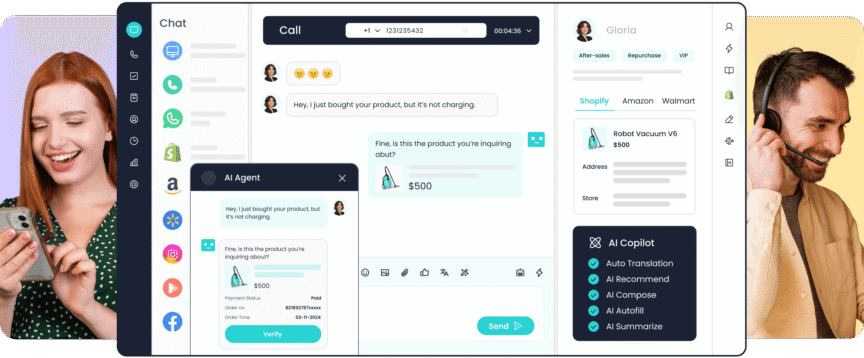
Sobot positions itself as an AI-native omnichannel customer service platform designed for high-volume, multi-channel support operations. Unlike traditional ticket systems that bolt on AI as an afterthought, Sobot was built around AI automation from day one.
🌐 Omnichannel Architecture
Sobot delivers a unified omnichannel platform that natively integrates online chat, ticketing, intelligent bots, call center capabilities, and knowledge base functionality. The platform converts all interactions from channels including web, mobile apps, WeChat, email, and voice into a unified ticket stream. This prevents businesses from switching between disparate systems and dealing with data fragmentation.
What sets Sobot apart is its unified data layer. All channels funnel into the same customer profile, and AI operates on this unified data. For example, if a customer interacts with a bot on the website and then escalates to a human agent, that agent sees the complete conversation history. If the same customer later calls, the IVR system can route them intelligently based on that prior context.
🤖 AI Capabilities
⭕ Pros & Cons
Pros
- Stronger AI automation than legacy platforms, significantly reducing agent workload
- True omnichannel with seamless online-voice integration and unified customer data
- Flexible and scalable for both enterprise and fast-growing companies
- Cost-efficient at scale with transparent pricing
Cons
- Global brand recognition in North America and Europe is still developing
- Third-party app ecosystem is narrower than established players like Zendesk
🎯 Best For
❷ Kustomer
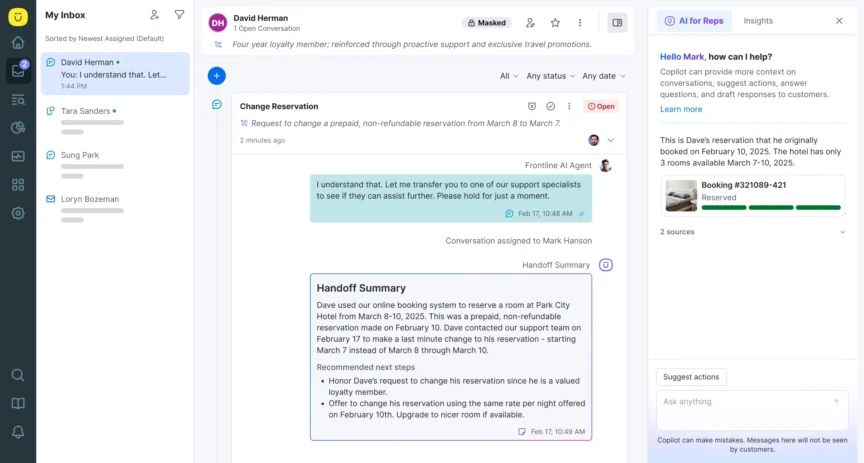
Kustomer takes a fundamentally different approach from traditional help desk software. Its core philosophy is customer-first, ticket-second, using a unified timeline to manage all support and CRM interactions.
🌐 Omnichannel Architecture
Kustomer organizes everything around a consolidated customer timeline. Every interaction from email, chat, social media, and phone feeds into a single chronological view. Agents do not see isolated tickets; they see a complete customer journey.
This architecture perfectly embodies the unified customer data layer and unified agent workspace standards. The platform includes native telephony, reducing reliance on third-party phone systems and ensuring voice interactions appear in the same timeline as digital ones.
🤖 AI Capabilities
⭕ Pros & Cons
Pros
- Crystal clear customer context; agents instantly see complete history
- User-friendly interface designed for brands prioritizing customer relationships
- Strong e-commerce and CRM integrations
- HIPAA-ready compliance features
Cons
- AI focuses on assistance rather than end-to-end automation
- Still requires manual configuration in complex scenarios
- Implementation requires dedicated effort
🎯 Best For
Retail, e-commerce, and DTC brands that prioritize personalized, high-touch customer relationships over pure automation volume.
Category 2 Conversational AI and Digital Experience Pioneers
These platforms excel in digital channels and have built world-class AI agents. However, their omnichannel coverage may have gaps, particularly in voice.
❸ Intercom
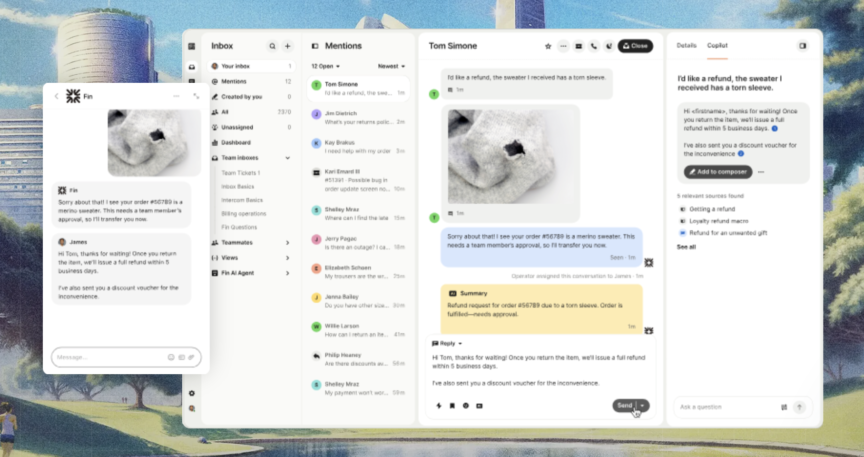
Intercom positions itself as an AI-first customer service platform that unifies customer engagement, support, and marketing through conversations. It is used by over 25,000 businesses globally and has built a strong reputation for digital-first support.
🌐 Omnichannel Architecture
Intercom excels in digital channels. Its unified inbox supports web, in-app, email, WhatsApp, and social media in a single view. The platform is designed around conversations rather than tickets, which feels natural for modern digital interactions.
However, there is a notable gap in its omnichannel coverage. Voice functionality exists as a separate module or paid add-on rather than a natively integrated feature. For businesses where phone support is mission-critical, this fragmentation matters.
🤖 AI Capabilities
⭕ Pros & Cons
Pros
- Powerful conversational AI that handles high volumes of repetitive queries
- Excellent user experience and fast deployment
- Blends marketing and support with proactive messaging and product tours
- Modern, flexible approach to help desk software
Cons
- Voice support is not natively integrated at the same depth as digital channels
- Weaker traditional ticketing for complex workflows with strict SLAs
- Complex pricing structure (base seat fee + usage-based AI costs) can escalate quickly
🎯 Best For
SaaS companies, internet businesses, and technology firms where digital channels dominate and AI automation is a top priority.
❹ Zendesk
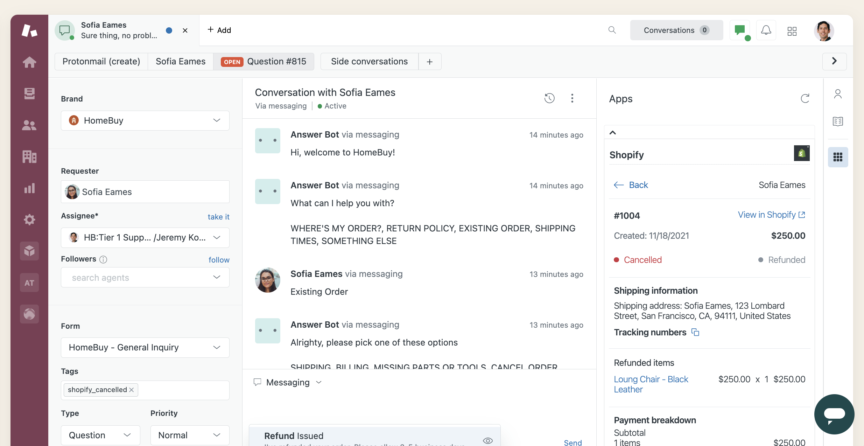
Zendesk remains the most recognized name in customer service platforms. As a pioneer in help desk software, it offers a comprehensive suite covering support, chat, voice, knowledge base, and analytics.
🌐 Omnichannel Architecture
Zendesk provides connections to multiple channels, but its architecture remains fundamentally ticket-centric rather than customer-centric. The platform offers multichannel support across email, phone, chat, and social media, but customer data can remain siloed across different modules.
Achieving true omnichannel with Zendesk is possible but requires significant customization. Companies with dedicated IT teams can build unified views through extensive API development and third-party integrations. This approach requires ongoing investment and maintenance.
🤖 AI Capabilities
⭕ Pros & Cons
Pros
- Broad functionality suitable for complex workflows in large organizations
- Mature ecosystem with access to over 1,000 third-party integrations
- Enterprise-grade security and compliance certifications
- Extensive documentation and training resources
Cons
- Traditional architecture makes true omnichannel difficult without customization
- AI assists agents rather than autonomously resolving issues
- Modular pricing leads to rapidly escalating costs
- High configuration and maintenance costs require dedicated administrators
🎯 Best For
Large enterprises with ample budgets, complex operations, dedicated IT teams, and needs for extreme scalability and compliance.
Category 3 Ecosystem-Driven and Vertical Specialists
These platforms achieve deep omnichannel integration within specific business ecosystems or verticals. Their data unification may be limited to their niche but is exceptionally deep within it.
❺ Gorgias
Gorgias is built specifically for e-commerce merchants, with deep integration into platforms like Shopify. It focuses on the common service scenarios that online retailers face every day.
🌐 Omnichannel Architecture
Gorgias achieves true omnichannel within the e-commerce context. It deeply integrates with Shopify to pull order data, customer information, and product details directly into the support interface. This is combined with messages from email, social media, and chat.
When an agent responds to a customer inquiry, they can see complete order history, process refunds, or handle exchanges without leaving the Gorgias interface. This represents vertical-specific omnichannel at its best: business data and communication data unified in one place.
🤖 AI Capabilities
⭕ Pros & Cons
Pros
- Streamlined support for order-related inquiries
- Easy for e-commerce teams to adopt and use
- Reduces repetitive work for common transactional questions
- Deep Shopify integration that actually works
Cons
- Narrow applicability outside e-commerce contexts
- AI capabilities focused mainly on order-centric automation
- Limited unified customer view in complex cross-channel scenarios beyond e-commerce
🎯 Best For
Shopify merchants and e-commerce brands looking to streamline order-related customer service.
❻ HubSpot Service Hub
HubSpot Service Hub is the customer service module within the broader HubSpot CRM ecosystem. It is designed for companies already using HubSpot for marketing and sales.
🌐 Omnichannel Architecture
For companies already invested in HubSpot, Service Hub offers seamless data flow. Every service interaction connects directly to the customer’s CRM profile, creating a closed loop between marketing, sales, and service data.
However, the platform focuses primarily on ticket management and knowledge base functionality. It may lack the depth needed for high-volume, multi-channel operations with complex routing requirements. The omnichannel experience is excellent within the HubSpot ecosystem but limited outside it.
🤖 AI Capabilities
⭕ Pros & Cons
Pros
- Smooth data flow for existing HubSpot users
- Consistent user interface across marketing, sales, and service
- Low learning curve for teams already in the ecosystem
- Affordable entry point
Cons
- Not designed for high-volume, complex support operations
- Limited advanced AI automation
- Less capable for complex multi-line operations
- Multichannel integration depth is limited
🎯 Best For
Small to medium businesses already using HubSpot for marketing and sales who need basic, integrated service capabilities.
❼ Salesforce Service Cloud
Salesforce Service Cloud represents the enterprise standard for CRM-integrated customer service. It sits within the broader Salesforce ecosystem and offers unparalleled depth for complex organizations.
🌐 Omnichannel Architecture
Service Cloud’s greatest strength is its integration with Salesforce Sales Cloud and other Salesforce products. It can build extraordinarily complex 360-degree customer views, connecting service data with sales opportunities and marketing campaigns.
The platform includes Omni-Channel functionality for routing work across phone, email, chat, and social media. However, this power comes with significant complexity. Implementation typically requires specialized Salesforce consultants, and achieving true omnichannel often means extensive customization.
🤖 AI Capabilities
⭕ Pros & Cons
Pros
- Unmatched depth for companies already in the Salesforce ecosystem
- Extremely powerful customization capabilities
- Enterprise-grade everything: security, compliance, scalability
- Deep integration with sales and marketing data
Cons
- Extraordinary complexity requires specialized expertise
- Very high total cost of ownership
- Implementation takes months, not weeks
- Steep learning curve for agents and administrators
🎯 Best For
Large enterprises already heavily invested in Salesforce who need to connect service deeply with sales and marketing and have the budget and expertise to manage complex implementations.
Category 4 Value-Oriented and Usability-Focused Platforms
These platforms target small to medium businesses with affordable pricing and easy learning curves. They may not offer the deepest omnichannel capabilities, but they provide excellent entry points.
❽ Freshdesk
Freshdesk is a cloud-based ticketing system from Freshworks that emphasizes rapid deployment and ease of use. It has become a popular choice for SMBs and startups.
🌐 Omnichannel Architecture
Freshdesk provides multichannel support for email, chat, phone, and social media. Everything generates tickets that agents can manage in a unified interface. However, the platform remains ticket-centric rather than customer-centric, and the level of data unification is not as deep as AI-native platforms.
For businesses with relatively simple operations and limited budgets, Freshdesk offers a solid foundation. It may require upgrading or replacing as complexity grows.
🤖 AI Capabilities
⭕ Pros & Cons
Pros
- Fast setup with low learning curve
- Affordable pricing with a usable free plan
- Good support for standardized workflows
- Excellent user experience
Cons
- Still fundamentally multichannel, not fully unified omnichannel
- Basic AI that mainly assists agents
- Limited scalability for high-volume, complex operations
🎯 Best For
Startups and small to medium businesses with limited budgets who need to establish professional customer service operations quickly.
❾ Zoho Desk
Zoho Desk is the customer service module within the broader Zoho ecosystem. It offers affordable, integrated service for companies using Zoho applications.
🌐 Omnichannel Architecture
Like HubSpot and Salesforce, Zoho Desk’s value comes from its integration with Zoho CRM and other Zoho apps. For companies already in the Zoho ecosystem, it provides a low-cost, data-consistent service solution.
The platform supports multiple channels but does not offer the deepest unified customer views or most advanced automation. It is a solid, practical choice for its target market.
🤖 AI Capabilities
⭕ Pros & Cons
Pros
- Seamless integration with Zoho ecosystem
- Very affordable pricing
- Low learning curve for existing Zoho users
- Solid basic functionality
Cons
- Less recognized as a dedicated service platform
- AI and automation capabilities are basic
- Limited to Zoho ecosystem depth
🎯 Best For
Small to medium businesses already using Zoho products who need integrated, affordable service capabilities.
❿ Gladly
Gladly takes a radically customer-centric approach to service platform design. Its philosophy revolves entirely around people rather than tickets.
🌐 Omnichannel Architecture
Gladly organizes every conversation from every channel around the customer’s profile. Like Kustomer, this creates a continuous, never-ending conversation stream rather than discrete tickets. Voice is natively included, and agents see complete history regardless of channel.
This architecture delivers on the unified data layer and unified workspace standards exceptionally well. The entire experience is designed to make agents feel like they are helping people, not processing tickets.
🤖 AI Capabilities
⭕ Pros & Cons
Pros
- Truly customer-centric design philosophy
- Excellent agent experience with complete context
- Native voice integration
- Perfect for high-touch, personalized service
Cons
- Less suitable for extremely complex workflows with rigid SLAs
- Smaller market presence than enterprise giants
- AI focused on assistance rather than autonomous resolution
🎯 Best For
Premium retail, luxury brands, and businesses where high-touch, personalized customer relationships are a competitive advantage.
Category 5 Enterprise-Grade Omnichannel Contact Centers
These platforms evolved from traditional call center infrastructure. They excel at handling massive volumes, complex routing, and mission-critical voice interactions with extreme reliability.
⓫ Genesys
Genesys is a global leader in enterprise contact center solutions, offering both cloud and on-premises deployment options.
🌐 Omnichannel Architecture
Genesys excels at complex routing, workforce optimization, and reliability at massive scale. It handles the most demanding requirements from telecommunications, financial services, and healthcare companies.
The platform has expanded from voice roots to include digital channels, creating enterprise-grade omnichannel capabilities. For companies where a minute of downtime means millions in losses, Genesys delivers the reliability required.
🤖 AI Capabilities
⭕ Pros & Cons
Pros
- Handles massive scale and concurrency
- Extreme reliability and compliance capabilities
- Deep workforce optimization features
- Suitable for the most regulated industries
Cons
- Extraordinary complexity and cost
- Implementation requires specialized expertise
- Less agile than cloud-native SaaS platforms
- Long deployment cycles
🎯 Best For
Telecommunications, financial services, healthcare, and other regulated industries where reliability, compliance, and scale are non-negotiable.
⓬ NICE
NICE similarly serves the enterprise contact center market, with particular strength in analytics, workforce engagement, and compliance recording.
🌐 Omnichannel Architecture
🤖 AI Capabilities
⭕ Pros & Cons
Pros
- Strong real-time analytics and data insights
- Comprehensive workforce engagement tools
- Enterprise-grade compliance features
- Suitable for data-driven organizations
Cons
- Complexity and cost similar to Genesys
- Requires specialized expertise
- Long implementation timelines
- May be overkill for most mid-market companies
🎯 Best For
Large enterprises with sophisticated analytics needs and compliance requirements, particularly in financial services and healthcare.
Part 3: How to Make Your Final Decision
| Primary Needs | Recommended Platforms | Key Rationale | |
|---|---|---|---|
| Startup / SMB | Limited budget, fast setup, ease of use | Freshdesk, Zoho Desk | Affordable entry points with solid basics |
| High-Growth / E-commerce | AI automation, business data integration, scale | Sobot, Gorgias | AI-native for cost reduction; Gorgias for e-commerce depth |
| SaaS / Technology | Digital experience, AI agents, in-app messaging | Intercom | Best-in-class AI agent and product messaging |
| Large / Complex Enterprise | Deep customization, ecosystem, complex workflows | Zendesk, Salesforce | Unmatched customization and third-party ecosystems |
| Premium Retail / Brand | Personalization, relationship focus, high-touch | Kustomer, Gladly | True customer-centric design, continuous conversation |
| Mission-Critical Enterprise | Massive scale, reliability, compliance | Genesys, NICE | Built for telecom, finance, healthcare requirements |
With so many options, how do you choose the right omnichannel customer service platform? Follow these three steps.
Step ①: Diagnose Your Core Needs
Ask yourself these questions:
What stage is my business in?
- Startup or SMB: Prioritize Freshdesk or Zoho Desk for value and simplicity.
- High-growth or e-commerce: Consider Sobot or Gorgias for AI automation and business data integration.
- Large or complex enterprise: Evaluate Zendesk, Salesforce, Genesys, or NICE for customization and scale.
- Premium brand: Look at Kustomer or Gladly for personalized customer relationships.
What does omnichannel mean for my customers?
- Are they primarily digital? Intercom may suffice.
- Do they expect seamless phone+digital transitions? You need Sobot, Kustomer, Gladly, or enterprise contact center solutions.
- Do they need order-related support? Gorgias delivers e-commerce depth.
Step ②: Validate with a Realistic POC
Do not rely on vendor marketing. In your proof of concept, simulate a real customer journey:
- Customer starts with a social media message.
- Customer receives an email with information and replies with a question.
- Customer calls to resolve the final issue.
During this test, verify:
- Does the phone agent know everything that happened on social media and email?
- Does the customer have to repeat themselves at any point?
- Is the experience seamless and continuous?
Step ③: Balance Ideal with Practical
No platform is perfect. The right choice balances omnichannel maturity, AI depth, total cost of ownership, and your team’s capabilities. Choose the platform that best serves your current needs while providing room to grow.
Conclusion: Choose Your Customer Experience Foundation Wisely
In 2026, choosing a customer service platform means choosing your customer data architecture and your customer experience design philosophy. Will you continue tolerating information silos that force customers to restart conversations? Or will you build a unified, intelligent communication hub that treats customers as whole people with continuous histories?
Use the frameworks and comparisons in this guide to evaluate every option against the true omnichannel standard. The right platform will not just solve today’s problems; it will position you to deliver the seamless, intelligent service that customers will expect tomorrow.
Whether you choose an AI-native platform like Sobot, a conversation-focused solution like Intercom, an ecosystem player like Salesforce or HubSpot, or an enterprise giant like Genesys, make sure your choice reflects a genuine commitment to treating customers as whole people with continuous stories—not as isolated tickets in disconnected systems.
The platforms that get this right will win the next decade of customer relationships. Those that do not will watch their customers defect to competitors who make the experience seamless.