In the e-commerce sector, customer service agents are not only responsible for promotion and post-sales issue handling, but also serves as a bridge between products and customers. For one thing, they convey the value of products to customers; for another, they collect customer feedbacks to drive product iteration.

Operational Foundation: Building a Strong E-commerce Customer Service Team
Customer service agents play dual roles within a company.
Externally, they face users—providing consultation, collecting feedback, offering pre-sales guidance, and post-sales support.
Internally, they undertake four roles: identifying and following up on online bugs, gathering suggestions for function optimization, enriching the user profile system, and supporting marketing and PR work.
Specifically, the positioning of a customer contact center in a company depends on the company’s business model. In e-commerce companies, customer service teams tend to focus on pre-sales consultation and post-sales support. A single agent can take on multiple functions, so there is no need to assign some staff to specialize in pre-sales and others in post-sales merely for clear responsibilities.
A mature customer contact center comprises two core modules: service and quality control, which are further divided into four functional teams:
1. Frontline Team
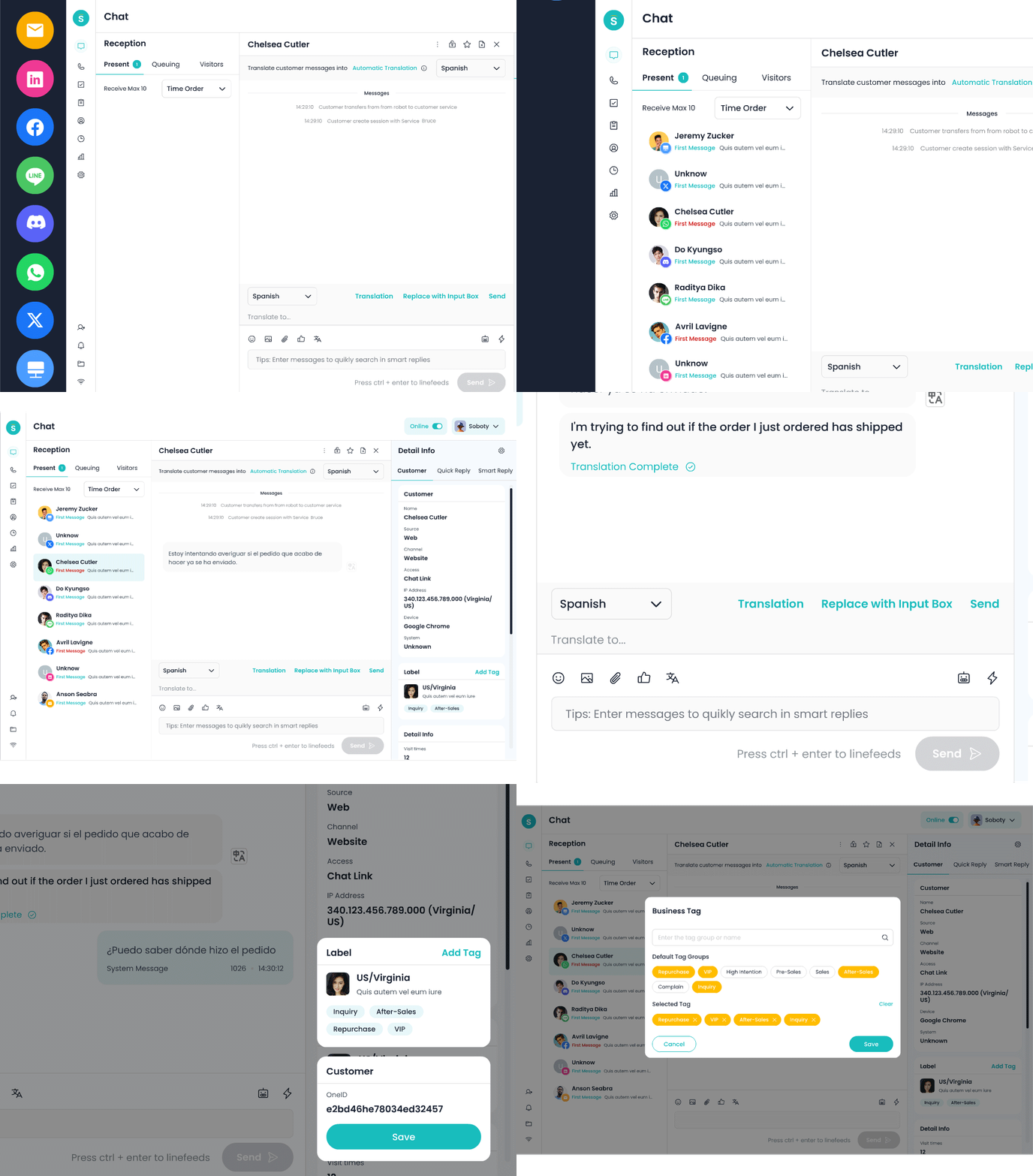
It includes basic and advanced customer service agents, responsible for communicating with customers in channels such as phone calls and live chat. Their tasks cover both making/receiving customer calls and handling complaints.
2. Internal Improvement Department
It handles supporting work beyond basic customer service, such as inspecting service quality, training customer service agents, updating knowledge base, and maintaining intelligent customer service tools. Meanwhile, it optimizes service processes based on customer complaint data to minimize losses in a timely manner.
3. External Improvement Department
It directly connects with other departments of the company to resolve issues, with a focus on managing product quality and logistics services. For instance, it can push for the removal of defective products and coordinate the closure of warehouses if logistics services are subpar.
4. VOC Team
It conducts customer service with brand and marketing thinking: not only identifying the needs of existing users, but also predicting the demands of potential users and determining which products are popular. Additionally, it carries out promotion through channels like communities and videos.
Product-Related Tips: Optimizing Products and Driving Sales
Every e-commerce practitioner must acknowledge the importance of customer service. But besides service, another critical factor is product management. There are some related suggestions for e-commerce businesses’ reference.
1. Opinion Feedback
Customer service agents should convey valuable user opinions to relevant departments. Examples include: product mismatch with images (Operations Department), VAT invoice issuance (Finance Department), inconvenient product use (Operations Department), and delivery requests (Logistics Department).
2. Daily Clearance Checklist
Pre-sales customer service agents often agree to meet customers’ special needs. However, if some of these needs are not met subsequently, customers may express dissatisfaction—forcing post-sales teams to spend more to resolve issues.
To address this, agents can establish a daily clearance mechanism: record the agreed special needs of customers daily, check progress before the end of each workday, follow up on unfinished items, and proactively communicate with customers to avoid dissatisfaction caused by passive communication.
3. Weekly Featured Products
Pre-sales customer service agents are frequently asked by customers, “What are the differences between these products?” or “Which one is more suitable for me?” Under such circumstance, guiding customers to choose the high-profit products can boost corporate profits greatly.
In response, the customer service department can establish a weekly featured product mechanism, set up corresponding incentive systems, and write guiding scripts for the featured products.
4. FAQ Script Optimization
A script optimization mechanism can be established. The specific approach is: for the same customer question, collect responses from all customer service agents, evaluate their quality, and refine the optimal script.
This can be implemented by retrieving a large number of customer questions from the backend, compiling them into an electronic questionnaire for all agents to fill out, then analyzing and selecting the best responses to finally develop the optimal script.

Customer Psychology: Understanding Emotions to Serve Better and Promote Growth
1. Compensation or Focus Shifting After Rejection
People instinctively resist rejection, and endorphins released by the brain during rejection may trigger irrational decisions. When customer service agents cannot meet customers’ requests, they often need to reject them—but they can offer compensation or shift the focus afterward.
Customer: “Can you give me a discount? Otherwise, I won’t buy it.”
Agent’s Response (for focus shifting): As customer service agents, we’ve done our utmost. While we can’t offer a discount, we can provide a three-year quality warranty, lifetime repair consultation services, and the most timely, high-quality after-sales support.
Agent’s Response (for compensation): Of course, we want to help finalize the transaction. Though we can’t offer a further discount, we can give you a notepad as a small gift.
2. Quickly Judging Customers’ Backgrounds
When communicating with customers, the first step is to judge their backgrounds. Using a language style familiar to them can quickly shorten the distance.
Customer: “I need to discuss this with my wife before deciding to buy.”
Agent’s Judgement: The customer is a male, over 30 years old, white-collar worker, with a college degree or above.
Agent’s Response: That makes complete sense. If your wife has any questions, I’m ready to answer them anytime. Is she with you by the computer now?
3. Providing Multiple-Choice Questions Instead of Open-Ended Ones
Offering options when asking questions makes it easier to keep the conversation going. A key tip for questioning is to use multiple-choice questions rather than open-ended ones—they are simpler to answer and help sustain communication.
4. Slightly Exceeding Customers’ Expectations
A practical way to improve customer satisfaction is to always slightly exceed customers’ expectations.
Customer: “My child is 7 years old and 135cm tall. What height of product is suitable?”
Ordinary response: Products of XX height are suitable, as they fit your child’s current height perfectly.
Expectation-exceeding response: The age of 7 is a critical period for a child’s self-awareness development. At this stage, you can gradually let them complete tasks independently to foster a sense of responsibility. Specifically for chairs, products of XX height are recommended as they are more suitable.

Conclusion
Well-rounded e-commerce customer service agents need to possess both operational and sales capabilities. They guide users through mechanisms and services to contribute to product value creation. Initially, it requires agents to have the patience and attention of operators, the proactivity of sales, and the carefulness of product managers. With these traits combined, agents can grow into senior customer service agents who excel at problem-solving and delivering more value.