Key Steps to Improving Customer Satisfaction in Call Centers


You know that improving customer satisfaction in call centers can change everything for your business. When you focus on improving customer satisfaction, you see real growth, stronger loyalty, and a reputation that stands out. Check out how call centers are doing around the world:
| Metric | Value |
|---|---|
| Average Customer Satisfaction Score (CSAT) | 78% |
| Good CSAT Score Range | 75% - 84% |
| World-class CSAT Score | 85% or higher |
| Percentage of Call Centers Achieving World-class CSAT | 5% |
“Customer satisfaction is pivotal as it directly impacts your bottom line,” said Nik Nicholas, the founder and CEO of Covelent.
Improving customer satisfaction means you need real strategies, smart technology, and proof that it works. Sobot leads the way by putting you and your customers first. See how improving customer satisfaction has made a difference for others:
- Agilent Technologies boosted support efficiency and hit a 95% customer satisfaction score.
- Veeva Systems solved thousands of tickets every month and reached 97% customer satisfaction.
Improving customer satisfaction is more than a goal—it’s your key to lasting success.
Why Customer Satisfaction Matters
Defining Customer Satisfaction
You might wonder what customer satisfaction really means in a call center. It’s more than just a happy customer at the end of a call. Industry experts say customer satisfaction is a key metric that connects directly to customer loyalty, company revenue, and even how your team feels at work. When you measure customer satisfaction well, you can spot what works and what needs fixing in your customer service. This helps you keep your standards high and your customers coming back.
Impact on Retention and Loyalty
Customer satisfaction does more than make people smile. It keeps them coming back and builds trust. Take a look at how important it is:
| Metric | Impact on Customer Satisfaction | Impact on Retention and Loyalty |
|---|---|---|
| Customer Satisfaction (CSAT) | High correlation with loyalty | Increases likelihood of repeat business |
| First Contact Resolution (FCR) | Directly correlates with satisfaction | Reduces need for follow-up calls |
| Customer Feedback Mechanisms | Essential for understanding satisfaction | Enhances loyalty through engagement |
When you focus on customer service, you boost customer loyalty. People who feel heard and helped will choose your business again and again. They also tell their friends about your great customer service, which helps your business grow.
Common Challenges in Call Centers
You face a lot of challenges when you try to improve customer satisfaction. Here are some of the most common ones:
- High call volumes can lead to long wait times. This frustrates customers and puts pressure on your agents.
- Customer satisfaction is tough to achieve. About 80% of consumers recommend companies that give excellent customer service.
- Agent burnout is real. Around 88% of agents say stress and repetitive tasks make their jobs hard.
- New technology can be tricky. It’s not always easy or cheap to add new tools, even if they help in the long run.
If you know these challenges, you can start to fix them. Better customer service starts with understanding what stands in your way.
Agent Training and Empowerment
Onboarding and Continuous Learning
You want your agents to feel confident from day one. A strong onboarding program sets the stage for success in customer service. The best training programs use real-world scenarios and hands-on practice. Agents learn faster when they can role-play and solve problems like they will on the job. You should also keep training fresh. Continuous learning helps agents stay sharp and adapt to new tools or customer needs. Personalized coaching makes a big difference. When agents get feedback and support, they build empathy and emotional intelligence. This leads to better customer interactions and higher satisfaction scores.
Here’s what works best for agent training:
- Use training materials that match what’s happening in the industry.
- Make sessions interactive with digital tools and group activities.
- Let agents practice with real-life situations.
- Create a space where agents feel safe to ask questions.
- Track training results by checking customer satisfaction scores.
Empowering Agents for Better Customer Experience
Empowered agents deliver better customer service. When you give agents tools like self-scheduling and real-time performance dashboards, they feel more in control. This reduces stress and boosts morale. Agents who can see their own progress provide more personal and efficient service. Personalized coaching based on real-time data helps agents grow. Generative AI tools also support agents, letting them focus on complex issues. A culture of continuous learning helps agents adapt to new technology and customer expectations.
| Empowerment Method | Impact on Customer Service |
|---|---|
| Self-scheduling tools | Higher morale, less absenteeism |
| Real-time KPI dashboards | More personalized service |
| Personalized coaching | Better customer interactions |
| Generative AI support | Improved service quality |
| Continuous learning | Higher satisfaction |
Soft Skills and Emotional Intelligence
Soft skills matter as much as technical skills in customer service. Empathy training helps agents build trust with customers. Active listening and role-playing teach agents how to handle tough situations. When agents show empathy, they solve problems faster and leave customers feeling valued. These skills boost important metrics like First Call Resolution and customer satisfaction. You want every customer to feel heard and respected. That’s how you turn a simple call into a great customer experience.
Reducing Wait Times and Boosting Efficiency
Smart Call Routing and Staffing
You know how frustrating it feels to wait on hold. The average wait time in call centers matters a lot for customer service. Experts say the ideal wait time is less than 20 seconds for inbound calls. Long waits can make customers upset and lower satisfaction scores. You can fix this with smart call routing and better staffing. Modern AI tools help direct callers to the right agent fast. These tools also use data to predict busy times and schedule more agents when you need them most.
- Intelligent call routing sends urgent calls to the best agent.
- Optimized staffing keeps enough agents ready during peak hours.
- These changes lead to shorter wait times, fewer dropped calls, and happier customers.
When you use these strategies, you see higher customer satisfaction, better agent performance, and a stronger brand reputation.
Callback Options and Self-Service
Nobody likes waiting on hold. Callback options let customers keep their place in line without staying on the phone. Did you know that 74% of people prefer a callback instead of waiting? Companies that offer this feature see up to a 32% jump in customer satisfaction scores. Self-service tools, like chatbots and online FAQs, also help. Many call centers ask for feedback after self-service to make sure the experience works well. These options give customers more control and make customer service faster and easier.
Workflow Automation
Workflow automation changes the game for customer service. It connects your CRM and knowledge systems, so agents see all the info they need. This means faster answers and less time wasted. Take a look at how automation helps:
| Metric | Impact |
|---|---|
| Customer Satisfaction | 47% increase |
| Customer Loyalty | 47% increase |
| Response Time | Faster responses |
| Service Experience | Improved |
A multichannel approach lets customers reach you on their favorite platform. With automation, you boost customer service, speed up responses, and keep customers coming back.
Leveraging Technology to Improve Customer Satisfaction


Sobot Live Chat for Omnichannel Support
You want your customers to reach you on their favorite channel, whether that’s your website, WhatsApp, Facebook, or even Discord. Sobot Live Chat makes this possible by bringing all your customer support conversations into one place. This means your team never misses a message, and your customers get quick answers. Omnichannel support helps you deliver a seamless customer experience, no matter where the conversation starts. With Sobot, you can also use chatbots and voicebots to answer simple questions 24/7, so your agents can focus on more complex customer service needs. Did you know that 62% of Millennials and 75% of Gen-Z prefer self-service options? Sobot’s tools help you meet these expectations and boost customer satisfaction. Source
Here’s a look at how technology is changing customer support:
| Technological Advancement | Impact on Customer Satisfaction |
|---|---|
| AI and Automation Tools | Enhance efficiency and allow agents to focus on complex issues, improving service quality. |
| CRM Systems | Provide personalized support by consolidating customer data, leading to more informed interactions. |
| Omnichannel Communication | Ensures seamless transitions between channels, reducing customer frustration and improving overall experience. |
| Self-Service Options | Allow customers to resolve simple issues independently, reducing wait times and agent workload. |
| Interactive Voice Response (IVR) Systems | Manage high call volumes efficiently, enabling customers to handle simple tasks without agent assistance. |
| Performance Analytics and Reporting | Provide insights into customer behavior and agent performance, helping to enhance service quality. |
AI and Automation in Customer Experience
AI and automation are game changers for customer service. Sobot’s AI-powered chatbots and AI Agents handle routine questions, so your team can focus on building real connections. This not only saves time but also cuts costs. Companies using omnichannel customer support see retention rates jump by 90% compared to those using just one channel. Source Sobot’s automation tools, like workflow automation and ticketing systems, help you resolve issues faster and keep your customers happy. Automated callbacks can reduce abandoned calls by 32%, which means fewer frustrated customers and higher customer satisfaction.
Here are some key benefits of AI and automation:
| Benefit | Description |
|---|---|
| Personalized Engagement | Chatbots provide real-time customer engagement similar to live chat without needing more staff. |
| Cost-Effectiveness | AI solutions like chatbots are a cost-effective option for companies aiming to scale quickly. |
| Improved Customer Retention | Omnichannel interactions lead to customer retention rates that are 90% higher than single-channel. |
| Consistent Experience | Centralizing customer service channels ensures a seamless experience across all platforms. |
Unified Workspace and Analytics
You want your agents to work smarter, not harder. Sobot’s unified workspace brings all customer data, tickets, and messages together. Agents spend less time searching for information and more time helping customers. Built-in analytics let you track over 150 service indicators, so you can spot trends and improve your customer support. With Sobot, you see a 30% boost in agent productivity and a 15% jump in customer satisfaction. Source
Check out this chart to see how AI tools improve agent performance and customer satisfaction:
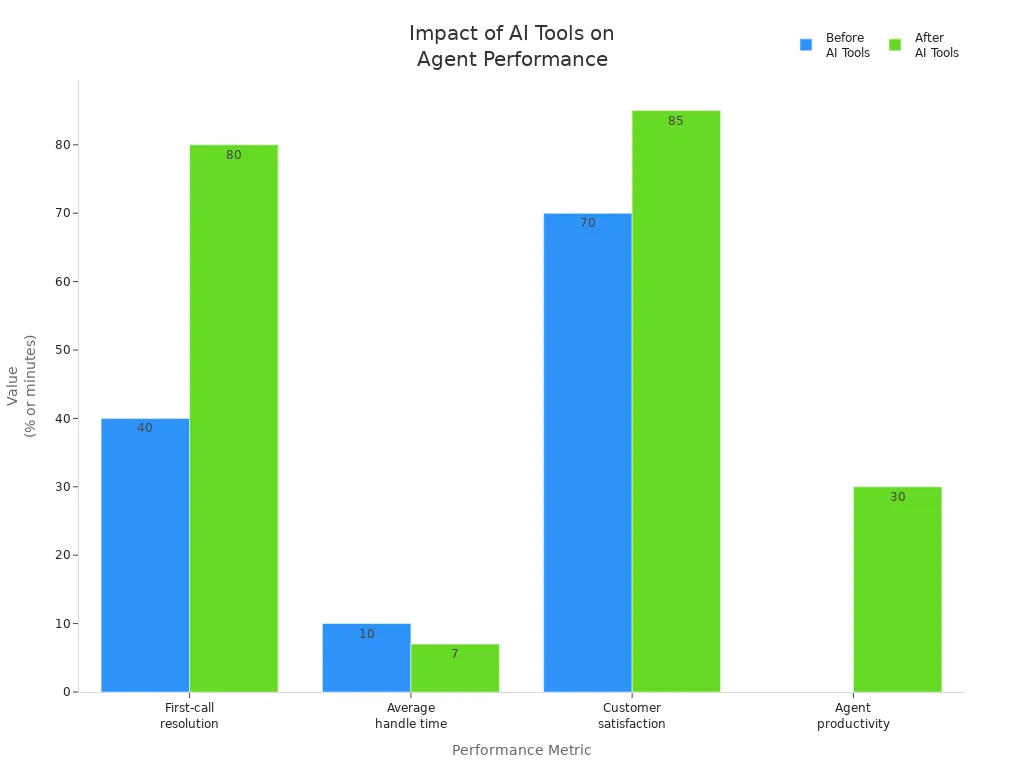
Samsung’s story shows what’s possible. After switching to Sobot’s all-in-one customer contact center, Samsung unified its channels, improved agent efficiency by 30%, and reached a 97% customer satisfaction rate. When you use the right technology, you make every customer service interaction count.
Acting on Customer Feedback
Collecting and Analyzing Feedback
You want to know what your customers think about your customer service. Start by collecting feedback from every channel—calls, chats, emails, and social media. Use surveys, satisfaction scores, and even short polls after each interaction. This helps you spot trends and see where you can improve customer satisfaction.
Here are some best practices for collecting and analyzing customer feedback:
- Train your agents to ask for honest opinions.
- Offer support on every channel your customers use.
- Use technology like Natural Language Processing to sort and understand feedback.
- Keep the conversation history so you don’t ask the same questions twice.
- Look for pain points in the customer journey with detailed analytics.
- Give customers the option for a callback if they don’t want to wait.
Proactive customer support will keep customers happy and inclined to continue supporting your business, and potentially even provide positive feedback.
Closing the Loop with Customers
You can’t just collect feedback—you need to act on it. When you close the loop, you show customers you care. Thank them for their input and let them know what changes you made. This builds trust and makes people feel valued. You turn unhappy customers into loyal fans. Companies that close the loop see a 25-40% jump in retention rates, according to Bain & Company.
- Acknowledge every piece of feedback.
- Share updates about changes you make.
- Follow up with customers who had issues.
Using Insights to Increase Customer Satisfaction
You can use feedback to increase customer satisfaction and improve your customer service. When you track the right metrics, you see real results.
| Metric | Improvement Percentage |
|---|---|
| Net Promoter Score | 230% |
| Agent Productivity | 42% |
| Headcount Reduction | 15% |
| Revenue Created by Agents | Millions |
You can boost customer experience by listening, learning, and acting on what your customers say. This keeps your customer service strong and helps you increase customer satisfaction every day.
Measuring Success with KPIs
Key Metrics for Customer Satisfaction
You want to know if your call center is really making customers happy. The best way to do this is by tracking the right numbers. Here are the top metrics you should watch:
- Customer Satisfaction Score (CSAT): This shows how happy customers feel after talking to your team. You usually get this score from quick surveys right after a call or chat.
- Net Promoter Score (NPS): This tells you how likely customers are to recommend your company to friends or family.
- Customer Effort Score (CES): This measures how easy it was for customers to get help or solve their problem.
These numbers help you see what’s working and what needs to change in your customer service. They also let you compare your results with other call centers.
Setting Goals and Benchmarks
You need clear goals to improve customer satisfaction. Start by picking KPIs that match your business goals. Use both numbers and feedback from customers. Set SMART goals—these are Specific, Measurable, Achievable, Relevant, and Time-bound. For example, you might aim to raise your CSAT score by 5% in three months.
Tip: Run surveys right after each customer service interaction. This gives you fresh feedback and helps you spot problems fast.
You can use IVR-based surveys to alert managers if a customer gives a low score. This lets you follow up quickly. Review your numbers often and talk with your agents about how to get better. When you balance customer-focused goals with your team’s needs, you build a stronger call center.
Continuous Improvement
You can’t just set goals and forget them. You need to keep getting better. Companies that focus on experience-centric quality management see a 21% jump in customer satisfaction scores. Try these steps for ongoing success:
- Give agents the power to fix problems right away. This cuts down on customer frustration.
- Use real-time coaching to help agents improve during calls.
- Create a supportive place to work. Happy agents give better customer service.
- Watch for trends like repeat calls or customers having to explain their issue more than once. High First Contact Resolution (FCR) rates mean happier customers and lower costs.
- Use positive language and address customers by name. Small touches make a big difference.
When you keep improving, you make every customer interaction count. Your call center becomes a place where both customers and agents feel valued.
You can boost customer satisfaction by following a few proven steps. Start by checking your current performance, then build a plan based on what your customers say. Use smart technology, empower your agents, and always listen to feedback. Companies that focus on improving customer satisfaction levels see real results, like higher efficiency and happier customers. If you want to see these changes, try solutions like Sobot and keep looking for ways to get even better.
FAQ
What is the most important metric for call centers?
You should focus on customer satisfaction. This metric shows how happy your customers feel after getting help. High scores mean your team is doing a great job.
How can I reduce wait times for my customers?
Try using smart call routing and callback options. These tools help your customers reach the right agent faster and avoid long holds.
Why do soft skills matter for agents?
Soft skills like empathy and active listening help agents connect with customers. These skills make every conversation feel personal and positive.
How does technology improve customer service?
Technology like AI chatbots and unified workspaces lets you answer questions quickly. It also helps agents find information fast and keeps service consistent.
What should I do with customer feedback?
Listen to feedback from every channel. Use it to spot problems and make changes. When you act on feedback, you show customers you care.
See Also
Enhancing Customer Satisfaction Through Effective Live Chat Strategies
Top Strategies for Effective Call Center Quality Management
Essential Principles of Quality Management Systems in Call Centers
A Comprehensive Approach to Omnichannel Contact Center Implementation
Improving Call Center Efficiency Through Effective Monitoring Techniques

