What Features Does a Contact Center Need?


Business leaders build high-performing operations by focusing on a core set of integrated features. A modern contact center relies on essential pillars for success.
- Omnichannel Communications
- Intelligent Routing
- AI-Powered Automation
- Robust Analytics
These essential features for a contact center directly improve customer satisfaction and boost agent productivity. A modern contact center, like one powered by Sobot, uses these tools to enhance the customer experience and enable data-driven decisions, transforming the entire contact center operation.
Essential Features for a Contact Center's Foundation
The bedrock of any high-performing contact center is its ability to manage customer interactions seamlessly and efficiently. This requires a focus on two essential features: providing a unified experience across all channels and intelligently directing customers to the right resource without delay. These capabilities are not just enhancements; they are the essential features for a contact center aiming to deliver exceptional service in today's competitive landscape.
1. Omnichannel for a Seamless Customer Experience
Omnichannel is more than just offering multichannel communication. It involves weaving together every channel—voice, chat, email, and social media—into a single, continuous conversation. Today's customers expect this level of consistency. In fact, 79% of them anticipate a unified experience when they interact with different departments or switch channels. They don't want to repeat their story every time they connect with your brand. A true omnichannel support strategy makes this a reality, creating a seamless customer experience.
Sobot’s Omnichannel Solution provides a powerful omni-channel hub that unifies all customer interactions. This software integrates channels like the Sobot Voice Call Center, Live Chat, and Ticketing System into one unified agent interface.
How a Unified Workspace Boosts Performance:
- Boosted Agent Productivity: Agents save hours by not having to switch between different applications. This consolidation allows them to handle more inquiries with less stress.
- Reduced Errors: With all context and customer history in one place, the chance of error decreases, leading to more accurate and effective customer service.
- Improved Morale: A streamlined workflow reduces agent burnout, a common issue in a chaotic, multi-channel environment. This leads to lower turnover and a more experienced team.
This integrated approach directly impacts key contact center metrics. By providing agents with a complete view of the customer journey, the software helps improve first contact resolution. When an agent can see a customer's previous chat transcript while on a phone call, they can resolve the issue faster and more effectively. This level of omnichannel engagement is crucial for building a modern contact center that excels at customer service. The goal of omnichannel support is to make every interaction feel like a continuation of the same conversation, which is vital for effective customer engagement.
2. Intelligent IVR and Smart Call Routing
Once you have unified your channels, the next step is to ensure customers connect with the right person to solve their problem quickly. This is where intelligent routing becomes critical for the modern contact center. Long wait times and multiple transfers are major sources of customer frustration. An advanced contact center uses smart routing to minimize these pain points.
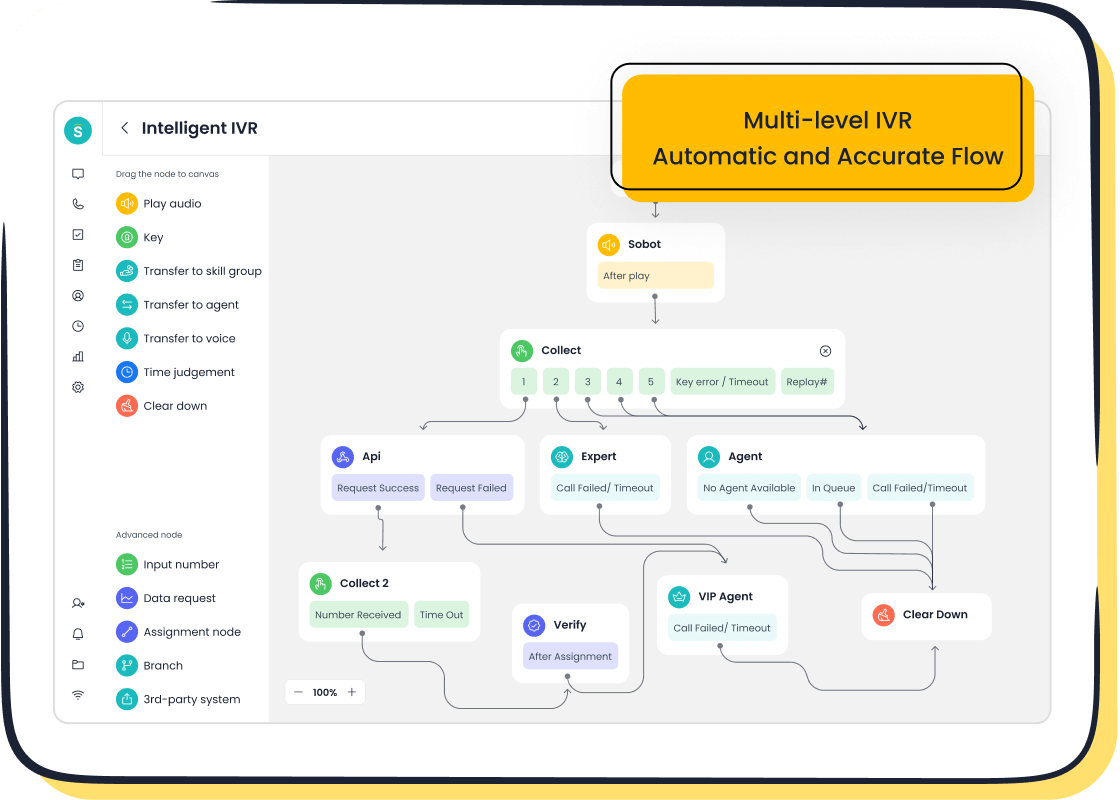
Effective routing can dramatically reduce customer wait times, with some deployments seeing a decline of 20-30%. Sobot’s Voice Call Center software achieves this with a powerful, drag-and-drop Interactive Voice Response (IVR) builder and sophisticated rule-based routing. This allows a contact center to design custom call flows that guide customers efficiently.
For example, a contact center can implement complex routing rules to improve customer-to-agent matching:
- VIP Routing: High-value customers can be identified by their phone number and automatically routed to a dedicated team of senior agents.
- Skills-Based Routing: A customer calling about a specific product can be sent to an agent with specialized product knowledge.
- Geographic Routing: Calls can be directed based on the caller's location to connect them with agents who understand regional needs or speak the local language.
These rules ensure that customer interactions are handled by the most qualified agent from the start. This not only improves the customer experience but also optimizes agent time, directly impacting metrics like Average Handle Time (AHT). A well-designed routing strategy is a cornerstone of an efficient contact center. The contact center software makes it easy to configure these workflows, ensuring the modern contact center operates at peak efficiency. By leveraging this technology, a contact center can provide faster, more personalized customer service. This level of omnichannel support and intelligent routing transforms the contact center into a strategic asset.
Intelligence in the Modern Contact Center with Sobot
A solid foundation of omnichannel communication and smart routing sets the stage for success. However, a truly modern contact center uses intelligence to transform its operations from reactive to proactive. Artificial intelligence and advanced analytics are the features that unlock peak efficiency and a superior customer experience. They empower teams to not only solve problems but also to anticipate them.
3. AI-Powered Chatbots and Voicebots
Many customer inquiries are simple and repetitive. Agents in a busy contact center often spend hours answering the same questions. This is where AI-powered automation and self-service create immense value. AI bots work 24/7 to provide instant answers, freeing human agents to focus on complex issues that require empathy and critical thinking.
These AI-powered tools are highly effective at handling a wide range of common customer service tasks.
- Answering Frequently Asked Questions (FAQs)
- Updating order statuses
- Scheduling appointments
- Processing routine transactions like bill payments
- Authenticating users and providing account details
Sobot’s Chatbot, which is enabled with ChatGPT technology, provides intelligent and natural conversations for self-service options. Similarly, the Voicebot in Sobot's Voice Call Center software can understand customer intent and provide immediate resolutions over the phone. This level of ai customer service ensures that customers get help instantly, any time of day.
The return on investment for this technology is clear. AI bots deliver:
- 24/7 Availability: Customers receive support without waiting for business hours.
- Lower Average Handle Time (AHT): Bots resolve simple queries instantly, reducing the overall time spent per interaction.
- Reduced Errors: AI delivers consistent and accurate information, minimizing human error.
- Scalability: A contact center can handle thousands of simultaneous customer interactions without hiring more staff.
Samsung's Success with Sobot Global technology leader Samsung implemented Sobot's all-in-one contact center solution to unify its customer service. By using chatbots to handle routine inquiries, Samsung empowered its agents to focus on more complex problems. The results were remarkable: a 30% increase in agent efficiency and a 97% customer satisfaction rate. This success story shows the powerful impact of integrating AI into a contact center. Read more about Samsung's journey with Sobot.
By automating routine tasks, a contact center can dramatically improve its operational efficiency and the quality of its customer service. This allows agents to dedicate their expertise to building stronger customer engagement. The software makes it easy to deploy these self-service options.
4. Analytics for a Better Customer Experience
You cannot improve what you cannot measure. Data is the lifeblood of a high-performing modern contact center. Advanced analytics and real-time monitoring are essential for understanding performance, identifying problems, and making informed decisions. A modern contact center moves beyond historical reports and uses live data to manage operations minute-by-minute.
Real-time dashboards are crucial for monitoring the health of a contact center. Managers need immediate visibility into key performance indicators (KPIs) to make quick adjustments. Important performance metrics and reporting include:
- Number of incoming calls and chats
- Current customer wait times
- Agent availability and status
- Call abandonment rate
- Service Level (e.g., % of calls answered in 30 seconds)
Sobot’s contact center software provides comprehensive dashboards for real-time monitoring of these metrics. This allows supervisors to see exactly what is happening in the contact center at any moment.
However, the true power of advanced analytics lies in proactive insights. Sobot’s software uses AI to analyze data and predict issues before they impact customers. This capability transforms a support team from reactive to strategic. For example, the system can:
- Forecast Demand: Predict call and chat volume based on historical trends, helping managers optimize staffing.
- Identify Friction Points: Analyze customer interactions to pinpoint where customers struggle, allowing for workflow improvements.
- Spot Abnormal Activity: Alert managers to unusual spikes in wait times or negative sentiment, enabling rapid intervention.
These enhanced customer insights help a contact center optimize its team performance. With this data, managers can identify coaching opportunities for agents, refine routing strategies, and improve knowledge base articles. This continuous loop of monitoring, analysis, and optimization is what defines a leading modern contact center. The use of advanced analytics in the contact center software ensures that every decision is backed by data, leading to better customer service and a more efficient operation. This focus on performance metrics and reporting is key to delivering consistent customer satisfaction.
Core Support and System Integration
A modern contact center is more than just its customer-facing features. Its strength comes from a powerful backend infrastructure. This core includes deep system integration, tools to support agents, and a reliable, flexible foundation. These elements work together to create an efficient and resilient operation, enabling a contact center to deliver exceptional service consistently.
5. Deep CRM and System Integration
Providing truly personalized service requires a complete view of the customer. A modern contact center achieves this through deep system integration. When contact center software connects with other business tools, agents get the context they need for every conversation. This eliminates the need for customers to repeat information.
Sobot’s contact center software integrates seamlessly with essential platforms like Salesforce and Shopify. This creates a unified agent interface for all customer interactions.
- Elevated Customer Experience: Agents see a full customer history, enabling quicker resolutions and a better customer experience.
- Improved Efficiency: Data syncs automatically, which reduces manual work and allows agents to focus on customer service.
- Increased Sales Opportunities: A full view of past purchases helps agents make relevant product recommendations.
This level of integration turns every interaction into a well-informed conversation. A contact center can improve customer retention by making each customer feel understood. This is a key function of a well-integrated contact center.
6. Workforce Engagement Management (WEM)
A great customer experience starts with happy and engaged agents. Workforce Engagement Management (WEM) software provides the tools a contact center needs to support its team. These solutions help improve agent morale and reduce high turnover rates, which are common challenges in the customer service industry. Companies with highly engaged employees even see a 23% increase in profitability.
WEM software helps a contact center by:
- Improving Performance: Quality management tools offer insights for personalized coaching and skill development.
- Boosting Morale: Gamified dashboards and recognition features motivate agents and celebrate top performers.
- Reducing Burnout: Flexible scheduling tools give agents more control over their work-life balance.
Investing in WEM demonstrates a commitment to employee growth. A supported and motivated team is the most valuable asset for any contact center focused on excellent customer service.
7. Cloud-Based Contact Center Infrastructure
The foundation of a flexible and scalable modern contact center is its infrastructure. A cloud-based platform, often called Contact Center as a Service (CCaaS), offers significant advantages over traditional on-premise systems. Businesses can save an average of $197,914 by switching to the cloud.
A Contact Center as a Service model allows a contact center to scale its operations up or down based on demand. This is perfect for handling seasonal peaks without investing in permanent hardware. This flexibility is crucial for maintaining smooth customer service during busy periods. Sobot’s Contact Center as a Service platform is built for reliability. It guarantees 99.99% system stability with a global network presence. This ensures that the contact center remains operational, providing uninterrupted customer interactions and building trust.
Building a modern contact center requires a strategic focus on key capabilities. The essential features for a contact center include omnichannel communication, intelligent routing, AI automation, deep analytics, and system integration. Investing in these tools, offered by solutions like Sobot, is critical for any contact center aiming to deliver excellent customer service. A resilient and efficient contact center uses these features to improve all customer interactions. Modernize your customer service tools and "Embark on Your Contact Journey" to build a better contact center today. These are the essential features for a contact center that wants to succeed.
FAQ
1. Can Sobot's contact center software connect with our existing CRM?
Yes, it can. The software integrates seamlessly with popular systems like Salesforce and Shopify. This connection provides agents with a complete customer history in one unified workspace, which helps create a more personalized and efficient customer experience.
2. How reliable is a cloud-based contact center?
A cloud-based contact center offers high reliability. For instance, Sobot guarantees 99.99% system stability. This level of uptime is supported by a global network infrastructure, ensuring your customer service operations remain consistently available.
3. How does AI improve a contact center?
AI improves a contact center by automating routine tasks. Chatbots and voicebots handle simple questions 24/7. This frees human agents to focus on more complex customer problems, which boosts overall team efficiency and customer satisfaction.
4. What is an omnichannel contact center?
An omnichannel contact center uses a single software platform to unify all communication channels. It combines voice, email, chat, and social media into one continuous conversation. This prevents customers from repeating themselves and creates a seamless experience.
See Also
Essential CRM Call Center Software Capabilities for Enhanced Customer Service
A 10-Step Guide to Deploying Omnichannel Contact Center Solutions Effectively
Leading Contact Center Solutions: An In-Depth Review for the Year 2024
Best Cloud Contact Center Services: Comprehensive Reviews for 2024
Implementing Top Quality Management Practices in Your Call Center

