How Customer Service AI Companies Use Multilingual Support

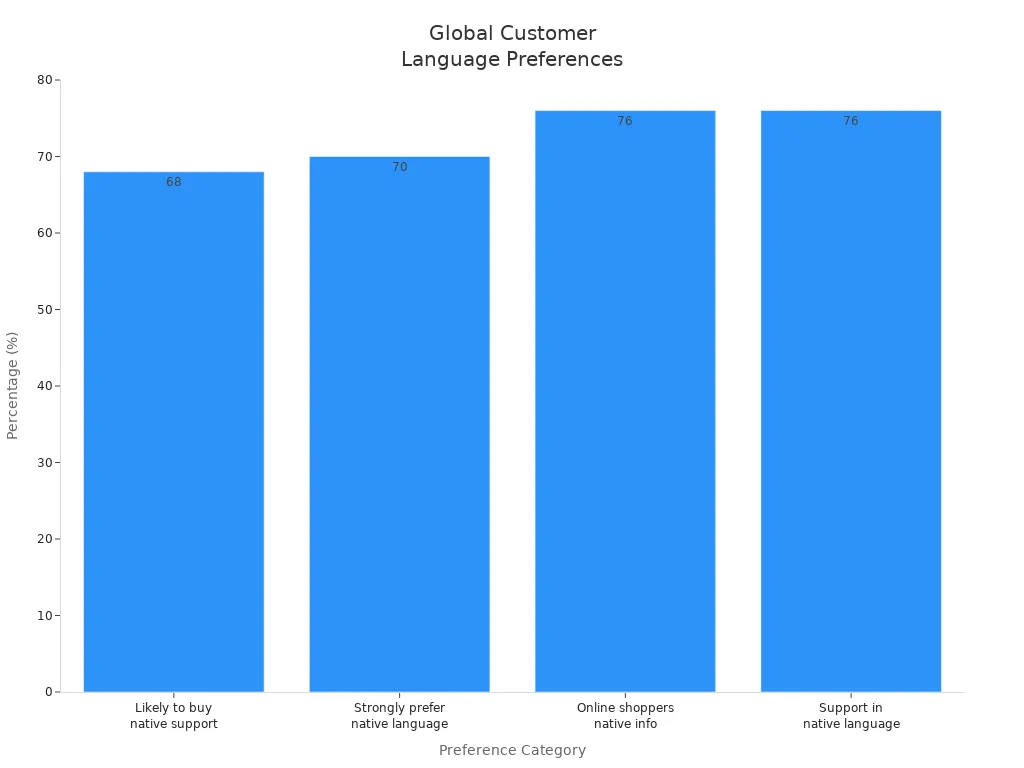
Multilingual AI support in customer service means you can talk to companies in your own language, no matter where you live. Companies like Sobot use this technology to help you feel understood and valued. You can see how much people care about this in the table below:
| Statistic | Percentage |
|---|---|
| Consumers likely to buy from businesses offering native language support | 68% |
| Consumers who strongly prefer to buy in their native language | Over 70% |
| Online shoppers preferring information in their native language | 76% |
| Users preferring customer support in their language | 76% |
Customer service ai companies with multilingual support help you connect better and make your experience smoother. Sobot uses this approach to build trust and make you happy, no matter where you are.
What Is Multilingual AI Support?
Definition and Scope
When you reach out to a business, you want to feel understood, no matter what language you speak. Multilingual AI support in customer service technology gives you that experience. It means you can communicate with service teams in your own language, and the system understands not just your words but also your tone and cultural background. This approach helps you feel included and valued.
You will find that customer service ai companies with multilingual support use advanced tools to make this possible. These tools do more than just translate. They recognize language preferences, adapt to different writing systems, and even learn new phrases as people use them. This makes your conversations smoother and more personal.
Here are the main components that power multilingual AI support:
| Component | Description |
|---|---|
| Natural Language Processing (NLP) | Breaks down text or speech for understanding context, sentiment, and nuances in conversation. |
| Machine Translation | Provides accurate translations by learning language patterns, capturing idioms and cultural contexts. |
| Speech Recognition and Synthesis | Converts spoken language to text and vice versa, enabling voice-based interactions. |
| Contextual Understanding | Detects user language preferences automatically for a smoother experience. |
| Ongoing Learning and Adaptation | Updates AI training data to adapt to evolving language trends and user-specific nuances. |
How It Works in Customer Service
You interact with multilingual AI every time you chat, call, or message a support team in your language. The AI detects your language and switches to it instantly. It keeps track of your conversation, even if you change languages during the chat. This helps you get answers faster and with less confusion.
- The AI can translate support articles and messages quickly, so you get help right away.
- It updates its knowledge to match new trends and phrases, making sure you always get accurate information.
- If your question is too complex, the AI sends you to a human agent who speaks your language.
- Companies can connect these AI tools to their websites, apps, and social media, so you always have support where you need it.
Customer service ai companies with multilingual support help you get answers in your language, improve your experience, and make global support simple.
Benefits for Businesses and Customers
Enhanced Customer Experience
You want to feel heard and understood when you reach out for help. Multilingual AI support makes this possible by letting you communicate in your own language. This leads to higher satisfaction and faster answers. For example, after companies started using multilingual voice AI, customer satisfaction scores rose from 82% to 94%. First call resolution rates also improved, and agents became more productive. You can see these changes in the table below:
| Metric | Before Multilingual Voice AI | After Implementation | Impact |
|---|---|---|---|
| Customer Satisfaction (CSAT) | 82% | 94% | +12% |
| First Call Resolution (FCR) | 78% | 89% | +11% |
| Agent Productivity | Moderate | High | +25% |
| Average Handle Time (AHT) | 7.1 min | 6.0 min | -15% |
| Global Market Reach | Limited | Expanded | +30% |
When you get support in your native language, you feel valued. In fact, 70% of clients stay loyal to companies that offer this service. Companies like Airbnb learned this the hard way when they faced backlash for not providing enough language options.
Global Reach and Accessibility
You can connect with businesses from anywhere in the world when they offer multilingual support. This gives you access to help, no matter what language you speak. Customer service ai companies with multilingual support help businesses stand out by meeting diverse language needs. They also increase customer engagement because people feel comfortable reaching out in their own language.
A report from ICMI shows that 72% of customer service leaders believe satisfaction improves when customers can use their native language. This means you get better service and more reliable answers.
Operational Efficiency
You benefit from faster service and shorter wait times. Multilingual AI support can reduce average handling time by 40%. AI tools handle routine questions and provide instant translations, so agents can focus on complex issues. This leads to big savings for businesses. Companies report operational savings between 30% and 70% after using AI in customer service. Per-call costs can drop by up to 90%, and support tickets cost much less to handle.
AI also helps businesses respond 24/7, so you get help whenever you need it. Startups and small businesses often see a return on their investment within a year because of these savings.
Technologies Behind Multilingual AI
NLP and Machine Translation
You interact with multilingual AI every time you chat or call a support team in your language. Natural Language Processing (NLP) and machine translation make this possible. NLP helps computers understand your words, tone, and even your emotions. Machine translation uses advanced neural networks to translate your messages quickly and accurately. These technologies now handle context and cultural differences much better than before.
Recent advancements include:
- Real-time translation that lets you get instant help in your language.
- Improved dialogue systems that make conversations feel more natural.
- Chatbots that can respond with empathy and understand your needs.
NLP also automates routine questions, analyzes how you feel, and routes your requests to the right person. This means you get faster answers and a more personal experience.
AI Chatbots and Voice Assistants
AI chatbots and voice assistants play a big role in customer service ai companies with multilingual support. These tools can:
- Detect your language from the first few words you type or say.
- Support switching between languages during a conversation.
- Understand your tone, emotion, and intent, just like a human agent.
- Keep track of the conversation, even if it gets long or complex.
AI chatbots use NLP to understand your questions in any language. They can recognize mixed-language inputs and adjust their responses based on your culture and expectations. Voice assistants add another layer by turning speech into text and back again, making phone support smarter and faster.
Sobot Live Chat Features

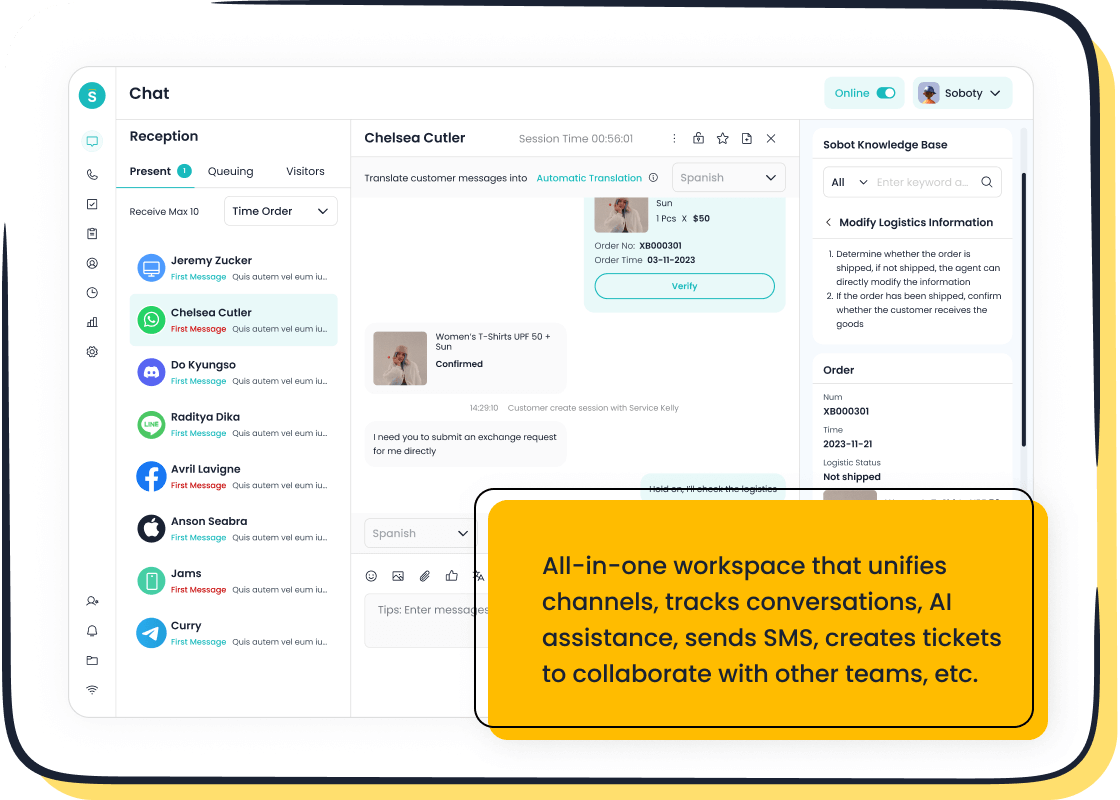
Sobot Live Chat shows how advanced multilingual AI works in real life. You can chat with support on websites, apps, or social media like WhatsApp and Facebook. The system detects your language and translates messages instantly, so you always get clear answers.
Key features include:
- Omnichannel support: Reach out on your favorite platform and get the same quality help.
- Auto-translation: Chat in your language while the agent sees your message in theirs.
- Built-in analytics: Sobot tracks over 150 service indicators, such as how quickly issues get resolved in different languages and how satisfied customers are.
Sobot also offers AI-powered chatbots, voicebots, and a unified contact center. These tools help businesses respond 24/7, reduce wait times, and improve customer satisfaction. Analytics help companies see which languages need more support and where they can improve. With these technologies, customer service ai companies with multilingual support can deliver fast, accurate, and personal help to people all over the world.
Implementing Multilingual AI in Customer Service

Language Selection and Model Training
You need to start by choosing which languages matter most for your business. Look at your support tickets and website visitors to see what your customers speak. Begin with a few high-impact languages, then add more as you grow. Here are some best practices:
- Focus on languages with the highest customer demand.
- Use quality data to train your AI models. This helps the system understand real conversations.
- Combine AI with human review. Native-speaking agents can check translations for accuracy and cultural fit.
- Build a central knowledge hub. Store FAQs and guides in every supported language.
- Use technology for real-time translation. This lets you help customers instantly.
Sobot helps you analyze your market and prioritize languages, making sure your AI learns from the best data.
Integration with Platforms (Sobot Example)
You want your multilingual AI to work everywhere your customers reach you. Sobot makes this easy by connecting with websites, apps, and social media like WhatsApp and Facebook. The system uses language auto-detection to switch languages as soon as a customer starts chatting. Contextual understanding helps the AI keep track of the conversation, even if the topic changes.
Sobot updates its AI models often. This keeps your support accurate and up to date. You can also connect Sobot with your CRM or helpdesk, so agents see all customer data in one place.
Quality Assurance and Continuous Improvement
You should check your AI’s performance regularly. Review customer satisfaction scores and update your knowledge base every week. Retrain your AI models every few months to keep up with new trends. Human agents should handle complex or sensitive cases, like refunds or complaints, to make sure customers feel heard.
Sobot offers training and support for your team. You get help setting up, testing, and improving your system. Customer service ai companies with multilingual support treat their solutions as living systems that need ongoing care. This approach helps you deliver reliable, high-quality service in every language.
Customer Service AI Companies with Multilingual Support: Real-World Impact
Sobot Success Story: Weee!
You can see the power of multilingual AI in action through the story of Weee!, America’s largest online Asian supermarket. Weee! serves a diverse customer base, including Chinese, Hispanic, Korean, and Vietnamese communities. The company faced big challenges. Many customers spoke different languages. The support team worked in Asia, while most customers lived in America. Time zones and language barriers made it hard to deliver fast, clear answers.
Weee! chose Sobot to solve these problems. Sobot’s voice product brought flexible IVR (Interactive Voice Response), an integrated workbench, and strong multilingual support. You could reach out in your own language and get help right away. The system detected your language and routed you to the right agent or provided instant AI-powered translations.
Here’s what changed for Weee! after using Sobot:
- Agent efficiency increased by 20%.
- Resolution time dropped by 50%.
- Customer satisfaction soared to 96%.
- The support team handled over 40,000 daily orders and 25,000 deliveries with ease.
“Weee! saw a huge improvement in customer happiness and agent productivity after switching to Sobot’s multilingual AI.”
You can see how customer service ai companies with multilingual support help businesses like Weee! break language barriers and deliver consistent service to every customer.
Overcoming Challenges and Ensuring Consistency
You may wonder what makes multilingual support so challenging. Many companies face similar obstacles when they try to help customers in many languages. These challenges include translation errors, cultural differences, and technical issues. If you want to see how these problems and solutions compare, check the table below:
| Challenge | Solution |
|---|---|
| Language barriers and translation inaccuracies | Use human agents for complex queries and generative AI for translations. |
| High costs and resource allocation | Invest in recruitment and training while balancing cost-effectiveness with service quality. |
| Inconsistent service quality | Ensure agents have similar proficiency levels and provide training to handle complex queries. |
| Nuanced language understanding | Regularly update training datasets and combine AI insights with human expertise. |
| Data privacy and security | Implement robust security protocols and comply with data protection regulations. |
| Integration complexity | Choose scalable AI solutions that integrate with existing systems. |
| Dependence on training data quality | Continuously invest in high-quality, diverse training data. |
| Resource allocation and scaling | Develop a thoughtful team structure and efficient workflows to manage resources effectively. |
| Handling less common languages | Use automation or AI translation tools with oversight to maintain service quality. |
| Technical and integration limitations | Ensure integration of translation tools and CRMs to avoid delays and data loss. |
You need more than just translation to deliver great service. Sobot uses several strategies to keep support consistent and accurate across all languages. These strategies include:
| Strategy | Description |
|---|---|
| Persistent Memory | Tracks customer history across languages to preserve context when transitioning to human agents. |
| Language-Oriented Processing | Works directly in the customer’s language, ensuring messages are accurate and not just translated. |
| Fallback Procedures | Sends unresolved issues to human agents to ensure compliance with brand standards. |
| Neural Machine Translation | Uses deep learning for natural, context-aware translations, improving accuracy over older systems. |
| Glossaries | Enforces consistent terminology across interactions, ensuring brand terms are translated uniformly. |
| Domain-Specific Models | Trained on specialized data to maintain technical accuracy in fields like finance and healthcare. |
You can trust that Sobot’s system remembers your preferences and history, even if you switch languages. The AI uses neural machine translation, which means it understands context and delivers natural responses. If the AI cannot solve your problem, it sends you to a trained human agent. This keeps your experience smooth and reliable.
You may also care about privacy. Sobot follows strict data protection rules and uses secure protocols. This keeps your information safe, no matter what language you use.
Measurable Results and Business Impact
You might ask, “Does multilingual support really make a difference?” The answer is yes. Many companies see big improvements after adding multilingual AI. For example:
- A SaaS company increased upsell revenue from German-speaking customers by 25% after launching a German-language support hub.
- Customer churn dropped from 8% to 4% within six months of providing multilingual support.
- 72% of customer service leaders report higher satisfaction when customers get help in their native language.
- 66% of consumers say they will pay more for products if they receive excellent service, including multilingual support.
- 72% of shoppers are more likely to buy from websites in their own language.
You can see these results in the table below:
| Metric | Before Multilingual Support | After Multilingual Support | Change |
|---|---|---|---|
| Upsell Revenue (German-speaking market) | Baseline | +25% | Increased |
| Customer Churn Rate | 8% | 4% | Decreased |
| Customer Satisfaction (CSAT) | Lower | Higher | Improved |
| Willingness to Pay More | 50% | 66% | Increased |
| Purchase Likelihood (Native Language) | 60% | 72% | Increased |
You can measure the impact of customer service ai companies with multilingual support by looking at these numbers. You will find that businesses save time, reduce costs, and make customers happier. Sobot’s work with Weee! shows how the right technology can break down language barriers and help companies grow.
Tip: If you want to reach more customers and keep them loyal, consider adding multilingual AI support to your service channels.
You see how customer service ai companies with multilingual support change the way you get help. These companies use technologies like speech-to-text, translation, and deep learning to remove language barriers. You gain faster answers and better service. Businesses enjoy higher customer satisfaction and market growth. As AI tools improve, you will experience real-time voice translation and smarter support. Customer service ai companies with multilingual support help you connect with brands worldwide and shape the future of global customer care.
FAQ
What are customer service AI companies with multilingual support?
You find customer service AI companies with multilingual support when you see businesses using AI to help customers in many languages. These companies use advanced tools to break language barriers and improve global communication.
How do customer service AI companies with multilingual support improve satisfaction?
You get faster answers and feel understood. Studies show 76% of users prefer support in their language. Customer service AI companies with multilingual support help you feel valued and increase your trust in the brand.
Can customer service AI companies with multilingual support handle rare languages?
You see many customer service AI companies with multilingual support using AI translation for common and less common languages. For rare languages, they often combine AI with human agents to ensure accuracy.
Is my data safe with customer service AI companies with multilingual support?
You can trust most customer service AI companies with multilingual support to follow strict data privacy rules. They use encryption and comply with laws like GDPR. > Note: Always check a company’s privacy policy for details.
How do I choose the right customer service AI company with multilingual support?
You should look for these features:
- Omnichannel support
- Real-time translation
- High customer satisfaction scores
- Strong security
You can read reviews or request a demo before you decide.
See Also
Enhancing Efficiency With AI-Driven Customer Service Solutions
Transforming Customer Support Through AI Service Agents
Evaluating AI Solutions For Enterprise Call Centers

