Zendesk vs Intercom vs Front The Ultimate Showdown


Zendesk provides structured support for large teams. Intercom excels at proactive customer engagement. Front is for shared inbox collaboration. Sobot offers a powerful all-in-one platform. These ai customer support software tools combine ai and human support with different pricing models. See how each tool serves the modern customer.
| Platform | Best For | AI Strength | Pricing Model |
|---|---|---|---|
| Zendesk | Large-Scale, Structured Support | Intelligent Triage | Per Agent |
| Intercom | Proactive Customer Engagement | AI Resolution (Fin) | Seat & Usage |
| Front | Collaborative Inbox Management | Summarization | Per Seat |
| Sobot | Integrated Omnichannel & AI | Generative AI Suite | Value-Based |
Core Philosophy: Ticketing, Conversation, or Collaboration?

Understanding the core philosophy of a customer support platform is crucial. Each tool is built around a specific approach: traditional ticketing, proactive engagement, or internal collaboration. Your choice will define how your team interacts with customers and each other.
Zendesk's Ticketing Powerhouse
Zendesk is built on a traditional ticketing model. This approach assigns a unique number to every customer request. The goal is to organize and prioritize issues efficiently. However, this method can sometimes depersonalize interactions, reducing a customer to a number.
Despite this, Zendesk has perfected the ticketing system. It acts as a centralized support hub, turning every interaction from email, chat, or social media into manageable tickets. This ensures no request is lost. Key features include:
- Built-in Automation: Rules and triggers automatically route tickets to the right agent.
- Multi-channel Integration: All communications become tickets in a single dashboard.
- Reporting Tools: Teams can track metrics like resolution times for all tickets.
This structured system provides a reliable foundation for large-scale support operations, ensuring all tickets are tracked from start to finish.
Intercom's Conversational Platform
Intercom champions conversational customer engagement. Its philosophy is to interact with users proactively, not just reactively. The platform combines an AI chatbot, a help desk, and proactive support tools into one system. This approach fosters continuous customer engagement.
Intercom's messenger anticipates user needs. It uses AI for timely notifications and product tours. This creates a seamless support experience without making the customer repeat information.
The focus is on building relationships through ongoing dialogue. This strategy drives customer engagement and helps turn website visitors into loyal customers. Intercom makes every conversation an opportunity for deeper engagement.
Front's Collaborative Inbox
Front operates on a philosophy of team collaboration. It transforms channels like email and SMS into a unified customer communication hub where teams can work together. Front is designed for complex workflows that require internal coordination. Instead of just managing tickets, it helps teams orchestrate responses. Agents can use internal comments and assign messages directly within a thread. This model combines AI efficiency with human intelligence, creating a powerful collaborative environment.
A Modern Alternative: How Sobot's Live Chat Competes
While Zendesk, Intercom, and Front specialize in ticketing, conversations, or collaboration, Sobot offers a comprehensive solution. It unifies all customer channels into a single, powerful contact center. This approach contrasts with more siloed systems that often require managers to purchase and check data across multiple platforms.
Sobot's All-in-One Contact Center
Sobot is built on an all-in-one philosophy. It integrates every customer channel and communication method into one service platform. This eliminates data silos and provides a complete view of the customer journey. The strategic difference is clear when compared to more specialized tools.
| Feature | Sobot | Zendesk | Intercom |
|---|---|---|---|
| Core Approach | All-in-one customer contact solution | Ticketing-focused | Conversation-focused |
| Integration | All channels on one platform | Specialized, may require multiple systems | Specialized, may require multiple systems |
| AI Strategy | "AI-First" strategic importance | Not an explicit core strategy | Known for intelligence, not an AI-first strategy |
This integrated model simplifies operations for any support team.
Unified Workspace for Sales and Support
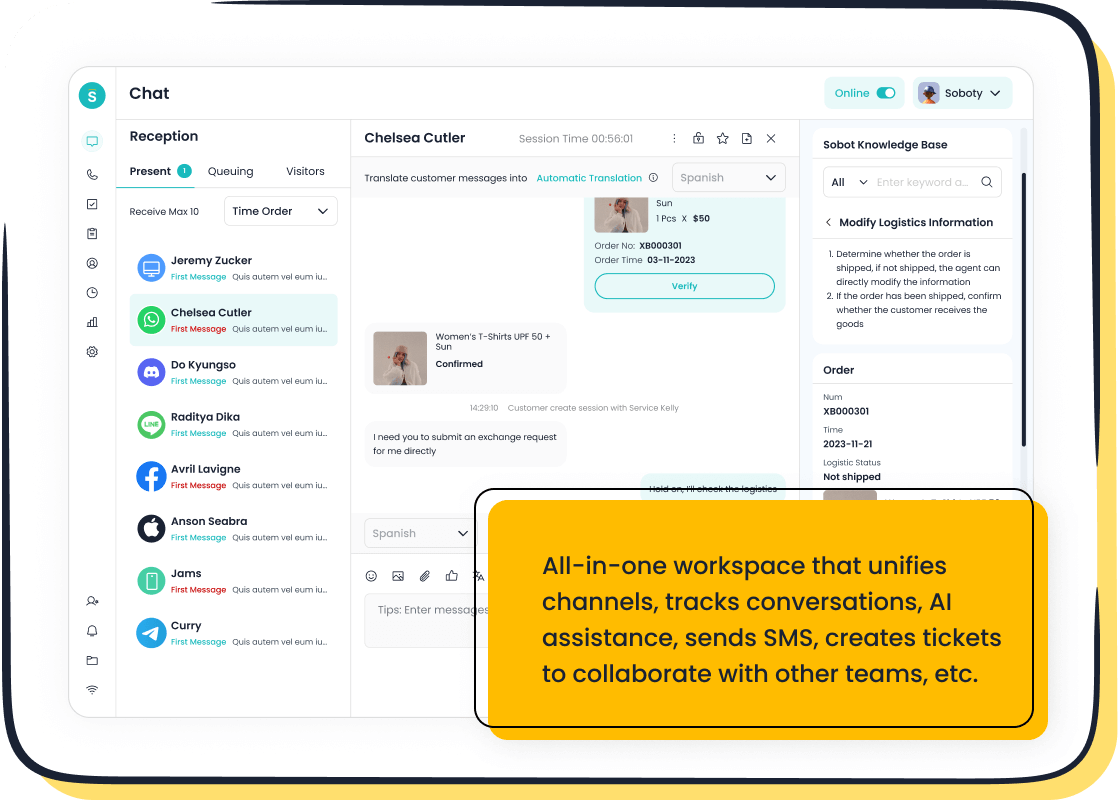
Sobot’s Live Chat product turns this unified philosophy into tangible results. It creates a single workspace for both sales and support teams. This allows businesses to meet every customer on their preferred channel, from websites to social media.
By being present where the customer is, Sobot achieves 100% acceptance and helps businesses see a 38% gain in conversion. It turns casual visitors into loyal clients.
This seamless experience ensures no conversation is lost. It empowers teams to provide timely and effective support.
Proven Success in Enterprise
Sobot's model is proven at an enterprise scale. For example, smart device leader OPPO needed to improve its service efficiency. By implementing Sobot's chatbot and ticketing system, OPPO achieved an incredible 83% chatbot resolution rate. This figure is well above the industry's best-in-class benchmark of 80%. This high level of automation freed human agents for more complex issues. The improved customer experience also led to a 57% increase in repurchase rate, demonstrating how effective support directly boosts loyalty and revenue.
Evaluating AI Customer Support Software Tools
The real showdown between these platforms happens at the intersection of artificial intelligence and human expertise. Modern customer support software must do more than just automate; it needs to empower. The best ai customer support software tools combine ai and human support to create a seamless experience. This section breaks down how each platform approaches this critical challenge.
How Platforms Combine AI and Human Support
Effective ai customer support software tools combine ai and human support through a cooperative model, not a replacement one. The goal is to enhance agent capabilities and improve the customer journey. This is typically achieved in three primary ways:
- Intelligent Routing and Triage: AI analyzes incoming queries for intent, sentiment, and language. It then routes complex or sensitive issues to the right human agent with full context. This ensures specialists handle the right tasks.
- Assistive Agents (Co-pilots): AI works alongside human agents in real-time. It can transcribe calls, suggest replies, and pull information from a knowledge base. This reduces handling time and ensures response consistency.
- Intelligent Handoffs: AI handles routine questions and escalates to a human when needed. The full conversation history is transferred, so the customer never has to repeat themselves. The AI can also provide post-handoff guidance to the agent.
Zendesk AI for Intelligent Triage
Zendesk uses its AI to bring order to the chaos of a busy support queue. Its strength lies in intelligent triage and automation. The platform automatically categorizes incoming tickets so human agents can focus on solving problems, not sorting them.
Here is how Zendesk AI works:
- It first reads every new ticket.
- It then detects the ticket's intent, language, and sentiment. For example, it can identify an intent like 'Item has problem or is damaged on arrival'.
- Finally, pre-set triggers and automation rules route the ticket.
This system allows for powerful workflow automation. A ticket with a 'Billing issue' intent can go straight to the finance team. A message with 'Very negative' sentiment can be flagged for immediate attention. This approach to automation makes Zendesk a solid choice for large teams needing structured support.
Intercom's Fin AI for Resolution
Intercom’s AI chatbot, Fin, is designed for resolution. It aims to answer customer questions instantly, drawing from your existing support content. Fin is effective at handling a high volume of "first-line queries" and can even automate complex workflows. It provides fast, multilingual support across channels like chat and email.
However, Fin's effectiveness can depend on the query's clarity. It excels with specific questions but sometimes struggles with "vague queries." In these cases, it might provide technically correct but irrelevant information. This highlights the importance of a system where ai customer support software tools combine ai and human support for nuanced situations. Fin is powerful, but it works best when backed by a well-structured knowledge base and clear escalation paths to human agents.
Front's AI for Summarization
Front focuses its AI on improving team collaboration. Its standout feature is the ability to summarize long email threads and customer conversations. This is less about direct customer interaction and more about internal efficiency. This automation saves agents from manually reading through lengthy exchanges.
The benefits of this approach are clear:
- Faster Handoffs: A new agent can quickly understand a ticket's history by reading a concise summary.
- Improved Collaboration: Managers can rapidly review escalated issues without reading every message.
- Quicker Responses: Agents spend less time reading and more time problem-solving.
Front’s AI makes it a strong customer support software for teams that rely heavily on internal communication to resolve issues.
Sobot's Generative AI Solution
Sobot offers a complete generative AI suite that redefines what customer support software can do. Unlike tools that bolt AI onto an existing model, Sobot builds its platform around AI. This multi-faceted approach includes AI agents, copilots for human agents, and deep AI insights.
Powered by advanced LLMs, Sobot’s ai customer support software tools combine ai and human support seamlessly. As an official WhatsApp Business Solution Provider (BSP), Sobot extends its powerful automation capabilities to one of the world's most popular messaging apps.
AI in Action: A Retail E-commerce Scenario Imagine a customer wants to return a product. Here’s how each platform might handle it:
- Zendesk: The AI would detect the "return request" intent and route the ticket to the returns department.
- Intercom: Fin would try to answer the request using knowledge base articles about the return policy.
- Front: The AI would summarize the customer's previous interactions for the agent handling the email.
- Sobot: The AI Agent (chatbot) would handle the entire process. It would understand the request, ask for the order number, verify the return eligibility, generate a shipping label, and update the customer record—all without human intervention.
Sobot’s solution automates customer interactions at a deeper level. Its AI agents deliver human-like conversations, while its AI copilots assist human agents with response generation and summaries. This is why leading brands like OPPO see an 83% chatbot resolution rate. The platform’s ability to unify channels and leverage generative AI makes it the top choice for businesses seeking maximum efficiency and a truly integrated approach where ai customer support software tools combine ai and human support to drive results.
Feature Breakdown for Customer Support

Choosing the right platform depends on its specific features. A deep dive into the core functions of each tool reveals their true strengths and weaknesses. We will examine omnichannel capabilities, helpdesk management, self-service tools, and analytics. This breakdown will help you match the right features to your team's needs.
Omnichannel and Channel Coverage
Modern customers expect to connect with you anywhere. True omnichannel support capabilities mean providing a seamless experience across every channel. This is more than just being present on multiple platforms; it's about unifying them.
Zendesk and Intercom approach this differently. Zendesk offers a broader range of native channels, while Intercom provides deeper integration for the channels it supports.
| Feature / Platform | Zendesk | Intercom |
|---|---|---|
| Native Channels | Email, phone, chat, SMS, social media, WhatsApp, community forums | Web chat, in-app messaging, email |
| Channel Breadth vs. Depth | Broader range of channels out-of-the-box | Fewer native channels, but deeper integration for supported ones |
| Unified View | All channels feed into a single ticketing system for a unified agent view | Core strength in seamless experiences within digital products |
| Integration Focus | Covers a wide array of communication methods | Contextual support based on user activity within the product |
| Expandability | N/A (already broad) | SMS and social channels can be added via integrations |
Front’s focus is narrower, centered on collaborative email and SMS. It excels at turning these channels into a team workspace but lacks the broad channel coverage of others.
Sobot, however, is built for true omnichannel support. It unifies websites, apps, and social media platforms like WhatsApp, Facebook, Instagram, and Telegram into one workspace. This all-in-one approach eliminates the need for separate systems and ensures a consistent customer experience everywhere.
Helpdesk and Ticketing Management
A helpdesk is the engine of any customer support operation. How it manages tickets defines your team's efficiency.
- Zendesk is the master of traditional ticketing. Its powerful ticketing system turns every customer interaction into a trackable ticket. With advanced automation features, it routes tickets based on language, intent, or channel. This structure is ideal for large teams that need to manage a high volume of tickets systematically.
- Intercom moves away from formal tickets. It treats every interaction as a conversation. While you can manage and assign conversations, the system is not built around a classic ticketing workflow. This is better for engagement-focused teams.
- Front turns emails and messages into shared tickets within a collaborative inbox. The focus is on internal teamwork to resolve the ticket. It is less about complex routing and more about clear ownership and internal comments.
- Sobot includes a robust ticketing system as part of its integrated platform. It automates workflows, manages service level agreements (SLAs), and supports email ticketing. Because it’s part of an all-in-one solution, these tickets are automatically enriched with the customer’s full interaction history from every other channel.
Self-Service and Knowledge Base
The best support is often the support a customer can find themselves. Effective self-service tools reduce agent workload and empower users.
Intercom excels here. It allows you to build a rich knowledge base that its AI assistant, Fin, uses to resolve customer questions automatically. This creates a powerful self-service loop. Zendesk also offers a solid knowledge base, but it functions more as a traditional FAQ repository.
Sobot approaches self-service with an AI-first mindset. Instead of just relying on articles, it uses its powerful AI chatbot to provide answers and resolve issues. This is one of its most powerful features. For e-commerce brands, this is a game-changer. Platforms like Gorgias also offer self-serve order management, but Sobot's AI is designed for deeper, conversational resolution.
💡 Real-World Impact: For OPPO, Sobot's chatbot achieved an 83% resolution rate. This shows how effective AI-driven self-service can be at handling inquiries without human help, far surpassing simple article suggestions.
Here is how some platforms compare on AI-powered self-service options:
| Platform | AI-Powered Self-Service Options (Answer Bots/Chatbots) |
|---|---|
| Zendesk | Answer Bot provides basic AI functionality, often limited to chat-only interactions. |
| Intercom | Fin AI Agent excels at conversational interactions and natural language understanding. |
| Gorgias | AI Agent automates common e-commerce tasks like order edits and cancellations. |
| Sobot | Specialized e-commerce support with multilingual AI capabilities and deep integrations. |
Reporting and Analytics
You cannot improve what you cannot measure. Reporting and analytics features are critical for understanding team performance and customer satisfaction. Good data helps you optimize every aspect of your service.
Zendesk offers deep, customizable reporting. Teams can track essential metrics to understand their operations fully.
“KPIs come as standard, but our founders want us to report back and tell them how our customer is feeling. With Zendesk we can do that.” - Naomi Rankin, Global CX Manager
Key Zendesk KPIs include:
- Customer Satisfaction (CSAT)
- First Contact Resolution (FCR)
- First Response Time (FRT)
Intercom’s analytics focus on engagement and conversion, tracking metrics like CSAT and how conversations impact sales. Front’s reporting centers on team productivity, such as response times and message volume per agent.
Sobot provides some of the most extensive analytics features available. Its platform evaluates over 150 indicators to help businesses optimize their service. It offers built-in analytics with customizable data reports, giving managers a complete view of chatbot performance, agent efficiency, and overall customer satisfaction across all channels. This level of detail is essential for businesses serious about data-driven support.
Pricing and Scalability: The True Cost
A platform’s pricing model often reflects its core philosophy. Understanding the true cost involves looking beyond the sticker price to see how each model supports growth. The right pricing structure should be both scalable and customizable for your business needs.
Zendesk's Per-Agent Model
Zendesk uses a per-agent pricing model. You pay a monthly fee for each support agent on your team. This approach is straightforward and easy to predict for a stable team size. However, costs can increase quickly as your support team grows, making it potentially expensive for rapidly scaling companies.
Intercom's Seat and Usage Model
Intercom combines seat-based costs with usage-based fees. You pay for each agent seat, but your bill can also change based on the number of people you reach or conversations you have. This pricing can be harder to forecast. It is designed for businesses focused on proactive engagement, where value is tied to outreach.
Front's Per-Seat Tiers
Front offers tiered pricing based on the number of user seats. Each higher-priced tier unlocks more advanced features for collaboration and automation. This model is simple to understand but may require you to upgrade your entire plan to access a single key feature, which can be a drawback for some teams.
Understanding Sobot's Value
Sobot provides a value-based pricing model designed for a higher return on investment. Unlike competitors, Sobot offers genuine omnichannel integration. This eliminates the need for separate subscriptions for ticketing, chat, and voice. This all-in-one approach can lead to a reduction in support costs by up to 50%.
Sobot's pricing is built to deliver results. Its AI-driven interactions can lead to 20% higher conversion rates, turning support into a revenue driver.
The platform is both scalable and customizable. Its pricing includes valuable features that others charge extra for:
- Advanced AI features and custom workflows
- Enhanced security and SLA guarantees
- Dedicated account management and priority support
For e-commerce, this scalable and customizable platform resolves 70% of inquiries automatically and can increase conversions by 3x. This makes Sobot's pricing a strategic investment in efficiency and growth.
Your choice depends on your core business need. Zendesk offers structured support, Intercom drives proactive engagement, and Front excels at team collaboration. Sobot provides a powerful, all-in-one contact center solution. Its deep integration of advanced AI with a full suite of support tools delivers maximum efficiency.
Choose Your Platform
- Choose Zendesk if: You need complex ticketing workflows. Companies like Lush see a 369% ROI with its structured support.
- Choose Intercom if: Your focus is on proactive, conversational sales and marketing engagement.
- Choose Front if: Your team's workflow is centered on a collaborative email inbox.
- Choose Sobot if: You need a powerful, integrated solution. Its seamless integration unifies sales, marketing, and support for superior customer engagement, increasing lifetime value by 20%. This deep integration and focus on engagement makes its integration unique.
FAQ
Which platform is best for a small, growing business?
For small businesses, the choice depends on your focus. Intercom is great for sales-focused chat. Front works for email collaboration. Sobot offers a scalable, all-in-one solution that grows with you, unifying all channels and tools without needing multiple subscriptions.
What is the main difference in AI capabilities?
Zendesk's AI sorts tickets. Intercom's AI answers questions from a knowledge base. Sobot uses advanced generative AI. Its ai customer support software tools combine ai and human support to fully resolve issues, like processing a return, without needing a human agent.
Can I manage WhatsApp and email in one place?
Yes. Sobot is an official WhatsApp Business Solution Provider (BSP). It unifies WhatsApp, email, social media, and chat into a single workspace. This gives your team a complete view of every customer conversation, improving efficiency and service quality.
How do I choose the most cost-effective solution?
Consider the total cost. Per-agent models like Zendesk's can become expensive as you grow. Sobot's value-based pricing provides an all-in-one platform. This integrated approach can reduce overall support costs by up to 50% by eliminating the need for multiple tools.
See Also
Comparing Leading Voice of Customer Platforms for Enhanced Business Insights
Evaluating Premier Interactive Voice Response Solutions for Superior Customer Service
Best 10 Live Chat Applications: Shopify's Edge Against Rivals
Analyzing Leading Live Chat Platforms: A Comprehensive Review for 2024
Discovering the Three Foremost Website Chat Software Choices Available Today