Choosing between AI agents and human agents for ticketing systems

You can decide between AI agents, human agents, or both in your ticketing system by matching the type of agent to the complexity of customer support inquiries, customer expectations, and operational goals. Review the nature of customer needs, emotional context, sensitivity of data, and value of customer interactions. Check the table below for quick guidance:
| Situation | Best Handler | Reason |
|---|---|---|
| Password reset | AI | Predictable, secure, fast to automate |
| Billing dispute | Human | Needs empathy, negotiation, flexibility |
| Order status update | AI | Low-risk, repeatable, time-sensitive |
| Service outage notification | Hybrid | AI alerts; humans manage escalations |
| Technical troubleshooting | Human | Needs judgment, creativity, adaptation |
| High-value account support | Human | Premium clients expect direct, personal service |
Choosing between AI agents and human agents for ticketing systems impacts customer support efficiency and customer experience. In the context of an AI agents vs traditional customer service methods comparison, Sobot helps you deliver the best customer service by aligning agent selection with customer needs.
Quick Guide: AI vs. Human Customer Service
Main Criteria for Choosing Agents
When you compare ai vs. human customer service, you need to look at the type of inquiry, the level of empathy needed, and your operational goals. You want to use ai agents for simple, repetitive tasks. These include password resets or order status updates. Human support agents work best for complex or sensitive issues. They can show real empathy and build trust with your customer.
Here are the main criteria you should consider when choosing between ai vs. human customer service:
- Simple transactional tasks work well with ai agents. These tasks let your customer self-serve and get fast answers.
- For simple consultative support, ai can provide information. You must check if your customer trusts ai for these answers.
- Complex transactional issues may start with ai agents. If the issue needs judgment, your support agents should step in.
- Complex consultative cases need human support agents. These cases require empathy, creativity, and problem-solving.
You should match the agent type to the task. This approach helps you deliver better customer support and service.
Summary Table: Sobot Ticketing System
The table below shows how ai vs. human customer service compares in Sobot’s ticketing system. You can see how each type of agent performs in key areas:
| Aspect | AI Agents | Human Agents |
|---|---|---|
| Response Time | 1–2 seconds (chat), 200–500 ms (voice) | Minutes of queue + 2–5 seconds |
| Scalability | Handles thousands of interactions | One call or limited chats |
| Availability | 24/7/365 support | Shift-based, limited hours |
| Empathy | Mimics empathy, may sound scripted | Genuine empathy and relationship |
| Complexity Handling | 90–95% accuracy on simple tasks | Better for complex issues |
| Consistency | Follows workflows every time | Performance can change |
Sobot Live Chat uses ai to handle many customer support requests at once. This means your customer gets fast, consistent service. Companies using ai agents see a 52% faster ticket resolution rate. If your customer waits too long for support, 60% will leave the request unfinished. By choosing the right mix of ai vs. human customer service, you improve both efficiency and satisfaction.
AI Customer Service: Best Use Cases
Handling Repetitive Inquiries
You often see the biggest difference between ai vs. human customer service when you look at repetitive tasks. Many customer questions are simple and predictable. These include password resets, order status updates, and appointment scheduling. You can use ai agents to answer these questions quickly. This approach saves time for your support team and gives your customer fast answers.
| Inquiry Type | Benefits |
|---|---|
| Password Resets | Automates routine tasks, reduces response times by 37% |
| Order Status Updates | Speeds up responses, saves agents 2+ hours daily |
| Appointment Scheduling | Frees up administrative staff for other tasks |
When you use ai customer service for these tasks, you let your human agents focus on more complex problems. You also reduce the number of tickets that need human attention. In many companies, human agents now handle only 20% of tickets. This shift means your team can spend more time on unique and challenging questions. You also see a drop in stress and an increase in job satisfaction for your staff.
You can see this effect in large organizations. IBM’s AskHR agent automates 94% of basic HR functions. The AskIT system has cut IT support calls and chats by 70%. Ai voice agents can reduce ticket volume by 35%. These results show that ai-powered customer chatbots and ai chatbots make a real difference in service efficiency.
High-Volume Ticket Management
You may face times when your customer service team gets a flood of tickets. This can happen during sales, product launches, or service outages. Ai agents help you manage high-volume ticket inflow by automating ticket routing and triage. They sort and categorize tickets, then send them to the right person or solve them on their own. This process leads to faster resolution and higher first-contact resolution rates.
Ai customer service also improves the overall experience for your customer. Automation means fewer follow-up tickets and less waiting. Your team can focus on tickets that need human judgment. Ai-driven support tools analyze and categorize tickets, so nothing gets lost or delayed.
Here are some key statistics that show the power of ai in high-volume environments:
| Statistic | Description |
|---|---|
| 79% | Organizations anticipate ai deployment to enhance response speed and cost efficiency. |
| 72% | Organizations implement ai-based automation for ticket management. |
| 57% | Large enterprises use ai agents for proactive support. |
| 2.3 million | Monthly conversations handled by Klarna’s ai assistant, equal to 700 full-time agents. |
| 14% | Increase in productivity for customer support agents using generative ai tools. |
| 66% | Organizations report measurable value from ai in productivity. |
| 40% | Reduction in average handling time achieved by Good Eggs through ai. |
| 30% | Reduction in manual work and operational costs due to ai agents. |
| 93% | Customer satisfaction scores maintained by ReserveBar while reducing agent workload. |
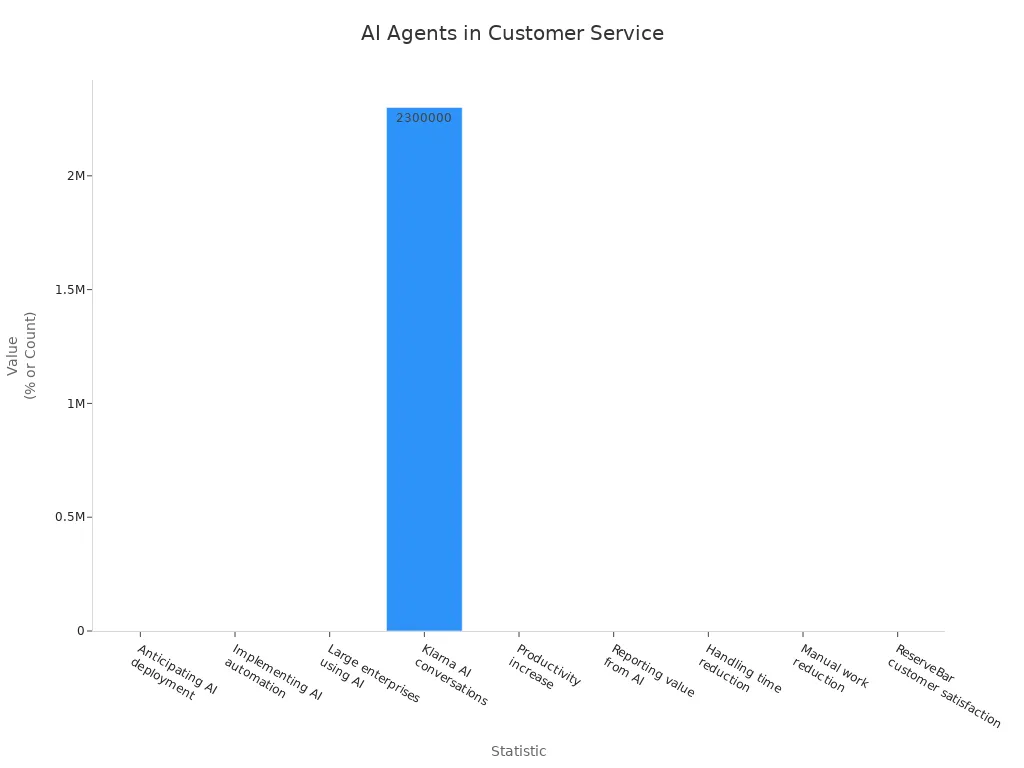
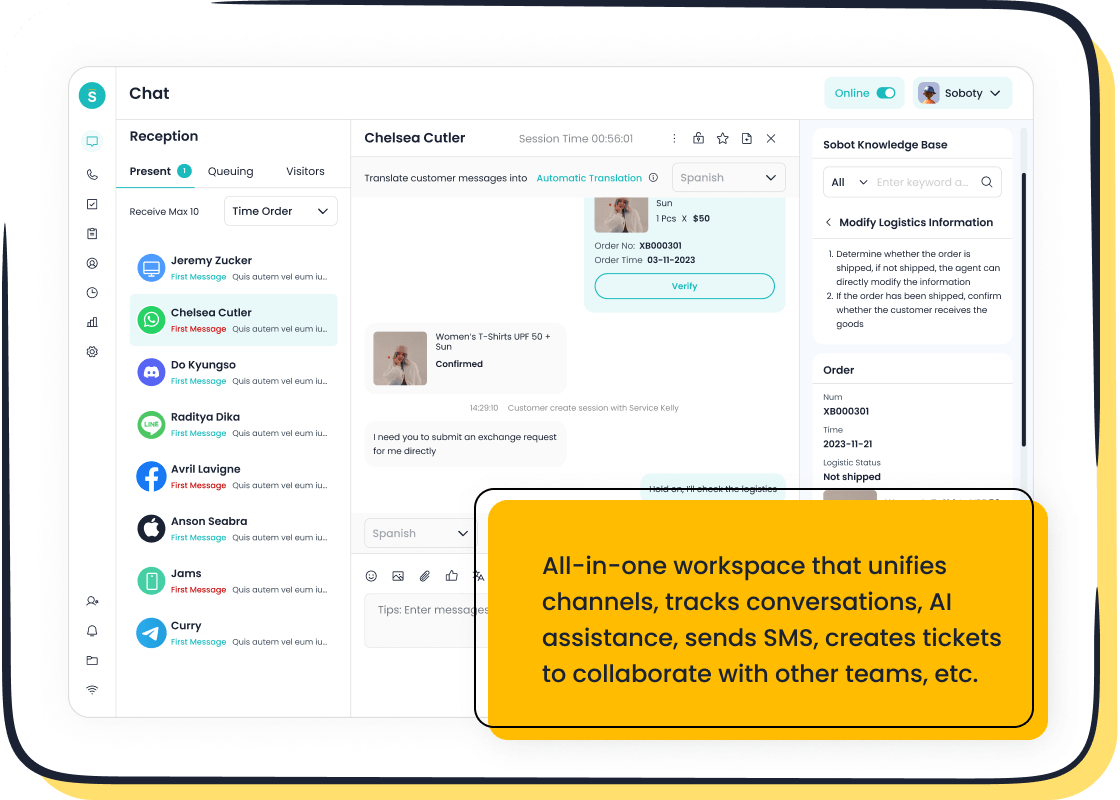
Sobot Live Chat uses ai to automate ticket management across all channels. You can connect with your customer on your website, app, or social media. This omnichannel approach means you never miss a message. Ai-driven support tools in Sobot help you keep up with demand and deliver consistent service.
24/7 Support with Sobot Live Chat
Your customer expects instant answers at any time. Many businesses struggle to provide round-the-clock support with only human agents. Ai customer service solves this problem. Ai agents and chatbots work 24/7, so your customer always gets help, even at night or on weekends.
Sobot Live Chat uses ai-powered customer chatbots to automate up to 80% of routine inquiries. This feature improves response times and boosts customer satisfaction. Companies using Sobot’s ai have seen a 15% reduction in abandoned carts. DHL manages over 30 million customer service inquiries each year with ai chatbots. This shows that ai can scale to meet any demand without hiring more staff.
You also get real-time responses with ai customer service. Your customer does not have to wait in line. Ai chatbots answer questions about sizing, shipping, and returns right away. This support helps your customer make decisions and complete purchases. You also free up your human agents to handle complex or sensitive issues.
Many customers now expect 24/7 support. Staff shortages make it hard to meet this need with only humans. Sobot Live Chat gives you an effective solution. You can provide self-service options and instant help at any hour. This approach improves both efficiency and the customer experience.
Tip: Use ai vs. human customer service together for the best results. Let ai handle routine and high-volume tasks. Let your human agents focus on building relationships and solving complex problems.
Choosing between ai agents and human agents for ticketing systems depends on your needs. Ai customer service gives you speed, scale, and 24/7 support. Human agents give you empathy and creativity. Sobot helps you combine both for the best customer service.
Human Agents: When Personal Touch Matters
Choosing between AI agents and human agents for ticketing systems often comes down to the value of the human touch. While AI customer service brings speed and efficiency, there are moments when only a real person can meet your customer's needs. You need to recognize these moments to deliver the best customer experience and drive customer retention.
Complex and Sensitive Issues
Some problems require more than fast answers. You face situations where emotions run high, or the issue involves sensitive data. In these cases, human agents become essential. They can read emotional cues, adapt their communication, and make nuanced decisions that AI cannot match.
Complex situations are best handled by people when emotions run high or answers require deeper judgment. Automated responses often feel limited in areas that affect trust.
Here is a table that shows when you should rely on human agents instead of AI:
| Issue Type | Description |
|---|---|
| Emotion | Situations where empathy is crucial, such as billing disputes or service outages. |
| Sensitive Data | Issues involving trust, like financial disputes or personal information. |
| High-Value Customers | Scenarios requiring priority treatment for top accounts and long-term customers. |
You need human agents for emotionally sensitive situations. They can empathize with your customer, understand the context, and offer solutions that feel personal. AI vs. human customer service shows its biggest difference here. AI can automate many tasks, but it cannot replace the human touch in complex cases.
You also see this in real-world examples. OPPO, a global smart device leader, uses Sobot to combine AI customer service with human agents. During peak shopping periods, OPPO’s chatbot handles repetitive questions, but human agents step in for billing disputes or technical problems. This approach ensures your customer feels heard and valued, even when the issue is difficult.
Building Customer Relationships
You want your customer to feel more than just satisfied. You want them to feel loyal to your brand. Human agents play a key role in building these relationships. They use soft skills, like empathy and active listening, to connect with your customer on a personal level.
- 3 in 4 customers are willing to spend more with businesses that prioritize positive customer experiences.
- Training agents in soft skills forms the foundation of human connections.
- Agents who understand customer context can advocate for them, which is a key objective in customer service.
When you compare AI vs. human customer service, you see that AI can answer questions quickly, but only a person can build trust over time. Human agents remember past problems, recognize returning customers, and offer tailored support. This personal approach leads to stronger customer retention and long-term loyalty.
Many companies use this strategy. For example, Salesforce assigns customer success managers to monitor account health. This proactive support leads to better retention rates. Sephora’s loyalty program offers exclusive rewards and personalized experiences, encouraging ongoing engagement. These examples show that the human touch is vital for building lasting relationships.
Escalation and Exception Handling
Not every problem fits into a script. Sometimes, your customer faces unique challenges or gets stuck in a loop with automated responses. You need a clear process for escalating these cases to a human agent.
Here is a table that highlights common scenarios where escalation is necessary:
| Scenario Type | Description |
|---|---|
| Emotion | Human agents are needed when customers express frustration or fear, as empathy is crucial in these cases. |
| Sensitive Data | Issues involving financial disputes, medical information, or legal inquiries require human discretion. |
| High-Value Customers | VIP or enterprise clients should always be escalated to human agents for priority treatment. |
| Repeated Bot Loops | If a customer receives the same response multiple times without resolution, escalation is necessary. |
| Language Cues | Specific language indicating distress or urgency (e.g., all caps, words like 'cancel' or 'angry') triggers escalation. |
| Compliance Tags | Conversations involving sensitive compliance-related information should be reviewed by a human. |
| Time Thresholds | If a resolution is not achieved within a set timeframe (2-5 minutes), the case should be escalated. |
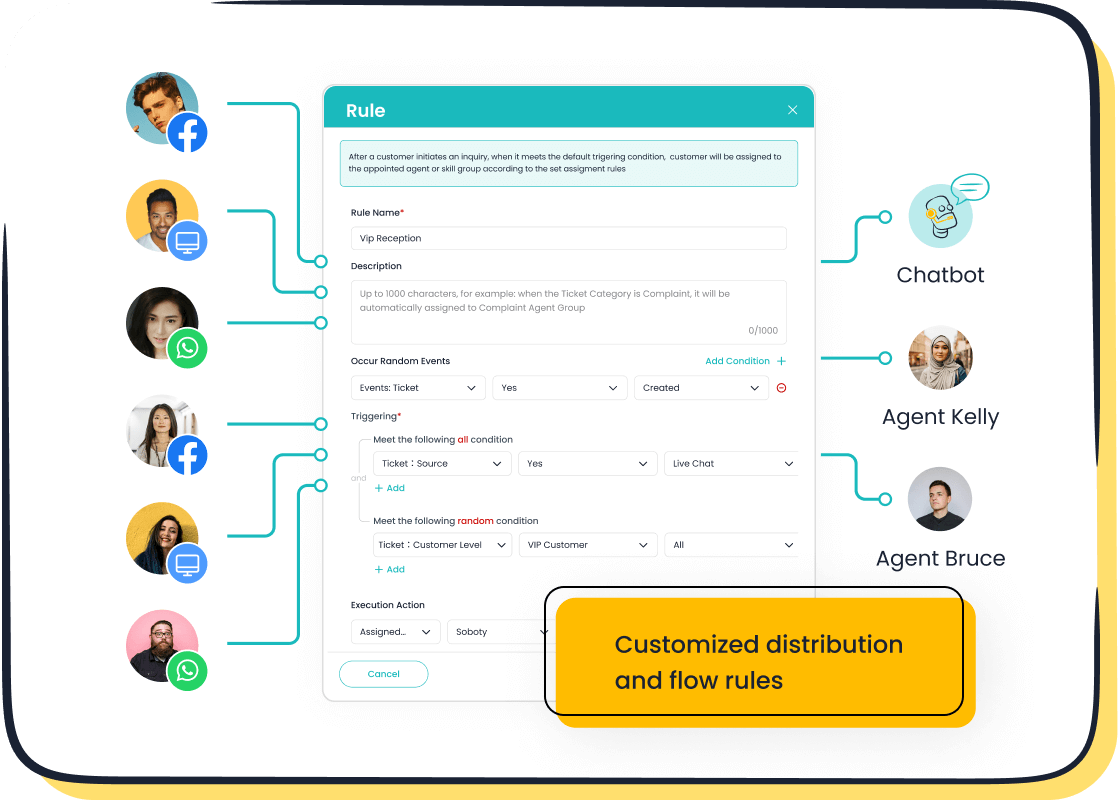
You need to monitor for these triggers in your ticketing system. Sobot’s platform allows you to set rules for automatic escalation. This ensures your customer never feels ignored or trapped by AI. When you use AI vs. human customer service together, you get the best of both worlds: speed for simple problems and empathy for complex ones.
Tip: Always give your customer a clear path to reach a human agent. This builds trust and improves the overall customer experience.
Hybrid Approach: Sobot Customer Support Solutions
Sobot uses a hybrid customer service model to give you the best of both worlds. You get the speed and consistency of ai agents, along with the empathy and expertise of human agents. This approach helps you deliver excellent customer support and service across every channel.
Smart Routing and Handoffs
Sobot’s customer contact center blends ai agents and human agents. Ai agents handle routine questions, such as password resets or order status updates. When your customer faces a complex issue, Sobot’s smart routing sends the ticket to a human agent. This process reduces transaction cycle times from days to hours or even minutes. You can save up to 50% in costs. Ai agents improve metrics like Time to First Response and Customer Satisfaction. You see higher retention and revenue growth.
- Ai agents manage routine inquiries, freeing human agents for complex issues.
- Smart routing ensures your customer gets the right help fast.
- Ai agents reduce transaction cycle times and boost efficiency.
Consistent Experience Across Channels
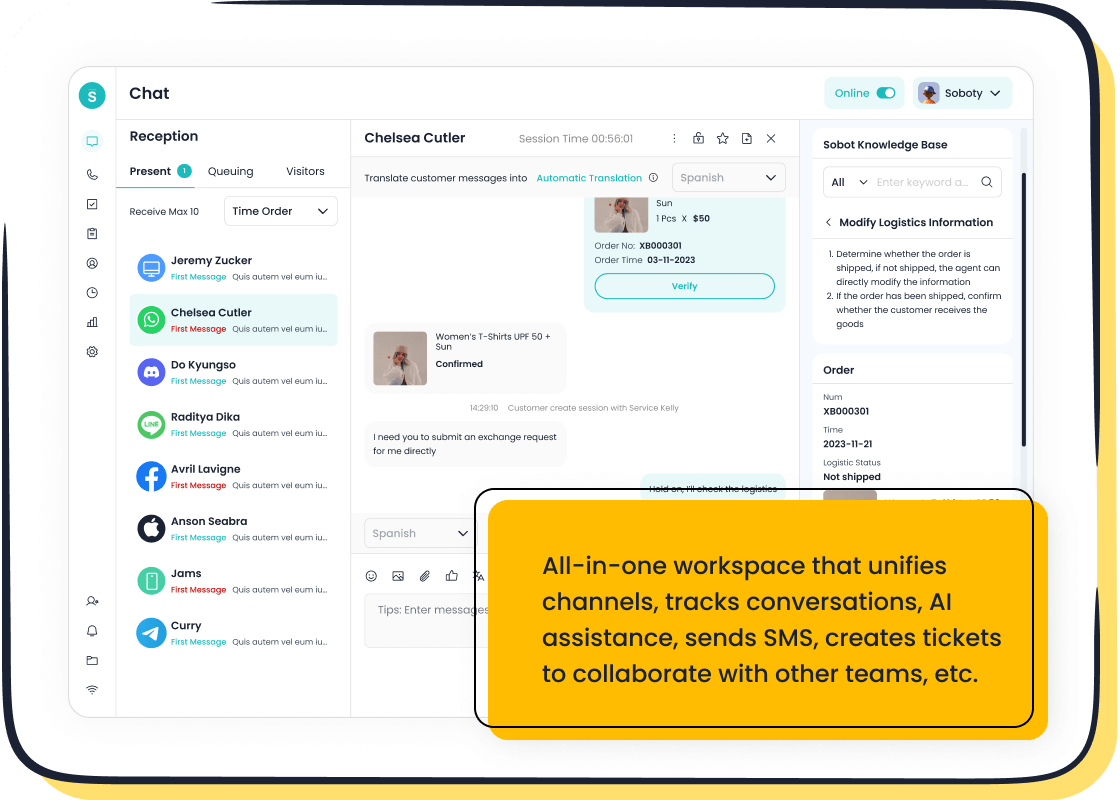
Sobot’s omnichannel integration brings all customer interactions into one workspace. You can connect with your customer through live chat, voicebot, chatbot, ticketing system, or social media. Ai agents use Natural Language Processing to understand questions and route them quickly. Your customer receives a seamless experience, no matter which channel they use. Sobot’s customer service automation keeps conversations unified and consistent.
Sobot’s Omnichannel Support feature consolidates interactions from websites, apps, and social media. Your customer gets the same quality of service everywhere.
Monitoring and Optimization
You need to track performance to improve customer support. Sobot’s platform monitors key metrics, such as engagement rates, resolution times, handoff rates, and direct attribution to sales. Ai agents resolve most issues, while human agents handle exceptions. You can optimize workflows and boost customer satisfaction.
| Metric | Description |
|---|---|
| Engagement Rates | Measures how often customers interact with the chatbot; higher rates indicate effective engagement. |
| Resolution Times | Measures how quickly the chatbot resolves issues; faster times lead to higher customer satisfaction. |
| Handoff Rates | Measures how often conversations are handed off to human agents; lower rates indicate effective resolution by the chatbot. |
| Direct Attribution to Sales | Measures the direct impact of the chatbot on sales; tracking sales generated from chatbot interactions helps attribute revenue. |
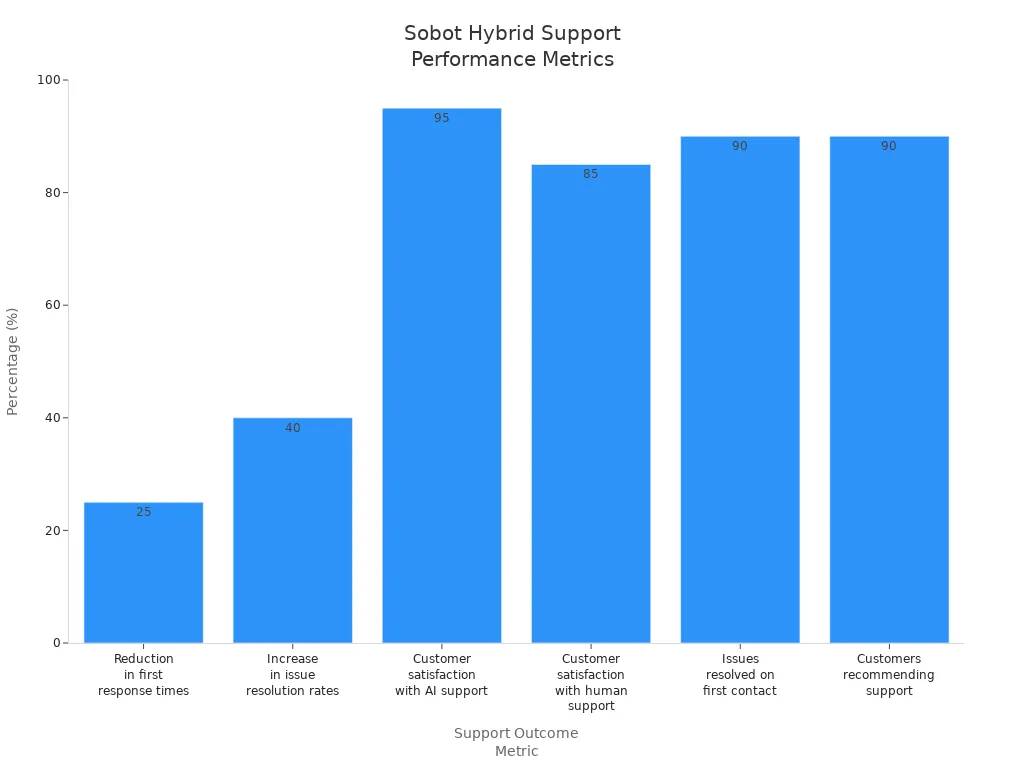
Sobot’s hybrid customer support model delivers measurable results:
| Metric | Value |
|---|---|
| Reduction in first response times | 25% |
| Increase in issue resolution rates | 40% |
| Customer satisfaction with AI support | 95% |
| Customer satisfaction with human support | 85% |
| Issues resolved on first contact | 90% |
| Customers recommending support | 90% |
You can use Sobot’s live chat, ai agents, chatbot, voicebot, and ticketing system to build a strong customer support strategy. Choosing between AI agents and human agents for ticketing systems becomes easier with Sobot’s hybrid approach. You improve efficiency, boost satisfaction, and deliver consistent service.
AI Agents vs Traditional Customer Service Methods Comparison
Efficiency and Cost Benefits
You see a clear difference when you compare ai agents vs traditional customer service methods. Ai agents handle thousands of customer support requests at once. Human agents work with one customer at a time. Ai customer service improves efficiency by automating routine tasks and reducing errors. Ai agents complete tasks 40-60% faster and stay available 24/7 without overtime costs. You save money and time.
Here is a table that shows the cost benefits:
| Metric | AI Systems | Human Support Teams |
|---|---|---|
| Initial Investment | $50,000 to $500,000 | Variable |
| Cost per Interaction | $0.25 | $10 |
| Training Costs | Minimal | Ongoing |
| Long-term ROI | Up to 30% savings | Variable |
Many organizations use ai agents to boost efficiency. 79% expect ai agents to be deployed for cost savings and faster response. 72% have adopted at least one ai automation solution. Support agents using ai handle 14% more inquiries per hour. Average operational savings range from 25-40%. Predictive maintenance with ai prevents costly failures.
Customer Satisfaction and Feedback
Ai customer service changes how you deliver customer support. Ai agents automate ticket resolution and speed up response times. 51% of consumers prefer bots for immediate help. Ai agents vs traditional customer service methods comparison shows that ai improves satisfaction for simple tasks.
You see mixed feedback for complex issues. Customers prefer human agents for emotional or sensitive problems. Many express frustration when ai cannot understand their needs. Here is a table showing preferences:
| Preference | Percentage |
|---|---|
| Prefer Human Agents | 93.4% |
| Would Cancel Service Over AI | 49.6% |
| Willing to Pay Extra | 41.5% |
Most customers value speed, convenience, and friendly service. 82% prefer human agents even if wait times are the same. Ai agents vs traditional customer service methods comparison shows that ai works best for routine support, while human agents excel in complex cases.
Real-World Example: OPPO and Sobot
OPPO uses Sobot’s ai customer service to improve efficiency and customer satisfaction. During peak times, ai agents handle repetitive questions. Human agents manage complex issues. OPPO achieved a 93% customer satisfaction score in conversational support. Ai agents vs traditional customer service methods comparison proves that combining ai and human agents delivers the best results. You get faster service, higher satisfaction, and improved customer support.
Tip: Use ai agents for routine tasks and human agents for complex issues. This approach boosts efficiency and keeps your customer happy.
Implementing Sobot AI Customer Service
Decision Framework and Checklist
You need a clear plan before you start using ai agents in your ticketing system. Begin by looking at your current customer support process. Find areas where ai can help you improve speed or accuracy. Explore platforms like Sobot that offer automated workflows, predictive analytics, and multi-channel support. Build a framework that uses ai to personalize customer interactions and make decisions in real time.
Here is a checklist to guide your implementation:
- Assess your customer journey management and spot gaps.
- Research ai-powered tools that fit your needs.
- Develop a plan for using ai agents alongside human agents.
- Set goals for customer satisfaction and operational efficiency.
- Create rules for when ai agents handle tickets and when humans step in.
Tip: Use this checklist to make sure you meet your customer needs and business goals.
Setting Up Workflows
You must set up workflows that let ai agents and human agents work together. Start by reviewing your current engagement landscape. Identify areas where ai can streamline customer support. Use Sobot’s omnichannel integration to bring all customer conversations into one place. Connect ai-powered tools with your existing systems and channels. Configure automation so ai agents handle routine tasks and route complex cases to human agents.
Follow these steps:
- Review your customer engagement and find improvement points.
- Centralize communication with Sobot’s omnichannel features.
- Integrate ai tools with your current systems.
- Set up ai-driven workflows for ticket routing and resolution.
- Monitor and optimize your ai workflows to improve outcomes.
You create a seamless experience for your customer by combining ai agents and human agents.
Measuring Success
You need to track performance to see if your ai agents and human agents meet your goals. Use clear metrics to measure customer support outcomes. Look at response times, resolution rates, and customer satisfaction scores. Check how many tickets ai agents resolve and how often human agents handle escalations. Review feedback from your customer to spot areas for improvement.
Here is a table of key metrics:
| Metric | What It Shows |
|---|---|
| Response Time | Speed of ai agents and human agents |
| Resolution Rate | Percentage of tickets solved |
| Customer Satisfaction | How happy your customer feels |
| Escalation Rate | How often tickets move to humans |
| Feedback Score | Quality of customer support |
Note: Regularly review these metrics to keep your customer support strong and efficient.
Choosing between AI agents and human agents for ticketing systems requires careful planning. You must match your ai setup to your customer needs and business goals. Sobot gives you the tools to build workflows, measure success, and deliver excellent customer support.
When you choose between ai, human agents, or a hybrid model, focus on the type of customer inquiry and your goals. Use ai for clear ticket categorization, ticket prioritization, and automation. Ai helps you monitor and measure key metrics, making your support more efficient. Human agents handle complex issues and build trust. Review your system often and adapt based on customer feedback. Try Sobot’s ai solutions to improve your ticketing system and keep your customer happy.
FAQ
What is the main benefit of choosing between AI agents and human agents for ticketing systems?
You gain flexibility. You match agent type to inquiry complexity. Sobot’s platform helps you automate simple tasks and assign complex issues to skilled agents. This approach improves efficiency and customer satisfaction.
How does Sobot Live Chat support choosing between AI agents and human agents for ticketing systems?
You use Sobot Live Chat to unify all channels. AI agents handle routine tickets. Human agents manage escalations. You get seamless handoffs and consistent service. Learn more at Sobot Live Chat.
Can I switch between AI agents and human agents in Sobot’s ticketing system?
You can set rules for automatic routing. Sobot lets you transfer tickets from AI agents to human agents when needed. You ensure your customer always gets the right support.
Does choosing between AI agents and human agents for ticketing systems affect customer satisfaction?
You see higher satisfaction scores when you match agent type to customer needs. Sobot’s hybrid model delivers 95% satisfaction with AI support and 85% with human support. You build trust and loyalty.
What industries benefit most from choosing between AI agents and human agents for ticketing systems?
You see strong results in retail, finance, gaming, and enterprise services. Sobot’s solutions help you manage high-volume tickets and complex cases. You improve operational efficiency and customer experience.
See Also
Exploring AI Solutions for Enterprise Call Centers
Navigating Artificial Intelligence Software for Call Centers
Enhancing Efficiency with AI Customer Service Tools

